BIRN Launches Book on Mladic in the Media

The Balkan Investigative Reporting Network, BIRN, of Bosnia and Herzegovina will launch its publication ‘Spotlight on Mladic: Villian or Celebrity?,’ on December 11 in Sarajevo. 

The publication contains an overview of the coverage of the arrest and the beginning of the trial of Ratko Mladic, who is charged with genocide and other crimes in Bosnia and Herzegovina, in the media in Bosnia and Herzegovina, Serbia and Croatia.

Monitoring focused on the highest-circulation dailies and weeklies in the three countries selected. 

The publication is co-authored by Christian Axboe Nilsen, Erna Mackic, Marija Ristic, Boris Pavelic and Selma Ucanbarlic, containing an introduction by Balkan Insight editor Marcus Tanner.

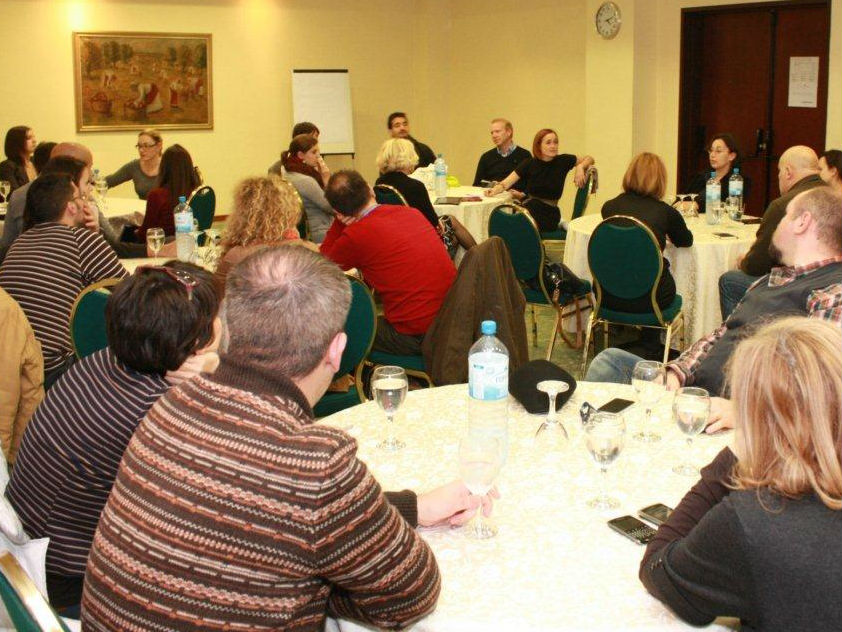
Speakers at the launch in the Atrium Hall of the Europa Hotel in Sarajevo will include Gordana Igric, the publication editor’s and BIRN Director, Sabina Wölkner, Director of the Konrad Adenauer Foundation in BiH, Erna Mackic, analyst and BIRN Justice Report editor and Christian Nilsen, historian, the author of the publication’s foreword

Implementation of the project was made possible with support from, and collaboration with, the Konrad Adenauer Foundation in Bosnia and Herzegovina.

BIRN, ProConcept Open National Budget Forum

BIRN Serbia and ProConcept will open the fourth annual National Budget Forum in Belgrade on Monday.

The two organisations will hold the forum on Monday, December 3 at 12.30pm in the small hall of the National Parliament.

Participants in this year’s forum will examine transparency in the budgeting process and control of budget execution.

Following an introductory debate, which will focus on the main budget policies and challenges that Serbia is likely to face in 2013, the Citizens Budget of the Republic of Serbia will be presented at working tables. Forum participants will then take part in a second debate that will focus on possibilities for greater control of the budget’s execution by the Serbian Parliament Finance Committee.

Senior officials from the Finance Ministry, Fiscal Council and National Parliament will take part in the debates, as well as experts from the community.

This annual event, now in its fourth year, is traditionally the final debate on budget priorities and models for improving the budgeting process.

Simultaneous translation from Serbian to English will be provided by the organisers.

For more information please contact Ms. Lada Vučenović at 060 3 1985 21 or [email protected].

First Culture Watch Award Goes to Vranje

The first ever Culture Watch Award for analytical and investigative reporting on cultural issues in the Balkans went to Valentina Milenkovic from Vranje.

Gordana Igric, Valentina Milenkovic

The award organised by Balkan Investigative Reporting Network (BIRN) and SeeCult.org was presented at the regional conference “What is (to be) Done” that took place on November 28 in Dom Omladine in Belgrade.

The jury, consisting of six cultural experts and an internationally awarded journalist, gave the first prize to Valentina Milenkovic, a journalist at “Vranjske” weekly magazine, for her complex investigative piece “How does government entertain people”.

Milenkovic investigated the funding of the cultural event “Cultural-touristic manifestation” in the municipality of Vranje in Serbia over the period of three years.

“For all that time they can only show four or five contracts that prove how the money was spent. Over 50 participants, some of them really famous Serbian singers, took part in the event,” said Milenkovic at the award ceremony.

“This is my first award in 13 years-long journalistic career, and therefore this is very important to me,” she added.

The second prize was awarded to Gordana Popovic from the daily newspaper Politika for her article “Serbia and the EU  – Culture and Candidature” about the reaction from the Serbian officials after the country obtained the EU candidate status.

“I talked to numerous officials and it was really interesting to confront opinions of two different sides in Serbia,” said Popovic.

The third prize went to Pristina to Vullnet Krasniqui, a journalist from the daily newspaper Koha Ditore for the article: “Kosovo authorities risk loosing some clay figures of Kosovar origin”.

Article by Bosnian journalist Irfan Hosic “Departures as a Rule” published in the “Dani” weekly magazine, was given the fourth prize.

“It is an honour for me to receive this award especially for my analysis of art scene in Bosnia and Herzegovina and the emigration of the artist from the country,” said Hosic.

The Balkan Initiative for Cultural Cooperation Exchange and Development, BICCED, envisages the Culture Watch Award was envisaged as a step towards strengthening the analytical and investigative approach to cultural issues.

The BICCED board decided on Tuesday that the award would become an annual event. This year’s awards were supported by the Swiss Cultural Programme for the Western Balkans (SCP).

Final BICCED Culture Conference in Belgrade

The closing event of the three-year project “Balkan Initiative for Cultural Cooperation, Exchange and Development”, BICCED, started on Thursday in Belgrade’s Youth Centre.

At the conference “Balkan Cultural Policies – What Is (to be) Done”, culture experts and speakers from the region review the cultural policies implemented in the Balkans over the past three years based on more than 300 analytical pieces produced as part of the project.

BIRN’s regional director Gordana Igric opened the conference by saying that BICCED has raised interest among the journalists and that now after three years there are 50 journalists in the group from the region that are interested in cultural polices.

“We have planted a seed and all should know that cultural policy is important because it reflex national identities in the Balkans but also financial power of the states themselves”.

The director of SEEcult.org and project partner Vesna Milosavljevic explained that the name of the conference is taken over revolutionary novel by Nikolay Chernyshevsky -What Is to Be Done? “This is an open call for all of us to think what should be done, so the situation in the cultural field would have change.”

“For three years BICCED journalists achieved much in realising the context of cultural polices in the Balkans. With the help of the experts and cultural workers journalists have managed to analyse and investigate topics that weren’t in the focus of the society. The articles dealt with laws on culture and its influence on various areas of arts. More than 300 hundred pieces were produced”,  said Nemanja Cabric, BIRN Culture Watch project coordinator.

BICCED has aimed to map the main problems and tendencies in the field of culture in Albania, Bosnia and Herzegovina, Kosovo, Macedonia and Serbia, and to present them to decision-makers and the public, thus contributing to finding solutions for problems and initiating needed reforms.

BICCED was implemented by the Balkan Investigative Regional Reporting Network, BIRN, and by SEEcult.org, and was funded by the Swiss Cultural Programme in the Western Balkans (SCP).

The conference brings together representatives of cultural institutions and media from the region, including journalists trained during the project.

In the first part of the conference Jelena Knežević, executive director of BITEF from Belgrade; Lutfi Dervishi, executive director of Transparency International in Albania and media lecturer at the University in Tirana; Nihad Kreševljaković, director of SARTR theatre from Sarajevo; and Robert Alagjozovski, independent cultural consultant, art and culture critic from Skopje, gave an overview of cultural policies in the region and the main problems faced by cultural organisations and institutions over the past three years.

In the afternoon session, the focus of the work during three panel discussions will be on the financial crisis and its consequences, new networks and initiatives in independent cultural scenes and the lack of space for culture in the media and possibilities for improving this situation.

Panelists and participants in the event include Lola Joksimović (Cultural Contact Point Serbia, Belgrade), Amila Ramović (Ars Aevi, Sarajevo), Josif Papagjoni (Center for Art Studies, Tirana), Dimitrije Vujadinović (Balkankult Foundation, Belgrade), Sašo Stanojković (artist, Skopje), Albert Heta (Stacion – Center for Contemporary Arts, Pristina), Milica Pekić (Kiosk/Kooperativa, Belgrade), Darka Radosavljević Vasiljević (Remont/ Independent Culture Scene of Serbia, Belgrade), Iskra Gešoska (Kontrapunkt/Jadro Assotiation, Skopje), Dražen Crnomat (UNSA Geto, Banja Luka), Marija Đorđević (Politika, Beograd), Janja Sesar (Kurziv/Kulturpunkt, Zagreb), Jasmin Duraković (Depo.ba, Sarajevo), Nebojša Ilijevski (Center for Media Activities, Skopje), Ben Andoni (Gazeta Shiptare, Tirana) and Nataša Novaković (blogger, Banja Luka).

The sessions will be moderated by Aleksandar Brkić (University of Arts, Belgrade), Gordana Igrić (BIRN) and Vesna Milosavljević (SEEcult.org), and will be followed by questions from the floor and discussion.

The conclusions of the conference and its panel discussions will be used for a common appeal and recommendation letter to all decision-makers and other relevant stakeholders in the region, as well as for the BICCED project follow up.

The end of the conference will include a presentation of the Culture Watch Award, established by the BICCED project with the aim of promoting an investigative and analytical approach to journalism in culture.

Raska Residents for Good Governance

The municipality of Raška has joined the “Participatory Budgeting” project by means of a street event organised by BIRN Serbia under the initiative for the promotion of good governance.

On Saturday, November 24, over 200 residents of the municipality of Raška filled in questionnaires at a street event aimed at informing the people better about the budgeting process, principles of good governance and including the local community in the process of defining budget priorities.

This was the first time people were given an opportunity to declare themselves regarding municipal priorities in the field of capital investments. The municipality offered six projects and the people were asked to select the three that they see as most important.

Following the street event a special booth was placed at the municipal Assistance Centre where people will have a chance to fill in questionnaires until the adoption of the budget and thus give additional recommendations to the government regarding what needs to be done first in the course of next year.

Organised further under this program in the municipality of Raska will be a Local Budget Forum at which the results of the poll will be presented along with the 2013 municipal budget.

The event is a part of the Participatory Budgeting Project and a continuation of the “I Want To Because I Live Here” campaign that BIRN is carrying out with the support of the EU Progres Program of assistance to municipalities in Southwest and Southeast Serbia.

The project of implementing the practice of participatory budgeting at the local level through the European Partnership Programme with EU PROGRES municipalities in 25 municipalities in the south and southwest Serbia is supported by the European Union, the Swiss and the Serbian government.

Balkan Fellowship Alumni Meet in Macedonia

The Balkan Fellowship for Journalistic Excellence has gathered 35 alumni from nine countries of the region in the Macedonian capital Skopje.

The award ceremony, honouring the work of the 2012 fellows, was held on Friday, November 23.

This year’s winners are Sorana Stanescu, Saska Cvetkovska and Aleksandra Bogdani.

“I will never forget the feeling when I was awarded, it was really special moment for me,” said Majlinda Aliu who won the first place in 2011 for her story about the Balkan war widows.

On Saturday the alumni had an opportunity to see the newly revamped Skopje. They were taken for a guided tour to see dozen new buildings and numerous monuments and sculptures, new bridges as well as hear about the controversies related to the costly project that has now put Macedonia on the tourist map.

The alumni also attended a panel with Roberto Belicanec of the Media Development Centre and Xhabir Deralla from the NGO Civil and a discussion about the current political situation in Macedonia, the deteriorating state of media and freedom of speech as well as the fragile inter- ethnic relations.

“I did not know much about the situation in Macedonia before, but now I am inspired to come back here with the TV crew and make a piece about it,” said Jelena Kulidzan, a journalist and editor from Montenegro, awarded with the second price in 2011
programme.

The same day, the group discussed future alumni activities and models of cooperation, including the joint regional reporting projects.

“It is great seeing all of us together, this network is the biggest asset of the programme and I really enjoy being in touch with the likeminded group of professionals,” said Nenad Radicevic, a fellow from 2007.

The idea to hold annual alumni meetings came about as a result of interest by former fellows to continue to jointly contribute to the goal of promoting excellence in journalism in the Balkans.

The alumni initiative is supported by Erste Stiftung and the Robert Bosch Foundation, in cooperation with the Balkan Investigative Reporting Network.

Culture Watch Award Shortlist Made

Four journalists from the region have made it to the Culture Watch Award shortlist.

Among the shortlisted candidates are Vullnet Krasniqi (Koha Ditore, Kosovo), Irfan Hosic (Dani, Bosnia and Herzegovina), Gordana Popovic (Politika, Serbia) and Valentina Milenkovic (Novine Vranjske, Serbia).

The award will be given to the best investigative and analytical story dealing with some aspect of cultural policy in the region, which has been published between September 1, 2011 and August 31, 2012.

The Culture Watch Award is launched by the Balkan Initiative for Cultural Cooperation Exchange and Development, BICCED, and funded by the Swiss Cultural Programme in the Western Balkans.

During the past three years over 30 journalists from Albania, Bosnia and Herzegovina, Macedonia, Serbia and Kosovo took part in the BICCED project.

 The journalists gained new skills in reporting on cultural policy in the region and their articles were published on the Balkan Insight’s focus page “Culture Watch“.

The Culture Watch Award is the next step in strengthening analytical and investigative approaches to reporting on cultural policy.

Applications received from the journalists were evaluated by a jury comprised of six experts on cultural policy in the region and one internationally awarded journalist.

The winners will be announced at the final event of the BICCED project – the regional conference „What is (to be) done“ that will take place in Dom Omladine in Belgrade on November 28.

Romanian Journalist Wins 2012 Balkan Fellowship Award

Sorana Stanescu, a journalist from Romania, takes first place in the 2012 Balkan Fellowship for Journalistic Excellence for her story about the job restrictions that have left migrant construction workers underpaid and vulnerable to exploitation.

The top prize in this year’s Balkan Fellowship for Journalistic Excellence has been won by Sorana Stanescu for her article, Cheap and Far from Free: The Migrants Building Britain.

Stanescu, a reporter for the Romanian public broadcaster, won 4,000 euros in prize money.

Second place and a 3,000-euro award went to Saska Cvetkovska from Macedonia for her article, Want to Work? Join the Party: Contacts Trump Merit in Balkan Job Market.

Aleksandra Bogdani took third place, winning a 1,000 euro prize, for her investigation entitled, Secrets and Lies: Victims of Albanian Communism Denied Closure.

The winning articles were selected by an independent panel of judges, including Florian Bieber, a professor and director of the Centre for Southeast Studies at the University of Graz; Remzi Lami, the executive director of the Albanian Media Institute, Milorad Ivanovic, executive editor of the Serbian weekly, Novi Magazin; Markus Spielman, editor of the Swiss newspaper, Neue Zeitung Zuricher; and Adelheid Wölfl, Zagreb correspondent for the Austrian daily, Der Standard.

All members of the committee stressed that it had been “extremely difficult” to choose the three winners. They noted that the winning article covered a highly relevant and complex topic, demonstrating great mastery of detail.

Stanescu said she was grateful that the fellowship had allowed her to carry out an in-depth investigation on a subject that she had been researching for a long time.

“The best part of the programme was the opportunity to work with a very scrupulous editor, an experience you rarely get in Romania, and one that can only enhance one’s storytelling,” she said.

The winners were announced on the evening of Friday, 23 November, at a ceremony at the Holiday Inn Hotel in Skopje. Besides fellows and jury members, a further 30 journalists from the region who are alumni of the fellowship also participated in the event.

The theme for this year’s competition was “communities”. Journalists on the programme reported on topics ranging from football fan groups, the environmental movement, radical Islamists, youth unemployment, orphans and the exploitation of immigrant workers within the European Union.

Initiated by the Robert Bosch Stiftung and ERSTE Foundation in 2007, in cooperation with the Balkan Investigative Reporting Network, the annual fellowship provides financial and professional support to foster quality reporting in the Balkan region.

Additionally, the programme encourages regional networking among journalists and provides balanced coverage of complex reform issues that are central to the region and the European Union.

This year’s ten fellows were selected from more than 120 applicants from nine Balkan countries. Next year’s programme will be open for applications from early 2013.

Balkan Fellows Meet in Skopje

Ten fellows from the region met in Skopje for the final seminar of the Balkan Fellowship for Journalistic Excellence.

Following the opening dinner on Wednesday night, on Thursday the agenda included a panel on social networking and the media with Filip Stojanovski, program coordinator at the Metamorphosis Foundation for internet and society.

Stojanovski gave the fellows valuable insight as well as practical tips into how journalists can use social networks to promote their work, but also how they can gather information and double check on facts. The fellows exchanged views and examples of journalists’ use of social networks throughout the region.

The second panel on the state of media in Macedonia included Goran Mihajlovski, editor-in-chief of Vest daily, Tamara Causidis, president of the Journalists’ union and Petrit Saracini of the Macedonian Media Institute. The panelists discussed the deteriorating state of the media and of journalistic standards in the country, and other challenges that journalists face.

The panelists and the fellows discussed issues of media freedom, the media’s struggle to survive in the market and alternative ways for the media to survive and resist pressures coming from political or business interests.

On Thursday the fellows had a guided tour in the centre of Skopje and visited all the new building and monuments erected as part of the Skopje 2014 project, a government project to revamp the city.

The Balkan Fellowship for Journalistic Excellence, funded by the Robert Bosch Stiftung and the ERSTE Foundation, in cooperation with the Balkan Investigative Reporting Network, BIRN, has been running since 2007.  Each year, ten Balkan journalists are competitively chosen to receive funding and professional support to conduct their own research projects.

Selected journalists receive a fellowship of 2,000 euro, a travel allowance of up to 2,000 euro and a chance to participate in a seven-month programme for professional advancement. In addition, the independent Selection Committee awards bursaries of €4,000, €3,000 and €1,000 to the authors of the three winning articles.

This years award ceremony will take place on November 23 in Skopje.

Balkan Cultural Policies – What is (to be) Done

The regional conference “Balkan Cultural Policies – What Is (to be) Done” will be held on November 28, 2012 in the Dom Omladine Beograda in Belgrade as the closing event of the three-year project “Balkan Initiative for Cultural Cooperation, Exchange and Development” – BICCED.

BICCED was implemented by the Balkan Investigative Regional Reporting Network, BIRN, and SEEcult.org, and was funded by the Swiss Cultural Programme in the Western Balkans (SCP).

The conference will be an opportunity to review the cultural policies implemented in the Balkans over the past three years, based on more than 300 analytical pieces produced as part of the project. BICCED aimed to map the main problems and tendencies in the field of culture in Albania, Bosnia and Herzegovina, Kosovo, Macedonia and Serbia, and to present them to decisions makers and the public, thus contributing to finding solutions for problems and initiating needed reforms.

The question that was formulated at the beginning of the BICCED project – Is there political will for changes in culture and when will the importance of culture be acknowledged in the region? – is still open, as confirmed by the investigations conducted and texts published within the BICCED project.

The conference will bring together the representatives of cultural institutions and media from the region, including journalists trained during the project.

In the first part of the conference Jelena Knežević, executive director of BITEF from Belgrade; Lutfi Dervishi, executive director of Transparency International in Albania and media lecturer at the University in Tirana; Nihad Kreševljaković, director of SARTR theatre from Sarajevo; and Robert Alagjozovski, independent cultural consultant, art and culture critic from Skopje, will give an overview  of cultural policies in the region and the main problems faced by cultural organisations and institutions over the past three years.

In the afternoon session, the focus of the work during three panel discussions will be on the financial crisis and its consequences, new networks and initiatives in independent cultural scenes and lack of culture in the media and possibilities for improving this situation. 

Panelists and participants in the event include Lola Joksimović (Cultural Contact Point Serbia, Belgrade), Amila Ramović (Ars Aevi, Sarajevo), Josif Papagjoni (Center for Art Studies, Tirana), Dimitrije Vujadinović (Balkankult Foundation, Belgrade), Sašo Stanojković (artist, Skopje), Albert Heta (Stacion – Center for Contemporary Arts, Pristina), Milica Pekić (Kiosk/Kooperativa, Belgrade), Darka Radosavljević Vasiljević (Remont/ Independent Culture Scene of Serbia, Belgrade), Iskra Gešoska (Kontrapunkt/Jadro Assotiation, Skopje), Dražen Crnomat (UNSA Geto, Banja Luka), Marija Đorđević (Politika, Beograd), Janja Sesar (Kurziv/Kulturpunkt, Zagreb), Jasmin Duraković (Depo.ba, Sarajevo), Nebojša Ilijevski (Center for Media Activities, Skopje), Ben Andoni (Gazeta Shiptare, Tirana) and Nataša Novaković (blogger, Banja Luka).

The sessions will be moderated by Aleksandar Brkić (University of Arts, Belgrade), Gordana Igrić (BIRN) and Vesna Milosavljević (SEEcult.org), and will be followed by questions from the floor and discussion. 

The conclusions of the conference and its panel discussions will be used for a common appeal and recommendation letter to all decision-makers and other relevant stakeholders in the region, as well as for the BICCED project follow up.

The end of the conference will include a presentation of the Culture Watch Award, established by the BICCED project with the aim of promoting an investigative and analytical approach to journalism in culture.

For more information on the BICCED program please go to:

http://www.balkaninsight.com/en/tag-group-topics/culture-watch

Information on organisers – BIRN: www.birn.eu.com, SEECult.org: www.seecult.org

Information on donor – SCP: www.scp-ba.net/