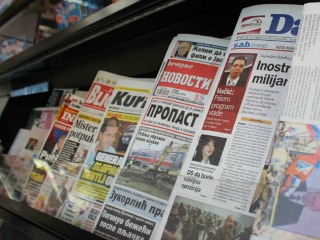
Serbia Press Council Backs BIRN Against ‘Informer’

The Complaints Commission unanimously agreed to issue a public reprimand to the Informer newspaper following its reports on BIRN’s investigation into the Tamnava mine.

In a session on February 26, the Commission ruled that Informerviolated the section of the Code of Journalists of Serbia related to the veracity of reporting in the article entitled “Wanted to get hold of 23.2 million euro, but are still ‘reputable journalists’ and diplomats,” which it published on January 15.

“BIRN editorial is presented ‘as being part of a media mob and of racketeering the state on behalf of the EU’ and Informerdid not even think that it should all be proved.

“Members of the Commission unanimously decided that Informer had violated the Code of Journalists of Serbia and imposed a public reprimand,” the Commission said.

Since Informer is not the member of the Press Council, it is not obliged to publish the Commission’s decision.

The ruling follows BIRN’s submission of a complaint against Informerto the Complaints Commission of the Press Council on January 23 in connection to the newspaper’s reports on BIRN’s investigation into the Tamnava mine.

In the midst of a public debate on the investigation, “Pumping out the mine and the budget,” Informerpublished false information, slander and unsubstantiated accusations, intentionally or unintentionally ignoring the substance of the topics BIRN dealt with, thus jeopardizing BIRN’s professional credibility and personal integrity, and the safety of BIRN’s journalists.

“The head of BIRN, journalist Slobodan Georgijev, instead of apologizing for the lie, continues to accuse the government of censorship, and claims that he is being persecuted!?!” Informerwrote on January 15.

It also accused BIRN of wanting to get hold of 23.2 million euro. Informer dubbed BIRN journalists corrupt, saying that the EU had paid them to lobby for some EU companies to win the tender in Serbia to clear out the mine.


BIRN Macedonia Launches Seventh Call for Investigative Reports

BIRN Macedonia, together with Centre for Investigative journalism – SCOOP Macedonia and the Centre for Civil Communications launched the seventh call for investigative stories on March 2nd.

The call is part of the ‘Project for Investigative Journalism and Cooperation Between Media and Civil Society’, part of a USAID programme for strengthening independent media in Macedonia.

In this call that closes on March 16, at least five journalists will be awarded a grant to cover their expenses while doing the investigation and writing the story.

Journalists will have about three months to dig deeper and research their ideas, but also will have the opportunity to work with experienced editors as their mentors to guide them through the process of writing to BIRN standards.

Topics for investigations include: health; cultural policy; education and youth; human rights; EU integration; good governance; inter-ethnic relations; environment issues; marginalised groups; quality of life.

The call only applies to journalists from Macedonia. More calls for investigative grants will follow.

Click for more information about the application procedure, with details in Macedonian.

BIRN Builds up Library of Investigative Journalism

BIRN Macedonia on February 25 donated a variety of books to the School of Journalism and Public Relations in Macedonia in order to provide additional support to the students of the school in strengthening their skills and knowledge of investigative journalism.

The donation consisted of more than 20 books on topics related to investigative journalism, covering trends in journalism, mining data, computing-assisted reporting, data visualization, manuals and best practices in investigative journalism in the world, and more.

BIRN also donated copies of BIRN’s guide to investigative journalism in the Balkans, “Digging Deeper”, by Sheila Coronel, director of the Stabile Center for Investigative Journalism and professor at Columbia University New York.

The main purpose of the books is to help students of journalism in Macedonia to expand their knowledge in the field with the latest literature available at the moment. Apart from students at the School for Journalism, the books may be used by students of other faculties, journalists and media professionals.

This donation was supported by the US Embassy in Macedonia and the USAID Mission in Macedonia through its Project for Investigative Journalism and Cooperation between Media and Civil Society.

Albania Reporters Trained on Likely Impact of Reform

On February 20th and 21st BIRN Albania held a two-day workshop in the city of Durres with ten journalists on the country’s administrative and territorial reform and its impact on the local elections, due at the end of June. 

The training was held as part of the “Accountability in Local Governance through Citizen Participation and Civic Journalism” project, supported by the US Embassy in Albania Democracy Small Grants Program.

This project aims to bridge the gap between local voters and mayoral candidates ahead of the 2015 local elections, by strengthening the capacities of CSOs, grassroots organizations, activists and the media in order to identify and stimulate public debate on the key issues facing local communities.

Reporters were trained by two independent experts on the changes that the new administrative reform will bring to the administrative map, on the way new municipalities are organized, and on the impact these changes will have on local governance and democracy.

The journalists also were also presented with information on how the administrative reform will impact on the upcoming electoral contest. 

The ten journalists, representing local media in Albania, were also trained by BIRN editors into identifying important issues for local communities in cooperation with CSOs.

Following the two-day formal training, the local journalists will develop a working plan and carry out at least 30 interviews and open discussions sessions (focus groups) with representatives of grassroots organizations, activists and representatives of relevant groups in each region of the country.

The interviews with community members will aim to identify key issues for each population subgroup in the run-up to the local elections.

Belgrade Insight Kicked Out of Distribution Points

Distribution of Belgrade Insight has been stopped at Belgrade airport and at Tourist Organisation of Belgrade centres – in what appears a continuation of the government-led campaign against BIRN.


As of February, BIRN’s English language newspaper, Belgrade Insight, will no longer be distributed at one of the paper’s biggest distribution points – Tourist Organisation of Belgrade centres.

While distribution of the free newspaper has also halted at Dufry outlets at Nikola Tesla Airport, negotiations with this company remain ongoing.

Dufry, a global travel retailer that operates over 1,700 shops in airports, on cruise liners, at seaports, and other tourist locations in more than 60 countries, pulled Belgrade Insight from its venues on February 6.

Dufry, which has been hosting Belgrade Insight pick-up points since 2008, said the company had no written contract that obliges it to continue distributing the newspaper.

Miodrag Popovic, the acting director of the Tourist Organisation of Belgrade, TOB, told BIRN that Belgrade Insight’s editorial concept was not appropriate for tourist info centres.

“When in comes to distribution of your publication in the tourist-information centers of TOB, the answer lies in the definition of these centres,” he said.

“They are tourist-information [centres] and materials that there can be found there, in addition to souvenirs, of course, are those who have tourist information purposes only. Your newspapers have a different editorial policy,” Popovic said on February 20.

TOB did not inform Belgrade Insight of its intention to end cooperation.Instead, staff at TOB info-centres, visited by Belgrade Insight readers, told them they would no longer be able to pick up their copies in TOB venues. “We just got a call that we should pull the paper,” one employee told BIRN.

The sudden curbs on the distribution of BIRN’s newspaper come after the government of Serbia launched a fierce attack on BIRN in January.

This was in response to BIRN’s publication of an investigation into the tender awarded for dewatering the state-owned Tamnava mine.

The investigation said the power company EPS awarded the contract to a consortium of two companies with no relevant experience, one of whose directors is standing trial for tax evasion.

“Tell those liars that they have lied again. They got the money from [Michael] Davenport [head of the EU delegation in Belgrade] and the EU to speak against the Serbian government,” Aleksandar Vucic, the Prime Minister, said.

Gordana Igric, BIRN regional director, said the latest developments showed that the campaign was ongoing.

“We perceive the fact that Belgrade Insight is being kicked out of venues that have been our partners for years as continuation of the campaign against BIRN in which state institutions and companies – which by the nature of their job have to cooperate with the state – are participating,” she said.

“This is not happening only to us. Mechanisms for ensuring media obedience differ, from conditioning awards of commercial contracts to financial control over media,” she added.

Readers can pick up copies of Belgrade Insight at the hall of BIRN’s Belgrade office at Kolarceva 7, as well as at venues listed bellow.

Readers may order home delivery of the newspaper by visiting http://www.balkaninsight.com/en/page/subscribe-to-belgrade-insight.

For additional information please contact [email protected].

BIRN Macedonia Promotes 2015 Fellowship

BIRN Macedonia has launched the ninth Balkan Fellowship for Journalistic Excellence, this year on the theme of ‘Values’.

The Balkan Investigative Reporting Network office in Macedonia on February 18 held a reception to promote the ninth annual Balkan Fellowship for Journalistic Excellence. Experienced journalists are invited to send story proposals by February 25 based on the theme of “Values”.

BIRN Macedonia Director Ana Petruseva explained the programme to journalists and editors who wish to apply with proposals for stories that involve cross-border investigations.

“The Fellowship is an opportunity to learn from some of the best journalists and editors out there and for your stories to be published in such renowned world media outlets as the New York Times, The Atlantic, The Guardian and others,” Petrusheva said.

Macedonian 2014 Fellow Marija Mitevska said work on such investigative stories was time-consuming but she nevertheless urged journalists to apply for what she called a “once-in-a-lifetime experience”.

The application deadline is February 25. Journalists from Albania, Bosnia and Herzegovina, Bulgaria, Croatia, Kosovo, Macedonia, Montenegro, Romania, Greece and Serbia are eligible.

Applicants selected for the Fellowship will receive €2,000 as a bursary and up to another €2,000 for travel and research expenses. They will also attend international seminars and receive one-to-one mentoring for their stories.

Completed articles will be published in English and in local languages by leading regional and international media. In addition, the top three articles will receive awards of €4,000, €3,000 and €1,000.

The Balkan Fellowship for Journalistic Excellence programme is supported by the ERSTE Foundation and the Open Society Foundation in cooperation with the Balkan Investigative Reporting Network, BIRN.

The application form, guidelines and further information about the fellowship are available online: fellowship.birn.eu.com.

BIRN’s Response to Johannes Hahn on Media Freedom

The Balkan Investigative Reporting Network is issuing a statement after Johannes Hahn, the European Commissioner for European Neighbourhood Policy and Enlargement Negotiation, said he could not react to claims about media freedom violations in Serbia without seeing proof. BIRN is sending its response to all relevant human rights organisations, EU diplomats and international journalists.

„The Balkan Investigative Reporting Network would like to express its alarm and serious concern over the statement of Johannes Hahn, the EU’s Commissioner for European Neighbourhood Policy and Enlargement Negotiations who has said that he needs to see evidence of declining media freedom in Serbia.

At a press briefing in Brussels on Monday Commissioner Hahn said that he could not react to claims about violations of press freedom in Serbia without seeing concrete evidence. He said:

“I have heard this several times [concerns about media freedom] and I am asking always about proofs….I am willing to follow up such reproaches, but I need…evidence and not only rumours,” Hahn told journalists.

The recent onslaught on our network is clear proof of what is happening in Serbia. Aleksandar Vucic, Serbia’s Prime Minister, targeted us, unleashing a wave of attacks in which we were branded as “liars”, “mercenaries” and “traitors’. Some of the material has been detailed here: https://birn.eu.com/en/page/birn-under-fire.

We see fit to remind Mr Hahn that, coupled with the attacks on us, came attacks on the European Commission itself which has funded an investigative reporting project published by BIRN. It was accused of paying BIRN to attack the Serbian government.

In the first week of vicious campaign, 170 reports were published about us. Only four media outlets in Serbia gave BIRN room to respond. No mainstream media reported on the corruption story published by BIRN, which triggered the attacks. By contrast the prime minister’s accusations against us were widely covered.

Mr Vucic’s demonstration of power sends the chilling message that a similar fate awaits any other critical voices. Campaigns have now followed against the Serbian Ombudsman and Humanitarian Law Center.

Other media have suffered significant pressures, and journalists talk of direct pressures and self-censorship which has been documented by the Association of Serbian journalists in December 2014.

The new World Press Freedom Index ranked Serbia in 67th position, a fall from the 54th place it had one year ago.

This ranking is also in line with European Commission’s own 2014 progress report which noted “concerns about deteriorating conditions for the full exercise of freedom of expression in Serbia.” Indeed Commissioner Hahn’s statement stands in a somewhat baffling and stark contrast to the report which warned of a “growing trend of self-censorship which, combined with undue influence on editorial policies, and a series of cases of intervention against websites, are detrimental to freedom of the media and adversely affect the development of professional and investigative journalism.”

In Serbia and the rest of the region, there is a widespread belief that democracy and freedom of expression are less important concerns for the EU than the issue of maintaining stability. We believe that this is a grave mistake and that there is no stability without them. 

BIRN and its partners are deeply concerned that the situation is likely to deteriorate further and we therefore expect the European Commission to express concern over these issues in a clear manner and not to leave any room for doubt about what is actually happening in Serbia.“

Unite for Freedom, BIRN Media Debate Hears

Panellists and guests at the ‘Free the media’ debate concluded that in times of financial hardship and other pressures, journalists must unite against new forms of censorship.

BIRN Serbia and Human Right House organised the first in a series of debates on media freedom on Thursday in Belgrade’s Media Centre.

One of the messages from the debate that gathered more then 50 people, including journalists, NGO activists and representatives of embassies, is the need for journalists, NGOs and citizens to connect and join forces in the fight for human rights and media freedom.

The debate was staged in the aftermath of the campaign launched against BIRN by Prime Minister Aleksandar Vucic after the organisation published an investigation on January 8 published a report on the controversial tender to de-water Tamnava mine.

Jovana Gligorijevic, from the weekly magazine Vreme, the only outlet to republish the BIRN investigation in full, said that the pressures had started even before the story was out.

“While the article was still being drafted, we received a phone call and it sounded like this: We heard that those people of yours [BIRN Serbia] are writing about this topic; if you publish it, we’ll sue you,” Gligorijevic said.

Gordana Igric, BIRN regional director, said the campaign against BIRN revealed the scale of the pressure on media freedom in Serbia.

In two first weeks of the campaign, she recalled, while the media reported on BIRN 294 times, BIRN had been contacted only 11 times to give statements and answer accusations or provide explanations of the story. None of the mainstream media contacted BIRN.

“That does not mean that media don’t want to report, but that they are completely hemmed in by an economically devastated country,” Igric stated, sourcing one of the main problems in the difficult financial situation of both media outlets and journalists.

“We need a coalition in the Balkans. Journalism is the field where the public interest is being defended, it’s not just a field where the money may be earned,” Igric said.

Journalists from southern and east Serbia participated in the debate via a video link from the Media Centre in the city of Nis.

Panellists recalled that while the state murdered journalists back in the Nineties, nowadays it was “killing them financially.”

Predrag Blagojevic, editor of newspaper Juzne Vesti, said the funds that the state allocates to the media are a key tool of control.

“The state pressures and controls the media through the money they give them by secret contracts, and in that situation it is impossible to expect them [those media] to criticise the government,” Blagojevic said.

He added that another form of financial pressure is what his newsroom faces constantly.

“Tax authorities are constantly in our office. Of course there are differences in levels of communications, threats, but the basics of control are the same,” he said.

Jovana Gligorijevic, from the weekly Vreme, agreed that pressures on media were common, and no one should expect them to just disappear; they had to be fought back against.

“Freedom is being conquered,” she warned.

Maja Stojanovic, executive director of Civic Initiatives, a member of Human Rights House, said the media, NGOs and ordinary people had to come together and fight for freedom of expression.

“It is our responsibility that media aren’t free, us as citizens and civil society organisations, because we haven’t done more,” Stojanovic said.

“Free Media” debate was the first in a series of events that BIRN Serbia and Human Rights House will be organising monthly. The Twitter tag on which everyone can follow the events and share the information is #OslobodiMedije.

BIRN Addresses International Human Rights Organisations

BIRN Regional Director Gordana Igric has sent a letter on behalf of the network to more than 30 international human rights and media organisations including the Committee to Protect Journalists, Amnesty International, Human Rights Watch, the Helsinki Committee for Human Rights and International Press Institute to highlight the continued pressure on BIRN in Serbia.

The Balkan Investigative Reporting Network, BIRN, wishes to draw your attention to alarming developments in Serbia, where the Serbian Prime Minister and other high-ranking government officials are conducting unprecedented attacks against critical voices, be it organisations or individuals.

It has been exactly a month since our organization came under attack for publishing an investigation flagging up important issues of public interest. In response, the government branded BIRN journalists EU mercenaries, spies and “liars”, working against Serbian national interests. The attacks from government-allied media have since receded but they have not stopped.

In the meantime, other organizations and independent institutions, like the Humanitarian Law Centre and the Serbian ombudsman have also come under fire, with almost identical ammunition, labeling them traitors, mercenaries, etc, which points to a worrying pattern and sends a clear message to any critical voices about what lies ahead.

Since the campaign against BIRN was launched, over 40 civil society organisations have called on the Serbian authorities to protect the public interest and investigate the concerns raised by BIRN, and many of them have engaged with BIRN to organise a series of events dedicated to freedom of speech.

For a while now the international community’s approach to the region appears to prioritise stability at the expense of democratic freedoms. In Serbia’s case, as long as the country is cooperating with the EU-led dialogue with Kosovo, there is a silence regarding other worrying developments.

BIRN and its partners are deeply concerned that the situation is likely to deteriorate further and we therefore appeal to you to express concern over these issues.