BIRN Albania Holds Court and Crime Reporting Training

The Balkan Investigative Reporting Network in Albania held a three-day training course in Tirana from November 24-26 for local journalists on court and crime reporting techniques, the transparency of the courts and mobile video reporting.

The training course was made possible with support from the USAID-funded Justice for all Project, which is implemented by the East-West Management Institute with local partners like BIRN Albania. Fifteen journalists representing all the regions of Albania attended the training course, at which advanced court and crime reporting techniques were discussed.

The workshop was greeted by EWMI Media Advisor Elira Canga, who underlined the importance of court reporting to advance Albania’s justice reform.

During the training course, the journalists were presented with the recently-published BIRN Albania report on the transparency of courts in Albania and told about techniques of how to use court websites and databases to identify leads.

The training course aimed to strengthen the skills of mid-career journalists to report from the courts, the prosecutor’s office and other law-enforcement institutions, as well assisting them to better use multimedia tools in their stories.

A special session on mobile video reporting was held during the training session by Ivana Dervishi, BIRN Albania’s multimedia journalist, at which the latest techniques of using cellphones to shoot video were presented.

The journalists who attended the three-day workshop have already been given on-the-job training and mentoring by BIRN Albania as part of the project ‘Enhancing the Transparency of Justice Reform in Albania’.

BIRN Holds Debate on Audit Reports in Prizren

BIRN Kosovo held its second debate to present findings from its analysis of municipality audit reports, this time for the municipality of Prizren, on November 23.

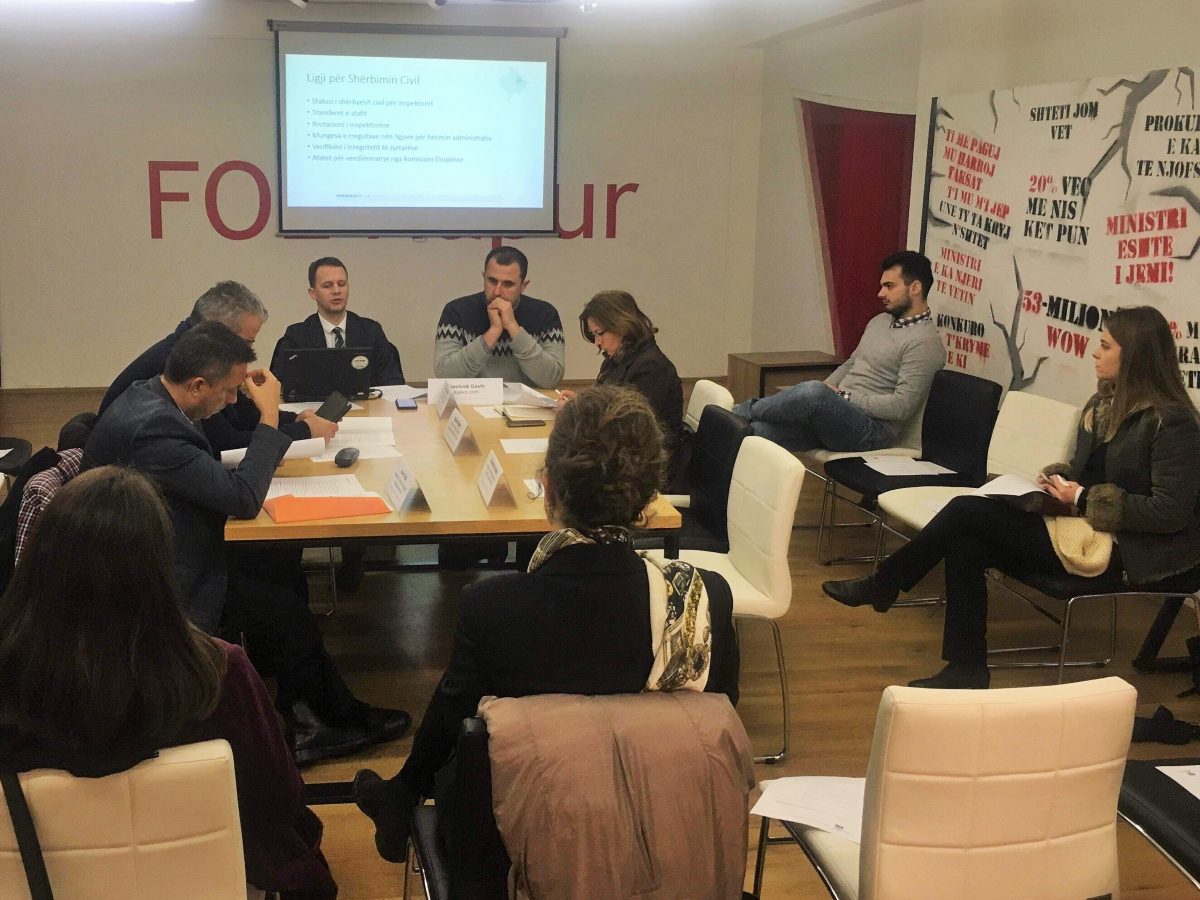
The outcomes of the analysis and monitoring were presented in an open debate with more than 20 participants from the municipality, the auditors and civil society, as well as local media including RTK and TV Prizreni.

Kreshnik Gashi, editor and moderator of BIRN Kosovo’s TV programme ‘Justice in Kosovo’, gave a brief presentation on the project and the findings of the analysis on the audit of the municipality.

The mayor of Prizren, Mytaher Haskuka, then discussed the situation with the implementation of recommendations from the National Audit Office.

Haskuka emphasised that the crucial issue for the municipality remains the managing of contracts with economic operators – suppliers of goods, works or services. Haskuka said the reason for this is the large number of contracts compared to the small number of directorate officials who have to deal with the contracts.

A representative of the National Audit Office, Ilir Salihu, was also present to answer questions from the panel and the audience.

Regarding the municipality of Prizren, Salihu said that activities that were planned have not been implemented, and advised that municipalities should be more careful when drafting action plans.

“I would like to emphasise an important thing… I think that neither the municipalities nor the other entities audited should draft action plans just for the sake of fulfilling a legal obligation, because the purpose of our recommendations is not to overburden the municipal or central administration with activities that are not important or necessary. So my personal advice is that when drafting action plans, [municipalities] should look at activities that are reasonable and feasible, and second, target realistic deadlines,” Salihu said.

This debate was organised within the framework of the project ‘Support civil society to increase public oversight and accountability of Kosovo public institutions’funded by the British Embassy in Pristina. This part of the project looks at compliance by institutions with recommendations in the Auditor General’s reports.

Similar debates will be held in other municipalities to present the findings of BIRN Kosovo’s analysis of the implementation of audit recommendations. Each debate will be held at municipal assemblies and will be livestreamed by BIRN Kosovo.

BIRN Editors Address Nuremberg Trial Reporting Seminar

BIRN editors from Kosovo and Bosnia and Herzegovina participated in a seminar in Nuremberg, Germany, on journalism and trial reporting on November 19-22.

BIRN Kosovo’s Kreshnik Gashi and BIRN Bosnia’s Denic Dzidic travelled to the German city of Nuremberg to address a seminar organised by the Kosovo Specialist Chambers and the International Nuremberg Principles Academy on journalism and trial reporting.

Gashi, editor and moderator of BIRN Kosovo’s TV programme ‘Justice in Kosovo’, made a presentation about the work of BIRN Kosovo’s site KALLXO.com on reporting war crimes, covering the legal responsibilities of journalists writing such sensitive reports, accurate and objective reporting, and the verification of facts before reporting on cases.

Dzidic, editor in chief of BIRN Bosnia’s online publication Detektor, spoke about lessons learned from following international tribunals and war crimes trials in Bosnia and Herzegovina. He highlighted how BIRN had become a specialised news media for transitional justice and what importance that played for the victims and diaspora communities in Bosnia and Herzegovina.

The seminar focused on the key role of journalists on informing the public about criminal trials, the seminar was structured into three modules – Basics of International Criminal Law; Journalism and International Criminal Tribunals, and Reporting on International Criminal Tribunals.

Opening remarks at the seminar were made by the director of the International Nuremberg Principles Academy, Klaus Rackwitz, and Dr. Fidelman Donlon from the registrar’s office at the Kosovo Specialist Chambers.

BIRN Holds Debate on Audit Reports in Peja/Pec

BIRN Kosovo held a debate on November 19, presenting findings from its analysis of the Auditor General’s reports for the municipality of Peja/Pec.

The debate at the municipal assembly was attended by more than 30 participants including representatives of the municipality, the Auditor General and civil society.

Visar Prebreza, editor at BIRN Kosovo, gave a brief presentation about the project and introduced the findings of the analysis.

The mayor of the municipality, Gazmend Muhaxheri, discussed the audit situation and crucial issues in Peja/Pec. Muhaxheri called on BIRN Kosovo to monitor all auditing processes in the future.

The third speaker was a representative of the Auditor General, Ilir Salihu, who discussed in detail the achievements and obstacles to auditing in the municipality of Peja/Pec.

Salihu said that municipalities should sit down with the auditors and discuss the recommendations they are given.

“It is crucial that complex recommendations are followed by a dialogue between the auditor and municipal officials in order to prevent uncertainties that can be reflected in the implementation and measurement of recommendations,” Salihu said.

Following a discussion of BIRN Kosovo’s analysis, audience members asked questions and expressed criticism of the work of the municipality in implementing the audit recommendations.

BIRN Kosovo journalists recorded the promises made by the General Audit and the municipality to be followed up and fact-checked by Krypometer, BIRN Kosovo’s fact-checking site.

This debate was organised within the framework of the project ‘Support civil society to increase public oversight and accountability of Kosovo public institutions’, funded by the British Embassy in Pristina. This part of the project looks at compliance by institutions with recommendations in the Auditor General’s reports.

Similar debates will be held in other municipalities to present the findings of BIRN Kosovo’s analysis of the implementation of audit recommendations. Each debate will be held at municipal assemblies and will be livestreamed by BIRN Kosovo.

Documentary Co-Produced by BIRN Serbia Wins Award

The documentary ‘The Dark Shadow of Green Energy’ by film-maker Dragan Gmizic, co-produced by BIRN Serbia, Al Jazeera Balkans and WWF Adria, was named the best Serbian film at the Belgrade International Green Culture Festival, Green Fest on Tuesday.

The Dark Shadow of Green Energy’ follows Irma Popovic Dujmovic, a WWF Adria activist, on the road through Croatia, Bosnia, Serbia and Montenegro, discovering how the regional plan for the mass construction of small hydropower plants creates multiple new problems instead of solving them.

The destruction of the natural environment, people’s resistance against small hydropower plants and the corruption involved in their construction are some of the issues covered by the film.

The documentary was aired on Al Jazeera Balkans, and was screened at the Free Zone film festival in Belgrade.

BIRN Takes Part in Panel on Arms Control

BIRN’s Jelena Cosic was speaker on a panel entitled ‘Reviewing Europe’s Regulations on Arms Export Control: Can Germany lead by example?’, which took place on November 7 in Berlin.

The topic of panel was arms exports from Europe that end up in Syria, Yemen and Mexico, and whether Europe’s regulations on arms exports are enough to prevent war crimes and human rights violations.

The topics were discussed within the context of Europe’s regulations on arms exports, the EU Common Position.

Panellist Radhya Almutawakel, chairperson of Mwatana for Human Rights in Yemen, presented cases of exported European weapons that are used in the Yemen conflict, while Sara San Martin expert from Centro de Estudios Ecuménicos from Mexico explained how Germany exported Heckler & Koch weapons to a different end-user than one one that was declared.

The moderator was Roy Isbister, team leader for arms units at the Saferworld organisation in London.

Cosic spoke about the risks of arms exports being diverted and ending up in Syria and Yemen, but also the misuse of international regulations on arms exports. The key findings came from investigations on arms exports that BIRN has published in recent years (link to http://www.balkaninsight.com/en/page/balkan-arms-trade).

The organisers of the event were Saferworld, the European Centre for Constitutional and Human Rights, the Friedrich Ebert Foundation and PAX, Netherlands.

BIRN Serbia Submits Shadow Report on EU Chapter 23

BIRN Serbia has submitted its shadow report to the EU Delegation in Serbia as a contribution to the compilation of next European Commission country report on Serbia.

The BIRN Serbia shadow report focuses on negotiations for Chapter 23 of the EU acquis, which covers the judiciary and human rights, particularly the section on freedom of expression, offering insights and an alternative narrative on state of progress in this area.

The shadow report puts special emphasis on freedom of expression and media pluralism issues as a precondition for overall democratic dialogue in the country.

BIRN Serbia found that the constant shrinking of media freedoms and freedom of expression and absence of a social, political and economic setting conducive to the development of professional and sustainable media sector is a matter of concern, influencing the country’s overall democratic capacity.

The shadow report also calls for changes related to media legislation and the cessation of pressures on media by state bodies.

The report is a result of BIRN Serbia’s overall engagement in the field of media development and media freedoms, but also as part of activities under the project ‘Public Money for Public Interest’ supported by the EU through the IPA Civil Society Facility instrument.

Follow this link [in Serbian] on our project site to find out more.

Documentary Co-Produced by BIRN Serbia Nominated for Award

The documentary ‘The Dark Shadow of Green Energy’ by film-maker Dragan Gmizic, co-produced by BIRN Serbia, Al Jazeera Balkans and WWF Adria, has been nominated for an award at the Belgrade International Green Culture Festival ‘Green Fest’, in the Serbian film category.

The Dark Shadow of Green Energy’ follows Irma Popovic Dujmovic, a WWF Adria activist, on the road through Croatia, Bosnia, Serbia and Montenegro, discovering how the regional plan for the mass construction of small hydropower plants creates multiple new problems instead of solving them.

The destruction of the natural environment, people’s resistance against small hydropower plants and the corruption involved in their construction are some of the issues covered by the film.

The documentary was aired on Al Jazeera Balkans, and will be screened at the Free Zone film festival in Belgrade on November 12 at 11 am, The Cultural Centre Of Belgrade.

BIRN Report Sparks Salary Declaration from Serbian MP

After BIRN Serbia reported on ruling party officials working illegally at the Medical College in the town of Cuprija, one of them, Aleksandar Martinovic, reported his income from the college, admitting he works there.

Аleksandar Martinovic, one of the officials from Serbian ruling Serbian Progressive Party who has an illegal contract with Medical College in Cuprija, as a Ministry of Education inspection has confirmed, reported his salary from the college to the Anti-Corruption Agency  for the first time after BIRN’s article was published.

BIRN Serbia published the article ‘Cuprija: Political Employment at Medical College’ on October 23 about officials from the Serbian ruling party who work at the college.

Several months earlier, BIRN asked the college about these contracts, but its director, Hristos Aleksopulos, responded that “everything is legal”.

An inspection by the Ministry of Education found that all the contracts are illegal and that the college is obliged to terminate them due to the lack of proper documentation for their employment.

However, two of them – Aleksandar Martinovic and Darko Laketic – are still on the Medical College’s list of teaching stuff for the new school year.

Martinovic, the head of Serbian Progressive Party’s parliamentary group, reported his salary as 60,000 dinars, with a start date of October 1, after BIRN’s report about him working at the college.

However, documents show that Martinovic has been working there much longer.

Beside his salary from the college, Martinovic has five more salaries from the state budget – a total of 264,000 dinars per month.

Another Serbian Progressive Party MP, Darko Laketic, reported his salary from the college for the new school year to the Anti-Corruption Agency, as he has for the past few years. However, Laketic is also among those whose contracts are to be terminated.

After BIRN published the report, there was a discussion in parliament about it, on the initiative of an opposition MP.

Martinovic and another member of the Serbian Progressive Party, Vladimir Orlic, who was also working at the college, rejected an official document from the Ministry of Education about their unlawful jobs.

At the same time as Martinovic and other Progressive Party members got their contracts, several employees of the college were laid off after their temporary contracts expired and were not renewed.

BIRN Albania Presents Baseline Court Transparency Report

The Balkan Investigative Reporting Network in Albania launched its monitoring report on transparency of courts in Albania on October 30.

BIRN Albania presented its Monitoring Report on Court Transparency during a roundtable with chief justices from the country’s First Instance and Appeals Courts on October 30.

The event was organised by USAID’s “Justice for All” programme, which has supported the publication of the report.

This monitoring report assesses the transparency of all courts in the country with respect to the information categories that these institutions make public through various means of communication with citizens.

The findings aim to encourage a willingness and readiness among judicial institutions to increase their level of transparency, as well as serve as a base study for further progress assessments.

For this purpose, Albania’s Constitutional Court and 38 courts that are part of the local judicial system were monitored on 36 indicators deriving from the legal framework that is currently in force.

The monitoring was conducted by combining three different methods of data collection: on-site monitoring in each court; online monitoring through court websites; and via requests for information submitted to them.

The chief justices present during the round-table welcomed the report as a tool that will aide their staff to better serve the public and improve its access to justice.

The baseline report will be followed by another report in a year’s time, while BIRN Albania will work with the “Justice for All” programme to train court staff to the requirements of the law on freedom of information and the legal framework on proactive transparency.

Read the report in Albanian.

Read the report in English.