Digital Media Action for Freedom of Expression in Serbia

BIRN Serbia

Summary

The project aims to open up space for different opinions and responsible community voices. In this way it responds to the lack of functional debate and to the very centralised information system which leaves a large part of the country outside the capital in isolation.

Donor: British Embassy Belgrade

Information Sheet

Main Objective:

To increase the influence and capacities of selected online media to become a primary source of information in their communities, contributing to informed debate on government performance and accountability.

Specific Objectives:

  • The project will utilise the existing community to initiate quality debate and engagement.
  • At the same time, the project will work towards expanding online outlets’ number of followers and fostering information flow. throughout the country to provide credible information from all parts of Serbia to the public.
  • This will have positive impact not just on the Serbian public, being better informed, but also to participating portals as their profile and influence will be strengthened.

Main Activities:

  • support of online portals that have potential to become genuine information platforms and that will enable quality production on national, regional and local digital platforms.
  • cooperation of media outlets in the production and dissemination of the content with the aim of initiating informed debate about the accountability of public officials in a media environment that lacks pluralism and critical analysis.

Target Groups:

  • editors
  • journalists
  • sales managers
  • tech. support

Highlights:

10 articles, 15 videos/visualisations

Main implementer:

BIRN Serbia

Partners:

  • Portal Juzne Vesti
  • Portal Danas

Report on Asset Declarations of Albanian Constitutional Court Judges (2017)

Analysis of the System of Declaration of Constitutional Court Judges in Albania, is a study published by the Balkan Investigative Reporting Network in Albania, which evaluates that structure of the wealth of the Constitutional Court members in Albania as well as the integrity of the asset declaration system.

The goal of this report is to identify key trends towards the enrichment of these judges who have a long career in the justice system and make up a quarter of its members. The study sheds light not only on how career judges in Albania have accumulated wealth but also on key practices, recognized as “red flags”, which obscure the origin of this wealth. These include dividends from businesses, debts owed by family members, real estate transactions and cash kept outside the banking system.

To download a copy of the report in English, click here.

To download a copy of the report in Albanian, click here.

Pressure Rises on Journalists in the Balkans

Weakening EU and US influence in the Balkans and increased Russian influence, as well as growing political and economic pressures on journalists, have created a harsher environment for Balkan media, BIRN’s biennial meeting heard.

At the biennial meeting of the Balkan Investigative Reporting Network on Saturday, Ana Petruseva, director of BIRN Macedonia, said the situation facing the media in the Balkans “seems to be going from bad to worse”.

In addition to the usual political and financial pressures, she said, the media is seeing new types of pressure – the labelling of reporters and media outlets as spies and foreign mercenaries, as well as the opening of a large number of fake news websites.

Petruseva said the flood of fake news was “creating a media noise” in which it is becoming difficult for the public to distinguish between real and fake information, as a result of which confidence in the media in general is declining.

“People are losing trust in the media, and start to see everything as propaganda and promotion,” Petruseva said at the BIRN meeting on Saturday in Kopaonik, Serbia, referring to the new challenges facing the Balkan media.

Wolfgang Petritsch, a BIRN Board member and the president of the Austrian Marshall Plan Foundation, warned the Balkan countries not to always count on EU support, as many in Brussels saw “stability as the priority” over reforms.

“The EU position has weakened owing to its internal problems. As long as it does not finish the process of internal reforms, there will be no strong EU role in the region,” he said, noting that while the promise of EU enlargement is fading, authoritarian regimes in the region are strengthening.

“Since no system has been established of how to handle enlargement, the situation will remain in the ‘twilight zone’,” Petritsch said.

Political analyst for The Economist and Balkan expert Tim Judah said the policy of “stabilitocracy”, whereby the EU and the US appear to tolerate authoritarian Balkan leaders who deliver stability, is essentially a pragmatic response.

“It means dealing with the leaders that we have, and dealing with the Balkans in the way that they are,” he said.

Judah said that while Western influence had decreased, Russian influence had grown, but that Moscow saw setbacks in recent months – giving the example of Macedonia, where Prime Minister Nikola Gruevski has been ousted, and Montenegro, which joined NATO on June 5 despite Russian opposition.

“What is Russia’s interest? It is simple, they want to create within the region pro-Russian or neutral territories,” Judah said.
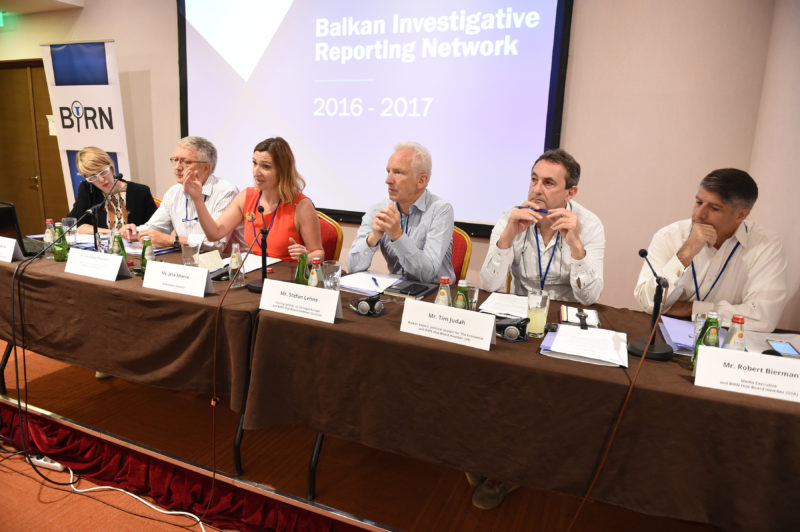
BIRN Board member and visiting scholar at Carnegie Europe Stefan Lehne said the Balkan countries could move closer towards EU membership in different ways.

“Parallel to the very, very slow and very boring and complicated enlargement process there could be some process of horizontal enlargement. The Balkans countries should not join only country by country, but policy by policy,” Lehne said, listing Balkan countries’ participation in the Energy Community as an example of this.

BIRN board member and media expert Robert Bierman spoke of the recent experience of the media in the United States, where the administration of President Donald Trump has been targeting the press.

“Any weakness in the media will be pointed at. It doesn’t matter if two things are wrong and 98 are right, those two things become the most important in the world. It doesn’t matter that the administration is doing 98 things wrong and two things right,” Bierman said.

However, he added more optimistically that Americans appear more ready now to pay for editorial content, adding that the media are also continuing to do their job.

Before the panel, BIRN Regional Director Gordana Igric presented the results of the BIRN network’s projects in the last year, noting that the network had directly reached over five million people.

“In the past year, this number increased by over half a million people,” Igric said, adding that milestone stories had tackled such major issues as corruption, problems with public procurements and concessions. As a result of these investigations, officials have been removed and criminal charges filed.

Igric said that BIRN currently operates 16 websites in various languages, and has produced over 100 TV reports and films and held 50 training courses during the past year.

According to Igric, BIRN’s articles have been republished or cited in many respected foreign media, including The Guardian, the BBC, and Bloomberg. BIRN has also been very active in advocating the prosecution of war crimes and in participative budgeting activities.

The biennial BIRN network meeting continues until June 10 on Mount Kopaonik in Serbia.
Albania Court Hears Judge’s Lawsuit Against BIRN

Hearing started in Tirana in a case brought by Gjin Gjoni, an Appeals Court Judge, and his wife, Elona Caushi, who claim they have suffered ‘moral anguish’ from BIRN reports and are seeking compensation.

The case of Judge Gjin Gjoni and his wife against BIRN Albania and its journalists, Aleksandra Bogdani and Besar Likmeta, started in the First Instance Court of Tirana on Wednesday and in the presence of several observers from local and international organisations.

Gjoni, an Appeals Court judge and member of the High Court of Justice, and his wife, Elona Caushi, a businesswoman, claims three BIRN articles published in Reporter.al, BIRN Albania online publication, caused them anguish and are demanding 52,000 euros in compensation from both BIRN Albania as an organisation and from the journalists.

One of the articles reported on the closure of an investigation against the judge, accused by the High Inspectorate for Declaration and Audit of Assets and Conflicts of Interest, of concealing wealth, falsifying official documents and money laundering.

The second one stated that the case against him has been reopened while the last showed the ten richest judges in the country based on their wealth statements – including Gjoni.

BIRN Albania stated in the court that it stands by the stories and considers the lawsuit baseless. The next hearing is scheduled for September 12.

Gjoni and his wife filed a separate lawsuit against the Tirana newspaper Shqiptarja.com and its journalists, Elton Qyno and Adriatik Doci. In this, the plaintiff seeks about 14,800 euros damages from the newspaper and 7,400 euros from each of the journalists.

The lawsuits have drawn criticism from both Albanian and international rights organisations as an attempt to intimidate journalists and to push them into self-censorship, so they drop further reporting on issues of public interest.

The European Federation of Journalists, a body representing about 320,000 journalists, called the lawsuits a “malicious use of the law”, in a press release on June 16.

EFJ President Mogens Blicher Bjerregard said: “The European Federation of Journalists believes the malicious use of the law in this case is a mean of pressure and harassment against journalists. It seems clear that the real aim of the lawsuit is to intimidate and to silence journalists reporting on matters of public interest.”

The Union of Albanian Journalists, based in Tirana, condemned the lawsuits in an earlier press statement as “doomed to fail”.

“The Union of Albania Journalists has been informed of the judicial assault launched by the member of the High Council of Justice, Gjin Gjoni, against several journalists and respective media, under the legal claim that his image has been tainted,” the Union said in a statement.

“The Union considers this process from a controversial name as an attempt doomed to fail from the start,” it added.

Sarajevo Panel: Transitional Justice is a Global Challenge

The implementation of transitional justice mechanisms represents the only way to secure stability and respect for human rights in Bosnia and Herzegovina and in other places around the world, concluded participants in a panel discussion held as part of the WARM Festival in Sarajevo on June 29.

The discussion on ‘Conventional and unconventional approaches to transitional justice’ dealt with lessons from the Balkan region and their implementation in areas throughout the world where attempts are being made to deal with the consequences of conflicts.

Denis Dzidic, editor at the Balkan Investigative Reporting Network Bosnia and Herzegovivna, said Bosnia’s biggest failure was in the field of compensation for victims, adding that there was also still no law governing the rights of torture victims.

“We, in Bosnia and Herzegovina and the region, have never gone through an institutional reform,” Dzidic said, adding that the country’s Transitional Justice Strategy was an excellent document, but it had not been implemented.

Tanya Domi of Columbia University in New York said the key issue was how to involve victims in reconciliation processes, how to give them a voice and ensure that they are satisfied with the process of justice.

Myles Wallingford of the Post-Conflict Research Center said his organisation focused on making sure that victims have access to justice and that it uses multimedia projects for memoralisation processes.

Samantha Owens of the Art Works Projects Chicago said her project attempted to expand the lessons learned in Bosnia, Congo and Columbia to the United States, where the racial gap was getting more pronounced.

Speaking on behalf of the Sarajevo Film Festival, Masa Markovic said that last year’s festival presented a programme on ‘Coming to terms with the past’.

She said she wanted films from the region that cover conflict-related topics to reach a broader audience.

BIRN – Regional Network Director

Outstanding individual sought for this exciting post, heading up the work of the Balkan Investigative Reporting Regional Network, BIRN Hub, the unique media development and human rights organisation in the Balkans. BIRN’s hard-hitting reporting and analysis has gained an unparalleled reputation in the 12 years since it was founded.

This post gives an opportunity to develop the network’s work at a time of key challenges in the Balkan region. The successful candidate will play a defining role in driving BIRN’s work over the coming years, develop and implement new strategies and extend and build partnerships across the region and internationally.

1.     WHO WE ARE?

The BIRN Network is a close-knit family of non-governmental, non-profit organisations, promoting freedom of speech, human rights and democratic values with a presence across the Balkans. Tacking key issues of the region BIRN implements a range of programmes and projects. They focus on journalist training, publishing, broadcasting, media-monitoring, advocacy and debate, working with civil society organisations and creating public archives and databases.

We have country-based organisations in Albania, Bosnia and Herzegovina, Kosovo, Macedonia, Romania and Serbia, while BIRN Hub acts as our umbrella organisation. It is a non-governmental, non-profit independent organisation registered in Bosnia and Herzegovina whose job is to act as the secretariat of BIRN’s individual country-based organisations.

Additionally, BIRN Hub manages the majority of the network’s regional programmes which are implemented in cooperation with our country-based or other organisations, journalists and consultants. The work of BIRN Hub includes capacity-building of the network, the quality control of editorial output and the management of websites at the regional level. It also includes journalist training and editorial production, implemented through several programmes.

Our network of journalists and editors also includes Montenegro, Croatia, Bulgaria, Greece, and beyond. We have a wide media presence; online, on social media, in print, television, radio. Balkan Insight is our flagship website.

 2.     WHAT DO WE SEEK?

A BIRN Regional Director (BIRN Hub), will have the following responsibilities:

  • Ensuring fiscal and legal compliance in the work of BIRN Hub, under the respective laws of Bosnia and Herzegovina
  • Ensuring the smooth operation of all projects and programmes implemented by the network
  • Ensuring compliance with donor requirements for projects and programmes implemented by BIRN Hub as the lead partner
  • Ensuring proper and timely staffing of the organisation
  • Leading and motivating employees and effectively managing the human resources of  BIRN Hub
  • Ensuring the effective administration of BIRN Hub operations including the efficient completion of all BIRN Hub’s duties as the network’s secretariat
  • Ensuring an exchange of information and decision-making processes within and between BIRN Hub, the BIRN network, the Steering Committee and Assembly, in compliance with Network Rules and Regulations, the BIRN Network Cooperation Agreement, BIRN Hub’s Statute and all legal provisions
  • Ensure Network Rules and Regulations are implemented and the values of the network are respected and maintained throughout across the BIRN family
  • Ensuring maintenance, smooth operations and regional cooperation within the BIRN network, in compliance with the Network Rules and Regulations
  • Ensuring the BIRN network’s compliance with international standards of journalism, libel laws, professionalism and objectivity
  • Leading the BIRN network’s fundraising activities with a specific focus on regional programmes and deepening cooperation within the network, including the design of programmes and projects, representation of BIRN Network in public and donor relations
  • Represent BIRN Hub and BIRN network in public, (including events, public appearances and donor conferences,) with the aim of furthering the network’s mission

3.     WHAT ARE WE LOOKING FOR?

  • An excellent understanding of Balkan politics, society, and interethnic relations, plus a strong editorial background
  • Strong media development experience and knowledge of international journalistic standards
  • Commitment, drive and passion for human rights and media freedom
  • At least five years of executive experience in the non-profit sector
  • A proven track record in fundraising and an understanding donor relations unique to the non-profit sector
  • A solid understanding of financial cycles, including budget preparation, analysis, financially-informed decision-making and reporting
  • Strong organisational skills, including planning, delegating, programme development and task facilitation
  • Strong leadership and interpersonal skills and a demonstrated ability to oversee and collaborate with staff of different backgrounds
  • Public appearance, diplomacy and speaking skills and excellence in conveying messages, including the vision of BIRN’s strategic future to staff, the Board, donors and public
  • Excellent English speaking and writing skills and knowledge of at least one language of the Balkans

4.     WHAT ARE WE OFFERING?

  • An opportunity to work with a motivated, diverse team of professionals and to pursue the BIRN’s mission
  • A 4-year contract (renewable) and a competitive salary package, after a 3-month probation period
  • Working from one of our offices in the Balkans with the opportunity of frequent travel around the region

Eligible candidates are invited to send an application including a CV, motivation letter and supplementary documentation to support their candidacy to [email protected], no later than August 1, 2017.

The short-listed candidates will be invited to an interview by the 15th of August 2017. The successful candidate is expected to start with the 1st of October 2017.

BIRN BiH Addresses ICTY Legacy Event in Sarajevo

Balkan Investigative Reporting Network Bosnia and Herzegovina (BIRN BIH) editor Erna Mackic was one of the speakers at a side event at a three-day conference reflecting on the legacy of the International Criminal Tribunal for the former Yugoslavia (ICTY) and how others can build upon its achievements.

Mackic spoke at an event called “How NGOs use ICTY findings and document”.

She reminded the audience about the problems that the Bosnian public have with the State Court and Prosecutor’s Office, not being able to receive indictments and convictions, and explained how they could be more open in their work.

“The situation in BiH is very specific and very often the facts established by the Hague Tribunal have been denied, both by state institutions and the public”, Mackic said.

She also spoke about the importance of ICTY Outreach program:

“We had the opportunity to organise the training of journalists who were at the Hague Tribunal and got acquainted with its work. In different ways we were trying to help ordinary citizens to learn more about the work of the Hague Tribunal,” she said.

More than 300 people attend the ICTY conference in Sarajevo from June 22-24, including judges and staff of the ICTY, stakeholders at the local level, as well as international experts and scholars.

A significant number of the participants were from the former Yugoslavia, including associations of victims, youth, lawyers, politicians, NGOs, academics, media representatives and the general public.

BIRN Albania in Call for Investigative Reports on Environment

The Balkan Investigative Reporting Network in Albania held a roundtable on environmental hotspots, bringing together journalists, civil society organisations and experts.

The Balkan Investigative Reporting Network in Albania launched a call for investigative stories on the theme of environmental hotspots on June 20.

The call forms part of the program “Fostering Transparency through Investigative Reporting”, supported by the Open Society Foundation in Albania, the Balkan Trust for Democracy and National Endowment for Democracy.

Three journalists will be awarded grants to cover their expenses while doing their investigations and writing their stories on organized crime.

The journalists will have about three months to dig deeper and research their ideas, and will also have the opportunity to work with experienced editors as mentors to guide them through the process of writing to BIRN standards.

The call only applies to journalists from Albania and closed on July 9th.

Click for more information (in Albanian) about the application procedure.

Click here (in Albanian) to download application.

Four Broadcasters Dominate Serbian Media, BIRN Shows

New research by BIRN and Reporters Without Borders highlights the extent to which the Serbian media space has become dominated by a handful of boadcasters and media companies.

The biggest threats to media pluralism in Serbia are the concentration of audience and political influence over the media, according to research conducted by BIRN and the German branch of Reporters Without Borders.

BIRN and Reporters Without Borders on Wednesday also presented the website http://serbia.mom-rsf.org/rs/, which contains the database with information about media ownership and audience shares.

According to the research, 62.35 per cent of the audience in Serbia is shared between four broadcasters that own seven channels.

These are the national broadcaster, RTS, and its regional subsidiary in Vojvodina, RTV, TV Pink, then TV Prva and B92, both owned by Antena Group, and TV Happy.

Television stations Pink and Happy are often accused of displaying pro-government bias.

A similar situation exists in print media, where 63.27 per cent of the audience is shared between the Ringier Axel Springer company, that publishes two daily tabloids, then Adria Media Group, that publishes the daily Kurir, Insajder Tim, which publishes the pro-government paper Informer, and Novosti, a company in which the state remains the largest individual shareholder.

According to BIRN Director Dragana Zarkovic Obradovic, the tabloids in Serbia are growing in influence and are “flourishing without a real economic basis”.

BIRN Programme Coordinator Tanja Maksic said that the research revealed the growing discrepancy between national and local media.

“The national media are getting a bigger share of public space and finance, while the local media remain unregulated, underfunded and prone to illegal practices, untransparent ownership and dealings,” Maksic said, according to Beta news agency.

Reporters Without Borders coordinator Nafisa Hasan said the research helped reveal the weaknesses of Serbia’s media sector, which is economically drained and susceptible to political influence.

Journalist Vladimir Kostic, who worked on the Serbian media database, which contains 48 broadcasters, said that even in newspapers with a long tradition such as Politika and Vecernje Novosti not even the employees know for sure who the owner is.

He added that there are no clear data on how much money from the state budget is spent on financing media content.