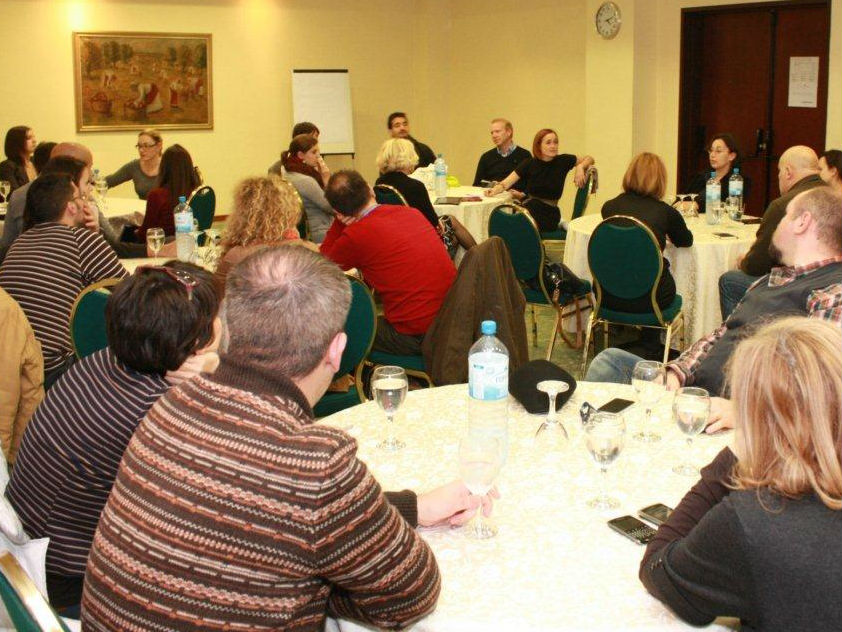
BIRN at TransConflict Breakfast on Transitional Justice

BIRN director Gordana Igric participated in TransConflict’s working breakfast on Tuesday, December 4,  together with Nemanja  Stjepanovic from SENSE agency,  on the challenges of  covering transitional justice issues in the former Yugoslavia.

Igric presented BIRN’s Balkan Transitional Justice initiative, which aims to improve public understanding of transitional justice in former Yugoslav countries through on-line news reports, radio programmes and a TV documentary to be released next year.

Both speakers agreed that the acquittals by the Hague Tribunal, ICTY, of Ante Gotovina and Mladen Markac of crimes against Serb civilians during the Croatian Army’s Operation “Oluja” [“Storm”], as well as the acquittal of Kosovo’s Ramus Haradinaj of war crimes against Serbs and non-Albanians during the Kosovo war, posed challenges when it comes to facing the past in the region.

Stjepanovic said that while the acquittal of Haradinaj was to be expected owing to the lack of fresh evidence on the part of the Hague prosecution, the EULEX mission in Kosovo and the Serbian government, the acquittal of the Croatian generals was more surprising as their indictment was supported with strong evidence.

Both speakers agreed that in both cases, the defence had been much more efficient than the prosecution.

Igric said that although the ICTY verdicts would surely affect relations between countries in the region, Serbia’s government remained determined to start membership talks with the EU.

The public saw the ICTY verdicts as backing the Croatian narrative about a defensive war, which Serbs saw as unfair, Igric noted.

TransConflict is a non-governmental organisation which undertakes conflict transformation projects and research, promoting an approach to – and understanding of – conflict that differs from traditional notions of conflict resolution.

Working breakfast – on the challenges of transitional justice in the former Yugoslavia – was organized as part of its project, ‘Understanding and combating extremism in Serbia’.

Serbia: Budget Process Fast, But Not Transparent

While Serbian officials adopted the state budget on time, the process lacked public input, participants in the Fourth National Budget Forum concluded on Monday.

At the forum, which was organised by BIRN and PRO CONCEPT, participants said the most significant progress made in Serbia’s budget process is prompt voting, but they lamented the lack of public participation.

The forum brought together over 100 representatives of ministries, members of parliament, civil society representatives and experts, representatives of embassies in Belgrade and local governments.

Vlajko Senić, State Secretary in the Ministry of Finance, said the budget is realistic, and added that in creating it, the Ministry considered the remarks of the Fiscal Council related to the improvement of budget control.

“The establishment of a quarterly expenditure control mechanism introduced tougher discipline and better transparency,” he said at the forum, which was held at the National Parliament.

Responding to the comment that there was no public debate before the vote on the budget, Senić said that a new government was formed in the final quarter of the budget season, and there was no time for wider public involvement in the decision-making process.

Vladimir Vučković, a member of the Fiscal Council, told participants he was pleased that the Ministry had acknowledged and adopted numerous comments made by the Council. He described the budget as realistic, while pointing to areas of risk on both the expenditure and the revenue sides.

“Non-tax revenue and income taxes have been overestimated in the projections, but it is still possible to reach the projections if the inflation rate increases,” Vucković said.

On the expenditure side the most important test for the Ministry of Finance will be to hold to planned salaries and not to succumb to social pressure and abandon the tight control of wages and earnings, he added.

Meanwhile Dimitri Boarov, a journalist from the weekly magazine “Vreme”, said he was pleased that the Ministry of Finance had adhered to the budget calendar and followed the advice of expert bodies, but noted that such steps do not bring about fundamental change to the process.

“It is almost certain that the budget will face major risks in implementation, primarily the risk of not maintaining levels of planned expenditures,” Boarov said.

Citizens budget

At the forum on Monday, BIRN and PRO CONCEPT presented the Citizens Guide to the State Budget, which was drafted by the two organisations.

The first manual of its kind in Serbia, the Citizens Guide was created with the aim of making the preparation, adoption and execution of the budget more accessible and more comprehensible to the public.

“We have forgotten about the citizens and the fact that the budget is actually in their interest. This guide is designed for citizens and is part of an effort to make it easier for them to actively engage in monitoring the budget, ” the guide’s creators told the forum.

The editor of the economic section of “Večernje Novosti”, Gordana Bulatovic, who represented the media at the public hearing, said that not only were citizens deprived of basic information related to the budget, but media outlets were also given inadequate information.

“The media can not find anything about hidden costs and how much money is given to each Ministry. For many subjects we have no counterparts in government. Reporting on the budget was reduced to tabloid newspaper and transfer of parliamentary replicas, while there was no analysis of the law and its impact on citizens,” said Bulatovic.

Kosovo and Serbia Talk “Live”

In an unprecedented public debate organized by Internews Kosova and BIRN, Edita Tahiri, Kosovo’s Chief Negotiator, and Serbia’s former Chief Negotiator, Borislav Stefanovic, have discussed the agreements they have reached during the EU moderated negotiations.

In their first public debate without the mediation of Robert Cooper, EU’s chief negotiator, Tahiri and Sefanovic recalled the most difficult moments of the 18-month long Brussels negotiations.
 
In the first ever edition of the series of regional TV debates called ‘Tema’(Topic), Tahiri and Stefanovic spoke about the challenges of reaching agreements in seven areas and elaborated on the problems encountered in implementing those agreements in the field.
 
The debate will be aired by privately owned national broadcasters, on Monday, December 3, at 10.30 pm on TV21 in Kosovo and on Thursday, December 6, at 9 pm on B92 INFO.
 
Since March 2011, the EU has been facilitating technical negotiations between Kosovo and Serbia, aimed at normalizing the relationship of Belgrade and Pristina.
 
So far, the two sides have reached deals on trade, mutual recognition of university diplomas, representation of Kosovo at regional meetings, freedom of movement including the Integrated Border Management, IBM.

The two negotiators engaged in polemics over what was exactly agreed especially on the issue of the ‘Integrated Border Management’ agreement reached by the two sides on December 2, 2011.
 
The former Chief Negotiator Borko Stefanovic, insists that Belgrade was provided with guarantees that some of the agreements reached are not applicable to the Serb-run north of Kosovo.
 
“We agreed that EULEX [EU Rule of Law Mission to Kosovo] has the executive role at the Jarinje and Brnjak border crossings,” Stefanovic said insisting that if this is not the case in the north, then “there will be no agreement,” as far as Serbia is concerned.
 
On the other hand, Kosovo’s former Chief Negotiator, Edita Tahiri, told Stefanovic that he misinformed his own parliament after the technical protocol was agreed upon.
 
This episode is the first in a series of several Kosovo-Serbia debates will be aired in both places.  
 
The aim of the debates is to break the communication barriers between Belgrade and Pristina and demystifies the process of negotiations.

View the trailer in Serbian

View the trailer in Albanian

Dijalog Kosova i Srbije “uživo“

U jedinstvenoj debati koju organizuju Internews Kosovo i BIRN, šefica pregovaračkog tima Kosova Edita Tahiri i bivši glavni pregovarač Srbije Borislav Stefanović pristali su da pred kamerama govore o dogovorima postignutim tokom pregovora vođenih pod posredstvom Evropske unije.

Dvoje političara prvi put razgovaraju bez posredstva glavnog pregovarača EU Roberta Kupera i prisećaju se najtežih trenutaka osamnaestomesečnih pregovora.

Debata će ove nedelje biti emitovana u ponedeljak, 3. decembra na TV21 na Kosovu, i u četvrtak, 6.decembra u 21h na B92 INFO.

U prvoj seriji regionalnih i televizijskih debata pod nazivom ‘Tema’, Tahiri i Stefanović govore o izazovima koje su imali u procesu postizanja sedam sporazuma i problemima sa kojima su se suočili u procesu implementacije ovih sporazuma na terenu.

Od marta 2011. pod pokroviteljstvom Evropske unije održava se tehnički dijalog između Kosova i Srbije koji za cilj ima normalizaciju odnosa dve strane. Do sada su postignuti sporazumi o slobodi trgovine, međusobnom priznavanju fakultetskih diploma, predstavljanju Kosova na regionalnim skupovima i o slobodi kretanja koja obuhvata i dogovor o integrisanom upravljanju prelazima.

Tokom razgovora uživo između Prištine i Beograda ova dva izaslanika ušla su u polemiku oko toga šta je tačno dogovoreno, naročito kada je u pitanju dogovor o integrisanom upravljanju granicama koji su dve strane postigle 2. decembra, 2011. godine.

Kada je u pitanju ova tema, bivši šef pregovaračkog tima Srbije Borko Stefanović insistira na tome da su Beogradu date garancije da neki od postignutih dogovora nisu primenljivi na severu Kosova.

“Dogovorili smo se da EULEX ima izvršnu ulogu u Jarinju i Brnjaku”, rekao je Stefanović insistirajući da, ako to nije tako na severu, onda, što se Srbije tiče, “neće biti nikakvog dogovora”.

S druge strane, pregovarač Edita Tahiri rekla je Stefanoviću da je on pogrešno informisao svoju skupštinu nakon što je postignut dogovor o tehničkom protokolu.

Ova epizoda je prva u nizu od nekoliko regionalnih debata između Kosova i Srbije koje će biti emitovane i na Kosovu i u Srbiji a koje imaju za cilj da demistkfikuju pregovarački proces i otvore u javnosti razgovor o temama važnim za obe strane.

BIRN Launches Book on Mladic in the Media

The Balkan Investigative Reporting Network, BIRN, of Bosnia and Herzegovina will launch its publication ‘Spotlight on Mladic: Villian or Celebrity?,’ on December 11 in Sarajevo. 

The publication contains an overview of the coverage of the arrest and the beginning of the trial of Ratko Mladic, who is charged with genocide and other crimes in Bosnia and Herzegovina, in the media in Bosnia and Herzegovina, Serbia and Croatia.

Monitoring focused on the highest-circulation dailies and weeklies in the three countries selected. 

The publication is co-authored by Christian Axboe Nilsen, Erna Mackic, Marija Ristic, Boris Pavelic and Selma Ucanbarlic, containing an introduction by Balkan Insight editor Marcus Tanner.

Speakers at the launch in the Atrium Hall of the Europa Hotel in Sarajevo will include Gordana Igric, the publication editor’s and BIRN Director, Sabina Wölkner, Director of the Konrad Adenauer Foundation in BiH, Erna Mackic, analyst and BIRN Justice Report editor and Christian Nilsen, historian, the author of the publication’s foreword

Implementation of the project was made possible with support from, and collaboration with, the Konrad Adenauer Foundation in Bosnia and Herzegovina.

BIRN, ProConcept Open National Budget Forum

BIRN Serbia and ProConcept will open the fourth annual National Budget Forum in Belgrade on Monday.

The two organisations will hold the forum on Monday, December 3 at 12.30pm in the small hall of the National Parliament.

Participants in this year’s forum will examine transparency in the budgeting process and control of budget execution.

Following an introductory debate, which will focus on the main budget policies and challenges that Serbia is likely to face in 2013, the Citizens Budget of the Republic of Serbia will be presented at working tables. Forum participants will then take part in a second debate that will focus on possibilities for greater control of the budget’s execution by the Serbian Parliament Finance Committee.

Senior officials from the Finance Ministry, Fiscal Council and National Parliament will take part in the debates, as well as experts from the community.

This annual event, now in its fourth year, is traditionally the final debate on budget priorities and models for improving the budgeting process.

Simultaneous translation from Serbian to English will be provided by the organisers.

For more information please contact Ms. Lada Vučenović at 060 3 1985 21 or [email protected].

First Culture Watch Award Goes to Vranje

The first ever Culture Watch Award for analytical and investigative reporting on cultural issues in the Balkans went to Valentina Milenkovic from Vranje.

Gordana Igric, Valentina Milenkovic

The award organised by Balkan Investigative Reporting Network (BIRN) and SeeCult.org was presented at the regional conference “What is (to be) Done” that took place on November 28 in Dom Omladine in Belgrade.

The jury, consisting of six cultural experts and an internationally awarded journalist, gave the first prize to Valentina Milenkovic, a journalist at “Vranjske” weekly magazine, for her complex investigative piece “How does government entertain people”.

Milenkovic investigated the funding of the cultural event “Cultural-touristic manifestation” in the municipality of Vranje in Serbia over the period of three years.

“For all that time they can only show four or five contracts that prove how the money was spent. Over 50 participants, some of them really famous Serbian singers, took part in the event,” said Milenkovic at the award ceremony.

“This is my first award in 13 years-long journalistic career, and therefore this is very important to me,” she added.

The second prize was awarded to Gordana Popovic from the daily newspaper Politika for her article “Serbia and the EU  – Culture and Candidature” about the reaction from the Serbian officials after the country obtained the EU candidate status.

“I talked to numerous officials and it was really interesting to confront opinions of two different sides in Serbia,” said Popovic.

The third prize went to Pristina to Vullnet Krasniqui, a journalist from the daily newspaper Koha Ditore for the article: “Kosovo authorities risk loosing some clay figures of Kosovar origin”.

Article by Bosnian journalist Irfan Hosic “Departures as a Rule” published in the “Dani” weekly magazine, was given the fourth prize.

“It is an honour for me to receive this award especially for my analysis of art scene in Bosnia and Herzegovina and the emigration of the artist from the country,” said Hosic.

The Balkan Initiative for Cultural Cooperation Exchange and Development, BICCED, envisages the Culture Watch Award was envisaged as a step towards strengthening the analytical and investigative approach to cultural issues.

The BICCED board decided on Tuesday that the award would become an annual event. This year’s awards were supported by the Swiss Cultural Programme for the Western Balkans (SCP).

Final BICCED Culture Conference in Belgrade

The closing event of the three-year project “Balkan Initiative for Cultural Cooperation, Exchange and Development”, BICCED, started on Thursday in Belgrade’s Youth Centre.

At the conference “Balkan Cultural Policies – What Is (to be) Done”, culture experts and speakers from the region review the cultural policies implemented in the Balkans over the past three years based on more than 300 analytical pieces produced as part of the project.

BIRN’s regional director Gordana Igric opened the conference by saying that BICCED has raised interest among the journalists and that now after three years there are 50 journalists in the group from the region that are interested in cultural polices.

“We have planted a seed and all should know that cultural policy is important because it reflex national identities in the Balkans but also financial power of the states themselves”.

The director of SEEcult.org and project partner Vesna Milosavljevic explained that the name of the conference is taken over revolutionary novel by Nikolay Chernyshevsky -What Is to Be Done? “This is an open call for all of us to think what should be done, so the situation in the cultural field would have change.”

“For three years BICCED journalists achieved much in realising the context of cultural polices in the Balkans. With the help of the experts and cultural workers journalists have managed to analyse and investigate topics that weren’t in the focus of the society. The articles dealt with laws on culture and its influence on various areas of arts. More than 300 hundred pieces were produced”,  said Nemanja Cabric, BIRN Culture Watch project coordinator.

BICCED has aimed to map the main problems and tendencies in the field of culture in Albania, Bosnia and Herzegovina, Kosovo, Macedonia and Serbia, and to present them to decision-makers and the public, thus contributing to finding solutions for problems and initiating needed reforms.

BICCED was implemented by the Balkan Investigative Regional Reporting Network, BIRN, and by SEEcult.org, and was funded by the Swiss Cultural Programme in the Western Balkans (SCP).

The conference brings together representatives of cultural institutions and media from the region, including journalists trained during the project.

In the first part of the conference Jelena Knežević, executive director of BITEF from Belgrade; Lutfi Dervishi, executive director of Transparency International in Albania and media lecturer at the University in Tirana; Nihad Kreševljaković, director of SARTR theatre from Sarajevo; and Robert Alagjozovski, independent cultural consultant, art and culture critic from Skopje, gave an overview of cultural policies in the region and the main problems faced by cultural organisations and institutions over the past three years.

In the afternoon session, the focus of the work during three panel discussions will be on the financial crisis and its consequences, new networks and initiatives in independent cultural scenes and the lack of space for culture in the media and possibilities for improving this situation.

Panelists and participants in the event include Lola Joksimović (Cultural Contact Point Serbia, Belgrade), Amila Ramović (Ars Aevi, Sarajevo), Josif Papagjoni (Center for Art Studies, Tirana), Dimitrije Vujadinović (Balkankult Foundation, Belgrade), Sašo Stanojković (artist, Skopje), Albert Heta (Stacion – Center for Contemporary Arts, Pristina), Milica Pekić (Kiosk/Kooperativa, Belgrade), Darka Radosavljević Vasiljević (Remont/ Independent Culture Scene of Serbia, Belgrade), Iskra Gešoska (Kontrapunkt/Jadro Assotiation, Skopje), Dražen Crnomat (UNSA Geto, Banja Luka), Marija Đorđević (Politika, Beograd), Janja Sesar (Kurziv/Kulturpunkt, Zagreb), Jasmin Duraković (Depo.ba, Sarajevo), Nebojša Ilijevski (Center for Media Activities, Skopje), Ben Andoni (Gazeta Shiptare, Tirana) and Nataša Novaković (blogger, Banja Luka).

The sessions will be moderated by Aleksandar Brkić (University of Arts, Belgrade), Gordana Igrić (BIRN) and Vesna Milosavljević (SEEcult.org), and will be followed by questions from the floor and discussion.

The conclusions of the conference and its panel discussions will be used for a common appeal and recommendation letter to all decision-makers and other relevant stakeholders in the region, as well as for the BICCED project follow up.

The end of the conference will include a presentation of the Culture Watch Award, established by the BICCED project with the aim of promoting an investigative and analytical approach to journalism in culture.

Raska Residents for Good Governance

The municipality of Raška has joined the “Participatory Budgeting” project by means of a street event organised by BIRN Serbia under the initiative for the promotion of good governance.

On Saturday, November 24, over 200 residents of the municipality of Raška filled in questionnaires at a street event aimed at informing the people better about the budgeting process, principles of good governance and including the local community in the process of defining budget priorities.

This was the first time people were given an opportunity to declare themselves regarding municipal priorities in the field of capital investments. The municipality offered six projects and the people were asked to select the three that they see as most important.

Following the street event a special booth was placed at the municipal Assistance Centre where people will have a chance to fill in questionnaires until the adoption of the budget and thus give additional recommendations to the government regarding what needs to be done first in the course of next year.

Organised further under this program in the municipality of Raska will be a Local Budget Forum at which the results of the poll will be presented along with the 2013 municipal budget.

The event is a part of the Participatory Budgeting Project and a continuation of the “I Want To Because I Live Here” campaign that BIRN is carrying out with the support of the EU Progres Program of assistance to municipalities in Southwest and Southeast Serbia.

The project of implementing the practice of participatory budgeting at the local level through the European Partnership Programme with EU PROGRES municipalities in 25 municipalities in the south and southwest Serbia is supported by the European Union, the Swiss and the Serbian government.

Balkan Fellowship Alumni Meet in Macedonia

The Balkan Fellowship for Journalistic Excellence has gathered 35 alumni from nine countries of the region in the Macedonian capital Skopje.

The award ceremony, honouring the work of the 2012 fellows, was held on Friday, November 23.

This year’s winners are Sorana Stanescu, Saska Cvetkovska and Aleksandra Bogdani.

“I will never forget the feeling when I was awarded, it was really special moment for me,” said Majlinda Aliu who won the first place in 2011 for her story about the Balkan war widows.

On Saturday the alumni had an opportunity to see the newly revamped Skopje. They were taken for a guided tour to see dozen new buildings and numerous monuments and sculptures, new bridges as well as hear about the controversies related to the costly project that has now put Macedonia on the tourist map.

The alumni also attended a panel with Roberto Belicanec of the Media Development Centre and Xhabir Deralla from the NGO Civil and a discussion about the current political situation in Macedonia, the deteriorating state of media and freedom of speech as well as the fragile inter- ethnic relations.

“I did not know much about the situation in Macedonia before, but now I am inspired to come back here with the TV crew and make a piece about it,” said Jelena Kulidzan, a journalist and editor from Montenegro, awarded with the second price in 2011
programme.

The same day, the group discussed future alumni activities and models of cooperation, including the joint regional reporting projects.

“It is great seeing all of us together, this network is the biggest asset of the programme and I really enjoy being in touch with the likeminded group of professionals,” said Nenad Radicevic, a fellow from 2007.

The idea to hold annual alumni meetings came about as a result of interest by former fellows to continue to jointly contribute to the goal of promoting excellence in journalism in the Balkans.

The alumni initiative is supported by Erste Stiftung and the Robert Bosch Foundation, in cooperation with the Balkan Investigative Reporting Network.