Arguing and noise in Ferizaj

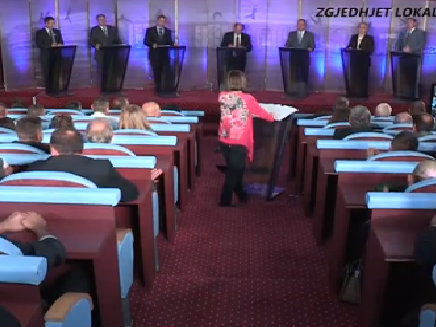
The debate program “Life in Kosovo” held on Wednesday, in Ferizaj, was with a lot of ado including arguments. Agim Aliu’s supporters cheered like they were in a stadium, causing the reaction of other candidates’ supporters.

The current mayor of Ferizaj, Agim Aliu, said he will withdraw from the race if proven he has misused public money during his term of 16 months.

Bashkim Fazliu from the Civic Initiative for Ferizaj replied by accusing the mayor of misusing millions of Euros and called the Ferizaj Municipality a champion in lawbreaking.

The debate held at the Ferizaj theatre, “Adriana Abdullahu,” served as an arena for supporters of candidates, especially between PDK and Vetevendosje supporters.

Ali’s government was heavily criticized by AAK’s candidate, Xhavit Zariqi, and Bashkim Fazliu from the Civic Initiative. Both of them were previously members of the PDK.

Bashkim Fazliu left PDK in April last year, while Zariqi left the party after 10 years. PDK was founded in October 1999.

Ferizaj is third biggest town in Kosovo with 108,000 residents and its municipality budget for next year will be worth 23 million Euros.

Citizens owe 6.5 million euro in municipal property tax. The candidates were asked how they would collect these debts.

While Agim Aliu said his administration started collecting this debt, while rest of the candidates gave only theoretical answers regarding the property tax debt.

Agim Aliu was asked again whether the real mayor behind the scene is Elmi Reçica, member of the parliament. Ali replied by saying he runs the house, but claimed Reçica helps him coordinate relations with central institutions.

Director of Economy and Finance in Ferizaj Municipality, Mustafe Grainca, explained to BIRN during the summer that capital investment of the Ministry of Infrastructure worth 3.5 million Euros, was made  possible thanks to the commitment of Mayor Ali and MP Recica.

Hysen Ibrahimi from AKR was asked about the road to his house, which was paved.

Hyseni,  head of the municipal department of Economic Development from 2007 to 2010, while his party was in coalition with the PDK, said the road pavement ends right in front of his house because it is the last house in the neighborhood and it was commissioned by the Ministry of Transport.

Muharram Svarqa, LDK mayoral candidate, was asked to explain why he always mentioned bribery during his electoral rallies. Svarqa said everyone knows that in order to win a public bid you have to pay ten percent of its value. He said he would fight this phenomenon within 24 hours if elected.

The candidate of the Partia e Drejtesise (Justice Party) was asked whether he knows the city well enough since he hasn’t lived in Ferizaj since 2001. Ardian Sejdiu said he knows the city enough to govern with it.

Xhavit Zariqi, AAK’s mayoral candidate, former member of PDK, was asked whether he is going to change his political party again. Zariqi replied that’s not necessary since he is going to win the race.

Hysen Ibrahimi from AKR did not feel great when asked about an illegal building built in Ferizaj by the Deputy Minister of Economic Development, a member of his party. Hyseni said there is no indictment against any of his party officials.

Svarqa said it is time to change the image of the politician faces criminal trials,  flees  from justice abroad and leads campaigns from prison.  Fazliu said he entered the race to bring the light that’s at the end of the tunnel.

Illegal buildings, gas stations inside in residential areas, illegal landfills and other disturbing phenomena were part of the debate.

There are around 1300 illegal buildings and numerous gas stations inside residential areas.

Mayor Agim Aliu had to explain once again why he cut 50 trees, planted in the city center, to make space for construction. He said it was a legitimate action, but his opponents reacted strongly considering unilateral action of the mayor.

Fazliu filed charges against Aliu for cutting these trees.

AKR’s candidate, Ibrahim Hyseni, part of the ruling coalition in the municipality, said LDK and AAK voted the draft regulation for town’s center. Candidates of the opposition parties in Ferizaj municipal assembly said the project did not include cutting of the trees.

Vetevendosje’s candidate, Faton Topalli, said the construction in the city center started on June 15 and should have finished within 48 days, in early August. Work is still continuing as of late October.

Gazeta Jeta ne Kosove investigated capital projects of the local government and concluded that most of them exceeded the budget limits and were delayed.

Some family members of Ferizaj candidates agreed to talk about their families. The wives of the AKR and PDK candidates said they keep the money their husbands make.

Water for votes in Drenas

Drenas mayoral candidates promised access to running water to a large number of residents, as only 10 percent of its citizens have access to the network. The current mayor of the Drenas municipality, Nexhat Demaku is running against Izet Abdyli from LDK, Rifat Demaku from Vetevendosje and Shaban Hasi from AAK. The candidates attacked one another during the debate.

Jeta Xharra, host of “Life in Kosovo,” asked Demaku the same question three times without receiving an answer.

The question was simple: What message would you like to give to people who have manipulated votes in previous elections?

He said, “All manipulated votes not only the PDK”.

Former U.S. Ambassador to Kosovo, Christopher Dell, said during the 2010 local elections  that  “industrial theft of votes” took place, while most of the irregularities were reported in Drenas and Skenderaj.

Tough questions were addressed to other candidates by citizens, BIRN and GAP researchers.

Shaban Hasi, AAK’s candidate, was asked why he was arrested in Switzerland in 2008 for misuse of disability pension –  to which he responded by saying that he was a suspect but everything got cleared up.

Rifat Demaku from Vetevendosje  was asked why he doesn’t carry the Albanian flag on his suit like the rest of the members of his party –  to which he responded by saying “I carry the flag in my heart.”

Izzet Ibrahim from the Civic Initiative for Drenas was asked about a shopping mall he built during his time as Mayor of Drenas in 2000-2002, which is considered a failed project.

Ibrahim said the mall only needs to be put into operation.

People were interested to hear more regarding the water supply, as only 10 percent of Drenas residents have access to the public water network.

Candidates promised that they will solve this problem during the next four years if elected.

All candidates gave various solutions, mostly theoretical, to problems Drenas people face every day.

The debate continued with arguments on various issues.

Residents mentioned rock quarries that threaten their lives, while the c Demaku said he will continue to improve sanitation and water supply network.

All but the LDK’s candidate agreed for their families to be interviewed.


Suspected law-breakers among mayoral candidates in Dragash

There are eight candidates running for the mayor of Dragash. Among them are those charged with the misuse of their official position and  tax evasion.

The candidates accused the current mayor of Dragash of corruption, misuse of official position and bad management of the municipality. Meanwhile, the current mayor and PDK’s mayoral candidate, Salim Januzaj, tried to fight these accusations.

All but one candidate for mayor took part in the debate. Safet Kushi from the Bosnian Initiative CDU did not participate.

Other candidates were: Bledi Kurtishi from VETVENDOSJE, Fatmir Mehmeti from LDK, Nexhat Isufi from Democratic Union, Nuhi Tairovci from VAKAT, Salim Jonuzi from PDK, Selami Sait from AAK and Nevxhet Tahiri from the National Front.

In the first two minutes, candidates unveiled their municipality programs, in which all promised to improve issues with the supply of running water, infrastructure, state of education and tourism development, but failed to explain the financing of these promises.

The disagreements were mainly among LDK, National Front, Democratic Union and the PDK candidates, while Nuhia Tairovci from VAKAT was more or less silent.

A business center full of garbage

Salim Januzaj, from PDK, praised himself for building the business center in Dragash, but remained speechless when the host of the program reminded him that the center was filled with garbage. He failed to provide an answer when asked about the removal of the garbage.

Fatmir Mehmeti of LDK, said Salim Januzaj has in fact created another illegal landfill by building the business center; there is a total of 20 illegal landfills in Dragash.

The National Front candidate admitted his wrongdoing when admitting to not paying his parking tax since. His reasoning behind this is the continuous disagreement with the town’s municipal current government. Xhevxhet Tahiri has been failing to pay parking tax for ten years now.

Salim Jonuzi was once again humiliated when asked whether his morals allow him to run for another mayoral mandate knowing he has been charged with the abuse of power.

Jonuzi declared not guilty to the charges.

Furthermore, the National Front candidate admitted he doesn’t pay the property tax either, hence failed to explain how he would collect the huge property tax debts of Dragash citizens.

Tahiri promised to pay his debt if elected mayor.

Selami Saiti from AAK stated he aided fellow citizens to bypass queues in the Prizreni hospital.
He works at the Radiology Department of the Daut Mustafa Hospital in Prizren.

The debate touched upon other issues, such as violence in schools of Dragash and low participation of women in education and employment. All candidates promised to work these issues.

Pulitzer Prize-Winner Leads BIRN Training in Macedonia

The Pulitzer Prize-winning US journalist and editor, John Ullmann, was the key trainer at BIRN’s investigative journalism training session in Berovo, eastern Macedonia, at the weekend.

Fourteen Macedonian journalists spent the weekend sharpening their investigative reporting skills and gaining insights into ways of gathering and managing information and writing up their stories.

Thoughts were also shared on journalistic research methods and ethics.

Ullmann praised journalists in countries like Macedonia who pursued their stories despite pressure on them to stop.

“I have nothing but admiration for any journalists anywhere who continue to try to do what’s right against the pressure that exists to keep them from doing it,” Ullmann told BIRN.

“I am sure there are many more journalists who care about the craft of journalism and about doing it right, the best they can, and I just hope they’ll keep at it,” he said.

Ullmann, 68, was the first executive director of Investigative Reporters and Editors, IRE, an international network of journalists, and started most of its programmes during his six years there, including The IRE Journal, its database, and other projects.

Projects that he supervised have won more than four dozen awards, including the 1990 Pulitzer Prize for investigative reporting. Two other stories that he worked on were Pulitzer finalists in other categories.

Speaking about the importance of journalism in a democracy, Ullmann said that it was crucial to hold those in power accountable for their actions and to boost public debate on important issues.

“There is not a single example that I am aware of in the world today where democracy works well without a strong free press. And those in power, who have the ability to quash it, must realise that those journalists are playing an important role, even when they do something ‘I don’t like’,” Ullman said.

“I am sure that President Obama probably has a whole list of journalists he would like to ship over here and not have to put up with anymore for the rest of his life,” Ullmann continued.

“But he knows he does not have that kind of power. Nor does he wage economic war on them, nor does he come around and try to get them fired from their jobs, or any kind of thing that sometimes happens in Macedonia,” he said.

As part of the training, journalists also heard a lecture on public information access from German Filkov, the co-founder of the Macedonian NGO Centre for Civil Communications, one of the leading anti-corruption NGOs in the country.

Filkov is an analyst and researcher in anti-corruption work and institutional transparency and has trained more than 250 journalists in investigative journalism and reporting on corruption.

The participants also picked up useful tips on how to pitch a story from Ana Petruseva, BIRN’s Macedonia country director and Balkan Insight’s managing editor.

The training, aimed at empowering Macedonian journalists with key investigative reporting skills, is part of BIRN’s ‘Project for Investigative Journalism and Cooperation Between Media and Civil Society’, part of a USAID programme for strengthening independent media in Macedonia.

Electoral debate: Klina

Three out of seven candidates vying to be the mayor of Klina, among which the current mayor Sokol Bashota, have received apartments built from the Municipality. However, Fadil Gashi (LDK) and Enver Berisha (AAK), beneficiaries of these pricey gifts, engaged in fierce discussion with Bashota during the “Life in Kosovo” debate. One of the candidates, Prend Buzhala (PShDK) and the incumbent mayor Bashota did not allow their families to provide short profiles for them, because, according to them, they did not want to politicize their families.

The candidates running for the mayor of this municipality are Sokol Bashota (PDK), Fadil Gashi (LDK), Hajzer Idrizi (LVV), Enver Berisha (AAK), Avni Gashi (AKR), Prend Buzhala (PShDK) and FIlip Berisha (PDI)
The current mayor and Bashota inaugurated the new water factory and the building of the culture centre during the electoral campaign.

Challenged by host Jeta Xharra, on the reasons why they were inaugurated during the campaign, Bashota said that the project were completed during his mandate, although he has made this electoral pledge for two years now.

The 2013 municipal report of the GAP Institute reveals that Klina, with six rivers flowing in its territory has only 23 per cent of its population connected to the public water supply network.

The new water factory will be ready in February 2014, although the municipality has failed to pay its debt of around 300,000 euro to few Dutch and Kosovar construction companies, which has become an obstacle in launching the plant.

During the debate, Bashota said that he had paid the last installment of his debt two days ago, adding that in ten-days time citizens of Klina will have plenty of drinking water.

Klina does not have a Culture Centre, and nor does it have a library. Most of the candidates promised that they will accommodate a library inside the new building of the Culture House. Klina has an overpopulated kindergarten, where the number of children is well above fifty.

The 2013 municipal report from Gap Institute notes that the municipality of Klina has spent more money on the maintenance of cars then on the maintenance of schools, with mayor Bashota’s 67,000 euro Range Rover being one of them.

Filip Berisha (PDI) pledged that the municipality would have only three departments, should he come to power. This model of governance, according to him, was a European one. At the moment, Klina has six municipal departments, renowned for their large spending of public money.

Prend Buzhala (PShDK) was challenged for his political turns he had made in his career, switching between three political parties before. Buzhala said that even the English politician Winston Churchill has changed three parties, but not his principles, claiming that the same is true for himself.

The Vetevendosje candidate, Hajzer Idrizi, answered a question about the equipment in the Youth Centre after it closed down. Idrizi said that all the equipment belonging to the said centre were there and that nobody has touched them.

Enver Berisha (AAK), running for multiple times for this political party, spoke about the reasons why he still is the candidate for the AAK. Berisha said that he would have been the winner of previous elections, had the process not been manipulated, and that is why he enjoys the faith of his political party to run again for Klina. He said that Bashota’s victory in previous elections was embarrassing.

In the meantime, Bashota labeled Berisha from AAK and Gashi from LDK as “veterans of losing”, warning them that the same will happened again during the November 3 elections.
 

Electoral debate: Kacanik

Most of the 23 palm trees planted in Kacanik in 2011, at the time when the municipality was led by now-fugitive Xhabir Zharku, have dried out, whereas the candidates vying for mayor of Kacanik, have agreed that the project was a failure.

Kacanik’s palm trees, planted alongside river Nerodime in 2011, heated the debate between the candidates vying for the mayor of this municipality. Most candidates said that the project was a failed one because most of the trees are dried out because of lack of maintenance.

It was only Selim Reka (LDK) who had a milder approach the palm tree project, noting that the project has been partially successful, bearing in mind that some of the trees are still healthy because cafe owners take care of them.

Apart from Reka, the following are also vying for the mayor of Kacanik: Besim Ilazi (PDK), Afide Kuka (LVV) Avni Tafili (Justice Party), Bardhyl Mjaku (AKR), and Tahit Caka (AAK).

Caka who came second during the extraordinary elections in 2012, was not present in the “Life in Kosovo” debate. According to the AAK branch in Kacanik, Caka was on an official trip abroad.

Bardhyl Mjaku (AKR) has admitted to have been an internet service provider and “dreambox” dealer, which are illegal in Kosovo, since they steal TV channels from other platforms with special satellite devices. Despite this illegal activity, he promised that should he be elected a mayor, he will not breach the law again.

The main problems faced by Kacanik citizens are the water supply, sewage system, road infrastructure, for which the Ilazi from PDK promised improvements.

Candidates running for mayor of Kacanik have promised progress in agriculture, the fight against corruption, as well as investment in healthcare and education.

Electoral debate: Gjakove

Five candidates from different political parties running for mayor of Gjakova were confronted with various municipal issues at the debate held by BIRN KOsovo. Candidates aiming for Mayor Pal Lekaj’s position mainly accused him of not fulfilling his promises, although this did not stop Lekaj to once again promising his citizens a better life.

Apart from the current mayor of the Gjakova municipality, Lekaj from AAK, who is running to secure another term, the candidates include Luan Gola from LDK, Hajdar Beqa from PDK, Arberie Nagavci of Vetevendosje and Mimoza Kusari-Lila from AKR.

Gjakova municipality is the only municipality to have two female candidates running for mayor.
During the debate the candidates of AKR, LVV and LDK criticized Lekaj’s current government in Gjakova. The PDK candidate, however, tried to attract voters by bringing up the Prime Minister and the Government of Kosovo, as if the elections were national and not local.

Once again Pal Lekaj from AAK and Mimoza Kusari-Lila from AKR are facing each other in the race for Gjakova. In their last confrontation, in the 2009 elections, Lekaj arose as the winner.

Both parties were confronted about the employment issue. Lekaj, who won the elections four years ago, had promised seven to eight thousand jobs. He apologized for failing to fulfill this promise, however promised he would achieve it during the next term.

Kusari-Lila avoided talking directly about the employment issue by tackling the infrastructure development of the town.

LDK’s Gola could not explain why his party keeps on losing votes in Gjakova, securing only 1,000 in the 2009 elections.

Gola reasoned that he does not know why the LDK has lost support since he was not a member of the governing structures of LDK in Gjakova before.

Beqa from PDK was asked why he, as the executive chief of the Iber-Lepenc public company, employed his wife. Not managing to answer the question, he also failed to recall even when he got married. Likewise he failed to give an answer as to why he employed Adem Grabovci’s wife, another member of PDK, at Iber-Lepenc.

Arberie Nagavci from Vetevendosje was asked by Gjakova citizens and investigative researchers of BIRN why she spent more time on trainings than in the elementary school, Yll Morina, where she was the headmistress.

She said such allegations come from slandering members of the ruling party – AAK, because, according to her, many people from school’s staff are members of this party.

Nagavci praised her time as the headmistress of the school, saying to saw that many projects were completed at the school.

Part of the debate was concerned Lekaj’s attempt to repair Gjakova’s Old Bazaar by replacing old cobblestones with flat stone tiles from Gllareva. The project was considered harmful to the cultural heritage and halted by the Ministry of Culture.

Nagavci from LVV accused the mayor Lekaj of selling old cobblestones or giving them to private people to pave their gardens. Lekaj denied such accusations, and was again accused once more by his opponents of undermining the economic development of the Old Bazaar.

Lekaj was criticized for giving out tenders without following necessary procedures. Gola from LDK, also criticized the mayor of Gjakova for not presenting the 1 million-euro worth project for reparation of the Old Bazaar to the town’s municipal assembly.

Mimoza Kusari-Lila spoke out about the current property situation, stating that four municipal officials have benefited from the publically owned properties.

Each of the candidates spoke about fixing roads and the lack of building permits, while Lekaj took criticism for the recycling system, which has not been completed.

In addition to the above, all candidates promised the citizens of Gjakova once again that they will pay more devotion to sports, running water, health, economic development and employment.

Electoral debate: Prizren

In the BIRN electoral debate held in the House of Culture in Prizren, citizens heard the promises made by seven candidates on how they will overcome the problems of this municipality. The candidates spoke about the degradation of the historical zone of Prizren, including the construction of over 100 buildings after the law on the Historical Centre was approved, the lack of water, insufficient parking and others.

In the first two minutes that each candidate used to talk broadly about their political offer, all of them emphasized the importance of having economic development as a main priority.

Arber Rexhaj, Vetevendosje’s candidate said that economic development will be achieved through investments in culture and tourism while he promised to also invest in agriculture. Kosovo’s Conservative Party’s candidate said that his party has a master plan for economic development through the creation of an industrial zone of 200,000 hectares. Eqrem Kryeziu from LDK spent his first minutes criticizing the current government but did not provide any alternatives of his own on how to resolve the problems. The current Mayor, who comes from PDK, Ramadan Muja did not take part in the debate while Eqrem Kryeziu, a former mayor of Prizren promised sufficient drinking water for all citizens.

These debates were also characterized by the portrayals of candidates made by their wives, with one telling what an enthusiastic reader her husband is or others praising their husband for being good at house chores and helping them out.

Electoral debate: Mitrovice

In Mitrovica’s electoral debate, seven candidates were in front of Jeta Xharra and the public while confronting one another harshly but not providing any solutions to the citizens’ problems. The audience in the hall was very noisy and affected the length of the programme, while the audience more sounded like football fans than voters who had come to listen to those who may run their municipality after November 3.

Vying to run Mitrovica, apart from Avni Kastrati, are Agrim Bahtiri, of AKR, Mehdi Jonuzi of, LDK, Faruk Mujka, of Vetevendosje and Nexhmedin Spahiu, of the Independents of Mitrovica, Shaban Dragaj, of AAK-LDD and Vesel Neziri, of the Justice Party.

AKR’s Bahtiri promised jobs and the revitalization of Trepca, Kastrati from PDK promised to make Mitrovica a city for youth and sports, LDK’s Januzi promised to solve the urbanistic chaos, independent candidate Spahiu promised a three-point programme of freedom, economic freedom and fighting against crime.

Vetevendosje’s Mujka said that he would convert Mitrovica into a free city, with rule of law and more jobs available while Dragaj of the AAK-LDD coalition said his government would be characterized by honesty, safety and professionalism, while the Justice Party’s Neziri, promised a an administration grounded by the nation, religion and the state.

The debate became even more interesting with the stories family members told about the candidates, with Kastrati’s wife saying that her husband wants to be remembered by the good deeds he has done as Mayor of Mitrovica and the mother of Agim Bahtiri saying that they live a very good life and she doesn’t want money earned indecently to be brought home. The Vetevendosje candidate’s wife praised her husband for speaking five languages, while Nexhmedin Spahiu’s mother said that her son is very smart and has taken part in many quizzes as a kid. Mehdi Jonuzi’s wife said that she doesn’t like the fact that her husband has started to drive very fast lately, while Vesel Neziri’s wife said that she leads a very happy life with her husband.

Electoral debate: Podujeve

In BIRN’s electoral debate on Podujeve, four out of six candidates for Mayor of Podujeva are former members of the KLA, now spread across four different political parties, two of them even being deputy ministers in the central government. Out of them, four actually live in Prishtina but are running for mayor of Podujeve. Apart from the current mayor, Agim Veliu, of LDK, the vote of Podujeve’s citizens is being sought by Ismet Abdullahu, of AAK, Ismet Ibishi, of AKR, Naim Fetahu, of PDK, Nexhat Llumnica, of Levizja per Bashkim and Xhemshit Vokrri of Vetevendosje.

The debate revealed that the current mayor, Agim Veliu, the deputy-mayor travel from Prishtina to work in Podujeve every day, with an official car of the municipality that goes to pick Veliu up in Prishtina every morning and takes him back there after work each day.

Both deputy-ministers Ismet Ibishi from AKR and Naim Fetahu of PDK, travel to Podujeve for electoral purposes with official cars due to them living in Prishtina, and while Ibishi said that he would travel to Podujeve everyday but live in Prishtina, Fetahu promised to move for good to Podujeve if he gets elected. The only candidate that doesn’t own a car but travels with public transportation, is that of Vetevendosje, Vokrri.

Promises that were made ranged from effective governance, agriculture, quality education, tourism development, and cleaning of the Llap river.

Apart from Veliu, all candidates promised to depoliticize the sector of education, while Llumnica promised to build a school in Halabak, and Abdullahu promised to reinforce even stricter criteria on the employment on the education sector.

Almost all candidates promised about 1 million euro to be invested in agriculture, but they were reminded by current Mayor Veliu that the budget for 2014 has already been approved and it foresees only 300,000 euros for agriculture.

The candidates promised investments in sports, with PDK’s Fetahu promising to raise the budget for sports by 200 per cent, while other candidates promised to build a stadium.