Call for Applications: Financial Support for the Production of Quality, Engaging and Innovative Content for Western Balkans Media Outlets and Journalists

The project Western Balkan Media for Change opens a call for the financial support of individuals, media outlets, associations and other organisations from the Western Balkans through its grants.

The grants are intended to support well-defined innovative projects, actions and initiatives that go beyond regular operations – but not to finance regular operations.

The call aims to support projects focused on quality, engaging and innovative content production, local and regional collaboration, professional development, internships, networking, mobility, and validation of business ideas. Specifically, six priority areas fall into this call:

  1. Validation of a business idea
  2. Content production through learning, mobility or collaboration
  3. Strengthening public broadcasting service content and audience reach
  4. Audience development and engagement
  5. Networking support
  6. Promoting quality professional and ethical journalism

Project activities should be implemented in the Western Balkans: Albania, Bosnia and Herzegovina, Kosovo, Montenegro, North Macedonia and Serbia. Their duration could range from one (1) month up to a maximum of six (6) months.

This call is open until December 31, 2024, at 24.00. Applicants may submit application(s) throughout this period.

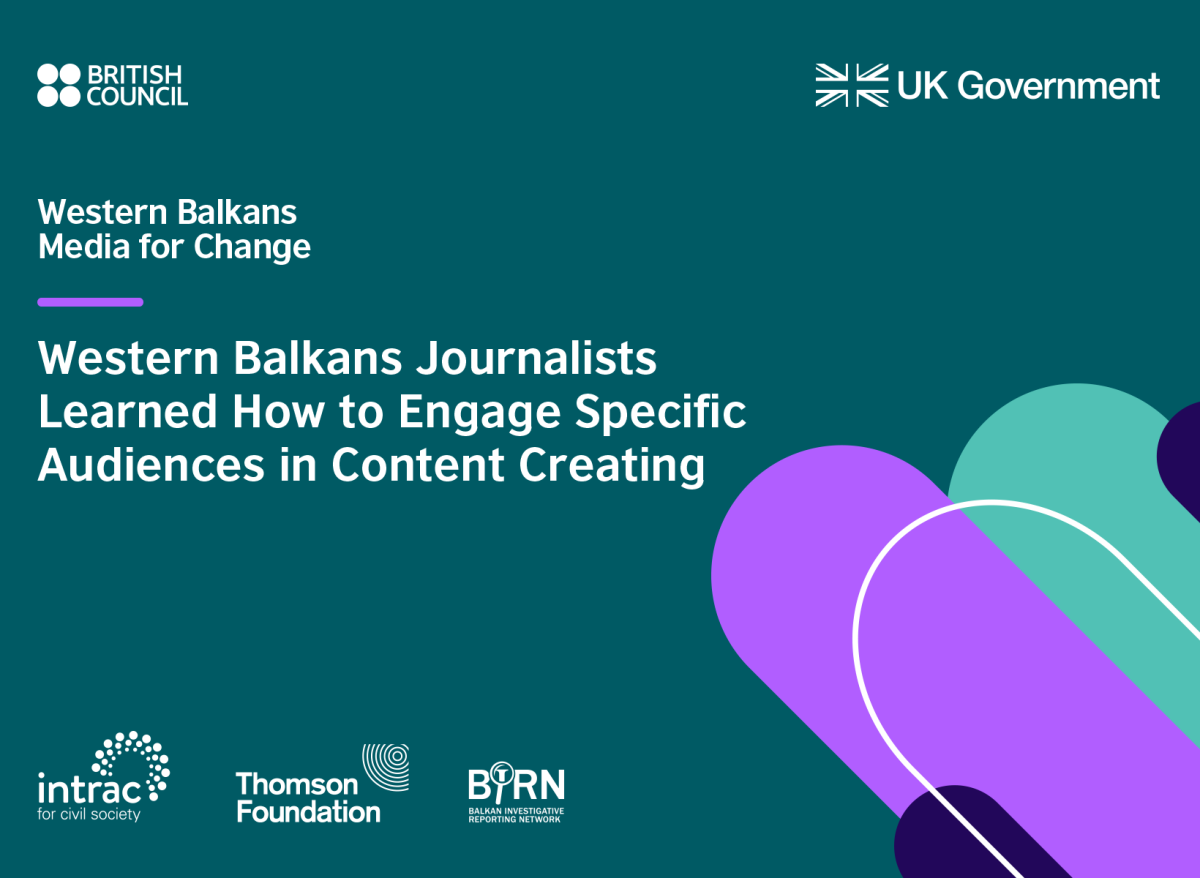
The Western Balkans Media for Change project is funded by the UK Government and implemented by the British Council in partnership with the Balkan Investigative Reporting Network (BIRN), Thomson Foundation (TF), and The International NGO Training and Research Centre (INTRAC). It supports the work of media outlets and individual journalists from the Western Balkan countries.

The project aims to help them improve operational capacity, business sustainability and innovation potential, while aiming to equip media professionals to produce more quality diverse, factchecked and gender sensitive content that will reach and engage with wider audiences.

More information about the call and how to apply can be found here.

Neil Arun

Neil joined BIRN in 2019 as an editor.

He edits the Fellowship for Journalistic Excellence, BIRN’s annual bursary for long-form journalism. He previously worked for the BBC News website’s world desk, and for flagship BBC radio and TV programmes.

He also spent two years in Iraq as an editor on media development programmes. His reporting from Iraq, the Balkans and the Caucasus has been published by the Financial Times Magazine, Vanity Fair, Monocle and BBC News. He graduated in English Literature from Cambridge University.

Svetoslav Todorov

Svetoslav Todorov joined BIRN Hub as a Balkan Insight’s Bulgaria correspondent in 2020, right before the onset of the pandemic and the beginning of the anti-government protest wave in Bulgaria.

The increase of disinformation in Bulgaria amid the Russian invasion of Ukraine and recurring ideological clashes in parliament are integral topics to his work. He is based in Sofia.

Todorov’s original background is in arts and culture writing, while also covering topics dealing with history, education and human rights.

In Bulgaria, he wrote and edited for the news website Dnevnik.bg (2010-2014), the business and politics weekly Capital (from 2014 onwards), independent magazine VIJ (from 2016 onwards), and has also contributed to international outlets such as Romanian fact-checking platform Veridica, the German newspaper Die Tageszeitung, and the Bulgarian branches of Granta magazine and Esquire.

Todorov has experience also as an art curator and speaker at events organised by the Sofia International Literature Festival, the Rhodope Documentary Film Festival and Romania’s Alternativa Sociale.

He graduated in Bulgarian Philology and Visual Culture from Sofia University’s Faculty of Slavic Studies. Alongside Bulgarian, he is fluent in English and French.

BIRN Albania Screens Documentary on Sexual Harassment

Premiere of Body of Shame, which challenges the societal norms that blame victims of sexual abuse, kicks off week of Women’s Rights Activism.

On March 4 in Tirana, Balkan Investigative Reporting Network Albania held a screening of its documentary Body of Shame, to launch Women’s Rights Activism Week.

The screening was attended by the British, EU and German ambassadors to Albania as well as women’s rights activists and civil society representatives.

The documentary was produced in collaboration with Barraka Productions and director Elton Baxhaku. In the first two weeks of March it will be screened across Albania, including in Saranda, Shkodra, Peshkopia, Kukes, Vlore, Berat, Durres and Elbasan.

Body of Shame explores sexual abuse and harassment of women in Albania in light of the #metoo movement, exposing the fact that few woman remain unscathed by this phenomenon.

The documentary showcases the stories of brave women who challenge stigmas and share their stories with a determination to shatter society’s wall of silence.

Body of Shame challenges the societal norms that blame victims and turn a blind eye on them, seeking collective change.

Through the powerful narratives of sexual violence survivors, the documentary seeks to promote culture change, sharing the ugly truth of sexual harassment and violence against women.

BIRN Serbia Presents Fresh Media Ownership Database

New data on ownership of 43 media with the largest audience share in Serbia, published by BIRN Serbia and Global Media Registry (GMR) reveals a high risk of ownership and audience concentration and political control.

BIRN Serbia and Global Media Registry (GMR) have presented data on media ownership in Serbia. The database, Media Ownership Monitor Serbia, MOM, offers information on media, their publishers and individual owners in English and Serbian.

Serbia is one of 26 countries included in media ownership monitoring; this was the second time the monitoring was done in the country. This year, MOM databases have been published by BIRN in Albania, Bosnia and Herzegovina, Kosovo, Montenegro, North Macedonia and Serbia.

Nafisa Hasanova, head of research at Global Media Registry, said that the MOM is an excellent diagnostic tool.

“This is an X-ray of a media system. We are not demonising any particular publication but are trying to understand the risks of different media players and their closeness with the state and regulators. This is a good starting point for local actors to introduce or launch changes and see if media have enough resources for media pluralism in a democratic society,” Hasanova said, presenting the database in Belgrade.

The research is based on open-source information and official sources. It shows that, in Serbia, the public broadcaster RTS and the media companies Pink, Kopernikus, United Media and Maksim Media are the source of information for 90 per cent of people, and that many of them have significant roles in different fields – television, radio, print and online.

Presenting the media pluralism indicators, Tanja Maksic, BIRN Serbia’s project manager, said the fact most of them are in red clearly shows that political control over media in Serbia is high.

“The only indicator in green is net neutrality, as we luckily live in a part of the world where there are no internet shut-downs or control,” said Makic.

She added that a new indicator, included into monitoring this year, reveals that less that 30 per cent of managing roles in Serbian media are held by women.

The Media Ownership Monitor, or MOM, has been developed as a mapping tool to create a publicly available, continuously updated database that lists owners of all relevant mass media outlets – press, radio, television sectors and online media.

The MOM sheds light on the risks to media pluralism caused by media ownership concentration.

The MOM was initiated by the German branch of Reporters without Borders with the aim of defending freedom of the media, as well as the right to inform and to be informed everywhere in the world.

In 2019, the project grew into the Global Media Registry, GMR, an independent non-profit organisation registered under German law. In Western Balkan countries, GMR cooperates with BIRN. The project was co-funded by the EU in 2023.

BIRN Kosovo Holds a Workshop for the Referral Mechanism Members of the Municipality of Hani i Elezit

On February 28, 2024, BIRN Kosovo held a workshop on strategic communication during the implementation of the activities of the National Strategy for Preventing and Countering Terrorism. The workshop was organised in Hani i Elezit for the members of the referral mechanism of the local municipality.

The workshop addressed the principles of strategic communication, including media functioning and other platforms of strategic communication thus ensuring that the members of the referral mechanism have a better understanding of the importance of different platforms on the P/VE, R&R, and other forms of extremism.

A total of 11 participants, 5 of them women, gathered at this workshop which started with a presentation of each member of the referral mechanism including an overview of the work of this mechanism.

The trainer for this workshop Kreshnik Gashi – Managing Editor of Kallxo.com, presented and thoroughly explained means of strategic communication regarding their work on P/VE, R&R, and other forms of extremism. With an emphasis on fake news and disinformation, Gashi mentioned that the members must pay attention to the usage of social media, considering the fact of the widespread usage of all social media platforms in Kosovo. Other elements such as direct and indirect forms of propaganda were illustrated with examples, while the members of the mechanism were instructed to be assured of the audience that they address and find correct ways of defining and addressing a specific group.

During the workshop, the attendees were very engaged and expressed an interest in sharing their firsthand experiences as members of the referral mechanism of the Municipality of Hani i Elezit. They were quite forthcoming in sharing their sources of information and providing tangible examples of times when they had fallen prey to fake news and disinformation.

This workshop was part of the ‘Resilient Community Programme’ founded by GCERF.

Meet the People Behind BIRN: Azem Kurtic

Azem Kurtic joined BIRN in 2022 as a correspondent from Bosnia and Herzegovina. He started his career in the youth newsroom at Bosnia’s public broadcaster, BHRT, where he covered a range of topics for different radio shows over the course of three years.

Even though he has a degree in physiotherapy, the first time he said “Good evening” in front of a microphone at the local radio station, he realized that journalism was the profession for him.

Since then, and during his work at BIRN, he has had the chance to “nerd over political affairs in Bosnia”, as it is a “really complicated but really interesting system to follow”.

Let’s meet him!

  1. You have a degree in physiotherapy but have been working in media since high school. Tell us something more about your professional path and this switch.

I was lucky enough to get in touch with journalism while in high school and one thing led to another. Journalism and its formats allow me to be creative with a purpose, which I truly liked since the beginning. I was also lucky to have amazing mentors, experienced journalists and producers who were patient enough to transfer their knowledge and experience in different media and different media formats. I must say that I’m a child of the radio and had my beginnings behind the microphone, and still feel the same thrill whenever I sit in front of the mike.

I would love to say that there was some amazing story behind the switch, but just the idea of being outside and among people was much more attractive than the idea of spending 40 years working in a hospital. In hospital, the days quickly become the same, you know you will have six to eight patients each day, some more challenging than the others. In journalism, the day is still young, even in the evening.

  1. During your career, you’ve worked as a producer of festivals and events, documentary films and series, as well as on live TV and radio programmes. How did this experience help your journalistic work?

The first thing I’m very thankful for is an extensive network of contacts in Bosnia and Herzegovina and abroad, which is the result of producing so many different formats. I’m using many of them in my daily journalism. The other thing is the “can do” attitude that I had to develop, and grow with it in the end, as sometimes the requests I had to fulfil in order to finish the shooting asked for a lot of research, calls and sometimes creativity. In the process, I also learned what I call “phone-charm” and how to actually speak to people, even when there is a language barrier. And the third is the knowledge of different formats, which I often combine in my stories.

  1. What turning point made you decide to become a journalist?

It was definitely my first time in front of the microphone at the local radio station. I’m still chasing the thrill of that first “good evening” I said. My decision was confirmed during the February 2014 mass protest in Tuzla, where I was living at the time. The calm protest became violent on the third or fourth day, when the demonstrators set fire to cantonal government buildings in Tuzla, Zenica and Sarajevo, including the Presidency building in the capital. I loved the thrill of covering it. After that, for some time I had this crazy idea of becoming a war reporter, but luckily I realised I was not made for that.

  1. As a Bosnia correspondent, you report daily for Balkan Insight and the Balkan Transitional Justice programme. What was the most challenging thing in your work since joining the BIRN team in 2022?

First thing that comes to my mind is the August 2023 livestreamed femicide, which I had to cover for Balkan Insight. I saw the video of that execution, as it quickly spread. After finishing the news, I remember telling Dusica, our editor, that I needed to go for a walk. It wasn’t the first time that something had an emotional impact on me, but I had never seen something so brutal before.

Second thing that comes to my mind is the 2022 Srebrenica Peace March, which I volunteered to cover without thinking much. I casually woke up one day and went on a 100-kilometre three-day walk, without any physical preparation. As a cherry on top, it was raining two days in a row, and on the second morning, after walking 33 kilometres completely wet, I was woken up at 4:30am because my tent was flooded. I think I never felt more miserable in my entire life.

  1. You cover politics, the rule of law and human rights, transitional justice, corruption and organized crime. What story/stories did you work on during this time that you’re most proud of?

I’m happy to have the chance to nerd over political affairs in Bosnia, as it is a complicated but really interesting system to follow. Probably the most challenging analysis I had to do was one on state-owned property in Bosnia and Herzegovina, a hot topic for years in the country. I spent days trying to understand the laws, regulations, agreements and procedures, and ended up mapping almost all state-owned property in Bosnia and Herzegovina.

My favourite part of the job is the chance to document stories of different people and I truly enjoy writing features. I’m really proud of the Women Picturing Bosnia’s War series, featuring female war photographers telling the stories behind their photos.

  1. What’s your message to some young person thriving to become a journalist in a region?

Buckle up; you’re up for a fun ride!

BIRN Invites Journalists to join IPI World Congress and Media Innovation Festival in Sarajevo

May 2024 congress will gather leaders and media professionals to explore new solutions, foster understanding, and critically assess the media’s role in navigating contemporary crises.

The 2024 IPI World Congress and Media Innovation Festival is set to gather prominent journalists, editors, and publishers worldwide in Sarajevo from May 22 to 24.

Themed “Navigating Crises: Journalism at a Turning Point,” this event offers a platform for media professionals, thought leaders, and innovators to search for new solutions, foster understanding, and critically assess the media’s role in addressing contemporary crises. Balkan Investigative Reporting network, BIRN, is partnering with the International Press Institute, IPI, at this three-day event.

Having originated amidst global turmoil, the IPI global network, now spanning over 70 years, remains dedicated to safeguarding press freedom and upholding independent journalism as crucial in tackling common challenges.

As the world grapples with multifaceted crises, including climate change, economic inequality, geopolitical conflicts, humanitarian strife, misinformation and intense polarization, the IPI World Congress remains a vital forum for dialogue. Participants will explore the media’s role in navigating these crises and discuss a path forward, recognising the power of a free and critical press.

The festival brings together media innovators, local news outlets, and startups to share stories, network, and learn from each other’s successes and missteps. Discussions will focus on the importance of innovation, the indispensability of local news in times of crisis, revolutions in business models, and more.

The IPI World Congress also includes the IPI Award Ceremony, an annual event honouring journalists and media organisations for their contributions to press freedom, often in the face of personal risk.

Registration for the 2024 IPI World Congress and Media Innovation Festival is now open, via the following link.

For more information about the programme visit the event page.

Media Innovation Europe (MIE) is a two-year program, funded by the European Union and led by the International Press Institute (IPI), along with Thomson Media (TM) in Berlin, the Media Development Foundation (MDF) in Kyiv, and BIRN in Sarajevo. The primary objective is to provide European newsrooms with the necessary resources, time, space, and expertise to navigate the challenges they face, reach new audiences, and secure financial sustainability.

 As part of this program, BIRN has taken the lead in managing the Audience-Engaged Journalism Grants, aimed at empowering media outlets to engage their audiences in investigative reporting.

BIRN Kosovo Holds Training for the Members of the Municipal Assembly in Vitia

On February 27, 2024, BIRN Kosovo held a one-day training to present the strategic vision of the National Strategy for Preventing and Countering Terrorism for the Municipal Assembly of Vitia, in Viti.

The training addressed the matter of the P/VE, R&R, and other forms of extremism. Also, it addressed the strategic vision of the strategy on the local level with an emphasis on the Municipal Assembly’s role in countering violent extremism and terrorism.

A total of 10 participants, 5 of them women, gathered for this training, which started with introducing the objectives of the National Strategy for Preventing and Countering Terrorism 2023-2028. The focus was on countering religious extremism and far-right extremism on the strategic vision of this strategy presented by Kreshnik Gashi – A member of the Working Group on drafting the National Strategy for Preventing and Countering Terrorism. Gashi presented his experience in contributing to the finalization of these documents and explained the objectives of this strategy.

Mensur Hoti – Director of the Department for Public Safety in the Ministry of Internal Affairs, focused his attention on the role of the local authorities in fulfilling the objectives of the Strategy. An important part of this presentation was oriented on discussing the current situation on preventing radicalism and violent extremism that leads to terrorism.

The participants were very active in sharing their experiences and addressing the current situation in their municipality. Among other issues discussed, they also highlighted the fact that they did not receive the National Strategy for Preventing and Countering Terrorism 2023-2028. As a result of them being more informed during this training session, they mentioned that besides the Strategy they will ask the Mayor to receive the Action Plan and agreed to be more vocal in their municipal assembly regarding P/VE, R&R, and other forms of extremism.

This training was held as part of the ‘Resilient Community Programme’ founded by GCERF.

BIRN Crew Attacked While Covering Church-Building Initiative in Kosovo

A man was questioned by police after he verbally attacked and insulted a crew from BIRN Kosovo while they were reporting on a controversial initiative to build a Catholic church in the village of Kline e Eperme/Gornja Klina.

Journalist Adelina Ahmeti and camera operator Jetmir Hoxha from BIRN Kosovo’s Kallxo website were attacked on Monday by a resident of Kline e Eperme/Gornja Klina, a village in the Skenderaj/Srbica municipality, where a proposal to build a Catholic church has encountered resistance from some locals.

The police said on Thursday that the “suspect was interviewed and after a case was initiated by a decision from the prosecutor, he was released in the usual way”.

The BIRN crew visited the village to report on the proposal to build the church, initiated by a local man called Ndreke Kelmendi. Kelmendi insists that a church had previously existed at the same location, but his proposal has sparked negative reactions from several villagers who claim that the land is privately owned.

Moments after the BIRN crew went to Kelmendi’s house to interview him about the church issue, his brother Mustafe Hasani confronted them for several minutes, using insulting language and making threats.

“I swear to God that you will be in trouble,” Hasani repeatedly threatened.

The BIRN crew reported the incident to the police.

The Association of Journalists of Kosovo, AJK condemned the incident, saying that “any attack against journalists is an attack on free speech and democracy”.

“The AJK is concerned about the threats toward its Kallxo.com colleagues and calls on the police to address the case as a priority,” it said.

“We condemn any form of threats against journalists, camera operators and media workers and call on the relevant institutions to secure justice for all threats and attacks on media,” it added.