Regional EU Awards for Best Investigative Journalism Announced

On October 5 in Europe House in Sarajevo, the winners of the Regional EU Awards for Best Investigative Journalism were announced. BIRN’s journalist Sasa Dragojlo was among the winners.

The Regional award was created and awarded for the first time this year with the goal of fostering collaboration and supporting stories with regional impact produced by journalists from different countries from the Western Balkans region and Türkiye.

The jury consisted of Brent Sadler, a multi-award-winning journalist, including a BAFTA for Gulf War coverage and an Overseas Press Club of America Award for reporting from South Lebanon, with 18 years of working experience in CNN; Janine Gibson, an editor of FT Weekend, and editor-in-Chief of BuzzFeed UK and Deputy Editor of The Guardian, who oversaw Pulitzer Prize-winning coverage of the Edward Snowden leaks; and Marko Milosavljević, a well-known academic at the University of Ljubljana, Slovenia.

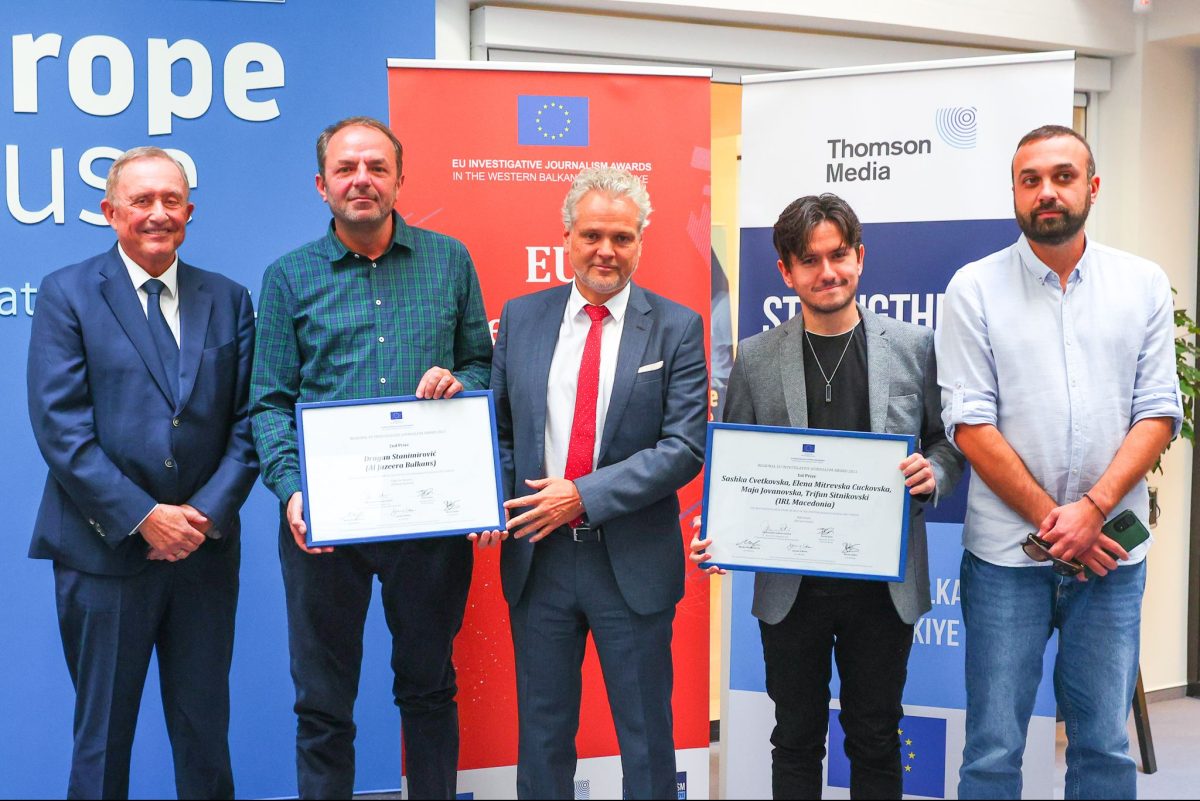
The first prize went the journalists from the Investigative Reporting Lab from North Macedonia – Sashka Cvetkovska, Elena Mitrevska Cuckovska, Maja Jovanovska and Trifun Sitnikovski – for their documentary Bad Blood, which shows the deadly effects of state-sponsored COVID profiteering. This made them double winners; they received the award for best story also on a national level in North Macedonia.

The second prize went to Dragan Stanimirović from Al Jazeera Balkans, Bosnia and Herzegovina, for his story “Battle for Neretva II and III”. This documentary series is about the Bosnian government’s plans to build hydropower plants in the Neretva basin and the struggle of activists and citizens to protect their rivers.

Third prize went to Sasa Dragojlo from Balkan Investigative Reporting Network, BIRN,  for “With Police Connections, Serbian-Syrian Translator Turned People-Smuggler”, a story about an organised criminal group that smuggled refugees and migrants of all nationalities, and illegally organised the crossing of the borders of Croatia, Bosnia and Hungary.

“I am really glad that I was awarded for this story. The investigation I conducted was highly demanding and long-lasting, while the scope of evidence was quite diversified – from video evidence, secretly taped audio recordings of criminals, to interviews with insiders in the people smuggling business and security officers,” Dragojlo said.

He said the fact it is a story about the fate of refugees and migrants makes the award even more important, emphasizing that due to global problems migration to Europe will likely not stop but increase in the future.

“Migrants are the most endangered category on the planet. They do not have a territory that they can consider their own, they are not in the system, they have no documents that show they belong somewhere, and they are left to the chaos ruled by violent smuggling gangs and corrupt policemen with a license to beat them,” Dragojlo concluded.

Sadler, as representative from the jury, announced the winners, while the Head of the Delegation of the European Union to Bosnia and Herzegovina, Ambassador Johann Sattler, handed the certificates to the winners.

The EU Award for Investigative Journalism 2023 is part of the project “Strengthening Quality Journalism in Western Balkans and Türkiye II”. This aims to recognise and promote outstanding achievements in investigative journalism as well as improve the visibility of quality journalism in the Western Balkans and Türkiye.

Internet Governance Forum Identifies Alarming Trends and Offers Recommendations to Improve Cyber Space in Bosnia and Herzegovina

Bosnia and Herzegovina (BiH) remains one of the least equipped countries in the Western Balkans to fight cyberattacks.

This was just one of the findings to emerge from the Internet Governance Forum (IGF), which was held in Sarajevo recently after a five-year hiatus. During the event, numerous conclusions were reached regarding internet management and human rights, cyber security, and ways to combat genocide denial, the glorification of war crimes, and hatred on the internet. These conclusions will be presented at a global forum in Japan.

The IGF provided an international platform for discussions and collaboration on issues related to the development of information society, bringing together representatives of various governmental, non-governmental and international organizations and institutions in Sarajevo to brainstorm practical ideas for advancing cyber security in BiH.

Julian Reilly, the British ambassador to BiH, underscored the significance of the forum, which was supported by the British Embassy, emphasizing its focus on crucial societal challenges facing the country. He placed particular emphasis on the issue of cyber security, which affects not only the authorities but also businesses and the general public.

“One proof of this is the 15 million attempted cyberattacks that took place in Bosnia and Herzegovina in the last few months. The forum will identify potential solutions and opportunities to address these attacks,” stated Reilly. He also noted the special attention given to other critical topics at the IGF, including abuse, gender-based violence, historical revisionism, and genocide denial, all of which persist in the online sphere.

The resident coordinator of the United Nations in BiH, Ingrid Macdonald, expressed her organization’s satisfaction at being able to contribute to the forum and called on people around the world to unite to improve the internet.

“Our lives have been completely changed by the internet and what it represents in our lives. It’s very important that we recognize the opportunities and the risks, because despite it affecting our lives every day, cyberspace remains largely unregulated and that is problematic,” said Macdonald.

She pointed out that while the internet serves as a platform for public discussion and increased access to information, it is frequently misused to spread misinformation, discrimination, hate speech, revisionism, and various forms of violence. These narratives, she observed, are particularly pervasive in BiH, where hate speech encompasses the denial of war crimes and the Srebrenica genocide, necessitating a broader dialogue to on issues that divide people in the country and hinder reconciliation.

In a video message, Melissa Fleming, UN Under-Secretary for Global Communications, expressed concern about the alarming trends, especially in light of the rise of artificial intelligence, which is developing more rapidly than any previous technological innovation.

“This is just one of the reasons that the UN is now addressing the information crisis as a global priority, dramatically scaling up its response,” Fleming noted, adding that her team is developing a code of conduct for information integrity on digital platforms, with the goal of creating a global “gold standard.”

Denis Džidić, director of the Balkan Research Network of Bosnia and Herzegovina (BIRN BiH), emphasized the importance of events like these is important because they expose the alarming trends that BiH has been facing over the past two years, especially those pertaining to cyber threats and the digital rights of citizens.

“The idea of this approach is to involve the entire community in resolving the issue of cyber threats, and violations of digital rights online, in order to come up with better solutions and exert pressures on government institutions to effectively tackle these issues,” explained Džidić.

In the course of several panel discussions on these topics, attendees had the opportunity to hear from domestic and foreign experts in information and telecommunication systems, representatives of the judiciary, journalists, and human rights activists, as well as representatives of the academic community and advocates for the protection of freedom of thought and expression.

During the plenary session, participants held an important discussion about the lack of a systemic approach to internet governance and human rights issues in BiH, a global challenge which is shared by other countries worldwide.

Arben Murtezić, director of the Center for the Education of Judges and Prosecutors of the Federation of BiH, argued that this country is likely the least equipped in the region to combat cyber-attacks, pointing to the absence of a number of strategic and legal documents necessary for this struggle. Speaking about practical attacks, such as the one on the Parliamentary Assembly, he noted that even larger and better prepared states struggle to find solutions. Murtezić suggested that embracing knowledge and experience from the private sector could provide viable solutions to these complex challenges.

“In today’s world, if you don’t have a CERT [Computer Incident Response Team], it’s like not having a State Department. That’s such an important point,” Murtezić added.

The importance of having such a body in BiH was also emphasized by Jurica Banić from the Cyber Security Excellence Center (CSEC), who believes that the complexity of state administration effectively hinders the establishment of such a team in the country.

“We have so many levels of government where everyone wants to grab their share of the pie. I’m not sure what pie, I think we all have the same interest – the protection of all, including the nation as a whole,” he remarked.

Sabina Baraković, an expert advisor in the Information and Telecommunications Systems Sector of the BiH Ministry of Security, pointed out that that efforts to establish CERT have been ongoing for years, but that several decisions stand between BiH and the finalization of this important body. She cited the major challenge of recruiting experts, given that the civil service isn’t attractive to IT experts, who find better conditions in the private sector.

The central focus of this session was on human rights issues in the online sphere. Lejla Huremović, an activist for the human rights of the LGBTIQ+ community, highlighted the numerous hateful narratives, usually with right-wing nationalism and religious undertones, are used to spread animosity.

“They’re part of the nationalist package that has been initiated and given a green light through the political narratives in our public space, emanating from those in power,” explained Huremović.

Sead Turčalo, the dean of Political Sciences at the University of Sarajevo, spoke about the connection between these attacks, their real sources, and their impacts. He said that the content altering our emotional relationship with reality has the greatest influence on various online incidents.

He described cyber security as collateral damage of the political dynamics in BiH and stressed the need to separate this issue from the narratives of everyday politics.

The conclusions drawn from the day’s forum on online challenges in Bosnia and Herzegovina, including those related to cyber incidents and human rights, will be presented at the global IGF in Kyoto, under the of the UN.

During the panel discussion on internet violence, participants emphasized the need to involve diverse stakeholders in prevention, protection, criminal sanctions, and policy coordination. They advocated for a firm judicial response that places the victims of violence at the center of all policies and approaches.

In the session on historical revisionism, genocide denial, and glorification of war criminals, the failure to prosecute these cases was attributed to political as well as judicial factors, including the tendency of prosecutors to yield under public pressure. The panelists expressed alarm at the normalization of these narratives, emphasizing the need for media regulation, timely convictions for the criminal offense of genocide denial, and a multi-perspective approach to educate citizens and rebuild trust in institutions.

The panel on cyber security in BiH stressed the urgency of forming a CERT and addressing the major dissonance between legislative and executive authorities.  The participants concluded that while BiH is facing intense and complex cyber-attacks, the country must contend with numerous limitations. Notably, the absence of systems for exchanging information and knowledge hinders the ability to learn from the attacks and incidents that have already occurred.

The organizing committee of the 2023 IGF Sarajevo comprises BIRN BiH, CSEC, BHNIX.ba, the Center for the Education of Judges and Prosecutors of the Federation, the Sarajevo University Faculty of Political Sciences, and Logosoft. The forum is supported by the Internet Society Foundation, the British Embassy in BiH, and the Hanns Seidel Foundation in Sarajevo.

Reports from individual panels will be available on the Forum website.
BIRN BiH Journalist and Editor Win EU Investigative Journalism Award

BIRN BiH Journalist Lamija Grebo and Dzana Brkanic, BIRN Bosnia and Herzegovina deputy editor, have won second prize of the European Union Investigative Journalism Awards for an investigation based on court verdicts over the past ten years for hate crimes.

The jury consisting of media expert Lamija Aleckovic, Political Sciences Faculty professor Lejla Turcilo and Friedrich-Ebert-Stiftung Foundation director Tanja Topic from Banja Luka awarded Grebo and Brkanic for their multimedia data research, which showed that hate crimes were mostly sanctioned with suspended sentences, with only one quarter of those convicted being imprisoned, and investigations in some cases taking more than 20 years.

Awarding the prize, Turcilo said the story threw light on the absurdity of the court system in Bosnia and Herzegovina, pointing to the need for changes in Bosnian society.

Suspended Sentences Do not Prevent the Spread of Hate” was based on verdicts passed down before all courts in Bosnia over a ten-year period. It revealed also that there was no unified system for registering such crimes, which has made the monitoring and investigating of those cases more difficult.

The two journalists thanked members of BIRN BiH newsroom for their help, adding that they appreciated the European Union Award and the jury which recognized their work.

“Many hours of browsing through hundreds of court and prosecutorial decisions, numerous queries, interviews with experts, but also with our fellow citizens who have still not seen justice after 20 years, stand behind this investigation. At a time when hate crimes are happening nearly on a daily basis, it is even more important to point to this problem with a view to improving the prosecution, ensuring justice for victims and achieving a potential general prevention [of such crimes],” Grebo said.

Brkanic said the value of the award was reflected in the additional visibility of investigative stories, which bring changes in society, adding that she hoped this story also would have a positive impact in favour of victims.

“Returnees live in fear throughout BiH, minorities are endangered, and no one has information about the attack on LGBTIQ activists and fellow journalists in March this year. Hence, this award, alongside the support which independent newsrooms such as ours get from foreign donors, represents an incentive and obligation to continue with our work,” she said.

Brkanic and Grebo shared second place with Predrag Blagovcanin, who was awarded for his story titled “Between the HDZ and DF: How the Defence Ministry of BiH Protected a War Criminal”.

First prize was awarded to Semira Degirmendzic for a story titled “Turkish Cengiz Wins Contracts Worth a Billion KM, but Fails to Pay Compensation to Bosnian Workers”. Third prize went to Arduana Pribinja for a story titled “Abuse of Patients in Sarajevo: False Diagnoses for Expensive Medicines”.

Johann Sattler, Head of the Delegation and Special Representative of EU in Bosnia, said during the awards ceremony that Bosnian citizens had the right to be informed about irregularities in society.

“Professional journalism is essential for the health of the society, while freedom of the media and expression is one of the key priorities for the entry of BiH into the European Union,” said Sattler, adding that without achieving this priority, Bosnia could not join the EU.

In 2021, BIRN BiH deputy editor Brkanic won the third prize of the European Union Investigative Journalism Awards for a piece on the non-transparent collection of humanitarian aid for construction of wells and mosques in Africa.

The EU Investigative Journalism Award celebrates the best investigative stories written in the previous calendar year and is awarded in all six Western Balkan countries (Serbia, Bosnia and Herzegovina, Albania, Montenegro, Kosovo, North Macedonia) and Turkey. The organiser of the award ceremony, Thomson Media, an organisation with multi-year experience in developing and promoting media freedom, awarded a regional prize for the first time this year.

Grebo and Brkanic previously won a special European Press Prize in 2020, as members of BIRN BiH, for “efforts and success in ensuring justice for victims of war crimes”.

Jointly with their colleague Jasmin Begic, they were shortlisted for the Srdjan Aleksic Journalism Award in 2022 in the “contribution to the community” category.

Aleksandra Vrbica

Based in Belgrade, Aleksandra joined BIRN in October 2023 as a Communications Manager. Her main responsibilities include developing and implementing communications strategies and work plans, designing promotional campaigns, and working closely with the programme departments, social media team and editorial team to ensure its content reaches target audiences.

Previously, Aleksandra worked as a journalist and a Social Media manager and has extensive experience in journalism, communications and Social Media.

For three years, she worked at the EU Info Centre in Belgrade as a Social Media Officer and was responsible for the EU Delegation’s SM accounts, amongst other things. During this period, she also gained valuable experience in project communications.

She has been awarded by the Serbian Public Relations Society and the 2020 EU Delegation to Serbia for the campaign “They Are Heroes”.

Aleksandra studied at the Faculty of Political Sciences, at the University of Belgrade. Her major was Journalism and Communications. Also, she has an MA degree in Social Policies. In addition to her formal education, she has attended various Social Media courses and seminars.

Along with her native Serbian, she speaks English.

EU Awards for Best Investigative Journalism in Serbia Announced

On September 28, in the EU info centre in Belgrade, the winners of the EU Awards for Investigative Awards for Investigative Journalism in Serbia were announced.

KRIK, CINS and a BIRN team of Jelena Zorić and Vuk Cvijić were selected from many colleagues as this year’s winners for their stories published in 2022.

The jury consisted of Tamara Skrozza a journalist who has worked for radio, press and TV productions and engaged with a number of different media outlets; Snjezana Milivojevic, a professor of public opinion and media studies who chaired doctoral and master’s programs at Bayan College in Oman and the University of Belgrade; and Sasa Lekovic, President of the Investigative Journalism Centre, based in Croatia, a reporter and editor and a licensed investigative reporting trainer and lecturer.

The first prize went to the KRIK team (Stevan Dojčinović, Bojana Jovanović, Milica Vojinović and Ana Adžić) for their stories on the Darko Šarić clan.

The second prize was shared between CINS and BIRN. The CINS team (Stefan Marković, Teodora Ćurčić, Jovana Tomić, Ivana Milosavljević and Vladimir Kostić) was awarded for their stories on political party financing.

Jelena Zorić from BIRN was awarded for her stories about medical malpractice in the sensitive area of psychiatric health.

The third prize went to Vuk Cvijić of NIN for his investigations into the connections between criminal circles and state officials, and CINS/BIRN (Dina Đorđević, Marija Ristić, Jovana Tomić and Saša Dragojlo) for “Paths of Serbian weapons”. Part of this series is the investigation “Serbian Rockets Sent to Myanmar Even After 2021 Coup”, a cross-border collaboration between BIRN, CINS, Myanmar Witness and Lighthouse Reports, originally commissioned at the BIRN Summer School of Investigative Reporting in Dubrovnik in 2021.

Manuel Munteanu, Head of Press and Info and Deputy Head of Political Section of the EU Delegation in Serbia, gave a speech highlighting the importance of independent media and extending congratulations to the winners.

Davor Marko from Thomson Media introduced the project and the importance of the EU awa for supporting investigative journalism in the Western Balkans and Türkiye. Snjezana Milivojevic, representing the jury, provided a detailed explanation of the award selection process and announced the recipients of each awarded position.

More information can be found here.

The EU Award for Investigative Journalism 2023 is part of the project “Strengthening Quality Journalism in Western Balkans and Türkiye II”. This aims to recognise and promote outstanding achievements in investigative journalism as well as improve the visibility of quality journalism in the Western Balkans and Türkiye.

The project is funded by the European Union and it is implemented by a consortium composed of Balkan Investigative Reporting Network – BIRN Hub, Central European University (CEU) – Hungary, the Association of Journalists (AJ) – Türkiye, Thomson Media (TM) – Germany, University Goce Delcev Stip (UGD) – North Macedonia, The Independent Union of Journalists and Media Workers (SSNM) – North Macedonia, Media Association of South-East Europe (MASE) – Montenegro, and Balkan Investigative Reporting Network Kosovo (BIRN Kosovo).

EU Awards for Best Investigative Journalism in Montenegro Announced

On September 25 in Europe House in Podgorica, the winners of the EU Awards for Investigative Awards for Investigative Journalism in Montenegro were announced.

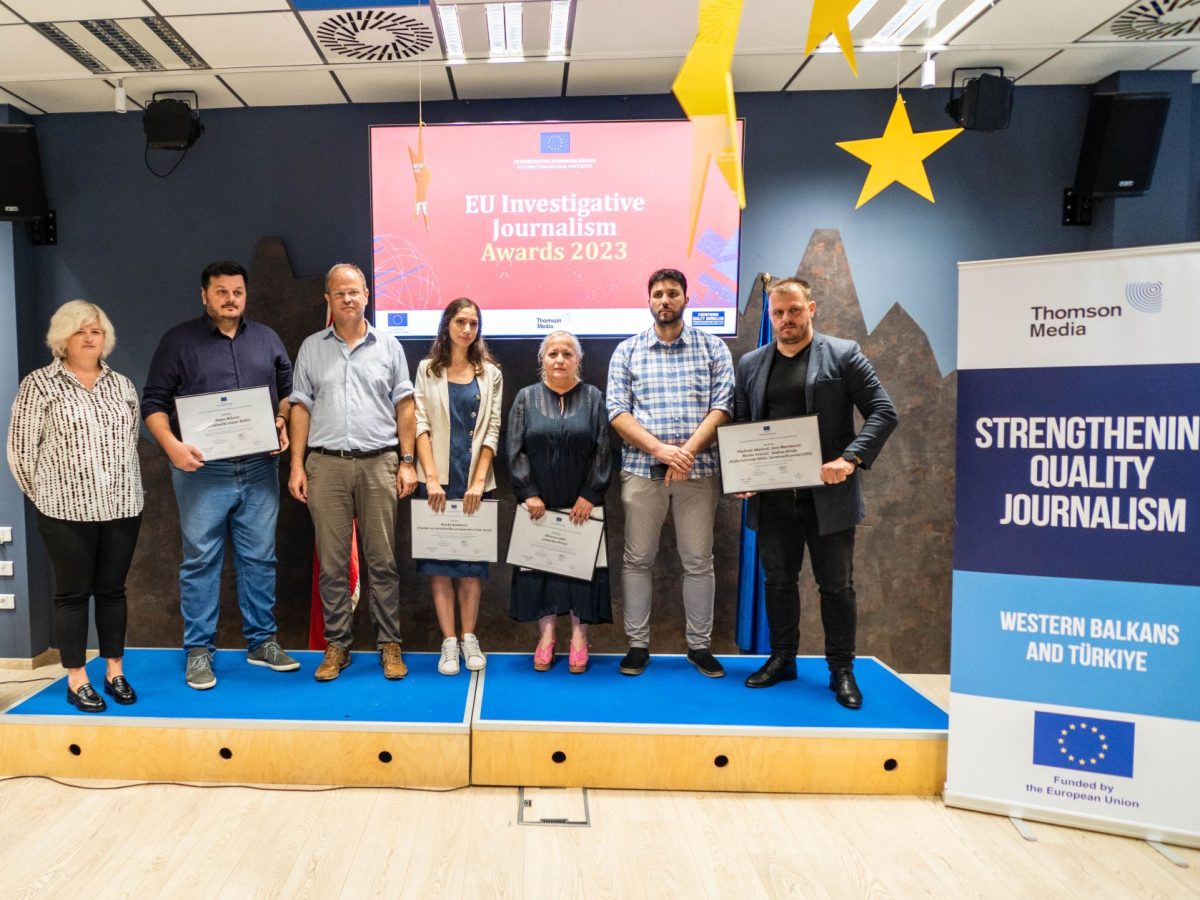
Đurđa Radulović, Olivera Lakic, Dejan Milovac, Vladimir Otasevic, Jovo Martinovic, Marko Vešović and Andras Kiraly were selected from many colleagues as this year’s winners for their stories published in 2022 exposing offshore companies, healthcare and corruption in the justice system in Montenegro.

The jury consisted of Tena Perisin, Professor at the University of Zagreb with a working experience in CNN, who led projects like HRT news program digitisation and founded Student Television and the first Journalism Research Laboratory in the region; Nataša Ružić, an academic and a journalist who worked as a journalist at Radio Golos Rossii and as editor-in-chief of the youth paper Zerkalo;  Boro Kontic,  awarded journalist and Director of the Media Center in Sarajevo.

The first prize went to Đurđa Radulović from CIN-CG for her article “Silence Surrounding Violence – Maternity Wards Violate WHO Recommendations”.

The second prize went to Olivera Lakic of Libertas Press for her series of articles on corruption in the Montenegrin judicial system and on crime and corruption within Montenegrin police structures.

The third prize was divided between Dejan Milovac from NVO MANS   for his investigation into the Pandora Papers, revealing Russian offshore millions invested in luxury real estate in Montenegro, and Vladimir OtasevicJovo MartinovicMarko Vešović and Andras Kiraly (Istraživački portal LUPA, RTV Nikšić) for  their story, “Secret E-gambling Affair”.

Oana Cristina Popa, Head of the EU Delegation to Montenegro, greeted the participants via a video message highlighting the importance of the awards and investigative journalism. The jury members presented their decisions and announced the awardees.

More information can be found here.

The EU Award for Investigative Journalism 2023 is part of the project “Strengthening Quality Journalism in Western Balkans and Türkiye II”. This aims to recognise and promote outstanding achievements in investigative journalism as well as improve the visibility of quality journalism in the Western Balkans and Türkiye.

The project is funded by the European Union and it is implemented by a consortium composed of Balkan Investigative Reporting Network – BIRN Hub, Central European University (CEU) – Hungary, the Association of Journalists (AJ) – Türkiye, Thomson Media (TM) – Germany, University Goce Delcev Stip (UGD) – North Macedonia, The Independent Union of Journalists and Media Workers (SSNM) – North Macedonia, Media Association of South-East Europe (MASE) – Montenegro, and Balkan Investigative Reporting Network Kosovo (BIRN Kosovo).