DONOR
ERSTE Foundation is a creative workshop for ideas and innovation, a lab for topics of the future which increases its effectiveness through the strategic cooperation with networks.
As the main shareholder of Erste Group ERSTE Foundation secures the independent future of one of the largest financial services providers in Central, Eastern and South Eastern Europe.
As a private Austrian savings banks foundation, the foundation is committed to serving the common good. ERSTE Foundation invests parts of their dividends into the region in which Erste Group operates.
ERSTE Foundation focuses on three thematic fields: Social innovation, European cohesion and democracy, and contemporary culture.
DONOR
The Swedish International Development Cooperation Agency (Sida) is a government agency working on behalf of the Swedish parliament and government, with the mission to reduce poverty in the world. Through their work and in cooperation with others, they contribute to implementing Sweden’s Policy for Global Development (PGU).
They work in order to implement the Swedish development policy that will enable poor people to improve their lives. Another part of their mission is conducting reform cooperation with Eastern Europe, which is financed through a specific appropriation. The third part of their assignment is to distribute humanitarian aid to people in need of assistance.
Sida carries out enhanced development cooperation with a total of 33 countries in Africa, Asia, Europe and Latin America. The selection of cooperation countries is based on political decisions made by the Swedish government.
Sida’s mission is to allocate aid and other funding. Their operations are managed by the government’s guidelines, describing the goals for each year’s operations and the size of the development aid budget.
Three thematic priorities determine the direction of Swedish development cooperation and all interventions should relate to them. Those are democracy and human rights, environment and climate, and gender equality and women’s role in development.
In the period 2015-2019 Sida provides core support to BIRN Hub for implementing cross-regional programmes and enhancing the capacity of the Network.
BIRN Kosovo
The Paper Trail Investigations is a project by Balkan Investigative Reporting Network – BIRN Kosovo and BIRN HUB – to promote the rule of law, accountability and transparency in the Balkans and Moldova.
Summary
The Paper Trail Investigations is a project by Balkan Investigative Reporting Network – BIRN Kosovo and BIRN HUB – to promote the rule of law, accountability, and transparency in the Balkans and Moldova.
Information Sheet
Main Objective:
Contribute to better functioning of the public sector that abides by principles of transparency and accountability to its citizens which will in the long-term contribute to human security to the whole South-Eastern Europe/Danube Region.
Purpose of the program: Exposing wrongdoings of the governments, public and private companies, as well as individuals, through the promotion of the rule of law, accountability and transparency
Specific Objectives:
Exposing wrongdoings of public institutions, public or private companies, and individuals, through multimedia investigations, in-depth analysis of institutions’ openness to freedom of information requests, and the establishment of an online database.
Main Activities:
Implementing investigative projects.
Two televised debates and reports produced and broadcasted.
Cross-border report on institutions’ compliance with Freedom of Information (FoI) legislation.
Creating an online, searchable database of documents obtained using FoI legislation in each country.
Workshops and on-the-job training for journalists.
Target Groups:
The main target group of the project consists of investigative journalists, researchers, journalists from other media and public in general in the region and worldwide.
Highlights:
The programme is focused on five key themes which are critical for good governance in the region – energy, road building, the financial sector, the influx of money from the Middle East and the arms industry.
Through the extensive use of public documents, the investigations are exposing wrongdoing in government, public and private companies and among powerful individuals.
The project also addresses the transparency of public institutions in Albania, Bosnia and Herzegovina, Kosovo, Macedonia, Montenegro, Serbia, and Moldova.
As part of our drive for openness, we have also established a free, user-friendly, searchable online library of public documents and scraped databases, BIRN Source.
Working with some of the biggest names in international journalism, BIRN has produced dozens of hard-hitting investigations which are reshaping the public perceptions of their governments, business elites, and journalism.
BIRN Hub
The BIRN Summer School of Investigative Reporting works to enhance the reporting skills and journalistic standards of journalists from the Balkans and beyond, training 20 journalists from the Balkan region and 10 international journalists each year.
Summary
Every year BIRN gathers renowned international investigative journalists and experts to train the Summer School participants, including Sheila Coronel, professor at Columbia University; Nick Davies, the journalist for The Guardian who revealed the Rupert Murdoch affair; Mark Schoofs, a ProPublica Senior editor and two-time Pulitzer Prize winner; and Paul Bradshaw, one of the UK’s most well-known bloggers.
BIRN also provides financial support for the top story ideas generated during the School. Summer School participants are divided into groups, where they develop their story ideas, and they then conduct investigations and produce a story that BIRN publishes on its flagship news portal- Balkan Insight. The Summer School also provides networking opportunities for the journalists who attend.
The training, which is held over five days each year, uses a curriculum based on the Investigative Journalism Handbook ‘Digging Deeper: A Guide for Investigative Journalists in the Balkans’, which was published by BIRN and has been translated into Albanian, Macedonian, and Serbian.
BIRN’s Summer School is organised in cooperation with the Konrad-Adenauer-Stiftung’s Media Program- South East Europe, and funded by the Open Society Foundation, the OSCE Missions to Serbia and Skopje, the OSCE Mission in Kosovo, the US Embassy in Skopje, BIRN Kosovo and the Embassy of the Netherlands in Zagreb.
Information Sheet
Main Objective:
Bringing high quality and high standards to investigative reporting in the Balkans, with the opportunity for wide dissemination of summer school journalists’ work in the Balkan region, and internationally.
Specific Objectives:
Enhancing investigative reporting skills and journalistic standards of 20 journalists from the Balkan region and 10 international journalists each year;
Providing networking opportunities for the journalists attending the school;
Promoting investigative journalism in the Balkans by publishing investigations produced by journalists trained at the Summer School.
Main Activities:
Training – BIRN provides five days of training based on the curriculum ‘Digging Deeper’.
Financing investigative stories – BIRN provides financial support for the best story ideas put forward during the School. An average of three stories are produced each year.
Publishing – BIRN publishes investigative pieces from Summer School participants on BalkanInsight.com
Target Groups:
Journalists, media experts, investigative reporters from the Balkans; International journalists and media experts; Local, regional, and international media outlets.
BIRN Hub
Through its Balkan Fellowship for Journalistic Excellence programme, BIRN works within the region to foster quality reporting, initiate regional networking among journalists and advance balanced coverage on topics that are central to the region as well as to the EU.
The programme provides training and networking for 10 journalists from the region every year, each of whom produces an investigative or analytical article with regional relevance.
Fellowship journalists receive training and editorial support from the Balkan Investigative Reporting Network’s team of editors, as well as a bursary of €2,000 and additional travel and research funding of up to €2,000.
The reporters attend seminars in Vienna and in the region, and enjoy extensive republication of their articles in regional and international print and online media, as well as a chance to win monetary awards.
Fellows are given a unique opportunity to network with other fellows, alumni and international experts.
This programme is very competitive and receives more than 100 applications annually, while the number of republications of the participants’ articles has grown every year, reaching an average of 500 republications in the region and abroad.
BIRN promotes the journalists and their work, securing public recognition and increasing the visibility of the programme.
In addition, the BIRN team strengthens the Alumni network through bi-annual meetings and a small grants scheme for quality content production.
Balkan Fellowship for Journalistic Excellence was initiated in 2007 by ERSTE Foundation and Robert Bosch Stiftung, in cooperation with BIRN.
Since 2014 it is supported by the ERSTE Foundation and Open Society Foundations, while the Robert Bosch Stiftung remains committed to the development of the programme alumni initiative.
Information Sheet
Main Objective:
foster quality reporting,
initiate regional networking among journalists and
advance balanced coverage on topics that are central to the region as well as to the EU
Specific Objectives:
To provide training and networking for 10 journalists from the region each year
To produce 10 investigative or analytical articles with regional relevance
To promote journalists and their work, securing public recognition and the visibility of the programme
To strengthen the alumni network through bi-annual meetings and a small grants scheme for quality content production
Main Activities:
Training for journalists
Production and publishing of quality content
Strengthening regional network of journalists
Promotion of programme findings through dissemination of articles and organization of public discussions
Target Groups:
Journalists from targeted countries
Highlights:
In 2011 alone four alumni and fellows were awarded for the outstanding results in their work. Adrian Mogos received the CEI SEEMO Award for Outstanding Merits in Investigative Journalism and the Kurt Schork Award in International Journalism; Marius Cosmeanu and Ivan Angelovski were awarded with the Milena Jesenska fellowship; and Stevan Dojcinovic received the Daniel Pearl – Raising Star Award, as part of the OCCRP project team.
Alumni fellows participated in some of the most prestigious media and political conferences organized in the region and the EU (Commission on Media Policy, Political Forum Alpbach, Global Investigative Journalism Conference)
Romania’s national journalistic competition Superscrieri has given awards to Elena Stancu and Vlad Odobescu, both 2013 fellows of the Balkan Fellowship for Journalistic Excellence.
In December 2013 three awards were given to the alumni from Kosovo – Selvije Bajrami was honored for contribution to the fight against the corruption by the UN Development Programme in Kosovo and Arbana Xharra was presented by KOHA Group with ” Rexhai Surroi ” award for journalism for the series of articles “Kosovo alarmed by conservative extremists “, while organization INPO Ferizaj awarded her with the “Stirring Debate”, for sparking debate in society on difficult topics, including religious radicalism.
Sorana Stanescu, alumnus from Romania, has won the 2013 Academic Association for Contemporary European Studies, UACES award for her article ‘Cheap and Far from Free’ produced through the Balkan Fellowship for Journalistic Excellence Project
Balkan Fellowship for Journalistic Excellence programme and its editor Neil Arun have been nominated for the European Press Prize 2012 in the Innovation Award category for the outstanding innovation of the year
Adrian Mogos, a Romanian journalist and Fellowship alumnus was nominated for the European Press Prize 2012 in News Reporting Award category, for the reporter or specialist expert whose work has made a decisive impact
Number of alumni fellows were awarded for their work in 2012, including Stevan Dojcinovic who has won the prestigious “Jug Grizelj” award for investigative journalism.
A 2015 alumna of the BIRN Hub Balkan Fellowship for Journalistic Excellence programme received a commendation from the United Nations Entity for Gender Equality and the Empowerment of Women in Albania, UN Women, for the “creation of a professional model of investigative journalism for the reporting on trafficking of women and girls”.
Following publication of a story about women in Romania and Bulgaria enduring low pay, long hours and gruelling work to make clothes for luxury Western clothing brands – produced as part of BIRN Hub’s Balkan Fellowship for Journalistic Excellence 2015 programme – Labour inspection issued three fines for one of the factories in Romania.
BIRN Hub
The Alumni Network, drawing on the work of the Fellowship, aims to promote the ideas of journalistic excellence and spread the concept of free and professional media throughout the region.
Summary
The project has brought together past fellows of the Balkan Fellowship for Journalistic Excellence since 2008. The Fellowship, which was launched in 2007, provides training and networking for 10 journalists from the region each year, each of whom produces an investigative or analytical article with regional relevance.
Participants come from Serbia, Bosnia, Croatia, Macedonia, Montenegro, Romania, Bulgaria, Kosovo and Albania.
The Alumni Network aims to strengthen the professional links between journalists from the region, produce high quality content, and promote excellence and professionalism in the media industry in the Balkans.
The Network holds bi-annual meetings and coordinates cooperative reporting projects between alumni of the Fellowship.
Alumni fellows have participated in some of the most prestigious media and political conferences organised in the region and the EU, and many alumni and fellows have received regional and international awards for they work.
These awards include the Europe Reporting Prize, awarded by the Academic Association for Contemporary European Studies, UACES, CEI SEEMO Award for Outstanding Merits in Investigative Journalism and the Kurt Schork Award in International Journalism, as well as the Daniel Pearl award for international investigative reporting and a TED fellowship for innovation.
Information Sheet
Main Objective:
Promoting the ideas of journalistic excellence in its work, spreading the concept of free and professional media throughout the region.
Specific Objectives:
Strengthening the professional links between journalists from the region;
Production and promotion of high quality content;
Promotion of excellence and professionalism in media industry
Main Activities:
Bi-annual meetings
Reporting projects
Target Groups:
Journalists from the Balkans
Highlights:
In 2011, two alumni of the Balkan Fellowship for Journalistic Excellence Ivan Angelovski from Belgrade and Marius Cosmeanu from Bucharest – were selected to take part in the prestigious Milena Jesenská Fellowship for Journalists.
Stevan Dojčinović, a 2011 fellow from Serbia, received a national award for investigative journalism.
Dojčinović and 2008 fellow Stanimir Vaglenov, along with other members of the Organized Crime and Corruption Reporting Project team, were awarded the Daniel Pearl award for international investigative reporting.
The 2010 Kurt Schork Awards in International Journalism honoured our 2009 alumni fellow Adrian Mogos, who in the same year also received the CEI – SEEMO award for outstanding merit in investigative journalism.
Yana Buhrer Tavanier, a 2009 fellow from Bulgaria, was the first fellow from Southeast Europe to be awarded the prestigious TED fellowship for innovation.
Barbara Matejcic, a 2009 fellow from Croatia, was the first Croatian journalist to win the Zagreb Pride award for her coverage of LGBT topics.
The short story Zlatka, written by 2009 Croatian fellow Maja Hrgovic, was included in the Best European Fiction 2012 anthology (Dalkey Archive Press) and published in Granta magazine. Shooting for a short movie based on the story is about to begin in Croatia and will be included in the Deep Cuts compilation film.
Selvije Bajrami, a 2011 fellow from Kosovo, was awarded first prize by the United Nations Development Programme for reporting on corruption.
Romania’s national journalistic competition Superscrieri has given awards to Elena Stancu and Vlad Odobescu, both 2013 fellows of the Balkan Fellowship for Journalistic Excellence.
Selvije Bajrami was in 2013 awarded for contribution to the fight against the corruption by the UN Development Programme in Kosovo
In December 2013 Arbana Xharra, editor of Kosovo daily Zeri, and alumnus of the Balkan Fellowship for Journalistic Excellence was awarded with two awards for her journalistic work during the year. KOHA Group awarded Xharra with ” Rexhai Surroi ” award for journalism for the series of articles “Kosovo alarmed by conservative extremists “, while organization INPO Ferizaj awarded her with the “Stirring Debate” for sparking debate in society on difficult topics, including religious radicalism.
Sorana Stanescu, alumnus from Romania, has won the 2013 Academic Association for Contemporary European Studies, UACES award for her article ‘Cheap and Far from Free’ produced through the Balkan Fellowship for Journalistic Excellence Project
Balkan Fellowship for Journalistic Excellence programme and its editor Neil Arun have been nominated for the European Press Prize 2012 in the Innovation Award category for the outstanding innovation of the year.
Stevan Dojcinovic, editor of the Centre for Investigative Journalism Serbia and an alumnus of the Balkan Fellowship for Journalism Excellence, has won the 2012 Jug Grizelj award for investigative journalism.
Jeton Musliu, an alumnus of the Balkan Fellowship for Journalistic Excellence, has won an award for the best culture story published in Kosovo in 2012.
Eldin Hadzovic, an alumnus of BIRN’s Balkan Fellowship for Journalistic Excellence, was honoured by UNICEF for his outstanding contribution to journalism in Bosnia in 2012.
BIRN Hub
The programme aims to contribute to the reconciliation process in the region by raising awareness of transitional justice issues among the citizens of the former Yugoslav republics.
Summary
The programme aims to promote best practice among local media outlets in reporting on often sensitive post-conflict transitional justice issues.
It works to improve the state of reporting in this specific field by creating a regional network of journalists who are trained to competently cover all aspects of the process and by allowing local media to republish high quality contributions.
The team had been producing a 10-minute radio programme called “Roads to Justice”, which covered the region and was broadcast monthly by numerous radio stations throughout the Balkans. I
The BIRN team has also produced a series of six TV pieces, which were released as a feature-length film entitled “The Majority Starts Here” and a documentary film “The Unidentified”.
The Regional Reporting on Transitional Justice Issues programme targets victims’ groups in the region and in the diaspora, as well as victims of war and former camp inmates.
In addition, the programme is aimed at international NGOs, human rights groups and local and international journalists.
It is supported by the European Commission, the Swiss Federal Department of Foreign Affairs, and the Robert Bosch Foundation.
Information Sheet
Main Objective:
To establish a network of journalists in the Balkans (Transitional Justice Regional Journalistic Team), who will be trained to report on transitional justice issues in the region, raising awareness and assisting in the reconciliation process.
Specific Objectives:
To contribute to the reconciliation process by raising awareness of transitional justice issues among the citizens of former Yugoslav Republics;
To improve the state of the media in this specific field while creating a regional network of journalists who are capable of covering all the aspects of the on-going process and by allowing local media to republish high quality articles;
To promote best practice in terms of reporting on often sensitive post-conflict transitional justice processes among local media outlets.
Main Activities:
Training for a specialized Transitional Justice Regional Journalistic Team;
Editorial Production;
Online Production and dissemination;
Radio “Roads to Justice” production and dissemination;
TV Regional Justice Production and dissemination. Regional Conferences.
Target Groups:
Victims’ groups in the region, as well as the diaspora;
Women victims of war and women searching for their families;
Male former camp inmates from throughout the region and abroad;
International NGOs, watchdogs, justice sector development institutions (i.e. Human Rights Watch, Amnesty International, International Centre for Transitional Justice etc);
Journalists, local and worldwide, who report on transitional justice issues.
Highlights:
The documentary film The Unidentified – produced by the BIRN Hub Balkan Transitional Justice programme won the best short documentary award at the South East European Film Festival in LA. The film investigated the commanders responsible for brutal attacks during the Kosovo war.
The War Crimes Verdicts Map – an interactive tool designed by the Balkan Investigative Reporting Network to provide an overview of court rulings on the crimes that were committed during the wars in the former Yugoslavia in the 1990s.
Two BIRN stories won this year’s Investigative awards from the Independent Journalistic Association of Serbia in the categories for print and on-line media.
“Secret of Vucic’s tavern” won the award in the print media category. BIRN Serbia journalist Jelena Veljkovic wrote on how Serbia’s Property Directorate claimed not to know that an exclusive restaurant had been opened in a part of the Belgrade Cooperative building, which the directorate had leased to the “Belgrade on water” company, refusing to answer whether it believed this use of public property was in accordance with the law.
A story by a group of journalists from BIRN and OCCRP, “Making a Killing: The 1.2 Billion Euro Arms Pipeline to Middle East”, meanwhile won the award in the online media category, along with a colleague from the Center for Investigative Journalism, CINS, whose story showed that the Governor of the National bank of Serbia plagiarized a significant part of her doctoral thesis.
The BIRN arms investigation revealed how thousands of assault rifles, mortar shells, rocket launchers, anti-tank weapons, and heavy machine guns have poured into the Middle East from Bosnia, Bulgaria, Croatia, the Czech Republic, Montenegro, Romania, Serbia and Slovakia. The same story is also among three finalists for the Czech Journalism Prize, the best-known Czech media award.
This year, 75 journalists applied for the award given by the Independent Association of Journalists of Serbia, NUNS, and the US embassy in Serbia. The jury included Danica Vucenic, journalist from Insajder, Milorad Ivanovic, editor-in-chief of Newsweek Serbia, Predrag Blagojevic, editor-in-chief of online portal Juzne Vesti and Pedja Obradovic, producer at TV N1
At least one story promises to read like a crime thriller. Others will delve deep into corruption, public health and human rights. All involve meticulous research and the highest standards of cross-border reporting.
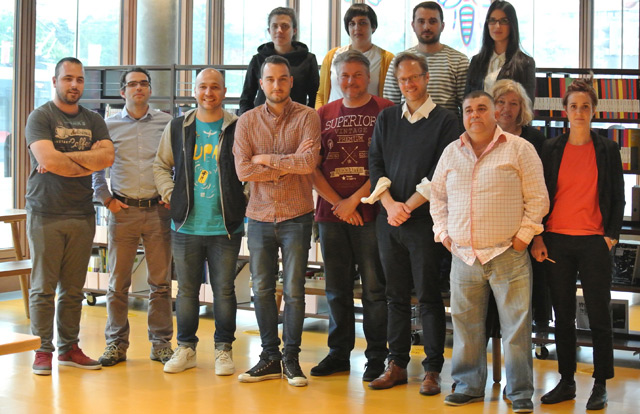
In its eleventh year, the programme kicked off with an opening seminar in Vienna for 10 new fellows from across the Balkan region.
Chosen from more than 130 applications, the fellows are from Bosnia, Bulgaria, Croatia, Greece, Kosovo, Macedonia, Montenegro, Romania and Serbia.
This year’s theme is change, giving the mid-career journalists broad scope to tackle issues ranging from the rise of populism and historical revisionism to Europe’s refugee and migrant crisis.
“I already had a look at the topics that you have proposed and I’m really glad to see that you indeed have taken several of the most pressing topics that the Balkans have,” Ulrike Lunacek, Austrian MEP and vice-president of the European Parliament, told fellows in a video message made for the seminar.
“It’s about environmental issues, family issues, women’s rights, LGBTi, refugee discrimination issues, but it’s also about rising nationalism.”
Ulrike Lunacek, Vice-President of the European Parliament welcoming 2017 fellows
At the ERSTE Foundation’s gleaming new headquarters, participants received practical tips on international standards in researching, reporting and structuring long-form stories that will be published at the end of the year in local languages as well as English and German.
A key goal was to refine story proposals based on initial applications. Individual editorial sessions were led by BFJE programme Editor Timothy Large, Balkan Insight Editor-in-Chief Gordana Igric and BFJE Programme Manager Dragana Zarkovic. The aim was to help fellows sharpen the focus of their stories and develop research and travel plans.
Timothy Large takes over as BFJE editor from Matt Robinson, now Reuters special correspondent for Central and Eastern Europe. Timothy was previously director of media development at the Thomson Reuters Foundation and editor-in-chief of global news services for the philanthropic arm of Reuters. Over coming months, he will work closely with fellows as they research, report and write their stories.
The seminar also included a visit to the newsroom of the Austrian daily derStandard, media partner of the programme; a multimedia and mobile journalism workshop run by Gunther Müller and David Klein from Forum Journalismus und Medien; and a presentation on press freedom, defamation and journalists’ legal rights by Barbara Trionfri, executive director of the International Press Institute.
The Annual Report presents the entire range of BIRN’s activities across the region from the perspectives of visibility, reach and impact.
In 2016, members of the BIRN network operated in a challenging environment which was marked by authoritarian tendencies among political elites, political turmoil, economic difficulties and deteriorating media freedoms. Political and financial pressure on the media, the refugee crisis, the long-term economic crisis and accompanying high unemployment, and high levels of corruption are just some problems that countries in the region have experienced.
Through investigative, analytical and specialised coverage of underreported topics such as war crimes cases, the flow of public money, cases of potential or verified corruption, problems within justice systems, media freedoms and ethics, and security issues etc., BIRN continued to play an important role in providing people in the Balkans with access to accurate information.
The Annual Report presents the entire range of BIRN’s activities across the region from the perspectives of visibility, reach and impact.
In this way, we show the scope and significance of the Network’s endeavours: for audiences in the countries of the region and beyond, media professionals, academics, policy makers (in the region and in international organisations), for the civil society sector, and for vulnerable groups. BIRN journalists and film-makers have also received awards for their work in their respective countries and internationally, and the report provides information about this.
 As the main shareholder of Erste Group ERSTE Foundation secures the independent future of one of the largest financial services providers in Central, Eastern and South Eastern Europe.