Threats to Serbian Journalists Rose in 2017

New report underlines the changing nature of threats to journalists in Serbia over the past year.

This year saw an increase in the number of threats made to media workers in Serbia sent via the internet and social networks, but also cases of surveillance.

A rise in the number of other pressures, compared to threats and physical attacks against journalists, does not indicate that journalists are safer now but that the forms of threats are changing, says a report by the Independent Journalists Association of Serbia, IJAS, published in cooperation with Civil Rights Defenders and presented on December 21 in Belgrade.

In 2017, the number of pressures recorded by IJAS amounted to 54; throughout 2016 that number was 33.

Pressures include: harassment, different forms of pressures exerted by state officials, politicians and other persons in positions of power, cases of restricting attendance or selective invitations of journalists to various public events, as well as pressures from the pro-government media on journalists and media outlets seen as critical of the authorities.

Analysis of the database shows that a large number of cases include pressures exerted by public officials, that is, representatives of authorities, from top state officials, to representatives of local authorities.

The most frequent targets of pressures are media outlets and journalists critical of the work of the government, ministers, and other state officials and local government units.

Such pressures are continuous and increasingly target journalists from TV N1, the daily paper Danas and non-profit media active in the investigative journalism such as CINS, KRIK and BIRN.

Maja Zivanovic, from BIRN’s regional publication Balkan Insight, recalled her own experiences from the June 24, 2016, when two men waited for her in front of her home in Novi Sad. At the time, Zivanovic worked for Vojvodina’s Investigative Center, VOICE.

“They knew when I left the apartment in the morning and I noticed them standing in front of my building. One of them started to follow me while I was walking, and the other one stayed in front of my building,” she said.

Zivanovic underlined that on that day she was supposed to meet an interviewee for her six-month ongoing investigation into corruption in a company that distributed gas in Novi Sad.

“I decided to stop and turned around and the man who followed me did the same. I noticed he had a Bluetooth microphone in his ear and then I realized I’d been followed,” she added.

She decided to go back and check whether the man who had stayed near her building had tried to enter her apartment in which she kept the documents for her report. “The man followed me back,” she recalled.

After seeing that everything was fine with her apartment, Zivanovic again left her building and once again saw the same two men. She reported the case to the police and immediately got 24/7 police protection.

“But I realized after 15 days that I can’t work under police protection and asked for it to be cancelled,” she added.

Zivanovic said the police never revealed who had followed her that day, although she was told that they have security cameras footage.

“My only protection was to continue to work as journalist,” she noted.

Zivanovic said that, despite an awareness of the risks and dangers of this profession, she still sees journalism as a “great job”.

However, she added, since the incident, she has carried paper spray and does not come back home late.

Živanović won the first prize this year in the EU award for investigative journalism in Serbia for a series of investigative articles about the local natural gas distributor, Novi Sad Gas, whose debts to the national company Srbijagas, with whom it trades gas on the free market, doubled over two years, reaching 6.89 billion dinars.

BIRN Journalist Targeted as ‘Enemy’ at Praljak Event

Balkan Insight Croatia’s correspondent has been labeled an ‘enemy’ and ‘anti-state’ journalist on the TV show ‘Bujica’, which broadcasts on local TV channels in Croatia.

Following the commemoration of Slobodan Praljak, the Bosnian Croat general who committed suicide in court after his war crimes sentence was upheld in The Hague, the Croatian TV show Bujica published a report on December 11 showing Sven Milekic, Croatia’s correspondent for BIRN’s flagship website and describing him as “enemy” and “anti-state” journalist.

“The commemoration for The Hague’s prisoner and Croatian hero went off with dignity and without a single incident. It wasn’t spoiled even by shameless characters from enemy and anti-state portals, who for years, under the disguise of journalism, wage war against all the values of contemporary Croatia and our defenders [1990s war veterans],” the report stated, showing the BIRN reporter on a clip of footage.

On December 11, 12 days after drinking poison in court, after the International Criminal Tribunal for former Yugoslavia, ICTY, upheld his sentence, Praljak was given a heroic farewell in Zagreb in the presence of two government ministers, many politicians from the 1990s, the nationalist singer Marko Perkovic Thompson and the far-right TV star, Velimir Bujanec, co-host of TV show Bujica.

While passing by Bujanec, the anchor grabbed the BIRN reporter by the arm and said: “Security is looking for you”. He also called the security stating the journalist was ridiculing the whole event, and that he needed help “in taking him out of the hall without making a major scene”.

The correspondent was let go after a brief conversation with security, and then filmed by a journalist and cameraman from Z1 television, asking him if he “worked for Index”. 

Bujica has also singled out reporters from Index, which angered right-wing audiences in Croatia with its critical reports of Praljak’s death and the ICTY verdict, receiving multiple death threats, which also prompted police to take action.

Bujica has featured similar reports about other “hostile” journalists, activists and politicians before.

On December 1, the far-right 1990s war commander, Ante Prkacin, said on the TV show that the former Croatian president, Stjepan Mesic, should be “publicly hanged” on Zagreb’s main square for his role in the ICTY verdict on Praljak.

This is the second time far-right media have targeted Milekic. Four months ago after covering the Operation ‘Storm’ anniversary in August, a far-right news portal did a story on Milekic libeling him as an enemy.

Following the article, Milekic received threats on Facebook, which he reported to the police. He received no further information on the case.

BIRN Hosts Panel Discussion on Media Reporting of Corruption in Serbia

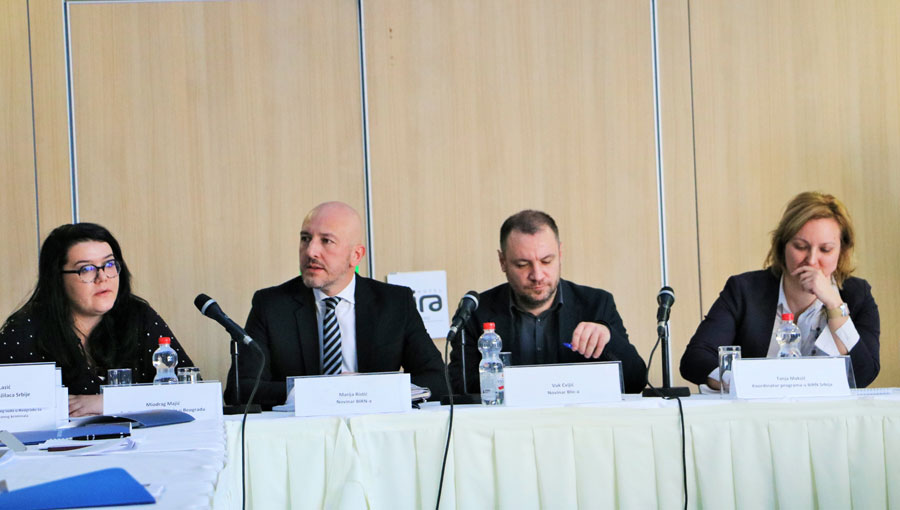
On the eve of International Anti-Corruption Day, BIRN held a panel discussion in the Serbian capital as part of a conference organised jointly with the CEPRIS on the role of the media and prosecution in fighting organized crime and corruption in this Balkan country.

More than 60 representatives of the judicary, NGOs and media in Serbia gathered in Belgrade ahead of International Anti-Corruption Day for a conference jointly organised by BIRN on the role of the prosecution and media reporting in the fight against organized crime and corruption.

The conference, which took place on December 8, was co-organised by the Center for Judicial Research (CEPRIS), the Center for Democratic Transition from Montenegro and the Croatian Legal Center, with support from the European Fund for the Balkans (EFB) and the German Embassy in Belgrade.

During the event, debates were held on the election and position of prosecutors and deputies in charge of combatting organized crime and corruption in Serbia and the region, as well as access to information and media reporting on investigative and judicials proceedings in this sector and problems facing the Public Prosecutor’s Office.

For BIRN’s panel discussion on the day, representatives of the NGO presented the main findings of its Serbian country report on media coverage on organized crime and corruption.

The report was produced as part of BIRN’s project titled “Exercising the Freedom of Expression and Openness of State Institutions in Bosnia and Herzegovina, Kosovo and Serbia,” an endeavor supported by the German Foreign Office Stability Pact funds.

This regional study on how media report on organized crime and corruption investigations and court processes in Bosnia and Herzegovina, Kosovo and Serbia began in March 2017, with the final outcomes to be presented at a regional conference in Bosnia’s capital, Sarajevo, in January 2018.

Balkan Fellowship for Journalistic Excellence – 2017 winners chosen!

Greek freelance multimedia journalist Alexia Tsagkari was awarded first prize for the 2017 Balkan Fellowship for Journalistic Excellence programme at a closing ceremony in Budapest on Thursday.

Tsagkari won the prize of 4,000 euros for her exposé of the abuse facing lesbian, gay, bisexual and transgender, LGBT, asylum seekers on their journey to a safe haven in Europe.

The second prize of 3,000 euros went to Romanian journalist Octavia Coman for his exploration of the complacency, bungling and discrimination that led to a deadly measles epidemic in Romania.

Third prize and 1,000 euros was awarded to Serbian journalist Vladimir Kostic for his investigation into illegal campaign financing by Serbia’s ruling Progressive Party.

Jury members praised Tsagkari for her intimate portrayal of life on the road for LGBT refugees travelling through Turkey and Greece — and the failure of host countries and the humanitarian system to protect them from appalling violence and intimidation.

“Alexia did an extraordinary job of winning the trust of one of the most vulnerable groups within an already vulnerable group,” said jury member Elena Panagiotidis, editor for Swiss daily Zürcher Zeitung. “At a time when people are fed up with refugee stories, she shed new light on the issue, and at considerable risk to herself.”

Jury members singled out Coman and Kostic for their nuanced work on difficult investigations.

“Octavian’s is a skillfully crafted story on a complex yet socially very relevant topic exposing the failure of the Romanian healthcare system through the example of a measles epidemic that has so far claimed 36 lives and infected around 10,000 people,” said Kristof Bander, deputy chairman of the European Stability Initiative.

Speaking of Kostic’s investigation into the use of proxy donors to fill campaign war chests with cash from secret sources by Serbia’s ruling party, Adelheid Wolfl, correspondent for Austrian daily Der Standard, said: “Vladimir not only revealed the arrogance and sense of impunity of the ruling party, but by showing the facts, he contributed to transparency and accountability.”

Ten journalists from Macedonia, Montenegro, Kosovo, Bulgaria, Bosnia and Herzegovina, Romania, Serbia, Croatia and Greece spent more than six months of 2017 pursuing in-depth stories and investigations around this year’s fellowship theme: ‘Change’.

The jury congratulated all of this year’s fellows on the high level of their work, which included stories on organised, crime, corruption, public health, nationalism, the environment and human rights.

A publication titled Change: The Trials of Transition brings together their work and was presented at the award ceremony in front of guests including media partners from around Europe.

The jury members who selected the winners were Florian Hassel, Central and Eastern Europe correspondent for the German daily newspaper Süddeutsche Zeitung; Remzi Lani, executive director of the Albanian Media Institute; Kristof Bander, deputy chairman of the European Stability Initiative; Milorad Ivanovic, representative of the BFJE Alumni network; Elena Panagiotidis, editor for the Swiss daily Neue Zürcher Zeitung; Adelheid Wolfl, correspondent for Austrian daily Der Standard; and Steve Crawshaw from Amnesty International.

With the conclusion of this year’s programme, the 10 fellows join the BFJE alumni network, which consists of more than 90 journalists from 10 Balkan countries who collaborate on stories and promote the highest professional standards.

The Balkan Fellowship for Journalistic Excellence was launched in 2007 to promote high-quality, cross-border reporting. The programme provides fellows with financial and editorial support, enabling them to travel, report and write their stories and develop their journalistic skills.

A project that promotes the development of robust and responsible press, the Balkan Fellowship for Journalistic Excellence has evolved into a decade-long platform that has helped shaping journalism standards in the Balkans and the very careers of participating reporters.

The fellowship will issue a call for applications for next year’s programme in January 2018.

The Balkan Fellowship for Journalistic Excellence is implemented by the Balkan Investigative Reporting Network, supported by ERSTE Foundation and Open Society Foundations.  

Balkan Insight Holds Digital Media Training Course

Balkan Insight held a four-day digital media training course for its reporters and editors across the region, focusing on writing for the web and shooting video stories on mobile phones.

Around 30 BIRN reporters and editors from across the region participated in the intensive, practical training course in Belgrade from December 3-6, which was aimed at giving them the knowledge and skills to enhance Balkan Insight’s multimedia coverage and improve its ability to report news and communicate with audiences in the digital era.

Murray Dick of Newcastle University led training in writing for the web, focusing on best practices in producing stories for online audiences.

Dick explained the principles and practice of search engine optimisation for news, explored online analytics and search metrics, and looked at techniques to help Balkan Insight increase its online readership and audience engagement.

He also introduced the reporters and editors to online interactive resources and methods of communicating data within stories, such as the use of infographics.

Alen Mlatisuma of Voice of America then led two days of training in video reporting techniques using smartphones.

The training covered the use of software and gadgets for video filming and editing with smartphones, and highlighted best practices for shooting news reports.

This was followed by a hands-on exercise in visual story planning, practical advice for shooting high-quality video reports and editing the finished product.

“In addition to raising the skills of our journalists, we hope that the most important benefit of this training will be a wider audience reach,” said Balkan Insight’s editor-in-chief, Gordana Andric.

“Considering the poor media environment in many of the countries in which we work, and the fact that mainstream media are mainly closed to independent and especially investigative reporting, we must find ways to bypass these obstacles, reach readers and provide information,” Andric added.

“Amidst a cacophony of news, fabricated scandals and propaganda, we need to attract their attention in innovative ways and enhance our methods of communicating important stories,” she said.

Global Shining Light Award Judges Honour BIRN

The judges of the prestigious Global Shining Light Award have honoured an investigation by Balkan Investigative Reporting Network with citations of excellence.

BIRN’s investigation “Making a Killing” received special recognition – certificate of excellence – at the Global Investigative Journalism Conference 2017 in Johannesburg on Saturday.

Making a Killing”, which was jointly produced with the Organized Crime and Corruption Reporting Project, uncovered how billions of euros of arms from the Balkans and Eastern Europe are illegally ending up with Syrian rebels, including Islamic State, ISIS.

In July this year, the story was shortlisted for the Global Shining Light Award, an award sponsored by the Global Investigative Journalism Network, GIJN, an association of 155 non-profit organisations in 68 countries.

The story was produced as part of “A Paper Trail to Better Governance” project supported by the Austrian Development Agency to promote rule of law, accountability and transparency in six South-Eastern Europe countries.

Global Shining Light Award Judges Honour BIRN from BIRN on Vimeo.

SHARE Foundation

PARTNER
SHARE Foundation is a nonprofit organisation founded in 2012, with the goal to stand for the public interest in the spheres of digital rights, privacy, free speech, government transparency and efficiency, surveillance and human rights.

SHARE Foundation is dedicated to protecting the rights of citizens and promoting positive values of openness, decentralisation, and exchange of knowledge, information, and technology.

Web: http://www.shareconference.net/en

The Dutch Fund for Regional Partnerships/Matra

DONOR
The Matra programme supports countries in Southeast and Eastern Europein the transition to a pluralist and democratic society, governed by the rule of law.

Matra supports activities that encourage the process of change and strengthen relations between the Netherlands and Matra countries. The programme works with civil society and central and local authorities alike. Most projects take the form of twinning, i.e. partnership between a Dutch and a local organisation.

BIRN project supported by the Matra programme aims to promote and strengthen criminal justice as a first pillar of transitional justice  by organising focus groups with the relevant stakeholders as well as by regular, in-depth, high standard reporting on war crimes processing from Bosnia and Herzegovina, Croatia, Serbia and Kosovo, with a goal of building capacities of local journalists, relevant officials, judiciary, law enforcement agencies, legal professionals, civil society actors on addressing impunity and the challenges of the transitional justice processes.

Webhttps://tinyurl.com/y9r36hbz

BIRN Publishes Ratko Mladic Trial E-Book

Ahead of former Bosnian Serb military commander Ratko Mladic’s war crimes verdict next week, BIRN has compiled all its reports on the landmark case into a free, downloadable e-book.

BIRN published a new e-book on Tuesday entitled ‘Ratko Mladic: From Battlefield to Courtroom’, ahead of the former Bosnian Serb commander’s trial verdict on November 22.

The e-book, which is downloadable free of charge, contains all BIRN’s reports on the case from the point when Mladic was transferred to the International Criminal Tribunal for the Former Yugoslavia in The Hague to face trial to his defence’s recent requests to postpone the verdict on grounds of ill-health.

“Our journalists have following every hearing in their landmark trial over the course of the past six years. We also reported regularly on developments outside of the courtroom that are relevant to the case,” said Marija Ristic, director of BIRN’s transitional justice programme.

“Ahead of the next week’s verdict, we believe this could be a valuable resource for anyone interested in getting all the facts from this important process in one place,” she added.

The e-book contains more than 500 articles and runs to more than 600 pages.

It is the second to be published this month, after BIRN also issued an in-depth e-book containing reports and analyses about the Kosovo Specialist Chambers.

Mladic’s trial, which began in 2011, lasted for 530 days and heard evidence from 591 witnesses, of whom 377 appeared in court.

Mladic is charged with the genocide of over 7,000 Bosniak men and boys from Srebrenica in 1995, the persecution of Bosniaks and Croats throughout Bosnia and Herzegovina, which allegedly reached the scale of genocide in several other municipalities in 1992, terrorising the population of besieged Sara­jevo and taking UN peacekeepers hostage.

According to the indictment, he used military force to implement a joint criminal enterprise, spearheaded by the Bosnian Serb political leadership and former president Radovan Karadzic, aimed at creating a Serb-domi­nated state.

Mladic, now aged 74, has denied committing genocide, war crimes and crimes against humanity.

To download the e-book, click here.

BIRN in Consortium to Assist Public Service Media

BIRN is a part of a consortium led by the International Federation of Journalists (IFJ) that will implement a project entitled ‘Technical Assistance to Public Service Media in the Western Balkans’, supported by EU funding.

The European Broadcasting Union (EBU), Austrian public broadcaster ORF and the Office of the Eurovision News Exchange for South-East Europe (ERNO) are the other members of the consortium.

The project is being implemented because public service media in the Western Balkans are at a crossroads. They urgently need to embrace an audacious reform agenda and adapt to a rapidly changing media environment or they run the risk of becoming irrelevant.

The project aims to revitalise the region’s public broadcasting sector and bring new confidence to the key stakeholders involved.

It is responding to the stark imperative to rebuild public trust in institutions which are still highly vulnerable to political interference and which appear to be increasingly disconnected from their audiences.

The project has three specific objectives; firstly, it aims to reestablish European standards and promote best practice at the six public service media organisations in Albania, Bosnia and Herzegovina, Kosovo, Macedonia, Montenegro and Serbia, with a particular focus on helping them to achieve financial autonomy from the state and greater accountability to the public.

It will work to seek consensus on the principles and practice for sustainable funding models as well as securing agreement on fair, transparent and accountable procedures for electing the members of governing bodies.

The project will also work to generate synergies between the six broadcasters by initiating a new phase in ongoing reform processes and helping to formulate long-term strategies.

As a part of this, the programme will facilitate the improved implementation of editorial policies and complaints mechanisms, which in some cases exist on paper only.

It will also support efforts to establish integrated newsrooms, to streamline newsgathering and production processes.

A further aspect of the project will is to continue work in the field of management reform, developing long-term strategies and mentoring their roll-out across multiple departments.

This will be complemented by an initiative to equip regulators with the skills to conduct or commission reliable surveys which will give programme-makers a better insight into audience needs.

The third objective of the technical assistance programme is to expand cooperation in programme-making between the six public service media organisations, ensuring that they can pool resources and share audiovisual materials in a more effective way.

This will be achieved by building the capacity necessary to produce in-depth investigative reports as well as high-quality programming for children and young people.

The project will also seek to introduce new interactive formats which optimise the potential for audience engagement.

In addition to this, a regional platform will be created for sharing archive material between the  broadcasters, enriching factual programming and encouraging further collaboration.

The training programme led by BIRN will address some of the shortcomings inherent in mainstream media across the Western Balkans – low levels of professional skills, an absence of continued mid-career training, and indirect or direct outside influence which prevents the broadcasting of stories which conflict with the interests of local power-brokers.