Balkan Transitional Justice Initiative Grants for Journalists

The Balkan Investigative Reporting Network is launching a call for in-depth investigative stories on transitional justice themes in the Balkans.

Grants are offered to ten journalists to cover topics related to truth, justice, accountability, memory, institutional reform and other issues related to dealing with the past. The selected journalists will receive mentoring by experienced editors.

The call is a part of the Balkan Transitional Justice Initiative project, financed by the European Commission.

The project’s aim is to strengthen in-depth reporting on transitional justice in the Balkans, in order to contribute to a more informed citizenry that is engaged in the democratic process.

Ten journalists will be awarded €1,000 grants to cover their expenses while conducting investigations and writing their stories on transitional justice issues.

The journalists will have around three months to dig deeper and research their ideas, and will also have the opportunity to work with experienced editors as mentors to guide them through the process of writing in accordance with BIRN standards.

The call applies to journalists from Croatia, Bosnia and Herzegovina, Macedonia, Serbia, Montenegro, Kosovo and Albania.

All further information regarding application process can be found in our application guidelines.

To apply, send the following documents to [email protected] with the subject “Balkan Transitional Justice Initiative grant application” by November 19th:

  • Resume (CV)
  • Letter of motivation
  • Completed application form 
  • Link to or copy of example of published work
  • Any other relevant documents

Resonant Voices Initiative

BIRN Hub

Resonant Voices Initiative (RVI) is a network of journalists, activists, and community leaders who challenge dangerous messages online, map online radicalisation trends, and provides training, mentoring, and technical support to counternarrative campaigns.

Summary

RVI counters dangerous messages that include terrorist propaganda, hate speech, disinformation, harassment, and intimidation. Online amplification and distribution tools has made targeting vulnerable audiences with manipulated and weaponised information possible at an unprecedented scale, increasing the risk of harm to individuals and communities, especially in post-conflict societies. The aim of the RVI is to empower a diverse group of civil society actors – activists, journalists, bloggers, educators, and other online (and offline) influencers – to strategically engage in online and offline communication campaigns, utilising technology, together with a deep understanding of their communities, to produce compelling content that effectively pushes back against polarising, inflammatory, and radicalising discourse.

From 2018, the Resonant Voices Initiative will expand its focus to the Western Balkan diaspora communities living in the EU.

Donor

European Union, Internal Security Fund – Police

Main Objective

The project’s general objective is to strengthen the influence of credible voices that challenge extremist propaganda by targeting audiences vulnerable to radicalisation within the Western Balkans diaspora in the EU.

Specific Objectives

–         To reach vulnerable segments of the Western Balkan diaspora living in the EU through a comprehensive and previously tested approach – a strategic communications model in response to radicalising influences leading to violent extremism, based on research, multi-stakeholder consultations, collaborative prototyping, and rigorous audience assessment and impact testing.

–         To provide credible, alternative, and positive narratives exposing and challenging online and offline extremist messaging and targeting of the Western Balkan diaspora.

–         To explore, address, and reduce the influence of push-and-pull factors of online extremist content among the Western Balkan diaspora.

–         To promote tolerance and the EU’s fundamental values among the targeted audience.

Main Activities

–         An in-depth audience research will be conducted with the aim to better understand the motivations, circumstances, and context that drives recruitment to violent extremism among the target audience. The research will also aim to identify gaps, shortcomings, and good practices in addressing extremist content, in the countering of extremist propaganda. Data will be collected to map online content and online behaviours of the target audience and their exposure to different types of narratives and problematic content, as well as existing or emerging counter-speech efforts.

–        The Resonant Voices Fellowship will create a pool of investigative journalists and reporters who will be able to competently and sensitively report on subject matters relating to extremist radicalisation and violence, as well as explore and investigate issues and influences driving online  extremist propaganda and other information manipulation efforts.

–         An online communication campaign to provide an alternative or counter narrative for a well-defined target audience that is vulnerable to radicalisation. This will be combined, where appropriate, with off-line activities, which will be designed and implemented. The project will strive to develop the capacities of local beneficiaries to meaningfully challenge extremist narratives by creating and distributing compelling content, using various creative communication techniques.

–         Based on the research, investigative reports, practical testing, and fieldwork conducted as part of this project, recommendations and other relevant findings will be compiled and further disseminated and used as guides in future Europe-wide efforts to counter violent extremism. These will be particularly for experts and practitioners engaged through initiatives of the Radicalisation Awareness Network (RAN) and the Civil Society Empowerment Programme (CSEP).

Target Groups

Audiences vulnerable to radicalisation and recruitment within the Western Balkans diaspora in the EU.

Main Implementer

Stichting Commission for International Justice and Accountability (CIJA) – Netherlands.

Partners

Foundation Propulsion Fund – Serbia

Balkan Investigative Reporting Regional Network (BIRN Hub) – Bosnia and Herzegovina

Dunja Hadzimurtezic

Dunja Hadzimurtezic joined BIRN Hub in September 2018 as Project/Administrative Assistant. She is based in BIRN Hub’s Sarajevo office providing support to the regional Finances, Operations, Projects and Programmes.

Her main responsibilities include close cooperation with the Finance Manager to ensure smooth operation of all finance matters, planning and organising petty cash for events, managing advances and reporting on expenses, managing bookings and travel related services, managing all entries into financial database, assisting and supporting Programme staff in implementation through advice and assistance on the ground (e.g. organization of event, collection of offers), assisting to the BIRN Regional Director in implementation of their work and all other administrative and operations tasks.

Before joining BIRN Hub, Dunja worked in the NGO sector for almost 14 years as Project Coordinator, gaining strong professional skills in Office Administration, Finances and Operations and Logistics. She also has experience working as Translator/ Interpreter for UNDP.

She studied at the University in Sarajevo in the Department of English Language and Literature. Along with her native Bosnian language, Dunja is fluent in English and has a basic knowledge of Albanian.

BIRN Holds Investigative Journalism Training for Public Broadcasters

Thirteen journalists from public broadcasters in the Western Balkans met in Belgrade on Friday for the start of an investigative reporting workshop organised by the Balkan Investigative Reporting Network, BIRN.

A three-day regional investigative reporting workshop for journalists from public broadcasters in the Western Balkans, organised by BIRN Hub, started in Belgrade on Friday with a visit to Radio Television of Serbia, RTS.

The workshop is a part of the project “Technical Assistance to Public Service Media in the Western Balkans”, financed by the European Union, which aims to revitalise the region’s public broadcasting sector and bring new confidence to the key stakeholders involved.

EU ambassador to Serbia Sem Fabrizi, who delivered the opening address of the training, highlighted that media freedom is of fundamental importance to a democratic society.

He noted that public service broadcasters play a special role in responding to public interest for information in today’s challenging media environment.

“The media landscape is changing – we now have social networks, fake news; these elements call into question the freedom of the media,” Fabrizi said, adding that public service broadcasters are crucial in today’s media sector.

Dragan Bujosevic, General Director of RTS, stated during his address at the opening ceremony, that he disagrees with the term investigative journalism, but for a specific reason:

“Journalism is always investigative… there is no other type,” he said.

2
5
3
4
Aperture: 2.8
Camera: Canon EOS-1D Mark III
Iso: 2500
Orientation: 1

BIRN Macedonia’s Director, Ana Petruseva, who was among the trainers for the workshop, noted: “We are seeing many challenges to investigative reporting today, and the role of public broadcasters is vitally important. Especially since we have less people in news rooms prepared to fight and look out for the public interest.”

She added that over the next three days, “we hope to give journalists tips, tricks and skills they can use to improve their reporting.”

Lead trainer Nils Hanson from the Swedish public broadcaster SVT said: “The need for investigative journalists has never been bigger than it is today,” stressing that “the work of an investigative journalist is very dangerous.”

He added that in Sweden there has been a revival of investigative journalism, with all TV stations having noticed that viewers demand it and are willing to pay for it.

The project, intended to train public broadcasters to produce increasingly pluralistic, independent and accountable content, is being led by the International Federation of Journalists, IFJ, together with BIRN, the European Broadcasting Union, EBU, the European Federation of Journalists, EFJ, the Austrian Public Broadcaster, ORF, and the Eurovision News Exchange for South-East Europe, ERNO.

Journalists Trained for Data Journalism in Montenegro

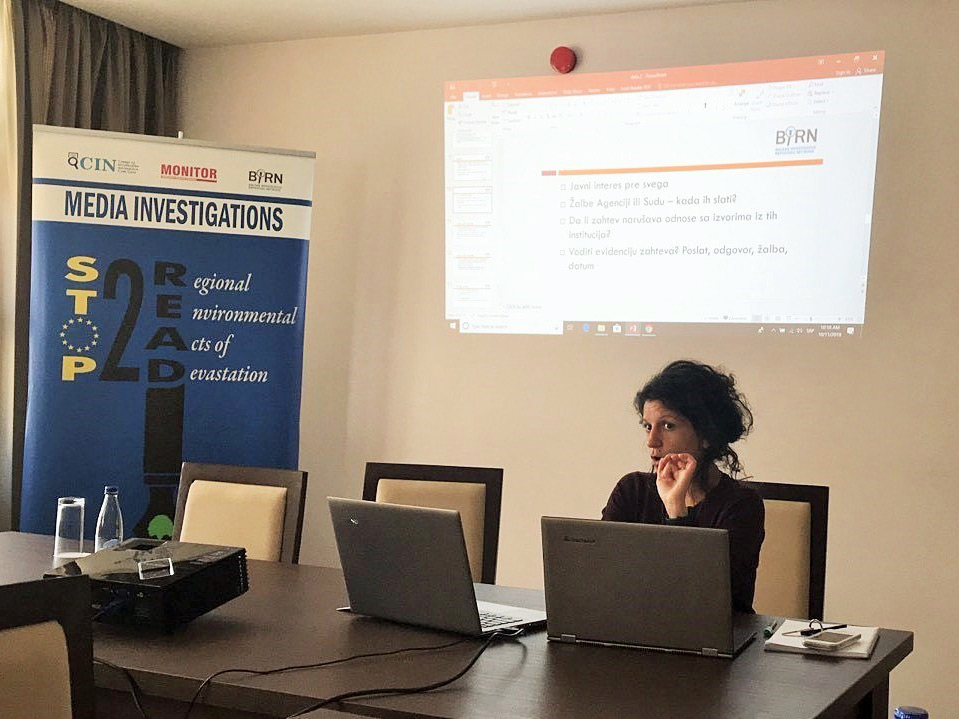
BIRN, CIN Montenegro and Monitor magazine organised a training course on data journalism for Montenegrin journalists on October 10 and 11 in Podgorica.

The training was held as part of the project Media Investigations: Stop to READ (Regional Environmental Acts of Devastation) which aims to strengthen investigative reporting in Montenegro.

Training topics included national and international databases and registries, their importance in investigative journalism and practical instructions on how to gather data and how to use them for writing stories; freedom of information laws and how to obtain data using them; tips and tricks for browsing, and using social networks in data journalism.

The training was held by Milka Tadic-Mijovic (CIN Montenegro), Dusica Tomovic and Jelena Cosic (BIRN Hub), and Slobodan Georgiev (BIRN Serbia).

The project was funded by the EU Delegation in Podgorica.

Facebook Removes Pages of Rightists Investigated by BIRN, BBC

Facebook has taken down at least 14 pages identified in a BIRN and BBC collaboration as linked to the Knights Templar International, a ‘Christian militant’ organisation active in the Balkans.

The social media giant has removed a network of pages, whose followers total millions, tied to the Knights Templar International, KTI, BIRN reported on Thursday.

KTI – which calls itself “a living shield and sword for the defence of Christian communities and the upholding of Christian principles” – has boasted about how its vast network of social media pages helped to elect Donald Trump as US President and swing the UK referendum on leaving the European Union.

The organisation has attracted controversy for its hard-line views on Muslim immigration to Europe and donation of equipment to so-called “migrant hunters” in Bulgaria and to Kosovo Serbs preparing for confrontation with Kosovo’s mainly Muslim Albanian majority.

In May this year, BIRN and the BBC published the fruits of their collaboration into the British nationalists operating in the Balkans.

BIRN’s investigation highlighted the links between British anti-immigration hardliner Jim Dowson and a web of patriotic sites, including the KTI, which are becoming increasingly active in Serbia.

The BBC produced television and radio documentaries focusing on Dowson, “the invisible man of Britain’s far right”, and his activities in Hungary, Bulgaria, Serbia and Kosovo. Read it here: Is this Britain’s most influential far-right activist?

These collaborations are part of BIRN’s Paper Trail to Better Governance programme, funded by the Austrian Development Agency.

BIRN Conference Highlights War Crimes Cooperation Problems

Cooperation on war crimes cases between prosecutors’ offices in former Yugoslav countries happens rarely despite agreements between the states, said participants at a major regional conference organised by BIRN.

Regional cooperation between prosecutors’ offices in former Yugoslav countries is beset by problems, despite the protocols that states have signed agreeing to collaborate on war crimes cases, said speakers at a conference organised by the Balkan Investigative Reporting Network in Sarajevo on Wednesday.

“The cooperation exists in theory, but it is non-existent in practice,” Aleksandar Kontic, legal officer at the Mechanism for International Criminal Tribunals in The Hague, told the conference entitled ‘After the ICTY: Regional Cooperation, Accountability, Truth and Justice in the Former Yugoslavia’.

Kontic said that the chief prosecutor at the Hague court, Serge Brammertz, has reported countries in the region to UN Security Council on several occasions due to their non-cooperation on war crime cases.

He also suggested that part of the problem was that all countries in the region still divide suspects into two categories – “our heroes and their criminals”.

The acting chief prosecutor at the Bosnian state prosecution, Gordana Tadic, said her institution wants to improve regional cooperation because some of the suspects being sought for prosecution in Bosnia and Herzegovina are living in Serbia and Croatia.

“It is important for war crime perpetrators not to remain unpunished no matter where they are,” Tadic said.

In 2013, the prosecutor’s offices of Bosnia and Herzegovina, Croatia and Serbia signed protocols enabling the free exchange of war crime cases, investigations and case documents. Despite the fact that several cases have been exchanged and processed, very few against high-ranking suspects have been successfully transferred to neighbouring countries’ jurisdictions, while numerous suspects have never been arrested or had cases brought against them.

Jurica Ilic of the County Prosecution in Zagreb pointed out that Croatia has certain legal differences that complicate cooperation with other former Yugoslav states.

“There is a problem related to existence of different standards in individual countries, which makes it impossible to take over complete cases,” Ilic said.

Croatian law does not recognise the concept of a ‘joint criminal enterprise’, and the Croatian government has ordered the country’s Justice Ministry, when reviewing cooperation requests from Bosnia, to refuse to act on any which “violate state interests” – meaning those in which Croatia is named as a participant in a joint criminal enterprise during the Bosnian conflict.

Paul Flynn, prosecution manager at the EU’s rule-of-law mission in Kosovo, EULEX, said meanwhile that cooperation between Pristina and Belgrade on war crimes cases was almost non-existent.

“Without that, I think we shall have no justice at all,” Flynn warned.

Merita Gashi, an adviser to the Kosovo chief state prosecutor, said that Pristina and Belgrade have no legal cooperation at all because of Serbia’s refusal to recognise Kosovo’s independence.

“There are around 13,000 victims of the military conflict in Kosovo. Victims are tired of waiting. They are beginning to lose confidence,” Gashi said.

Ivan Jovanovic, an expert in international law, told the conference that former Yugoslav countries had to accelerate cooperation because as the years pass, suspects, victims and witnesses are all getting older.

“We are witnessing that victims are dying and many suspects are dying,” Jovanovic warned.

The conference continues on Thursday.

Read more:

Poor Cooperation Leaves Balkan War Crime Suspects at Large

Srebrenica Suspects Find Safe Haven in Serbia

Serbia-Kosovo Stalemate Allows Fugitives to Stay Free

After the ICTY: Regional Cooperation, Accountability, Truth and Justice in the Former Yugoslavia

Twenty years after the conflicts in the former Yugoslavia and a year after the International Criminal Tribunal for the Former Yugoslavia closed down, accountability, truth and justice still seem more like an ideal than a reality.

The conference, organised under the umbrella of BIRN’s Transitional Justice Initiative, will discuss regional cooperation in war crimes prosecution and missing persons, victims’ participation, and the role of archives, art, media and museums in dealing with the past.

Participants from civil society, the expert community, institutions, academia and the media will try to answer the overarching questions – how far we are from reconciliation, and what more we could do to combat impunity and increase intercultural dialogue?

The conference aims to have a results-oriented approach that will be reflected in a policy paper that will be used to further influence policies on both the national and EU levels with the goal of making transitional justice one of the key areas within the framework of EU negotiations.

The working languages of the conference are English, Albanian and BCS. Simultaneous translation will be provided during the whole event.

For more information about the conference, click here.

BIRN Holds Meeting on Regional War Crimes Cooperation

After previous meetings in Zagreb and Sarajevo, BIRN organised a meeting of transitional justice stakeholders in Belgrade on September 11 to develop recommendations for improving regional cooperation in prosecuting crimes committed during the 1990s wars.

The meetings are being held as a part of BIRN’s Balkan Transitional Justice programme, bringing together representatives of war victims’ associations and the courts, as well as NGO members, humanitarian law experts and representatives of international organisations.

At the meeting in Belgrade, the participants raised various issues concerning regional cooperation in prosecuting war crimes committed during the 1990s conflicts, such as trials of defendants in their absence, the lack of cooperation between countries’ prosecutor’s offices and the lack of political will for states to fully cooperate.

As well as raising their concerns about such problems, the participants suggested possible solutions.

This input, along with input from the meetings in Zagreb and Sarajevo and the upcoming one in Pristina in September, will be formulated into recommendations.

After all four meetings with stakeholders, one final conference will be held at the regional level in Sarajevo on October 3-4.

The recommendations from the stakeholders’ meetings and the conference will be used to create a policy paper for improving regional cooperation between states in prosecuting war crimes.

BIRN Participates in Media and Terrorism Conference in Bosnia

Providing accurate and unbiased information is essential when reporting about terrorism and violent extremism, heard a conference organised by the OSCE Mission to Bosnia and Herzegovina on Mount Jahorina from August 31 to September 2, at which BIRN’s regional director was a speaker.

The conference brought together over hundred journalists and media professionals to discuss professional standards related to reporting on terrorism and violent extremism.

As Bruce G. Berton the head of the OSCE mission in the country noted, while news about these topics draws a lot of attention and outlets are expected to publish or air it as quickly as possible, it is up to media to avoid sensationalism in the process.

The age of social media had put even greater importance on reporting professionally and responsibly on violent extremism and terrorism.

Unnamed and non-credible sources are one of the dangers for spreading propaganda.

Adhering to ethical standards such as truthfulness, independence, objectivity, empathy and responsibility are key principles in reliable reporting about terrorism and terrorist attacks, said Aidan White, president of the Ethical Journalism Network.

Marija Ristic, BIRN’s Regional Director, who spoke about reporting on violent extremism in Serbia, stressed that media often respond to the dominant narrative in society.

Reporting on the topic in Serbia is overly tabloid with sensationalistic content, almost no sources, and often alarmist in tone, emphasising Islamic radicalization, Ristic said.

But Serbian media takes a completely different tone when reporting on Serb fighters serving with pro-Russian forces in Ukraine, when its dominant narrative is one of “support for our Russian brothers” and a “justified struggle”, she added.