
CEI SEEMO Investigative Awards Judges Praise BIRN Journalist

Nermina Kuloglija, a BIRN journalist from Bosnia and Herzegovina, was given a special mention by the judges of the CEI SEEMO journalism awards for outstanding merits in investigative journalism.

The judges at the CEI SEEMO journalism awards ceremony in Belgrade on Wednesday praised BIRN’s Nermina Kuloglija for her dedicated work on monitoring public procurement during the coronavirus pandemic.

From March 2020 until the end of the year, Kuloglija followed all public expenditures in Bosnia and Herzegovina that were part of the authorities’ counter-pandemic efforts through a special database. She registered the expenditures totalling more than 30 million euros and published several stories about the issue.

“Nermina was praised for the database she produced during the pandemic that collated public procurements across the country related to medical equipment, which also allowed her to reveal some notable corruption stories,” a member of this year’s jury, Sasa Lekovic, said while presenting the award.

The jury also gave a special mention to Vlad Odobescu, a freelance journalist who works for the Romanian Investigative Journalism Centre.

The award for outstanding investigative journalism was given to Sadeta Bajrovic, a journalist with the Centre for Investigative Journalism in Sarajevo, in the ‘professional journalists’ category. The jury has praised her stories focusing on vulnerable and ordinary people during the pandemic.

The award for ‘young journalist’ was given to Milica Vujanovic, a journalist who works for the Organised Crime and Corruption Reporting Project and KRIK investigative media outlet in Serbia, for her stories about organised crime.

The CEI SEEMO awards aim to honour the work carried out by investigative journalists and their contribution to investigative reporting despite the difficult conditions under which they have to operate. Thay are organised by the Central European Initiative, CEI, in cooperation with the South East Europe Media Organisation, SEEMO.

The 2021 awards were intended to bring public attention to journalists who reported on the social and economic influence of the pandemic on people’s lives, investigating stories focusing on gender, youth, minorities and people with disabilities.
BIRN Bosnia and Herzegovina Journalist Shortlisted for International Award

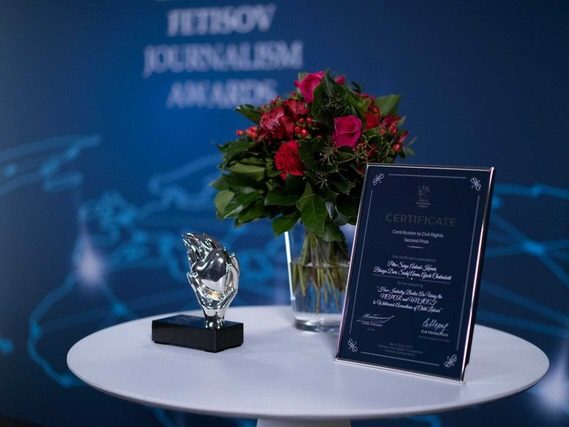
Haris Rovcanin, a journalist with BIRN Bosnia and Herzegovina, has been shortlisted for the Fetisov Journalism Awards in the ‘Outstanding Contribution to Peace’ category.

Four articles written by Haris Rovcanin for BIRN Bosnia and Herzegovina, two of which were co-written by Albina Sorguc, have been shortlisted in the ‘Outstanding Contribution to Peace’ category of this year’s Fetisov Journalism Awards.

The articles include two investigative pieces, Bosnian Serb Military Police Chiefs Never Charged with Srebrenica Killings and Serb Chetniks’ Links to War Criminals and Extremists Uncovered.

They also include a feature, 28 Years on, Families still Searching for Missing Bosnian Soldiers and an analysis piece, BIRN Fact Check: Is the Bosnian Serb Report on the Sarajevo Siege Accurate?

The annual Fetisov Journalism Awards aim to promote “universal human values such as honesty, justice, courage and nobility through the example of outstanding journalists from all over the world”.

Other nominees in the same category as Rovcanin include Swedish-Syrian duo Ali Al Ibrahim and Khalifa Al Khuder’s story ‘Syria’s Sinister Yet Lucrative Trade in Dead Bodies’, Nigerian journalist Kalopo Olapojua’s series of stories ‘Conflict in a Pandemic’, Spanish journalist Marga Zambrana’s article ‘Uyghur Refugees Speak Out Against Genocide and Crimes Against Humanity’ and Olatunji Ololade from Nigeria for the piece ‘The Boys Who Swapped Football for Bullets’.

The ‘Outstanding Contribution to Peace’ category recognises publications on anti-war topics that have made an important contribution to peace-making.

The three other categories in the awards are ‘Contribution to Civil Rights’, ‘Outstanding Investigative Reporting’ and ‘Excellence in Environmental Journalism’. This year, just under 400 entries from 80 countries were submitted.

Three winners will be announced in each of the categories in February, while the awards ceremony will take place in Switzerland in April

Former BIRN Bosnia and Herzegovina journalist Sorguc was also shortlisted alongside Emina Dizdarevic for the Fetisov awards in 2019 in the ‘Outstanding Contribution to Peace category with a series of articles on war crimes and transitional justice.


BIRN BiH Leads Petition for More Transparency in Bosnia’s Judiciary

Through a campaign to collect citizens’ signatures, the Balkan Investigative Reporting Network Bosnia and Herzegovina, BIRN BiH, wants to draw public attention to the problem of inaccessible corruption indictments and verdicts, asking judicial institutions to increase the transparency of their work.

BIRN BiH will hand over the signatures alongside an analysis on the (non)transparency of the judiciary and recommendations for improvements to the High Judicial and Prosecutorial Council of Bosnia and Herzegovina, HJPC, demanding a revision of recommendations for publication of prosecutorial acts, in particular the public availability of corruption indictments.

Through its project, “Transparency against Corruption in Judiciary,” BIRN BiH wants to encourage citizens to take a proactive role and seek necessary changes in the judiciary, as well as raise awareness on the need to standardize document publication practices with the focus on corruption indictments and point to bad practices in the Bosnian judiciary in terms of transparency.

This campaign is being carried out as part of the “Transparency against Corruption in Judiciary” project with financial support from the US Agency for International Development, USAID.

It forms part of a broader project, “Assistance to Citizens in the Fight against Corruption,” which is being implemented by the Centers for Civic Initiatives as the leading partner.

Petition can be signed here

Video for the campaign https://www.youtube.com/watch?v=HsrLO30-3DU

Memorial Center and BIRN BiH to Hold Oral History Conference

On July 7, the Memorial Center in Srebrenica and the Balkan Investigative Reporting Network Bosnia and Herzegovina, BIRN BiH, will hold a conference in Potocari on “The Role of Oral History in Countering Revisionist Narratives”.

They will present a joint project here titled, “The Lives behind the Fields of Death”, within which a special methodology for collecting oral history from surviving genocide witnesses has been developed.

During the conference in Potocari, the Memorial Center’s director, Emir Suljagic, and BIRN BiH’s executive director, Denis Dzidic, will speak about their experiences in recording oral history.

Suljagic pointed out that through this project the Srebrenica Memorial Center has made a pioneering undertaking of documenting Bosnian history by filming not only the experiences of the July 1995 genocide survivors but also their pre-war lives. “The Lives behind the Fields of Death” records the habits, tradition and spirit of Srebrenica as it was before the events of 1995.

Researchers, as well as the broader public, will have a chance to see the faces and hear the stories, while not having to create an image of the Srebrenica genocide only in terms of the numbers of casualties – which are being denied constantly.

“The idea of this conference is to see how our common history and memories and all our knowledge can find a way to young people in this country both through formal and informal mechanisms. I am particularly glad that the Memorial Center will be the venue for a discussion on this topic,” Suljagic said.

Dzidic said it was shocking that nearly 30 years after the genocide, many young people are still unfamiliar with what happened in Srebrenica in July 1995, and during the entire war. Young people, he noted, are now exposed to denial of genocide and other crimes, as well as the open glorification of convicted war criminals.

“Through this project we have enabled a serious debate about revisionism and the ways to counter it. Following so many verdicts by both international and domestic courts, crimes and genocide are still being denied. It is of extreme importance to start countering that within the educational system,” Dzidic said.

During one of the conference panels, the participants will discuss how oral history can be used to counter revisionism and war crime denial, while international and domestic experts will also discuss how to include oral history in the formal and informal educational systems.

During the conference, videos from “The Lives behind the Fields of Death” will be premiered alongside a video presentation of an exhibition room from “The Lives behind the Fields of Death” project, which will be open to visitors by the end of 2021.

Since October last year, 100 testimonies of genocide survivors have been filmed within the “The Lives behind the Fields of Death” project using, for the first time, a special oral history methodology designed by the Memorial Center.

Through this project financed by the government of the Netherlands, the Memorial Center and BIRN BiH wanted to link individual testimonies with items in the museum collection of the Memorial Center, which survivors have donated. They have also collected new artefacts and testimonies. In future the Center will work on developing the methodology further in cooperation with the De Montfort University from Leicester in England.


Mirza Mrso

Mirza joined BIRN BiH in March 2021. He has been a cameraman for 15 years in TV companies in Bosnia.

He has experience in making documentaries and feature TV series and in daily monitoring significant events. Before starting at BIRN BiH, Mirza worked for the Federation of BiH’s Public Service Radio and Television.

BIRN BiH to Build Database of Judicially Established Facts About Bosnia War

The Balkan Investigative Reporting Network Bosnia and Herzegovina, BIRN BiH, has begun to create an interactive educational database of judicially established facts about the 1992-5 war with the aim of confronting revisionist narratives and war crimes denial.

The Balkan Investigative Reporting Network Bosnia and Herzegovina, BIRN BiH, has begun to create an interactive educational database of judicially established facts about the 1992-5 war with the aim of confronting revisionist narratives and war crimes denial.

The goal of the project, launched in early April this year, is to raise the level of public understanding, ensure support for coming to terms with the past by developing a tool for teaching and learning about the war in Bosnia and Herzegovina, and challenge revisionist narratives.

BIRN BiH executive director Denis Dzidic said the project will present a unique approach to war crime judgments. Instead of focusing on individuals, he said, BIRN BiH will investigate and report judicially established facts about the things that happened in certain areas of the country during the war.

“The idea of the project is to create a source of fact-based data, which can be used for educational and informational purposes and which will contribute to combating disinformation and improving media literacy,” Dzidic said.

As a result of the project activities, BIRN BiH will create a multimedia database enriched with short documentaries, as well as educational tools for teachers that will help them prepare a methodology for teaching and learning about the Bosnian war.

“The database, documentaries and teaching tools will be developed in a unique manner, leaving no space for interpretations and misuse of established facts,” Dzidic said.

The project is supported by the UN Democracy Fund.


BIRN Bosnia’s Nermina Kuloglija Longlisted for One World Media Award

Nermina Kuloglija, a journalist with the Balkan Investigative Reporting Network Bosnia and Herzegovina, BIRN BiH, has been longlisted for the One World Media award in the New Voice category for young journalists who have made a substantial contribution to international journalism during the year.

Nermina Kuloglija, a journalist with the Balkan Investigative Reporting Network Bosnia and Herzegovina, BIRN BiH, has been longlisted for the One World Media award in the New Voice category for young journalists who have made a substantial contribution to international journalism during the year.

She has been listed alongside ten other journalists in one of the categories of the One World Media international awards for her series of articles on far-right organisations in Bosnia and Herzegovina.

Kuloglija was the first journalist to investigate the links between right-wing groups in Bosnia and extreme right organisations in the USA Europe, Russia and Ukraine. She is the only journalist from Bosnia put up for this year’s award.

The nomination refers to these published investigations: In Bosnian River Town, Far-Right Symbols and a Link to Ukraine, Ultra-Right Groups Show Their Face in Bosnian Town as well as a TV Justice episode, Nationalism Festers in Srebrenica, 25 Years after Genocide.

A total of 150 journalists and media workers are competing in 15 categories. The short list of three nominees in each category will be announced in May. The winners will be announced during an online ceremony on June 17.

Kulogija joined BIRN BiH in August 2019. She began journalism after graduating from the Faculty of Political Sciences in Sarajevo in 2017. As a member of BIRN BiH team, she has won the European Press Prize award for reporting on transitional justice and war crimes processes in Bosnia for many years, as well as a special plaque of the Srdjan Aleksic award for reporting about marginalized groups.

BIRN Bosnia Journalist Awarded for Balkan Cossack Army Report

Bosnian winner of prize for reporting on issues of regional dialogue and cohesion praised for tackling topical issue of foreign influences on Balkans.

Mladen Obrenovic, a journalist with the Balkan Investigative Reporting Network Bosnia and Herzegovina, BIRN BiH, has won an award for his article on the Balkan Cossack army.

The journalistic awards were given at an online ceremony during a regional conference of the Dialogue for the Future, DFF: Fostering Dialogue and Social Cohesion in, and between, Bosnia and Herzegovina, Montenegro and the Republic of Serbia.

This year the jury consisted of three members, Kristina Ljevak from Bosnia, Lidija Vujacic from Montenegro and Galeb Nikacevic from Serbia.

Vujacic, an anthropology professor at the University of Montenegro, said Obrenovic had explored a topical issue from the political and ideological, and broader cultural, aspect, with his feature about foreign influences and their effects.

“Under Cossack Banner, Russian Ties with Balkan Fighters Strengthened” followed a group of pro-Russian Cossacks who call themselves an army and gather veterans of the wars in Bosnia and the eastern Ukraine in Balkan countries.

Obrenovic investigated the operations of this group in the Balkans, whose central organization in Russia  has the Russian President Vladimir Putin as its honorary chair.

Obrenovic said that he worked on this story for three months, adding it was a very demanding in some areas as it involved “a very deep digging through numerous secrets and many things whose actors did not want to see discovered”.

“Now, I somehow see this as an award for my work so far,” Obrenovic said.

The journalistic award for Serbia was given to Una Sabljakovic, whose story was the on institutional invisibility of women victims of sexual violence during the past wars, who, having experienced the traumas of war, have faced secondary intimidation and stigmatization during the subsequent time of peace.

Svetlana Djokic, the award winner for Montenegro, wrote her story about the transnational problem of organised crime with a focus on trafficking in human beings.

“Dialogue for the Future, DFF: Fostering Dialogue and Social Cohesion in, and between, Bosnia and Herzegovina, Montenegro and the Republic of Serbia,” is a joint regional programme implemented by the UNDP, UNICEF and UNESCO with the support of the UN Peacebuilding Fund.

The initiative was launched in Bosnia in 2014 following discussions between the UN Secretary General and the Presidency of Bosnia and Herzegovina.

In 2015, at the Brdo-Brijuni Summit in Budva, Montenegro, the leaders of the region recognised the project and encouraged its expansion to Southeast Europe.

The joint DFF regional programme contributes to the realization of Agenda 2030 and particularly to the realization of four goals listed among the sustainable development goals; quality education; gender equality; sustainable citizens and communit and peace, justice and strong institutions.

The programme aims to offer support on the collective identification of issues affecting all citizens in the region and contributing to improved interaction and cooperation between groups.

BIRN BiH Journalist Wins Srdjan Aleksic Award

Emina Dizdarevic, a journalist with the Balkan Investigative Reporting Network Bosnia and Herzegovina, BIRN BiH, has won the Srdjan Aleksic Journalist Award in the category of nominations by journalists, for her three articles on the challenges facing marginalized groups in Bosnian society.

“Dizdarevic has won the award for shedding light, in a special, analytic and creative manner, on topics already addressed by many other journalists, but she did it in a different way and from a different angle.

“The judges were most impressed with her article on the special ‘obstacles’ placed before the Sarajevo Pride Parade organizers, to prevent the LGBT population from realizing its right to hold peaceful protests,” the announcement said.

Her first awarded article dealt with the rights of LGBT persons in Bosnia. Dizdarevic noted systemic shortcomings that force those citizens to pay a higher price than other Sarajevo citizens to exercise their freedom of assembly.

In the second awarded article, Dizdarevic addressed online radicalization through the example of a 23-year-old man, and the systemic problems of online content, which leads to radicalization. This topic does not receive much attention in Bosnia but is of great importance in its post-conflict society.

The third award-winning story pointed to problem of holding trials during the coronavirus pandemic. Many crime victims have been awaiting justice for years, but Dizdarevic warned of the extent to which COVID safeguards will further slow down the prosecution of complex cases.

Second prize in the category of nominations by journalists went to Hilma Unkic and Ajdin Kamber of Diskriminacija.ba portal, while third prize went to Alema Kazazic of Federation TV.

In the category of nominations made by civil society organisations first prize for professional reporting went to Minela Jasar-Opardija of N1 TV. Second prize went to freelance journalist Kristina Ljevak, while Lidija Pisker of Media.ba portal was awarded a special plaque.

Dizdarevic has worked with BIRN BiH since 2014. Over more than six years she has published over 1,600 researches, analyses, interviews, footages and news on judicial topics, war crimes, corruption and terrorism on Detektor.ba portal.

She graduated from the Faculty of Political Sciences in Sarajevo, where she also obtained her master’s degree.

In 2019 she was shortlisted for the Fetisov international journalist award for articles on transitional justice processes and rights of war crime victims, as well as their families in Bosnia.

As a member of BIRN BiH team, she won a special award of the European Press Prize for 2020 for “efforts and success in securing justice for war crimes victims” and for continuous professional reporting on sensitive issues over many years.

Last year, BIRN BiH’s director, Denis Dzidic, was honoured with a special plaque at the Srdjan Aleksic Journalist Award ceremony for continuous professional reporting on sensitive issues by BIRN BiH over many years.

Dizdarevic’s award-winning articles can be found on the following links: Pride Parade Put in Unequal Position by Additional Security RequestsNo Response by Authorities to Online Radicalization, Coronavirus Safeguards Stop Large-Scale Bosnian War Trials Resuming.

The journalist award is presented for professional and continuous reporting on marginalized and vulnerable groups in Bosnian society and development of socially responsible journalism.

This year’s presentation was organised by the Helsinki Parliament of Citizens of Banja Luka and Peace Building Network with support from Civil Right Defenders. The official ceremony will be held in spring next year.