
Apply for the 2010 Programme

The Robert Bosch Stiftung and ERSTE Foundation, in cooperation with the Balkan Investigative Reporting Network, BIRN, announce the launch of the fourth year of their prestigious fellowship programme for journalists in the Balkans.

Journalists from Albania, Bosnia-Herzegovina, Bulgaria, Croatia, Kosovo, Macedonia, Montenegro, Romania or Serbia, are encouraged to submit research proposals on 2010’s theme -TABOO.

Each year ten journalists are chosen, through an open competition, to receive funding and professional support to research and report on a topic of regional and European importance.

Participating fellows will receive:

• A bursary of €2,000, a travel allowance of up to €2,000 and a chance to participate in a seven-month programme of professional development.

• The opportunity to travel across the region to produce an in depth report with a regional and European dimension.

• Training from internationally recognised journalists and experts.

• The opportunity to have their work published Europe-wide and to become a member of a growing network for journalistic excellence in the Balkans.

In addition, the independent Selection Committee will award bursaries of € 4,000, € 3,000 and € 1,000 for further professional development to the authors of the three winning articles.

For detailed information on eligibility for the fellowship programme, application and the selection procedure, please read the full Guidelines before you download Application Form.

Applications must be received no later than 01 March 2010.

TV Justice Starts Airing

Based on the success of our Justice Report and Justice Radio, BIRN BIH has created a regular monthly televised magazine about the country’s fight against the impunity.

Justice TV – a 30-minute programme is produced by BIRN’s journalists and FLASH production team on monthly basis throughout the year and offered to TV stations across the country and neighboring countries for airing. The programme is heavily concentrated on war crimes trials before the Court of BiH.


Justice TV will be produced once a month and in the same month distributed to interested TV stations in the country and the region. BIRN has already negotiated with State Television-BHT to broadcast the magazine in their prime timing on every first Monday in a month at 19:30. More than 15 independent TV stations with thier local and satellite channels already started broadcasting the programme as well.


The programmes will also be available on internet through uploads on website of BIRN : www.bim.ba , thus ensuring the programmes are reachable for the country’s citizens in the diaspora. An English language subtitled version of each programme would also be uploaded on the internet for the many international actors interested in the work of the Court of BiH.


Our aim is to ensure justice is accessible to all citizens of Bosnia and Herzegovina, the region and the diaspora as well as interested international actors through a unique production of monthly informative programme dedicated to the rule of law, truth and justice. The team’s overall goal is to increase understanding of and support for the work of the local judicial institutions dealing with war crimes, to ensure a transparent and accessible justice system and thereby contribute to the establishment of truth and reconciliation in the region.


TV Justice programme has been generously supported by the Royal Norwegian Ministry of Foreign Affairs, the Foreign and Commonwealth Office – FCO, through the UK Embassy in Sarajevo, the Swiss Federal Department of Foreign Affairs and NED.


You can receive additional information on the TV JUstice magazine through the following email address: [email protected]
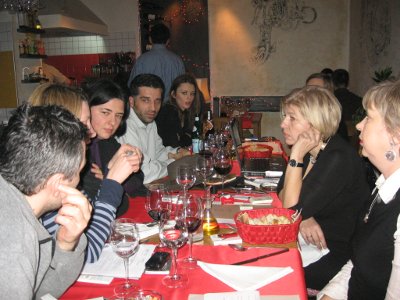


The First Meeting under BICCED Held in Sarajevo

As part of the project recently awarded to BIRN  by the Swiss Cultural Programme in the Western Balkans, Balkan’s Initiative for Cultural Cooperation, Exchange and Development (BICCED), BIRN brought together some of the most active players the cultural scene in Sarajevo and Bosnia-Herzegovina. Danis Tanovic, the movie director, Amra Kresevljakovic from Deblokada, Nihad Kresevljakovic from the festival MESS, Elma Tatarevic from the Sarajevo Film Festival and Amila Ramic from the ARS AEVI shared their views and knowledge of the cultural scene in Bosnia-Herzegovina and the problems facing the creative industries.

As much as other spheres of life of Bosnia and Herzegovina, the culture is also suffering from the consequences of the division of Bosnia & Herzegovina into largely separate entities. There is no ministry of culture at the state level, and this affects many institutions which are of national importance. The main areas of concern identified by the participants are related to the lack of of a national cultural policy, lack of clear criteria for the allocation of funds, politically-driven support both for organisations and for appointments to leading positions, along with a range of administrative obstacles, VAT policies, ATA Carnet, tax exemption, etc.

The participants gave a valuable input to the creation of an editorial strategy for the programme and provided their views on how the leading players might work together.

Similar meetings will be held in Republika Srpska, and in other countries participating in the project – Albania, Kosovo, Macedonia and Serbia – to arrive at a cohesive and inclusive approach to cultural poly across the wider region

BIRN Receives a 3-year Grant from the SCP

The Balkan Investigative Regional Reporting Network, BIRN, is delighted to announce the signing of a three-year contract with the Swiss Cultural Programme in the Western Balkans, SCP.

“Swiss Cultural Programme in the Western Balkans” sub=”Swiss Cultural Programme in the Western Balkans” >The project, “Balkan’s Initiative for Cultural Cooperation, Exchange and Development,” BICCED, aims to build a platform for development of culture-related co-operation in Albania, Bosnia-Herzegovina, Kosovo, Serbia and Macedonia, focusing on common cultural policy issues and contributing to the change and development of individual country policies. BIRN, as lead partner in this project, will work closely with SEECult, from Serbia, and BIRN’s country-based organisations in Kosovo, Macedonia and Serbia.
 
The first phase of the project will involve the preparation of an editorial strategy and the establishment of links with cultural organisations and experts from across the region.

Later, a small group of influential representatives of the creative industries from all of the participating countries will get together for a regional conference to discuss the challenges faced and to agree a common approach.

Alongside, BIRN will organise the first of three annual training programmes in analytical and investigative reporting for 10 journalists, two from each of the participating countries. Journalists, who have an interest and focus on arts and cultural policy are strongly encouraged to apply for this opportunity which, in addition to the training, will offer them the   opportunity to participate in study visits around the region. Each group will visit one country attending a selection of cultural events, and meeting decision makers in institutions and organisations. Applications will be opened for interested journalists in February. After the initial training, the selected journalists will receive on-the-job training for a further 10 months. For each of the three years of the programme, 10 new journalists will be selected.

During the on-the-job training phase, each month, the journalists will participate in the production of 12 texts which will be published on a dedicated culture section of BIRN’s Balkan Insight web site www.balkaninsight.com and the six best texts will be put together to produce a monthly newsletter. The web section will also include a cultural calendar for the region and links to other resources in the cultural and arts field.

Twenty Issues of Radio Justice Magazine

By the end of 2009 Radio Justice Report had produced and broadcast 20 weekly BIRN Radio Justice reports and more than 750 daily audio reports.

BIRN Bosnia and Herzegovina started broadcasting its weekly radio magazine on August 14 this year, nearly a year after we started broadcasting our first audio reports.  

The support we received from the radio stations that broadcast our reports and from the readers who access Justice Report on our web page, www.bim.ba, has encouraged us to continue our radio production in 2010.  

At present the daily and weekly reports are broadcast by about 100 radio stations all over the country and abroad.  

Each week our Radio Justice magazine brings an overview of trials conducted before the Court of Bosnia and Herzegovina, War Crimes Chamber, and topics and analyses pertaining to the entire process. During 2009 Radio Justice interviewed Sonja Biserko, President of the Helsinki Committee for Human Rights in Serbia, Natasa Kandic, Director of the Humanitarian Law Fund from Belgrade, Vesna Terselic, Director of Documenta organization from Zagreb, Mirsad Tokaca, President of the Research and Documentation Center from Sarajevo, Svetlana Broz, Director of GARIWO organization from Sarajevo, Hans Christian Schmid, Director of Oluja (“Storm”) a movie on war-crimes trials conducted at The Hague, and many others.   

We would like our Radio Justice reports to reach as many people interested in following the trials conducted before the War Crimes Chamber of the Court of Bosnia and Herzegovina and many other topics related to justice and war-crimes victims in Bosnia and Herzegovina as possible. In our efforts we receive great support from the media stations with which we cooperate.

“The public has to be aware of justice and war-crimes issues. BIRN is the only media that works in a systematic way. For as long as this topic is open, the weekly BIRN Radio Justice magazine will be a valuable media product. The magazine is substantial, well articulated and well designed,” says Emir Habul, Editor-in-Chief of BH Radio 1 news programmes.

Local media are key partners for the Radio Justice Report project. Mirsada Cosic, Konjic Radio News Programme Editor, says the written and audio reports made by Justice Report journalists, dedicated to following war-crimes trials, are of extreme importance for the general public in Bosnia and Herzegovina.

Dragana Sivonjic, Editor-in-Chief of Vitez radio station, says that Radio Justice and our agency news enable the station to follow the trials, “which we would otherwise not be able to follow because of a limited number of reporters and the distance between Vitez and Sarajevo”.  

Staff at Tuzla Canton Radio, which covers the broad area of Podrinje, say that the reaction to Radio Justice reports from listeners has been positive.

The situation is similar in the Zivinice area, where our reports are carried by a local TV station. “We carry BIRN Justice Report articles in our news. We receive positive reactions from our TV station audience. We do not have a radio station, so we include the reports in our TV news. The topics covered by Justice Report are certainly of interest to our viewers,” says Nihad Kovacevic, Editor-in-Chief of Zivinice Public RTV Station:


We intend to continue broadcasting daily and weekly reports next year, and we will also expand our production to include audio inserts from trials in most of our written reports.  

We receive continued support from the Governments of the Kingdom of Norway, Great Britain and Switzerland, as well as the Konrad Adenauer Foundation, the OSCE Mission in Bosnia and Herzegovina, the Soros Foundation, NED and USAID.

BIRN BiH Congratulated on New Project

The Association of Reporters from the Court of Bosnia and Herzegovina, AIS, held a meeting on December 23 at which the first TV Justice issue was premiered for AIS members.

Twelve monthly TV Justice programmes will be produced next year. They will be broadcast by local TV stations and on our web page. The first programme features a review of trials conducted before the Court of Bosnia and Herzegovina during 2009, an interview with a war-crimes convict and interviews with Court officials.

AIS members agreed on the importance of broadcasting this type of programme, with specialized reports on war-crimes trials.

“This programme really succesd; the review of trials has been done in a very good way,” said BH Radio 1 journalist Mirela Hukovic-Hodzic.

Lea Tajic of the Communications Regulatory Agency, RAK, described the end product as “an extremely good job”.

Other AIS members who attended the premiere agreed with these opinions.


Participants at the meeting included Muamer Selimbegovic, FENA, Denis Dzidic, BIRN BiH, Velma Saric, IWPR, Anisa Suceska Vekic, BIRN BiH, Nidzara Ahmetasevic, BIRN BiH, Dragana Erjavec, TV Justice, Aida Alic, BIRN BiH, Merima Husejnovic, BIRN BiH and Erna Mackic, BIRN BiH.

In other business, AIS members agreed to request a meeting with representatives of the Court of Bosnia and Herzegovina and its Prosecution in order to discuss requests that have been made by this informal advocacy association but which have not yet been fulfilled by the Court.

It was said, once again, that the Court of Bosnia and Herzegovina should organize weekly, or at least monthly briefings for journalists, enable access to public documents, such as decisions and resolutions, by uploading them on the State Court’s web page, and publish CDs and photographs from hearings which are open to the
public.

Anisa Suceska Vekic informed participants about the education of journalists from local communities, which BIRN BiH plans to organize next year. She said that AIS members would play an active role in this.

AIS members will discuss future plans of the Association at their next meeting, scheduled for early next year.


The First National Budget Forum

The first national budget forum organized by BIRN Serbia and its partner organisation Pro Concept was held on Tuesday in presence of more than fifty governmental, NGO, business sector representatives, experts and journalists.

The aim of the forum was to gather stakeholders from the field of public finances in Serbia and to create a platform for wider public debate in the field.

The panelists on the forum included: Serbian Finance Minister Diana Dragutinovic, National Bank of Serbia Vice Governor Branko Hinic and former high official in Serbian government and university professor of public finances Milica Bisic. Moderator of the event was editor in daily Politika Misa Brkic.

Brkic presented results of analysis, which Pro Concept carried out  on possibilities for savings in the ministries of health and education budgets. He also presented Baseline study on current situation in sector of public finances in Serbia.

“It is possible to save five to seven per cent of the overall budget of ministries of health and education with better planning,” Brkic pointed out.

Dragutinovic said several interesting things regarding problems with controlling public finances in Serbia.
“We do not know how we had spent about 130 billion dinars last year because we do not control spending in different agencies and directorates” Dragutinovic said.

She said that the new law on budget system in Serbia is good and will thus bring a greater level of transparency to Serbia’s public finances. The finance minister announced that she will initiate forming of new fiscal body in order to strengthen capacity of institutions for better planning and spending.

Ms Bisic said that budget for 2010 is realistic but that there will be problems in its implementation if the policies of public finances are not improved.

“The foreign investors are not interested in low tax rates as they are interested for stability and assurance of the whole system” she stressed adding that large numbers of exclusions in tax system were huge mistake.

In the afternoon session, the debate was run within The Chatham house rules, while debate’s conclusions and recommendations are to be used for next stages of the project.

Public Outreach Section Letter

The letter was sent after the AIS meeting in October. 

Dear Sirs,


The Association of Court Reporters, AIS, would like to express its dissatisfaction with the Decision contained in “The Regulations on accessing information controlled by the Court of Bosnia and Herzegovina”, adopted at the General Session. The AIS considers this Decision to be inappropriate for several reasons – the most important of which is that if it is implemented the Decision will deprive the general public of information about court proceedings. 


We would like to remind you that the AIS has for a considerable period of time been appealing to the Court of Bosnia and Herzegovina to follow the practice of the Hague Tribunal and allow media to have access to more photographs from courtrooms. On several occasions public assurances have been given that the media will be provided with more photographs, showing unprotected witnesses, judges and prosecutors. However, these assurances have not yet been fulfilled; on the contrary, they are completely undermined by this Decision.  


Journalists reporting from war-crimes and organized-crime trials conducted before the Court of Bosnia and Herzegovina consider that the current practices pertaining to sharing photographs should be improved. The number of shared photographs should certainly not be reduced. The fact that we receive only indictees’ photos taken at the beginning, in the middle and at the end of trials deprives the public of information from the courtrooms, as these photographs offer only a very limited perspective. We still do not receive photographs of other participants in trials.


Significantly, the fact that photographs of indictees are the only photographs published in the media can in certain circumstances be used as an argument by Defence teams. Defence lawyers can claim that repeatedly publishing photos of the indictees develops prejudices against some people even before their guilt has been proved. We have already drawn attention to this problem and received support from judges.


We can easily provide you with examples of how the selective publishing of photographs, which is taking place now, undermines objective reporting. We continue to receive group photos of  all indictees at a trial, even though only one of them may have pleaded guilty, for example. In addition, we regularly receive photographs of indictees dressed in summer clothes, even though the reporting period is the the middle of winter. 


We are extremely concerned that the new Decision may mean that we will no longer receive video recordings from all hearings, but only recordings made at the beginning, in the middle and at the end of trials. This would directly and negatively affect our capacity to report the work of the Court in an efficient way. 


We respectfully request that you reconsider your Decision. It is manifestly in the interest of the Court of Bosnia and Herzegovina that its proceedings are transparent and open to the public, and this can only be ensured by providing appropriate access to the media. 


We are formally asking you to convey our disapproval of the Regulations to the Court authorities. We are convinced that this Decision will make it harder for you to garner public support for the Court and disseminate information about the important work being done by this institution. 


Judges of the Court have stressed again and again that “justice must be transparent”. This is a fundamental and indispensable pillar of an open society – and this Decision would lead to the very opposite situation, where transparency in the administration of justice in Bosnia and Herzegovina is actually reduced.


Yours sincerely,


The Association of Reporters from the Court of Bosnia and Herzegovina (consisting of representatives of print and electronic media).
 

Sarajevo, October 23, 2009

The European Young Journalist Award 2010 kicks off

Brussels – The European Commission’s Directorate General for Enlargement is launching the European Young Journalist Award 2010 (EYJA). The competition will reward Europe‘s best young journalists, focusing on EU Enlargement, for the third year running.

The EYJA 2010 challenges journalists and journalism students, aged 17 – 35, to enlarge their vision. It is an opportunity to represent EU Enlargement from creative and thought-provoking angles. The competition will run until 28 February 2010. Print, online and radio journalism, published between 1 October 2007 and 28 February 2010, can be submitted by citizens of one of the EU Member States, Candidate Countries, Potential Candidates or Iceland.
 
The 36 national winners will each be selected by official juries in each participating country. An international jury will then select the three best submissions in the following categories: “Most original”, “Best research” and “Best journalistic style.” Each of the three Special Prize winners will receive a cultural trip, to a European capital of their choice.

Olli Rehn, Commissioner for Enlargement welcomed the EYJA 2010: “The third edition of the European Young Journalist Award continues to reward excellent journalism and gives the European Commission the opportunity to exchange ideas with Europe’s most promising young journalists about questions at the heart of the EU Enlargement project.”

The winners of the EYJA 2010 will visit Istanbul in May 2010 for a cultural and historical trip. Istanbul, one of Europe’s Capitals of Culture for 2010, provides an ideal location for the winners to enlarge their vision through cross-cultural interaction. The trip will end with a conference where views will be exchanged with leading international analysts about European culture, identity and EU Enlargement.

For information on how to enter the competition, please visit www.EUjournalist-award.eu


Press contact:

Maurizio Picheca
European Commission / DG Enlargement
Tel. +32 2 29 51929
Email:  [email protected]

Romy Eckert
MEDIA CONSULTA International Holding AG
Tel. +49 (0)30 65 000 – 348
Email: [email protected]

Getting the Message Out

With final proofing and preparation for
publication in progress, some of the editorial team met last week to
discuss this year’s achievements and to look at the editorial
process and importantly to ensure that the articles from this year
receive the widest possible republication and syndication ahead of
the book launches planned for December.

They were joined by Gjerg Erebara one
of last year’s fellows, who like many former fellows has stayed in
touch with BIRN and become a regular contributor to BIRN’s Balkan
Insight online news website (www.balkaninsight.com).
Gjerg was full of praise for the programme, saying that it was an
opportunity for national journalists to “look through a window at
the wider world” and put national events in an international
framework.

One of the bugbears of the programme
every year is the editing process. Even in these technologically
advanced days getting geographically spread individuals together to
collaborate can be a difficult process.

Milos Milosavljevic, BIRN’s Director
of Online Projects took the editors though some new online
collaborative tools that will undoubtedly make things run more
smoothly next year.

The team then discussed plans for
regional re-publishing of this year’s articles. And, less than a
week after the first article was posted and with more than 100
republications of the six articles published to date in some of the
most prominent newspapers and weekly’s in the region, as well as in
international press, they seem to have made a pretty good job of
getting the pieces out to a wider audience.

One online publication is complete, the
articles will be collated and put together in a 250 page book, which
is due for promotional launches in each of the capital cities of the
region during December.

The book launches are a great
opportunity to celebrate and publicise this year’s achievements but
importantly to talk to potential candidates for next year’s
fellowship programme.