Report on Self-Censorship in the Albanian Media

A Blind Eye on News: Self-Censorship in the Albanian Media is a study published by the Balkan Investigative Reporting Network in Albania, on the frequency, roots and causes of self-censorship in the Albanian media.

This report aims to offer a complete overview of the roots and causes of self-censorship in the Albanian media as well as the forms in which it appears, based on the perceptions of media professionals.

In view of the absence of previous studies of this phenomenon in the Albanian media, the findings of this study aim to raise awareness of the presence and influence of self- censorship on freedom of expression and the quality of professional media, with the goal of providing the public with balanced and objective information.

This study also offers a series of recommendations on the necessary means and mechanisms that should be employed to fight self-censorship in Albania, based on the suggestions of the media professionals involved.

To download a copy of the report in English click here.
To download a copy of the report in Albanian click here.

To download a shorter summary of the report in English click here.

Exposing the Truth: A Guide to Investigative Reporting in Albania

Exposing the Truth: A Guide to Investigative Reporting in Albania, is a manual about online and offline investigative reporting techniques, produced by BIRN Albania with the support of the OSCE Presence in Albania.

The manual, which was authored by BIRN editor and media trainer Lawrence Marzouk, explores all the steps that a journalist should follow and the resources he/she should use to produce in-depth investigative reports.
The manuals is divided into seven chapters, which start with the necessary preparatory work that reporters should carry out before they begin an investigation, online research techniques using search engines and databases, access to public documents through the freedom of information law, how to organize the research data and overcome legal hurdles before publication.
The guide aims to provide reporters with the necessary skills to tackle complex stories of corruption and wrongdoing that stretch across borders and involve both local and international actors.
To download a copy of the manual click in English here
To download a copy of the manual click in Albanian here

Annual and Financial Reports – BIRN Macedonia

The Annual Reports provide an overview of BIRN Macedonia’s activities throughout the given year.
The Financial Reports contain data on BIRN’s finances during the year.

2024
Financial Report (Macedonian version)

2023
Financial Report (Macedonian version)

2022
Financial Report (Macedonian version)

2021
Annual report  | Financial Report (Macedonian version)

2020
Annual report  | Financial Report (Macedonian version)

2019
Annual report  | Financial Report (Macedonian version)

2018
Annual report  | Financial Report (Macedonian version)

2017
Annual reportFinancial Report (Macedonian version)

2016
Annual report | Financial Report (Macedonian version)

2015
Annual Report | Financial Report  (Macedonian version)

2014
Annual ReportFinancial Report

2013
Annual Report

BIRN Macedonia Launches “Skopje 2014 Uncovered” Database

On the anniversary of the devastating Skopje earthquake in 1963, BIRN Macedonia published an online interactive database “Skopje 2014 Uncovered” documenting the new classical look of Skopje in the past five years.

When the grand revamp of the Macedonian capital was first announced back in 2010, the project, known as “Skopje 2014”, envisaged the construction of some 40 monuments, sculptures, facades and new buildings.

Fast forward to 2015 and the number of buildings and monuments has tripled.
The price tag of Skopje’s new look has meanwhile also shot up, far surpassing the initially announced figure of €80 million, to around €560 million, a BIRN investigation shows.

The eight-month  investigation draws on data procured through the Access to Public Information Act, the official web page of the Public Procurement Bureau, the “Skopje 2014” audit and a joint report by the government, the Skopje municipality of Centar and the Ministry of Culture, presented after the 2013 local elections.

The “Skopje 2014 Uncovered” database documents and maps works built or under construction  with the official contracts, authors’ fees, annexes and statistics on most contracted builders, sculptors, architects and foundries that participated in the project. As of July 26, this data is available to the public in Macedonian language. An English version will be available soon. An official launch and promotion event will be held in September.

The online database is available at: http://skopje2014.prizma.birn.eu.com/

More details on the investigation and the results are available here.

Film “The Unidentified”

The Unidentified, a documentary about the Serbian commanders responsible for attacks near the town of Pec during the Kosovo War premiered in 2015.

The feature-length documentary reveals the untold story of the brutal atrocities committed during the 1999 war, told from the perspective of the victims and of the commanders who ordered the attacks.

During their campaign in Kosovo, Serbian forces committed some of their worst crimes in the town of Pec and its surrounding villages. Women, children, and the elderly were driven out of their homes, while men were murdered in cold blood and their bodies were burned or buried in mass graves.

Many of the commanders who ordered the attacks currently live free in Belgrade. “The Unidentified” names these officers and poses anew the question of whether, nearly two decades after the war, justice can finally be done.

Writing for The New York Review of Books, Tim Judah called “the Unidentified” an “extraordinary film” and praised  its inclusion of the first-hand account of Zoran Raskovic, one of the perpetrators of the attacks.

The film won the “best short documentary” award at the South East European Film Festival in 2016. It was screened at seven film festivals in 2016, and at 10 debates and lectures. The film has reached an estimated one million people via its broadcasts on Al Jazeera Balkans. It has been reviewed or featured in publications including Radio Free Europe, Voice of America and Aljazeera Balkans.

Reporting Corruption on Broadcast and Print Media: The Case of Albania

The media monitoring study assesses Albanian media reporting on corruption, as well as its adherence to the guiding principles of journalism which make it possible for news organizations to be an effective tool against corruption.

The objective of the study is to present and interpret a summary of the general characteristics as well as the quality and reliability of the reporting of Albanian media on issues and cases of corruption, based on a set of quantitative indicators, in order to identify possible problems and shortfalls in the implementation of journalistic standards.

The findings of this monitoring initiative are intended to be used as reference material to assist the various local and international actors involved in media development in Albania, local journalists’ unions, as well as reporters and editors, in undertaking projects and activities that could eventually increase both the quantity and the quality of reporting on corruption, impunity and efficiency of anti-corruption initiatives.

To download a copy of the report in Albanian click here.

To download a copy of the report in English click here.

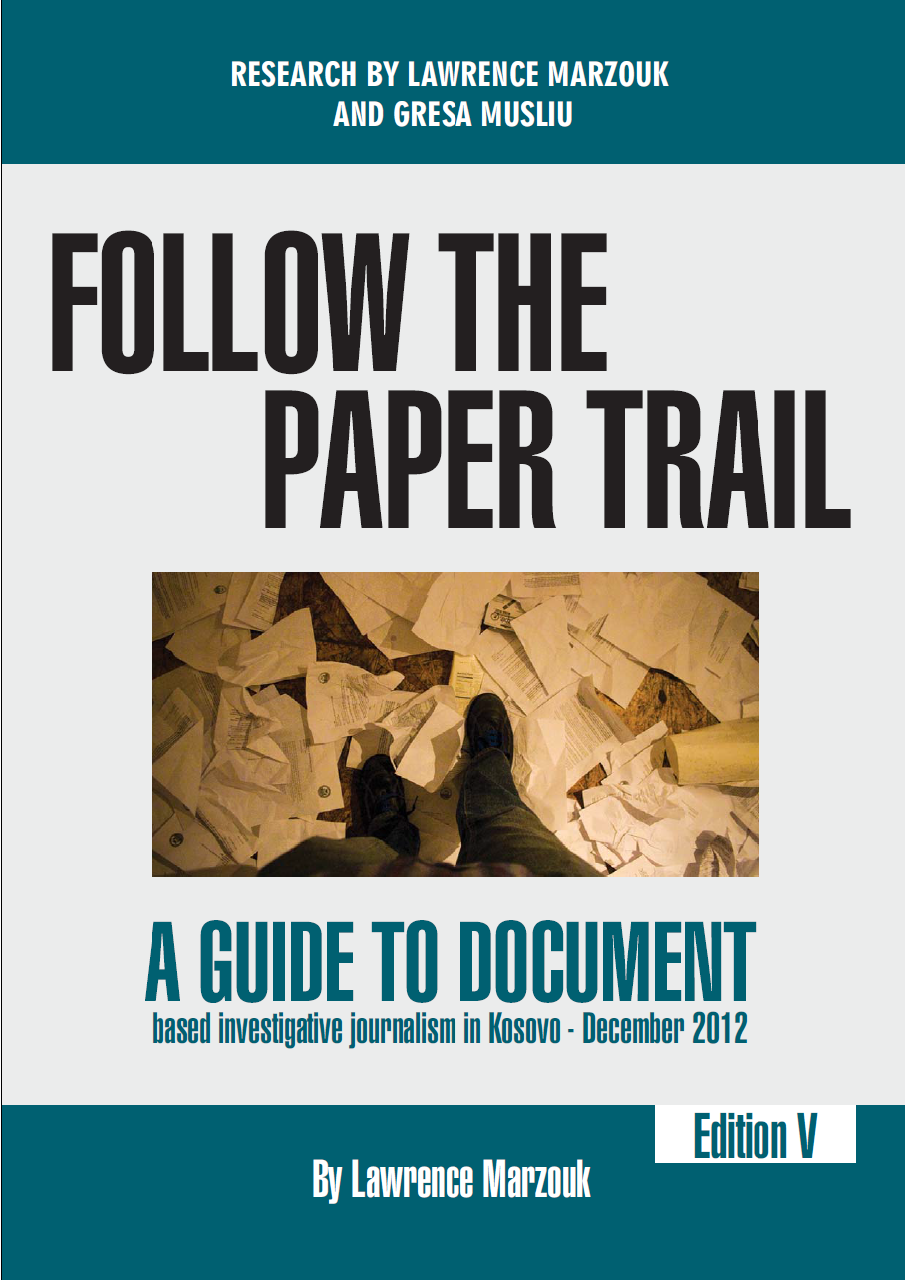
Follow the Paper Trail

Follow the Paper Trail, a guide to document-based journalism in Kosovo, explains relevant laws, access to public documents, how to publish safely, where to find databases on investigative journalism, and how to locate documents online through various search engines.

Download the Guide: English
| Albanian

FollowFor those wanting to uncover wrongdoing, knowing how to follow the paper trail is crucial, and this means a strong grasp of relevant media laws, a host of web-based skills and the ability to manage large quantities of documents.

Journalists must know how to prize documents from secretive institutions using ,Right to Know” laws but also find key reports which are already in the public do-main, many online. An in-depth knowledge of Google and other online search tools is also essential.

Reporters who cannot follow the paper trail across borders will soon find they are hitting brick walls in their quest for truth.

Spotlight on Mladic: Villian or Celebrity?

The publication brings an overview of the coverage of the arrest and the beginning of the trial of Ratko Mladic, who is charged with genocide and other crimes in Bosnia and Herzegovina, in the Balkan media.

The monitoring and analysis encompassed the highest-circulation dailies and weeklies in Bosnia and Herzegovina, Serbia and Croatia.

Languages: Bosnian/Croatian/Serbian (BCS) and English

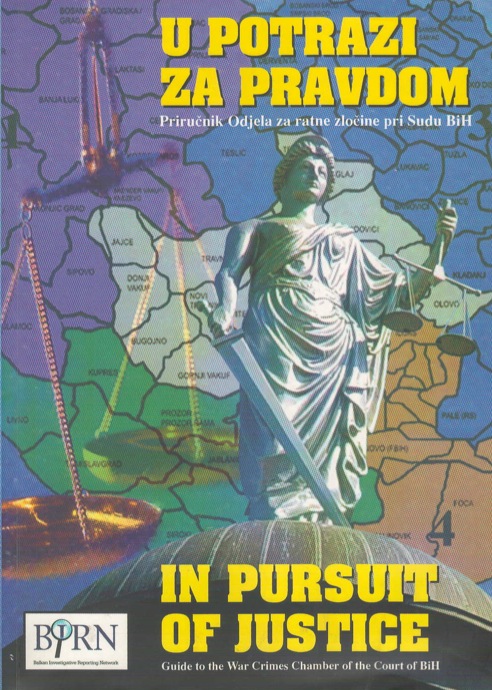
Pursuit for Justice: Guide to the War Crimes Chamber of the Court of BiH vol.I

Pursuit for Justice explains the main differences between the International Criminal Tribunal for the former Yugoslavia, ICTY, and the War Crimes Chamber of the Court of BiH.

It provides the reader with an overview of the Bosnian court’s mandate, major functions, and structure.

The guide covers topics such as the transfer of cases from the ICTY to the Prosecutor’s Office in BiH and amendments to the criminal procedure, and aims to inform the public, government representatives, and civil society organisations about the way war crime cases are handled before the Court of BiH.

Languages: Bosnian/Serbian/Croatian (BSC) and English

Pursuit for Justice: Guide to the War Crimes Chamber of the Court of BiH vol.II

The second volume of Pursuit for Justice analyses key legal documents that regulate the processing of war crimes cases by the Court of BiH and the Prosecutor’s Office of BiH.

This volume places particular attention on the methods used to deal with the war’s legacy.

It also lists other institutions in the country that are involved in transitional justice matters, and introduces Justice Report, a specialized news agency of the Balkan Investigative Reporting Network of BiH that reports from the War Crimes Chamber of the Court of BiH.

Languages: Bosnian/Croatian/Serbian (BSC) and English

Download the guide as a PDF file in English