The manual was authored by BIRN editor Lawrence Marzouk and the investigative journalist Crina Boros.
More information available here.
The whole manual is available here.
Balkan Investigative Reporting Network
‘Getting Started in Data Journalism’ is a manual published by the Balkan Investigative Reporting Network in Albania which aims to introduce journalists to data-driven reporting techniques that are essential to contemporary investigative journalism.
This is an overview of the BIRN Network activities and achievements in 2017-2018, the social and political context in which it operates, the prizes its journalists won and the impact of its reporting.
Analysis on the System of Assets Declarations of Prosecutors in Albania, a study published by the Balkan Investigative Reporting Network in Albania, evaluates that structure of the wealth of the members of the prosecutor’s office in Albania as well as the integrity of the asset declaration system.
This latest report comes on the heels of four studies published by BIRN Albania on the integrity of the assets declarations of judges from first-instance courts, appeals courts, the Supreme Court and the Constitutional Court.
The study sheds light not only on how prosecutors in Albania have accumulated wealth but also on key practices, recognised as “red flags”, which obscure the origin of this wealth, such as gifts or loans from relatives, inherited assets, large bank loans, real estate transactions and cash kept outside the banking system.
This report aims to analyse the structure and source of assets, expenditures, liabilities and income declared by all prosecutors, as well as provide detailed information on changes to the overall wealth of these officials. The authors of this report hope these data will help journalists, experts and civil society actors to independently monitor the performance of the vetting institutions that are expected now to sift through the judicial cohort and investigative cases of illegal assets of judges and prosecutors.
To download a copy of the report in English, click here.
To download a copy of the report in Albanian, click here.
Six civil society organisations in Serbia, including BIRN, have prepared a comment and Alternative Report on the findings on freedom of expression and media pluralism in the European Commission’s recently-published Serbia Country Report for 2017.
The whole report is available here.
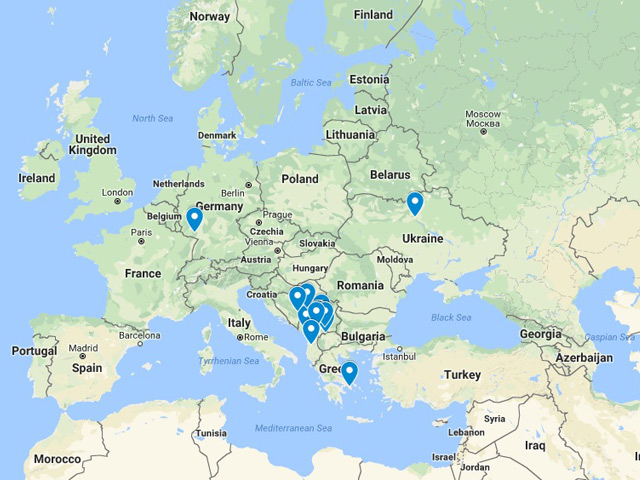
BIRN’s journalistic work produced in 2017 some very tangible social and political changes, both within the region and internationally, showing that non-profit media can influence the work of public institutions and authorities when applying high professional standard to their work.
Please click on the pinned locations on the map to read about the impact of BIRN’s reporting.
The Balkan Investigative Reporting Network in Albania has published two new manuals, which aim to give civil society and activists the necessary knowledge to advocate their causes in the media.
The first guide focuses on advocacy through the traditional and social media, while the second guide deals specifically with the various uses of photography as a medium for advocacy.
The drafting and publication of the two manuals was supported by the Balkan Trust for Democracy, BTD and the Swedish International Development Agency, SIDA.
Both manuals are part of BIRN Albania’s efforts to bridge the gap between civil society and the media in order to strengthen the fight against corruption and impunity, reinforce the rule of law and promote the respect of human rights and minorities.
They come on the heels of dozens of workshop between journalists and civil society organized over the last four years by BIRN Albania, which have guided the focus themes for investigative stories in its award winning publication Reporter.al.
The manuals cover an array of topics crucial to media advocacy, which range from making the difference from advocacy to propaganda, to tips and tools to produce a viral photo and how to distribute it.
These publications not only aim to strengthen the presence of civil society in media but also enrich the diversity of voices and opinions that comment on issues important to society in local media outlets.
To download a copy of the manual on “Advocacy through traditional and social media: A guideline for CSOs and activists” in Albanian, click here.
To download a copy of the manual on “Photography and Advocacy: A practical guideline” in Albanian, click here.
The Balkan Investigative Reporting Network (BIRN) and Internews Kosova, for 12 years, have monitored the Kosovo judicial system at all levels in order to assess its performance in respecting legality, work ethics and judicial proceedings.
The monitoring also included cases targeted for visa liberalisation in all court instances where the judicial procedure takes place. In order to have a situation analysis on the fulfillment of the second criterion for visa liberalization, BIRN and Internews Kosova drafted a report with detailed data on the status of the targeted cases.
For 12 years, the Balkan Investigative Reporting Network (BIRN) and Internews Kosovo have monitored the Kosovo judicial system at all levels in order to assess their performance in respecting legality, work ethics and judicial proceedings.
A particular focus of this report is on corruption cases, including criminal offenses that are of interest to society, monitored during 2017, but it also addresses other issues observed during the work of monitors in the field. Moreover, the report highlights procedural violations by judges, prosecutors and other parties during court proceedings, observed by court monitors in courts of the Republic of Kosovo. The report contains procedural violations, ranging from failure to hold court hearings, changing of witness statements, failure to schedule court hearings, unreasonable delays in trials, failure to comply with the legal deadlines for the initial hearing, holding trials without the presence of the accused, disorder at trial, poor preparation of prosecutors for the trial, and failure to hold hearings due to the lack of court interpreters as one of the basic principles of justice, for trials to be in a language that is known and spoken by the defendant in the proceedings.
On May 8th, 2017, BIRN and Internews Kosova marked a decade of monitoring Kosovo’s judicial system with the launch of the 2016 Court Monitoring Report.
This project has been implemented for ten years now, and each year it has provided an overview of the situation in Kosovo’s justice system and has offered recommendations on how to increase transparency and accountability at all levels of the system.
This year’s report reflects the monitoring of 600 court hearings across 26 courts in the country throughout 2016, including basic courts, the Supreme Court, and the Court of Appeal. Panel participants included BIRN Kosovo Director Jeta Xharra, Internews Kosova Executive Director Faik Ispahiu, Chief Prosecutor Aleksandër Lumezi, as well as representatives from the Supreme Court, the Prosecutorial Council, and the Judicial Council.
The report shows what the organisation did to offer high quality journalistic work and to provide citizens with reliable, timely and in-depth reporting as well as BIRN’s contribution to improving media freedom and openness of public institutions.
It also highlights the instances in which BIRN’s work had a strong political and social impact, showing that—despite difficulties—professional journalistic reporting can conclude in tangible results.
The whole report is available here [link].