Digital Rights Training for Bosnian Journalists: Applications Open

BIRN Bosnia and Herzegovina invites journalists, NGO representatives and activists from across Bosnia to apply for a three-day training program addressing topics and cross-cutting issues related to digital rights and freedoms violations in the Balkans.

The training will take place in Bjelašnica, Sarajevo, from September 29 to October 1, 2023.

The way the media reports on dangers and human rights in the digital space is very important, so journalists and human rights advocates need to understand how the Internet and its networks work and be informed about the latest policy developments in order to be able to recognise and report on violations of rights in the digital space and point out questionable policies.

BIRN BiH’s three-day training will focus on understanding human rights-related issues in the digital sphere, such as privacy, security, violence against women and marginalized groups, content regulation, malign foreign influence through propaganda and manipulation, and other relevant topics.

“When we talk about ‘digital rights’, we are talking about the same rights that are fundamental for all people in the physical space, such as freedom of expression, privacy, access to information, security, which also apply in the era of the Internet, technology and social media. It is important to understand digital rights in order to protect them in online spaces that are developing every day, and in which human rights require effective and human-centric responses towards arising malicious influences and often oppressive legal regulations,” said Aida Mahmutović, BIRN BiH project manager. She added that violations of human rights on the Internet in Bosnia and the Balkans are no different from those in the rest of the world.

The first threat report on cyber threats in Bosnia and Herzegovina, issued by the Cyber Security Excellence Center and BIRN BiH, shows more than 9.2 million separate cyber attacks were recorded in Bosnia in November 2022 alone, against a wide range of targets. This points to the significant vulnerability of citizens, companies and institutions to cyber-security threats.

The lack of regulations at a national level, comprehensive and coherent strategies and systems in place is worrisome when it comes to responding to these threats, which are aimed at not only institutions but citizens as well.

Online harassment, especially against women and marginalized groups, is burgeoning. When it comes to abuse of intimate images, for example, the absence of laws and support system in place discourages the victims, the latest Detektor Magazine reports.

The BIRN BiH training will give at least ten selected journalists, NGO representatives and activists a comprehensive understanding of the risks at stake, in order to help them to identify and report on digital rights violations more effectively.

Journalists especially play a crucial role in raising public awareness and driving change. By equipping them with the necessary skills and knowledge, this training will enable them to produce impactful stories that can contribute to a more informed public debate and eventually lead to policy changes that protect and promote digital rights in Bosnia and Herzegovina and the Balkans.

Who can apply?

BIRN Bosnia and Herzegovina invites journalists from across Bosnia and Herzegovina, as well as NGO representatives and activists who have an interest in or advocate for human rights in the digital space, to apply.

Those interested should demonstrate an interest in digital rights, possess previous journalism experience and/or show active engagement in the field of rights in the digital space. A selection committee will evaluate the applications. Ten participants will be selected to participate in the training.

Where?

The training will take place in Bjelašnica, Sarajevo, BiH, from September 29 to October 1, 2023. On October 2, all participants will then join the Internet Governance Forum in Bosnia and Herzegovina in Sarajevo. The organisers will fully cover the travel, food and accommodation costs of the selected participants. The working language of the training is Bosnian. Knowledge of the English language is desirable.

Opportunity to pitch ideas after the training

On the last day of the training, participants will have the opportunity to pitch their ideas for stories and other content to BIRN BiH. The selected participants will receive mentoring and financial support to implement their ideas in accordance with newly acquired knowledge related to human rights violations in the digital space, such as freedom of expression and freedom of media, access to information, violence against women and marginalized, cyberthreats and foreign malign influence (including manipulation and propaganda).

How to apply and deadline

You can apply by filling in the application form below no later than August 31, 2023, by 10 pm CET. If you have questions about the training, contact: [email protected]. Please note that only selected participants will be contacted.


BIRN’s Annual Summer School Kicks Off in Greece

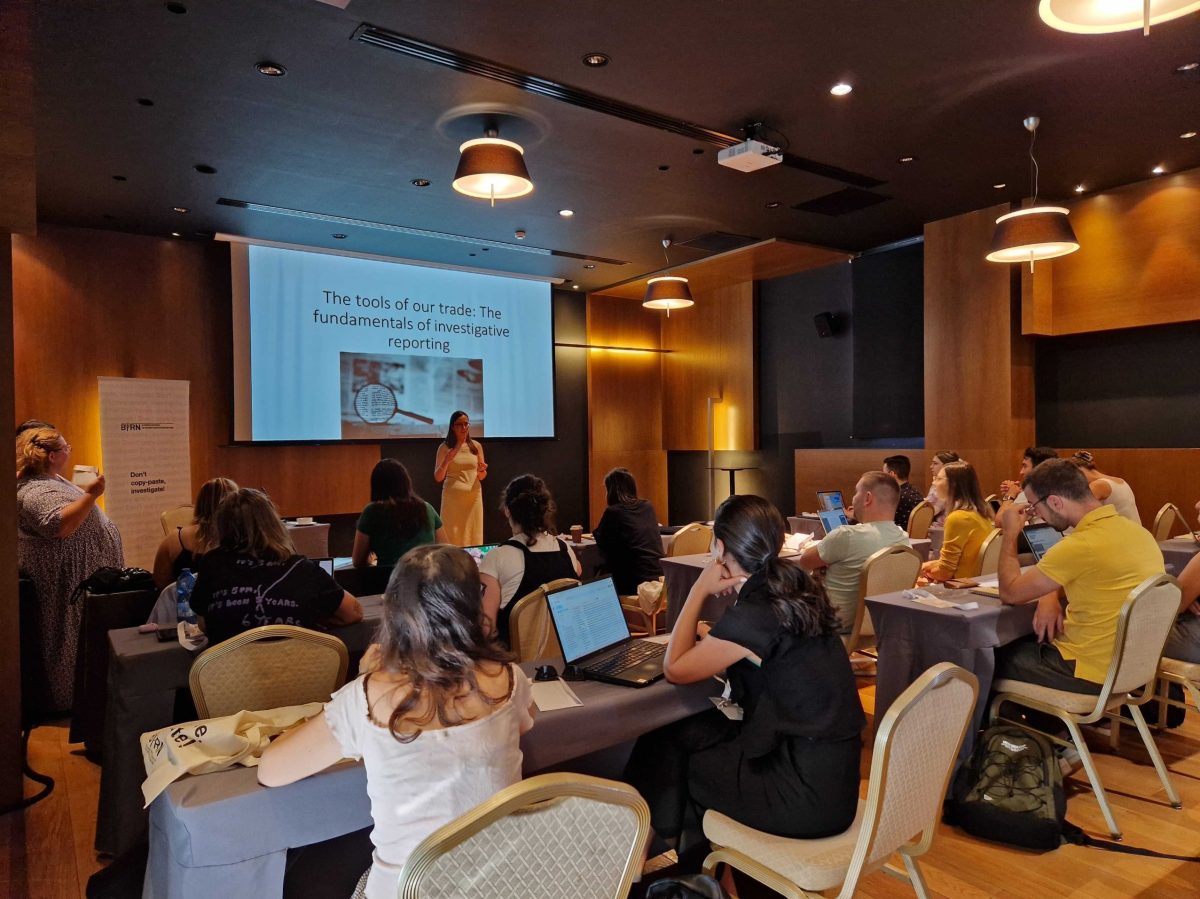
BIRN’s 13th Summer School of Investigative Reporting is bringing together 36 journalists from South-East and Central European countries for a week-long training to develop skills, explore new techniques and cooperate in cross-border stories.

This year’s Summer School of Investigative Reporting started on Monday in Thessaloniki, Greece.

During the week-long programme, journalists from Albania, Bosnia and Herzegovina, Bulgaria, Croatia, Czech Republic, Greece, Hungary, Kosovo, Moldova, Montenegro, North Macedonia, Ukraine, Poland, Romania, Russia, Serbia, Slovakia, Turkey, Georgia and Uzbekistan will master their investigative skills and techniques and learn from Pulitzer and European Press Prize winners.

Regional Director of BIRN HUB Milka Domanovic welcomed the participants to one of BIRN’s flagship programmes. “We hope that you will be able to implement the knowledge you gain here and connect even after the course is finished,” Domanovic said.

Ivana Nikolic, Programme Manager at BIRN’s Investigative Reporting Initiative Programme, presented the agenda to participants selected from a record-breaking number of applications – more than 220 this year.

“We are very proud to have had this amazing number of applications, and to be honest, it was very hard to select the best ones,” Nikolic said.

During the week, participants will learn about basics of investigative reporting; OSINT; visual investigations; how to stay digitally secure while working on a story; essentials of cross-border reporting; how to avoid burnout in journalism; how to master data journalism, etc.

In addition, there will be two panel discussions: one dedicated to “journalism in exile”, that is, reporting about one’s country from afar, and one dedicated to investigating the migrant crisis in Greece. The full programme can be found here.

The first day started with Michael Montgomery, a senior reporter and producer for Reveal. He talked about the fundamentals of investigative reporting. “It’s less often than not that you will come up with a completely new story. A new angle on a story that’s been covered can be even more impactful,” Montgomery said, advising participants to follow their passion and check their sense of outrage when choosing a story.

“It’s always easier to get someone to confirm something you already know or think you know than to get them to volunteer information you do not possess. That’s super important, to get people to talk. Most people don’t like to think they are spilling secrets,” Montgomery told participants.

Marija Ristic, Manager at Amnesty International’s Evidence Lab, introduced Open Source Investigations.

“Open-source researchers expose themselves and the subjects of the information they collect to various digital threats. Understanding how to protect yourself and the data generated during your research from threats is essential knowledge for digital investigators,” she said.

The first day ended with a workshop on story pitching, with journalists sharing ideas.


Digital Rights Reporting Training for Balkan Journalists: Applications Open

BIRN invites Balkan journalists to apply for our three-day digital rights reporting training programme in Sarajevo, Bosnia and Herzegovina, from September 26-28, 2023. Successful applicants will also become eligible for a small grant to produce a digital rights story.

If you are a journalist from Bosnia and Herzegovina, Montenegro, North Macedonia, Serbia, or Kosovo interested in reporting on digital rights, BIRN’s digital rights reporting training in Sarajevo is an opportunity to deepen your knowledge.

This specialised training course offers a rare chance for regional journalists to delve into some of the most exciting and relevant areas in modern journalism: you will understand digital rights comprehensively, focusing on reporting breaches, content blocking, manipulation and propaganda in the digital realm.

Our training programme will help you understand the complexities of digital rights and their impact on journalism and give you insights into open-source investigations, data journalism, fact-checking, and more. Successful applicants will engage in hands-on workshops about identifying and documenting digital rights violations and will learn to enhance their storytelling by using contemporary multimedia tools.

After completing the training course, the trainees will receive a small grant to write an article, applying their newly acquired skills in digital rights reporting.

Who can apply?

BIRN is inviting journalists from Bosnia and Herzegovina, Montenegro, North Macedonia, Serbia, and Kosovo to apply for the three-day training course on digital rights reporting.

How to apply?

To apply, fill out this application form no later than September 5, 2023, at 5pm CET.

Where will it be held?

The training course will take place in Sarajevo, Bosnia and Herzegovina, from September 26 to September 28, 2023. BIRN will fully cover travel and accommodation costs for all successful applicants.

The working language of the training is English.


Call for Applications for a Two-Day Training Course on Investigative Reporting and Fact-Checking

BIRN Kosovo has opened a new call for applications for its first two-day training course on investigative reporting and fact-checking, as part of the EU-funded project ‘Strengthening Quality News and Independent Journalism in the Western Balkans and Turkey II’.

BIRN Kosovo has opened a new call for applications for its first two-day training course on investigative reporting and fact-checking, as part of the EU-funded project ‘Strengthening Quality News and Independent Journalism in the Western Balkans and Turkey II’.

​​In recent years, fake news and orchestrated disinformation campaigns have had a geopolitical influence, affecting elections in established and nascent democracies and undermining the response to global challenges including the COVID-19 crisis and the war in Ukraine. The endemic worldwide phenomena of fake news and disinformation have plagued Western Balkan countries in recent years as well.

The war in Ukraine has increased the volume of fake news circulating on social networks as various countries seek to extend their influence in the region. The Ukraine war aside, local media outlets in the region have seized opportunities to spread misinformation, particularly in the context of relations between the Western Balkan countries.

Both fact-checking and the framing of information in the correct social context are rarely applied in the region, while journalism degrees do not offer courses in this field. As a result, journalists are not aware of the latest standards in fact-checking or new methods that platforms such as Facebook or others use in the fight against fake news.

As one of the only media organisations in Kosovo that is part of the International Fact-Checking Network, the mission of BIRN Kosovo is to extend its fact-checking policies and knowledge to other national and regional media outlets.

This training course will help tackle fake news and unverified reporting by helping journalists learn how to spot fake news and provide verified information that adheres to journalistic standards. The knowledge delivered will be of a practical nature and will draw on the unique experiences of journalists who have successfully developed such skills in similar environments.

BIRN will invite different regional and international media professionals to administer the training course and share their knowledge and experience with the participants. 

Note:

Following the training, participants will have the opportunity to be part of a fellowship for writing articles on cross-border investigations and fact-checking.

 Who can apply?

Final-year journalism students, recent graduates, and young and professional journalists from the Western Balkan countries including Albania, Bosnia and Herzegovina, Kosovo, Montenegro, North Macedonia and Serbia may apply for the course.

Candidates from across the region are encouraged to apply. However, the number of participants is limited and we will give priority to younger journalists with less experience in the described field.

How to apply?

All applications should be submitted in English before September 15, 2023, at midnight Central European Time to [email protected] along with the following documents:

  • Applicant’s CV
  • Work Sample
  • Motivation Letter

Applicants who do not have any published work can submit their student assignments from practical courses in journalism. The motivation letter should provide information regarding the applicants’ opinion and knowledge on the topic and should not exceed 400 words.

Language:

The training will be held in English.

Location:

The training will take place in North Macedonia. Details regarding the specific location, agenda and accommodation will only be provided to selected participants.

Deadline for applications: 12:00, Central European Time, on September 15, 2023

Date of the training course: October 2023

Remarks:

Travel costs and accommodation will be covered by BIRN.


BIRN Wins Solar Power Investigation Case Against Kosovo Media Regulator

A Pristina court annulled the national media regulator’s decision to issue a warning to BIRN Kosovo over its award-winning investigation into a businessman who violated anti-monopoly rules in the solar energy market.

Pristina Basic Court on Friday annulled a decision made by the Independent Media Commission, IMC in January 2021, which issued a warning to BIRN Kosovo’s television programme ‘Jeta ne Kosove’ over its investigation into a businessman’s monopolistic practices.

The investigation, entitled ‘Unclean Energy: The Kosovar Who Would Own the Sun’, showed how businessman Blerim Devolli was behind six companies reaping millions of euros from the sale of solar energy in violation of anti-monopoly rules.

It was aired by public broadcaster Radio Television of Kosovo, RTK, which was screening BIRN Kosovo’s ‘Jeta ne Kosove’ programme.

This prompted Devolli’s complain to the IMC, the institution responsible for the regulation, management and oversight of broadcasters in Kosovo. Devolli claimed that the programme used hate speech and violated the IMC’s code of ethics for audiovisual media providers.

The investigation carried out by Visar Prebreza and Jeta Xharra revealed a scheme in which shell companies owned by Devolli registered in Malta would have benefited from incentive tariffs for the production of solar energy, breaking anti-monopoly rules by hiding the real owner of the companies.

In the Pristina court verdict, judge Anita Nikqi-Morina concluded that the programme show was “fully in line with the code of ethics”.

The court also found that IMC’s decision “was not properly justified” and it “did not correctly establish the factual situation”.

The verdict said that the language used in the programme “does not seem to constitute an insult because the language used is sarcastic”.

The court also found that IMC’s decision to reprimand RTK and ‘Jeta ne Kosove’ contradicts guarantees of freedom of expression in Kosovo’s constitution and the practices of the European Court of Human Rights.

In 2021, BIRN filed a lawsuit at Pristina Basic Court against IMC’s decision, describing it as Strategic Lawsuit Against Public Participation or SLAPP and requested its annulment.

The case was taken to the court only after the IMC’s Board of Complaints rejected BIRN’s complaint and upheld the main points in the IMC board’s initial decision.

The IMC’s reprimand was one of the reasons behind RTK’s management decision to stop airing the ‘Jeta ne Kosove’ programme, ending its 15-year run on RTK.

For more details on the legal battle, read Prishtina Insight’s article here.

SEE Digital Rights Network Members Chart Forward Path in Bosnia

Attending organisations agreed to chart a path to advance digital rights advocacy efforts across the network and foster collaboration – focusing on education and promoting advocacy initiatives among Network members.

BIRN assembled key national stakeholders from the SEE Digital Rights Network in Bosnia and Herzegovina to discuss digital rights challenges and opportunities in the Balkans.

Highlights of the national SEE Digital Rights Network meeting in Sarajevo on July 28 included the review of the Network’s successes, presentation of the attending organisations’ upcoming initiatives and plans for BiH Network members’ work in the short term.

With the organisations that participated in the meeting, BIRN BiH representatives shared methods on how the organisation monitors digital rights violations within Bosnia and described their work on developing cybersecurity policy papers and creating educational content to raise awareness about digital rights.

The Citizens’ Association “Zašto ne (Why not)”, well known for its accountability websites, Istinomjer and Raskrinkavanje, continues to enhance transparency and promote responsible digital citizenship in their work. They also expressed interest in developing digital literacy and security initiatives, especially for the elderly.

The Center for Investigative Reporting, CIN, is actively involved in a regional project against hate speech, demonstrating the importance of civil society’s role in digital spaces. With an eye on the future, CIN showed interest in projects related to artificial intelligence and its potential influence on digital rights.

Finally, the Sarajevo Open Centre, SOC, shared news about its work on monitoring EU laws and amendments to the law on freedom of information and personal data protection efforts. SOC is also assessing the impact of artificial intelligence on the LGBT community and women’s rights.

The meeting showcased a shared enthusiasm for collaboration among Network members, especially in education and advocacy for digital rights.

Participants agreed on the need for a concise survey to coordinate and streamline digital rights activities within the Network. They highlighted the benefits of experience sharing, including both successful and challenging practices from EU Network members, for their cooperative and institutional activities. Emphasizing the value of academia, IT, and digital rights experts, the members agreed to engage with these sectors for stronger digital rights advocacy.

In the following months, BIRN will organise regional meetings to facilitate experience sharing among Network members, to affirm the Network’s commitment to strengthening digital rights advocacy in the Balkans.


Turkish Fraudster Seeks to Delete BIRN Investigation Into Citizenship Acquisition

After Turkish courts ordered the removal of website articles about businessman Yasam Ayavefe, his representative called on BIRN to delete its investigation into how the convicted fraudster bought his way to honorary Greek citizenship.

A representative of Turkish businessman Yasam Ayavefe – a convicted fraudster who was revealed in an investigation by BIRN and Greek media partner Solomon to have acquired honorary Greek citizenship via his political ties – has asked BIRN to delete its report.

He also urged BIRN to delete articles about cyberattacks that targeted the Balkan Insight website after the publication of the investigation.

“These kinds of posts affect the business life of my client [Ayavefe]. He has invested in so many countries and posts like this cause my client material and moral damage,” Bener Ljutviovski, who introduced himself as Ayavefe’s representative, told BIRN in an email.

His request for the removal of BIRN’s reports came after Turkish courts, in two separate judgments in Istanbul and Ankara, ruled that Turkish online media articles about based Ayavefe’s activities in gambling, crime and business in Cyprus, Greece and Turkey should be removed.

The Turkish court rulings said that Ayavefe’s rights had been violated by the articles, citing “the presumption of innocence”.

BIRN has confirmed that at least 114 news pieces about Ayavefe have been removed from Turkish websites as a result.

Ljutviovski also said that a case had been launched in Greece to ask websites to remove articles about Ayavefe, but after checking with judicial authorities in Greece, BIRN could not verify this.

Ljutviovski further claimed that Ayavefe won a case in Greece to have arrests removed from his criminal record.

He said that all this proved that Ayavefe “has nothing to do with these accusations” and that he was being accused “without any proof” of being connected to the DDoS attacks on BIRN’s Balkan Insight website and Solomon’s site after the publication of the investigation.

He called on BIRN to take down the articles in line with the Turkish court rulings although one of the judgments clearly stated that domestic courts cannot remove content of “foreign origin”.

“Please help us in this situation and let’s fix this without prolonging… We are open to suggestions from your side,” Ljutviovski wrote.

He appeared to offer BIRN financial incentives in return for compliance: “My client Dr. Yasam Ayavefe has advertising company, if you help us in this case we can provide advertising service to your organisation, so you can grow to bigger organisation. We would love to cooperate with you,” he wrote.

BIRN declined Ljutviovski’s offer and rejected his repeated demands to remove the articles about Ayavefe.

Ljutviovski sent a series of requests to BIRN, initially from an email address under his own name but then from an email address under the name Igor Stefanov.

BIRN and its Greek partner media outlet Solomon’s websites came under DDoS attack by hackers in 2022 following the publication of the investigation into Ayavefe and how he acquired honorary Greek citizenship.

Solomon said on Twitter at the time that honorary citizenship is “a state honour long reserved for those who have significantly promoted Greek culture”, but has been “turned into a golden visa scheme for those with deep pockets”.

The investigative outlet Inside Story first broke the honorary citizenship story in July 2022, triggering a fierce debate over Ayavefe’s suitability for such an honour. Inside Story also came under DDoS attack after publishing its report on Ayavefe.

BIRN Albania and SCiDEV Present Studies on Disinformation, Propaganda and Fake News

Reports on Russian, Chinese and Iranian propaganda welcomed by EU ambassador in Tirana who calls for a renewed emphasis on ethical journalism

The Balkan Investigative Reporting Network in Albania, together with Science and Innovation for Development Center, SCiDEV, on July 14 presented the findings of four reports on information manipulation in Albania and the launch of a new website against disinformation.

The study reports were financed by the European Union and analyze the circulation in Albanian-speaking media in Albania, Kosovo and North Macedonia of fake news on Russia’s war against Ukraine, Russian disinformation narratives, as well as Chinese and Iranian propaganda through state-sponsored media in Albanian language.

The presentation of the reports was greeted by the EU Ambassador in Albania, Christiane Hohmann, who emphasized the need for media owners to put quality journalism at the top of their agenda.

“We have to look into how we can actually improve the situation, fight misinformation and disinformation, while promoting ethical journalism,” said Hohmann.

The reports were presented at Europe House in Tirana by BIRN Albania Editor Besar Likmeta and SCiDEV’s Executive Director Blerjana Bino in the presence of media, journalists, civil society activists and media experts.

The reports are published in the newly launched website: DisInfo.al, which also contains a database on fake news on the war in Ukraine, as well as educational resources against disinformation, fact-checking links, video tutorials, etc.

Download the reports in English and Albanian:

  1. For the report: “False News on Russia’s Invasion of Ukraine in the Albanian-Language Media” click here.
  2. For the report: “Russian State-Sponsored Narratives in Albania” click here.
  3. For the report: “Media Analysis: China’s Public Diplomacy in Albania” click here.
  4. For the report: “Media Analysis: Iran’s Propaganda in Albanian Language” click here.


BIRN Serbia and IJAS Report: Journalists Feel Undefended From Online Attacks

Report says online abuse is becoming so ‘normalised’ that journalists often do not report it – or have any faith in institutional protection.

Online threats against journalists are more intense and common than physical ones, but most newsrooms have not set up safety protocols to help them respond to these attacks, while laws do not provide efficient protection, BIRN and IJAS’s new report reveals.

Working in an environment that is becoming primarily digital has left journalists and media more exposed to online to attacks, insults and threats, but many newsrooms have not established mechanisms to deal with such cases and legislation does not provide adequate protection either.

These are some of the findings from the latest report, “Journalists’ Safety in the Digital Environment”, which BIRN Serbia and the Independent Journalists’ Association of Serbia, IJAS, published on July 18.

Online attacks and threats impact journalists’ mental health and private lives and affect relations in the newsrooms and commitment to professional standards. Online abuse is typically “normalised” and considered as part of the job.

“The most striking finding is that hate speech, threats, insults,
intimidation, pressure and other forms of digital violence against
journalists are so widespread in Serbia that journalists believe that it has become a daily ‘normal’ environment in which they work and that it is the price they pay for their work.

“When faced with digital threats and insults, they generally
do not report them because they know that, at the institutional level of protection, things are rarely undertaken and resolved,” says Aleksandra Krstic, associate professor at the Faculty of Political Sciences of the University of Belgrade, one of the report’s authors.

Endangerment of journalists’ safety may lead to self-censorship and journalists may even abandon stories of public interest. which then lowers the quality of information the public receives and puts at risk media independence and freedom of speech, the report notes.

The report says many journalists rarely report insults and threats, warning that “the lack of trust that journalists have in the institutional protection system, the competent prosecutor’s office or the courts, is alarming”.

Marija Babic, lawyer at IJAS and another author of the report, says it is necessary to harmonise laws with developments in the digital space in order to prosecute attacks.

“Competent authorities should process attacks and threats to journalists as quickly as possible. It is also very important that such attacks are condemned by high-ranking state officials, who should stop pressuring and targeting journalists and the media as this is only making them [journalists and media] targets of very serious attacks,” says Babic.

The report also notes the lack of professional solidarity with attacked journalists and the fact that journalists and editors mainly turn to the public – which is the only thing they still trust – hoping that publicising attacks and threats will save them from potential attackers.

“All these findings should be read in a general, social context that is not conducive to the development of free and independent media. Threats and pressures, intense public campaigns led by representatives of the highest state authorities, a culture of impunity and weak institutions lead to a situation where journalists and the media are legitimate ‘targets’.

“Apart from the need to strengthen the capacities of the newsrooms themselves, we should insist on more effective protection mechanisms through amendments to the laws and a stronger response from institutions,” says Tanja Maksic, program manager and researcher at BIRN and one of the authors of the report.

The full report in Serbian and English is available on BIRN Serbia’s website.


BIRN Albania Holds Roundtable on Human Rights in the Digital Sphere

Balkan Investigative Reporting Network in Albania on June 27 held a virtual roundtable with 30 journalists and representatives of local civil society organisations to discuss human rights in the digital sphere in Albania.

The aim was to introduce journalists, activists and representatives of local civil society organisations to a set of initiatives launched by BIRN Albania in the last month related to human rights in the digital sphere in the country, as well as discuss future steps needed in such regards.

During the event, BIRN presented its two latest awareness campaigns launched in June 2023. The campaigns aim to raise awareness on the spread of hate speech against women and members of LGBTQIA+ community in the digital sphere. The video messages filmed and produced by BIRN Albania have been distributed through its social media channels on Facebook and Instagram.

The first campaign was focused on gender bias in the digital sphere. The campaign titled “Ajonukhesht” (“She won’t be silenced”) includes video messages from activists and civil society leaders working on issue related to gender equality, the fight against gender-0based violence and women’s participation in politics and the public sphere.

They included Mirela Arqimandriti, head of the Gender Alliance for Development, Ines Leskaj, executive director of the Albanian Women’s Empowerment Network, Edlira Cepani, national coordinator of the network “Equality in Decision-making,” Armela Prevazi, from the National Democratic Institute in Albania, and Estela Bulku, program coordinator at UN Women.

The second campaign, titled “#Hapezemrën” (“Open you heart”), includes video messages from activists and civil society leaders fighting discrimination toward the LGBTQIA+ community in Albania. They included Alba Ahmetaj, from Pro LGBT, Arber Kodra, from OMSA, Edlira Mara, from Historia Ime, Xheni Karaj, from Alenca LGBT, as well as messages from participants in the last Pride March organised in Tirana in May 2023.

During the roundtable, BIRN Albania also launched two new publications related to digital rights and internet freedom: a new policy brief on the regulatory framework on privacy and data processing for journalists, and a research report on women’s representation in online and social media during the 2023 local elections in Albania.