Opposing Opinions at Premiere of ‘The Silent Scream’ in Banja Luka

The premiere of “The Silent Scream” documentary produced by BIRN BiH, provoked debate at the screening in Banja Luka on Monday, November 24 2014.

Richard Rogers, expert on International Law and a member of Preventing Sexual Violence Initiative, talking about the International Protocol on Documentation and Investigation of Sexual Violence in Conflict, pointed out three main problems on prosecuting sexual violence crimes.

“The first problem is the lack of criminalization of those acts. The second concern is victims who are scared to talk about what they survived. And the third challenge is gathering evidence of those acts,” he said.

Bozica Zivkovic Railic, from the Association of Women War Victims, who was featured in the film, expressed her deep dissatisfaction with how the victims of Serbian ethnicity are perceived. Along with several people from the audience she stated her discontent with presentation of facts.

Nada Golubovic, president of the “United Women Banja Luka” said that society has to change the discourse when it comes to supporting survivors of sexual violence in the past war.

“We have to be aware that every time when a victim comes to court, that presents re-traumatization, and we have to ensure that they will receive all necessary support,” she said, also expressing that the Protocol is the most important thing that could have happened to the victims.

After Sarajevo, Mostar and Banja Luka, the presentation of the Protocol and film screenings will be organised in Brcko District and Zenica.

Lack of Support Discourages Rape Victims in Herzegovina from Speaking Up

The non-governmental sector in Bosnia and Herzegovina should not be alone in carrying the weight of post-war trauma, it was said at the premiere of the film, “The Silent Scream”, in Mostar on Friday, November 21, 2014 .

“Sexually-violated women from the Herzegovina-Neretva Canton do not want to speak about because of they do not enjoy the support from their communities or the State for that matter,” said Zeljka Zovko, a former detainee.

According to Teufika Ibrahimefendic, a psychotherapist from Vive Zene, an NGO from Tuzla that provide mental help to rape victims says many professionals and family members want to help but they often do not know how.

At the event, the British Embassy in BiH presented the International protocol on documentation and investigation of sexual violence in conflict.

“The protocol was supported by 155 countries from all over the world, including Bosnia and Herzegovina, which is the first country where it is being launched on the State level,” said John O’Shaughnessy, second political secretary of the British Embassy.

The event gathered students from the Faculty of Law who, after viewing the film, expressed their dissatisfaction with the fact that they know more about sexual violence in Africa than from the war in BiH.

After Mostar, the presentation of the protocol and film screenings will be organized in Banja Luka, Brcko District, and Zenica.

Curbing Power – A Regional UNDP Conference

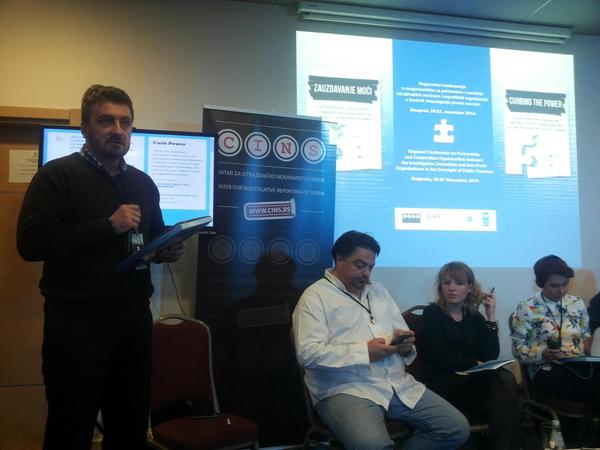
BIRN Serbia and CINS (Center for Investigative Reporting of Serbia) are organising a conference entitled ‘Curbing Power’ about partnership and cooperation opportunities between investigative journalists and non-profit organisations in the oversight of public finances.

The two-day conference will bring together more than 70 journalists and CSO activists who will share their experiences of joint investigative activities and analysing alternative perspectives on current events. The conference will be held at the Holiday Inn hotel in Belgrade on November 26th and 27th.

Participants and speakers from seven countries in the region will discuss subjects including:
–    The government’s attitude towards media and journalists in the region and ways to improve the relationship.
–    Overcoming the illusion of transparency – establishing priorities for opening data sets that should serve as a source of information for investigative journalism and advocacy campaigns, and indirectly as an advocacy tool in order to encourage states in the region to make their data open.
–    “The response to the floods” – investigating the floods in Serbia. Monitoring organisations and investigative journalists look at an alternative picture of the disaster as opposed to the official one.
–    If you follow the money, will the money follow? – Funding the partnership projects between investigative journalists and non-governmental organisations. Is it an opportunity or a trap?
–    The story behind exposing the inner workings of a bizarre dictatorship – Ukrainian journalists’ and activists’ efforts to document a corrupt regime – a story on activism as a symbol of the Ukrainian revolution.
–    The art of investigating public procurements in the completely closed institutions of Macedonian political system.
–    Ethical boundaries between journalism and activism.
–    Experiences in investigating new coal power plants and pollution.
–    New methodologies in the monitoring of public finances and the establishment of a transparent and accountable system resistant to corruption, based on integrity and participation.

Serbia’s Business Registers Agency Urged to Protect Media

A BIRN Serbia debate was told that the Business Registers Agency must do more to protect the identities of investigative journalists using its archive to prevent them from being tracked and targeted.

A debate organised by BIRN Serbia on Monday entitled ‘Limitations to Institutional Freedoms: How to Protect the Information of Those Publishing Information’ heard calls for the Business Registers Agency (APR) to revise its internal procedure for registering people using its archives to avoid additionally jeopardizing journalists.

The debate was addressed by Commissioner for Information of Public Importance and Personal Data Protection Rodoljub Šabić, APR Director Zvonko Obradović, Serbian Centre for Investigative Journalism (CINS) editor-in-chief Stevan Dojčinović and BIRN journalist Slobodan Georgijev.

Investigative journalists often base their work on access to information obtained from the APR archives but the newly introduced procedure for obtaining information of public importance from the agency poses a threat to the safety of journalists, the debate heard.

APR director Zvonko Obradović however said that cooperation with journalists was working well and clarified that the new procedure is no different from the old one regarding records of the information requested.

Obradović maintained that the APR is an institution that is exposed to pressure for it to be transparent.

But Šabić responded that still allows for the possibility of information “leaking” from the APR which could result in danger for the journalists.

Several journalists from the audience inquired why the procedure had been changed just after the recent scandal involving Serbian prime minister’s brother, Andrej Vučić, whose identity was reported to have been stolen.

While not answering the question directly, Obradović insisted that, in cooperation with the Office of the Commissioner, he would do all in his power to revise the procedure and make it as safe as possible for those seeking information.

This would mean that, when paying for services at the APR, an applicant is not required to enter the registration number of the company that he or she is investigating as the reference number on the payment slip.

Šabić: poor standards in personal data protection

The debate also examined the overall situation in the field of personal data protection.

Šabić said that the area of video surveillance, security checks and telephone call records is completely unregulated and that Serbia was dramatically lagging behind in the field of basic standards of personal data protection.

Video surveillance is fully unregulated except for police traffic control, yet thousands of cameras have been installed. Security checks should be regulated by the law yet they are not and telephone call records end up in the wrong hands, said Šabić.

He explained that there are people whose personal data is treated, under the law, as particularly sensitive and this usually involves sexual minorities, those with “compromising” illnesses, people of other nationalities, political orientation or religious affiliation.

Such information should be treated and safeguarded in a special way, he said. The law envisages that within six months the government must pass a decree on archiving and safeguarding particularly sensitive data, he continued, but noted that the law was adopted in 2008 but was not followed by the adoption of a decree.

When a backward society in transition decides to adopt personal data protection standards that are applied in societies in which individuals are very highly valued, it is faced with an extremely difficult task, said Šabić.

He argued that the most important thing is to “change the mentality” so people regard themselves as citizens rather than subjects, and will be willing to speak out and ask the question: “Why are you doing this, and with what right?”

He also said that an investigation carried out by his colleagues had established that information “has not leaked” from APR.

BIRN Macedonia Launches Sixth Call for Investigative Reports

BIRN Macedonia, together with Centre for Investigative journalism – SCOOP Macedonia and the Centre for Civil Communications launched the fifth call for investigative stories on November 25th.

The call is part of the ‘Project for Investigative Journalism and Cooperation Between Media and Civil Society’, part of a USAID programme for strengthening independent media in Macedonia.

In this call that closes on December 8th, at least five journalists will be awarded a grant to cover their expenses while doing the investigation and writing the story.

Journalists will have about three months to dig deeper and research their ideas, but also will have the opportunity to work with experienced editors as their mentors to guide them through the process of writing to BIRN standards.

Topics for investigations include: health; cultural policy; education and youth; human rights; EU integration; good governance; inter-ethnic relations; environment issues; marginalised groups; quality of life.

The call only applies to journalists from Macedonia. More calls for investigative grants will follow in 2015.

Click for more information about the application procedure, with details in Macedonian.

‘The Silent Scream’ Opens in Sarajevo

‘The Silent Scream’, a documentary dedicated to the victims of wartime sexual violence, produced by the Balkan Investigative Reporting Network in Bosnia and Herzegovina (BIRN BiH) premiered on Wednesday in Sarajevo.

Presenting testimonies of the victims who survived sexual violence during the war in BiH, the film aims to encourage all victims to speak up and report the crime.

“We wanted to point out that people who survived this violation of their rights are not guilty for what happened to them and that they have to tell their stories so that the crimes can be prosecuted,” Mirna Buljugic, acting director of BIRN BiH said in her opening speech.

Nasiha Klipic and Dobrivoje Bojovic, film protagonists and survivors of sexual violence in the war, shared with the audience their dissatisfaction with the way the state treats victims.

“The only thing that I want is to find my missing ones. I want to be able to go to their graves,” Klipic said.

Bojovic explained how the financial situation is very hard. “I don’t need to be seen as a hero, I don’t need monuments to be built in my honour. I just want a normal life for my children,” he said.

Gordana Tadic, from the Prosecutor’s Office, said that the Prosecution has developed its capacities in the past two years. She also stressed the necessity for victims to tell their stories as it presents the key element in the investigation process.

Amra Delic, neuropsychotherapist, emphasized the urgent need for society itself to break the ‘law of silence’, because “if we don’t recognise victims and their suffering, we all participate in a process of their re-traumatisation.”

The production of ‘The Silent Scream’ was supported by the Foreign and Commonwealth Office of the United Kingdom.

International Protocol To Deal With Sexual Violence in Conflict Launched in Sarajevo

The International Protocol on Documentation and Investigation of Sexual Violence in Conflict was launched today in Sarajevo. The Balkan Investigative Reporting Network in BiH, a partner in the project, presented several testimonies of sexual violence survivors.

“The testimonies are part of BIRN BiH’s wider research with the aim of making a documentary film dedicated to victims of rape. Their stories compelled us to address all the issues they face today,” said Mirna Buljugic, acting director of BIRN BiH.

The protocol contains a set of standards of best practice on how to document sexual violence as an international crime. In addition to containing guidelines on how to recognise sexual violence it is also protective of the rights of survivors.

“There is a need for survivors to speak up, to be heard, and to address the trauma of sexual violence,” said the UK ambassador to BiH Edward Ferguson.

The Protocol is to be used by the Center for Support of Peace Operations to further the education of BiH troops who are deployed in war zones.

The event is part of the Prevention of Sexual Violence Initiative launched in 2012 by the UK Foreign Minister William Hague at the time and the UN Special Envoy Angelina Jolie.

BIRN BiH Presents Documentary Film on Wartime Rape

The Balkan Investigative Reporting Network in Bosnia and Herzegovina (BIRN BiH) will on November 19 premier its latest documentary film dedicated to the victims of wartime sexual violence in Sarajevo, at the Business Center Unitic.

The film, ‘The Silent Scream’, features account of several men and women who were raped during the Bosnian war. Their stories portray a wide range of issues that the victims of sexual abuse face today.

“One of the most challenging things for the victims of sexual violence is speaking up. We hope their testimonies will motivate other silent victims to step out,” says the executive producer of the film, Mirna Buljugic.

Victims of sexual abuse are often stigmatized in their local communities. Their trauma is passed on to their children and their status is still not regulated by the State. They are often unaware of their rights when invited to testify before courts.

“The film explains the entire process, from the moment when victims are invited to testify, through to the identity protection measures they are entitled to, and the support that they can get from professional associations,” says Buljugic.

Earlier this year BIRN BiH hosted a panel discussion on the topic and presented several testimonies at the End Sexual Violence in Conflict Global Summit in London, which is part of a worldwide initiative launched by the UK government.

The film is the second documentary to be produced by BIRN BiH, and supported by the Foreign Commonwealth Office.

BIRN BiH Holds Judiciary-Media Meeting in Travnik

The Balkan Investigative Reporting Network Bosnia and Herzegovina held the second of its annual countrywide round of meetings with representatives of the media and judiciary in Travnik on Wednesday.

The aim of the meetings is to improving cooperation between local media and judiciary representatives.

Local journalists and representatives of the Cantonal Court in Novi Travnik, the prosecutor’s office in Travnik and the Organization for Security and Co-operation in Europe had a productive debate on a set of guidelines introduced by High Judicial and Prosecutorial Council that regulate the publishing of indictments and verdicts on official web pages.

Although the guidelines are not obligatory, both court and prosecutor’s office representatives said that they were very useful and will be adopted and implemented in their internal rulebooks.

“We do support the initiative that name and surname of the accused should be published, but not before the indictment is confirmed. Although it is hard to give a statement using only initials, we have to protect the investigation process,” explained Edina Jaganjac, spokeswoman of the prosecutor’s office in Travnik.

Dragana Sivonjic, a journalist from Radio Vitez, asked the court and prosecutor office’s spokespeople to simplify the language they use in official news and public statements.

“It happens quite often that we receive a press release full of technical and legal phrases which even we cannot understand. It would be very helpful if we could receive statements in more appropriate language for the general public, so we can transfer the news to a wider audience,” Sivonjic said.

Participants also agreed on the necessity of following professional and ethical standards in reporting in order to inform the public in an objective way, but also to secure the rights of participants in a legal process – the accused, victims and witnesses.

“The wrong interpretation of information from the court can cause lots of damage, both to the institution and trial participants,” judge Zuhdija Cosic said.

By the end of November, BIRN BiH will organise three more meetings with local representatives in Brcko, Banja Luka and Sarajevo.

BIRN Fellowship to be Presented in Belgrade

For the eighth year in a row, 10 promising journalists from across the region will present the investigative reports they developed at part of BIRN’s annual Balkan Fellowship for Journalistic Excellence scheme.

This year’s topic is ‘Generations’, and the 10 reporters who were selected to take part have been working hard for the past few months to complete their cross-border investigations.

The best three works will be chosen by a selection committee and awarded a cash prize of 4,000 euros for first place, 3,000 euros for second place and 1,000 euros for third place.

The while award winners will be announced at the Balkan Fellowship for Journalistic Excellence closing event and award ceremony in Belgrade on November 28.

This year’s final event will also be attended by more than 60 Fellowship alumni from nine countries in the region.
They will gather at the BFJE Alumni meeting, organised every second year with the aim of enabling networking and providing a platform for the sharing of experiences as well as providing funds for joint regional journalistic projects.  
At a time when media across the region are under strong political and economic pressures, the Fellowship programme enables journalists to work on projects of their own choice with editorial and professional support, serving as an example which the media industry could emulate.