International Forum on South Serbia Kicks Off

BIRN has organised a high-profile conference and open debate today in Belgrade on the further development of South Serbia and possibilities for the increased integration of ethnic Albanians into Serbian state institutions.

The conference is entitled ‘South Serbia: From Frozen Conflict to Sustainable Solutions: Opportunities for Long-Term Integration and Development of the Region’.

The Forum is organised under the auspices of the British Embassy in Belgrade and the Balkan Fund for Democracy on the occasion of the first anniversary of the reinstatement of the Coordinating Body for South Serbia.

Participants in the forum include: Stephen Wordsworth, UK ambassador to Serbia; Mary Burce Warlick, U.S. ambassador to Serbia; Milan Markovic, Serbian minister for state governance and local self-governance; Riza Halimi, member of the Serbian parliament; Vincent Degert, head of the EU Delegation to Serbia; and Dimitrios Kypreos, ambassador of the OSCE Mission to Serbia.

The southern Serbia municipalities of Presevo, Bujanovac, and Medvedja are home to Serbia’s largest ethnic Albanian population outside of Kosovo and are among the least developed in Serbia. High unemployment rates and an average wage lower than the state average of about 350 euros are two of the many challenges facing the area.

In 2000 and 2001 the region was the scene of an armed conflict between state security forces and local ethnic Albanian militants in the Liberation Army of Presevo, Bujanovac and Medvedja.

The aim of the forum is to provide a platform for the participation of all interested parties and allow them to take part in a discussion on the opportunities for fostering stability and development in South Serbia, with particular reference to the work of the Coordinating Body of the municipalities of Presevo, Bujanovac and Medvedja and the establishment of a National Minority Council.
Decentralisation of Serbia Conference

Organised by the Balkan Investigative Reporting Network (BIRN) and Centre for Regionalism, a two-day conference was held on the subject of “Decentralisation of Serbia  – situation, requirements and obstacles”. The conference was held in the Great Hall of the Novi Sad City Assembly, on February 25 and 26, 2010.

The conference was held in the Great Hall of the Novi Sad City Assembly, on February 25 and 26, 2010. The topics covered by the conference were: Regional policy of the European Union, Usage of pre-accession funds, Vojvodina’s experiences so-far in using pre-accession funds , Statistical and functional decentralisation of Serbia

Through reviewing of the current situation in Serbia and the need for its decentralisation, the conference noted resistance and obstacles emerging on that path. The discussion that ensued after introductory speeches by panellists helped a good deal in eliminating dilemmas existing in the public about the process of decentralisation itself. The gathering emphasised correlation between the process of decentralisation and possibility of using European funds, especially those intended for equal regional development and cross-border cooperation.

Opening the conference, state secretary for regional development Dejan Jovanovic emphasised the significance of Serbia’s decentralisation and explained that the basic purpose of that process is investment into poorly developed regions of Serbia. After that, opinions of other panellists ensued. Head of the political department of the British embassy Cathy Cottrell said that: “Regionalisation is groundwork of the European integration processes.”

At the opening, other speakers were Aleksandar Jovanovic – speaker of the Novi Sad City Assembly, Gordana Igric, director of BIRN, and Aleksandar Popov, director of the Centre for Regionalism, who pointed out the fact that only a fifth of Serbia’s citizens believes that decentralisation is necessary, assessing that it is the consequence of wrong perception by citizens that decentralisation leads to separatism.

About the current processes of decentralisation, which are always a hot issue in countries of the European Union, spoke Dr Franz Schausberger, president of the Board of Directors of the Institute of the Regions of Europe, Salzburg/Austria, and Antonella Valmorbida, director of the Association of Local Democracy Agencies, ALDA Italia and other speakers.

The conference gathered around 130 participants from Serbia, Austria, Italy. Participants of the conference were representatives of local self-governments: Nis, Kragujevac, Prijepolje, Bor, Medvedja, Presevo, Novi Sad, Kovin and others.

The conference’s realisation was supported by the British Embassy in the Republic of Serbia.

The First National Budget Forum

The first national budget forum organized by BIRN Serbia and its partner organisation Pro Concept was held on Tuesday in presence of more than fifty governmental, NGO, business sector representatives, experts and journalists.

The aim of the forum was to gather stakeholders from the field of public finances in Serbia and to create a platform for wider public debate in the field.

The panelists on the forum included: Serbian Finance Minister Diana Dragutinovic, National Bank of Serbia Vice Governor Branko Hinic and former high official in Serbian government and university professor of public finances Milica Bisic. Moderator of the event was editor in daily Politika Misa Brkic.

Brkic presented results of analysis, which Pro Concept carried out  on possibilities for savings in the ministries of health and education budgets. He also presented Baseline study on current situation in sector of public finances in Serbia.

“It is possible to save five to seven per cent of the overall budget of ministries of health and education with better planning,” Brkic pointed out.

Dragutinovic said several interesting things regarding problems with controlling public finances in Serbia.
“We do not know how we had spent about 130 billion dinars last year because we do not control spending in different agencies and directorates” Dragutinovic said.

She said that the new law on budget system in Serbia is good and will thus bring a greater level of transparency to Serbia’s public finances. The finance minister announced that she will initiate forming of new fiscal body in order to strengthen capacity of institutions for better planning and spending.

Ms Bisic said that budget for 2010 is realistic but that there will be problems in its implementation if the policies of public finances are not improved.

“The foreign investors are not interested in low tax rates as they are interested for stability and assurance of the whole system” she stressed adding that large numbers of exclusions in tax system were huge mistake.

In the afternoon session, the debate was run within The Chatham house rules, while debate’s conclusions and recommendations are to be used for next stages of the project.

BIRN Serbia at the end of March in South Serbia

On March 27- 29 BIRN Serbia will organize follow up training for journalists from Southern Serbia, as a part of the Minority media training and reporting project, supported by the British Embassy in Serbia.

Seven journalists from both Serbian and Albanian media outlets will participate in training and editorial workshop, focusing on reviewing accomplishments of previous session, held in January and articles produced as a result of it. Also, significant time will be devoted to basic training in covering economic issues, and discussing economic topics that will be covered through next phase of on the job training, which implies trainees work on an article and editor’s mentorship.

After the training session BIRN Serbia team will be heading to Vranje, where second supplement of “Novine Vranjske” will be produced as a result of journalism, editorial and lay out training organized in previous three months. First supplement of the most important print outlet southern of Belgrade was dealing with the economic situation and prospects of this region, offering answers to questions such as the future of former giants in textile and furniture industry, the position of the jobless in Vranje and the new business perspectives in term of development of small enterprises. 
 
Second supplement will be looking at the variety of issues that are common ground or points of differentiation for communities in Southern Serbia, how they perceive each other and what can be find behind the gloomy political scene. These supplements are part of the in house training that will be implemented in “Novine Vranjske” throughout the year. First results are already visible in contents and lay out.
 
“This is crucial help for us because now we understood where we made mistakes and realized how to solve it” said Vukasin Obradovic editor in chief of “Novine Vranjske”
 
During its visit to south BIRN Serbia will organize series of meetings as a part of preparations for the round table event, to be held in April.

BIRN Serbia Economic reporting training

Belgrade_BIRN Serbia organised a training workshop for ten journalists from local media in Serbia in order to strengthen their capacity to report about the economy. The programme is supported by IREX Serbia and USAID.

Trainees were introduced to various aspects of the global financial crisis and its effects upon the region and Serbia in particular.

The first day of the training event was designed to offer insights into the current economic situation, its causes and potential consequences, as a necessary framework for understanding economic trends.
 
Goran Nikolic, a researcher from the Serbian Chamber of Commerce, was talking about the roots of the global economic crisis, the wreckage of major financial institutions in USA, and the consequences of that affair. Part of his presentation was devoted to explaining the situation in Europe, especially South-East Europe, and the way in which financial markets are dependant on each other.
 
Miroslav Zdravkovic, an expert from Economic institute, talked about the economic situation and reforms carried out in Serbia, the country’s place in the regional economy before the economic crisis, its current situation and the effects of the crisis that can be expected. He argued that Serbia is in a worse position than officials’ want to present to the public, partially due to slow reforms and inconsistent economic policy. He explained the meaning of the government’s economic measures, the importance of the IMF programme in Serbia and problems that remain unsolved, such as the large discrepancies in regional economic development and the unfavourable climate for investments.
 
“This was important for us, I feel that I understand the current economic situation in Serbia much better, and I would like to see practical work during coming sessions” said one of the journalists.
 
The second day of the training was devoted to honing trainees’ journalistic skills and brainstorming on potential story ideas as preparation for the practical work on developing story outlines scheduled for the final day.
 
Rodoljub Sabic, commissioner for Information of Public Importance and Personal Data Protection, introduced journalists to the practices of his institution and explained its implementing mechanisms for free access to information.
 
“This institution can help you to do stories for the Pulitzer award,” stressed Sabic.
 
The importance of economic news; how to write it; whether it has to be boring; how to use numbers and how to make economics understandable to the general public were the main themes of the training session led by Aleksandar Vasovic.
 
The afternoon session was dedicated to understanding the importance of economic news and recognizing the phenomena that lies behind it. Senior editor of daily Blic, Mijat Lakicevic, worked with trainees on how to develop an analytical story on economic news, and brainstormed on potential economic story ideas that tackle the issue of the financial crisis in Serbia on a local level.
 
The third day was on-the-job training, mainly oriented towards commissioning articles to be written by trainees and edited by BIRN editors.
 
BIRN’s editor Gordana Igric introduced journalists to the basic principles of analytical reporting, with special attention paid to the issue of libeling.
 
Eight stories, covering a variety of topics from all around Serbia, were commissioned while the best of them will be published in BIRN’s online publication, www.Balkaninsight.com.
 
Trainees evaluated the training, especially the variety of information that was presented, very highly, expressing their interest to participate in similar activities in the future.


BIRN Serbia Launches New Programme for Journalists and Media in South Serbia

Vranje _ BIRN Serbia launched a multi-year project “Building Public Awareness in Multiethnic Areas”, supported by the UK Government, in Southern Serbia.

The program is designed to contribute to the reduction of tension in multiethnic communities and develop objective media reporting through media training that both develops journalistic skills and allows local journalists to develop a better understanding of political and social context of the area.

The first activity in the programme was a five day ‘in – house’ training session in “Vranjske” – an independent weekly in Serbia’s southern city of Vranje. A group of experienced trainers worked hands on with journalists, editors and technical staff, helping them to prepare one weekly edition of the newspaper. The trainers tackled important issues such as respect for the highest professional standards, making reporting more  relevant to the readership, improving editorial policy and procedures and the market positioning of the newspaper.

This training was the first of many – during the first year of the programme there will be three similar events followed by the publishing of four supplements of Vranjske, aiming to provide in-depth reporting of important issues in this region of Southern Serbia.

Within the wider scope of the programme for media and journalists in Southern Serbia, in addition to implementing basic and advanced training and editorial mentoring for journalists, BIRN will produce high quality coverage on political and social developments in Serbia’s southern province, organise web journalism workshops and hold a series of round table discussions.

 The “Building Public Awareness in Multiethnic Areas” programme was launched on December 10, 2009 and will run until mid 2011 and is supported by the UK Government’s Conflict Prevention Pool.
 

Sandzak and South Serbia Journalists Study War Crimes Reporting

Belgrade _ BIRN Serbia together with the OSCE mission in Serbia organised a three day study visit for journalists from South and Southwest Serbia on reporting war crimes trials.

The event gathered eight journalists who work for print and electronic media from Presevo, Bujanovac, Novi Pazar, Tutin and Raska.

The first session at the OCSE mission was focused on general issues: journalists were introduced to the basics of international law standards and practice in the context of war crimes prosecutions trials in Serbia over the last decade.

Following this, Matthias Hellmann from the International Criminal Tribunal for the former Yugoslavia office in Belgrade presented the work of The Hague tribunal and Dusan Ignjatovic from the National office for cooperation with the tribunal presented the work of this Serbian institution.

“It was substantively important for us to hear first hand how some institutions work,” said Baki Rexhepi from TV Spektri in Bujanovac.

On the second day, participants were taken to the District court, Chamber for war crimes, where they had meetings with the president of the court, representatives of the prosecutor’s office and followed current, ongoing trials.

“Being in the court was crucial for this study tour,” said journalist Nikola Lazic from Bujanovac.

On the third and final day, participants followed the morning session in the court and in the afternoon session they had opportunity to meet colleagues from Belgrade-based media.

Aleksandar Roknic from the Danas daily introduced them to techniques of court reporting. Milos Milic, B92 editor, gave a presentation on The Hague tribunal and the role of the media who report from there while Misa Stojiljkovic explained the techniques of interviewing the victims.

Reporting from Kosovo

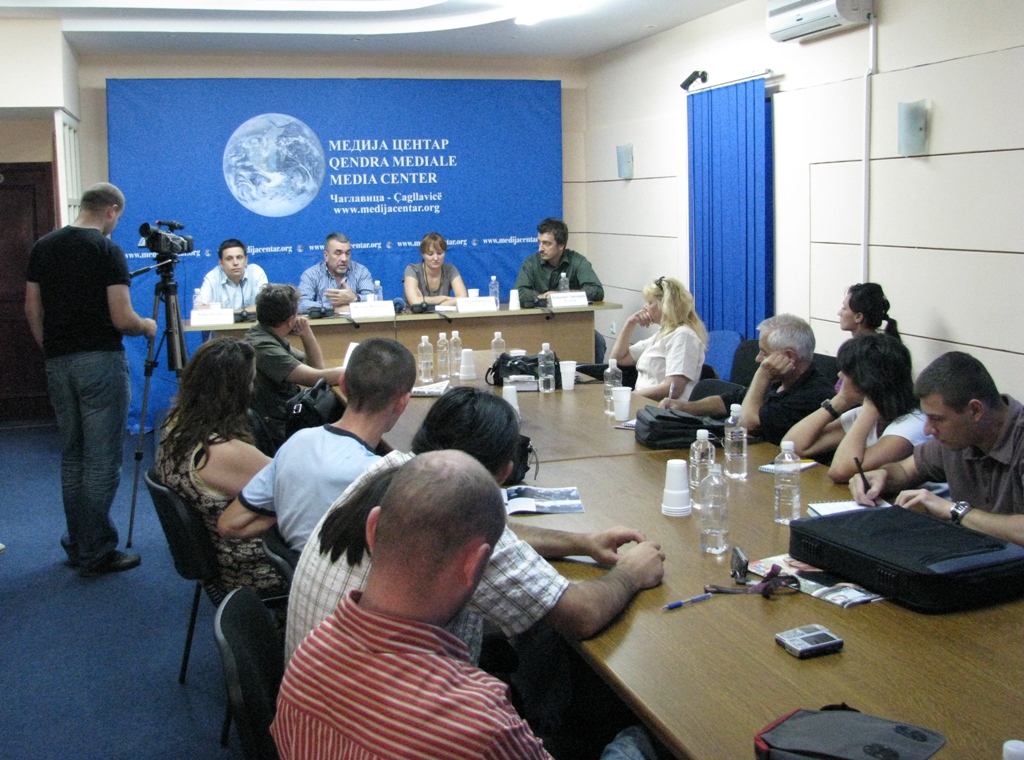
Caglavica – BIRN Serbia organised a round table at Caglavica’s Media centre on Friday September 12 addressing the issue of reporting from Kosovo for Serbian media.

The event gathered 15 journalists, mainly correspondents of Belgrade-based media who were interested to discuss the picture Serbian media paints regarding Kosovo and life there after independence was declared in February 2008.

The panelists were Miki Mihajlovic from the Office for communications for the Serbian Government, Tanja Petrovic, media researcher and analyst from Belgrade as well as Pedja Obradovic, deputy editor at the Belgrade daily Blic.
 
In an almost three hour long and lively debate, the guests from Belgrade presented their views on the challenges of reporting from Kosovo and the impact that it has on Serbian public.
 
Petrovic presented a study on media coverage of events that followed the declaration of independence as well as the act itself.  The results of the research showed that Serbian media were mainly focused on reporting from a Serbian perspective. In depth analysis and features about life in Kosovo took the smallest slice of media coverage of the situation in Kosovo.
 
Mihajlovic gave an overview of the policy of the Serbian government towards Kosovo, stressing that Belgrade will support media outlets for Serbs in Kosovo. Government has no influence on media reports, argued Mihajlovic, but is interested in keeping the Kosovo issue high on the agenda, as well as preserving Serbian media in Kosovo. He also called on representatives of the local media to apply for grants which the Serbian government wants to establish for helping media.
 
Obradovic talked about editorial policy and the importance of journalists’ initiative. He said Kosovo is the important issue for Belgrade media but mainly in a political context, as a part of overall Serbian political climate and these days especially in terms of foreign policy, which leaves little space for local reporters’ contribution. In spite of that, good stories on life in Kosovo can always attract attention and get coverage in the media, noted Obradovic, stressing that reporters are not offering enough attractive material.
 
Journalists from Kosovo used this chance to talk as well about problems that they are facing in terms of safety, access to information and bad economic situation. Freelance journalist Nikola Besevic from Pristina said that everything depends on the editorial policies of Belgrade-based media and that journalists who work for it have little scope for initiative. Refki Alija from Prizren said that media are only interested in disputes and not the struggles of everyday life in Kosovo, or any positive example.
 
The debate highlighted that journalists from Kosovo do not have enough support from Serbia and they were very disappointed by the treatment of the Serbian broadcasting company – RTS. One of the participants said you could not use the same language today in 21st century as the one have been using 20 years ago, when you report on the situation in Kosovo.
 
“We need a new language in journalism if we want to produce true stories,” he said.
 
This event is a part of BIRN’s project entitled, Minority Media Training and Reporting supported by the National Endowment for Democracy.

Belgrade Insight Resumes after Summer Break

After the successful launch and publication in May, June and July, Belgrade Insight, BIRN`s new project and a unique English-language newspaper in Serbia, will be resuming publication in September.

The readers will have the opportunity to enjoy Belgrade Insight articles, stay informed on the latest political and business news, browse through the city’s cultural and arts guide and read about the most interesting events in the countries of the region.
 
Beginning in September, Belgrade Insight will be published on a regular basis. For more information on how to subscribe and receive your copy, please contact BIRN office in Belgrade at [email protected]

BIRN Serbia Holds Evaluation Meeting

Belgrade – BIRN Serbia organised an evaluation meeting for journalists who in the last three years have participated in the Minority Media Training and Reporting Project.

24 journalists from South Serbia, the Sandzak region, Vojvodina, Kosovo and Montenegro participated in the discussion, which is almost one third of the total number of journalists who passed through BIRN Serbia’s training programme.

The evaluation meeting with journalists from the BIRN Serbia network is part of the overall review of project results.
This is an ongoing initiative which should be completed by mid June, and includes, besides journalists, all the key participants in implementing the Minority Media Training and Reporting Project as well as its beneficiaries such as editors from the Serbian media, Balkan Insight subscribers and other relevant stakeholders.

The meeting, organised at Belgrade’s Media Centre, was moderated by Mr. Danko Cosic of ProConcept, (www.proconcept.org.yu ) who developed the methodology for the evaluation of entire project.

The Minority Media Training and Reporting Project, generously supported by the British Embassy in Belgrade since 2005, aims to improve standards of journalism in areas with substantial minority populations and to improve understanding of minority issues among the mainstream population and decision makers, thereby challenging the current mood of suspicion and misunderstanding.
In course of the last three years, 84 journalists have passed through the primary level training while 76 of them went through the advanced level on job mentoring. 159 articles and 11 investigations were produced and published in Balkan Insight (www.balkaninsight.com) as a result of the training activities and 11 public debates on the most pressing social and political topics were held in Belgrade and targeted areas.
The final report of the evaluation will assess the activities and results in the past three years and provide BIRN with ideas for future development.