BIRN’s Summer School Hears Tips For Developing Investigations

The second day of the Balkan Investigative Reporting Network’s annual summer school for investigative journalism continued with lectures and workshops on how to develop story ideas and gather information.

Renowned British journalist David Leigh started the day by speaking about possibilities for developing stories which have emerged from major data leaks, such as the material released by WikiLeaks.

“Your aim should be to use WikiLeaks to build your investigations by using the information as actual leads to uncover new things,” said Leigh.

Another way to collect valuable information when building investigations is filing official requests for information to governments, said Helen Derbishire, from the NGO Access Info Europe.

“The requests themselves can help your stories in many ways. For one, you can actually get the information you wanted. Never assume you would not get something. Even if you are rejected, you can appeal, but also you can publish the rejection, which is a story in itself,” she said.

German journalist Marcus Lindemann also revealed ways through which researchers can use Google and social networks to find personal data on individuals of interest.

The executive director of the Organised Crime and Corruption Reporting Project, Paul Radu, said that investigations are about creativity and connecting the dots.

“Today we have a lot of access to a variety of information. The more data we have, allows us to discover bigger schemes… This is fun! It’s just great to ruin the plans of criminals and to get to the bottom of a story,” said Radu.

He used examples of several investigations he worked on to explain the ways in which journalists can gather information about money laundering, offshore companies and proxy companies.

Researcher Laura Ranca highlighted the importance of data visualisation in investigations, explaining that the collected information is only as good as it is presented to the readers.

The BIRN Summer School opened on Monday in Bled, Slovenia with 30 journalists from Serbia, Slovenia, Kosovo, Croatia, Bosnia and Herzegovina, Montenegro, Albania, Bulgaria, Austria, Estonia, France and Romania participating. The lectures will continue on Wednesday.

BIRN Summer School of Investigative Reporting 2013 is organized in cooperation with the Media Program South East Europe of the Konrad-Adenauer-Stiftung and with support of King Baudouin Foundation and Belgium National Lottery and OSCE Mission in Kosovo, OSCE Mission to Serbia and USAID in Macedonia.

BIRN’s Journalism Summer School Opens in Slovenia

The Balkan Investigative Reporting Network’s annual summer school for investigative journalism has begun at Lake Bled with 30 young journalists participating.

The journalists – from Serbia, Slovenia, Kosovo, Croatia, Bosnia and Herzegovina, Montenegro, Albania, Bulgaria, Austria, Estonia, France and Romania – heard on the first day about investigative stories, methods of online research and the challenges of reporting on human trafficking.

Renowned British journalist David Leigh explained that working on investigative stories is a dangerous game. “In essence, you’re blundering along blind, because you don’t know what you’re looking for, but despite this, it is your job to collect the evidence and proof,” said Leigh.

He added that the longstanding principles of Britain’s Guardian newspaper – honesty, integrity, courage, fairness and a sense of duty – are applicable to modern investigative journalism.

Leigh told the participants about a seven-year-long investigation that he was part of, which uncovered bribery in arms dealings in Britain, highlighted the need for patience and hard, written evidence for investigative stories.

“Comment is free, but facts are sacred. This is why it is the job of journalists to get the facts right,” said Leigh.

German executive producer and journalist Marcus Lindemann discussed various online research possibilities. He revealed effective ways in which journalists can get information online about companies, individuals and issues.  

The summer school’s first working day ended with a discussion about the challenges of investigative reporting about human trafficking. Independent consultant and adviser Ruth Rosenberg spoke about the need for journalists to be highly sensitive to victims’ needs when reporting about trafficking.

“We must take care of the privacy, confidentiality and security of victims when reporting on human trafficking stories. You, as journalists, must bear in mind that your stories can have extreme consequences for the people you interview,” said Rosenberg.

Slovenian state prosecutor Savica Pureber and Katjusa Popovic from the NGO Kljuc talked about how the state and non-governmental sector work together to deal with human trafficking issues, highlighting the need for media to cover these stories, but in a sensitive and professional manner.

Meanwhile, Marija Andjelkovic from the NGO ASTRA in Serbia told the journalists about her organisation which runs a trafficking hotline which has received thousands of calls.

“The trends of trafficking in Serbia are changing. Ten years ago we had mostly victims of trafficking from Moldova, Russia, but today 99 per cent of victims are from Serbia. We are also seeing a rise in under-age victims,” said Andjelkovic.

Katrin Adams, who works on the prevention of human trafficking for Germany’s Gesellschaft für Internationale Zusammenarbeit, said that because these issues have been in the public eye for a while, the situation in the region has improved compared to 15 to 20 years ago.

“Prosecutors and judges have been sensitised. We have NGOs and they cooperate very well, but we have problems with sustainable and coherent ideas to improve the social welfare system. We need sustainable prevention,” said Adams.

BIRN Summer School of Investigative Reporting 2013 is organized in cooperation with the Media Program South East Europe of the Konrad-Adenauer-Stiftung and with support of King Baudouin Foundation and Belgium National Lottery and OSCE Mission in Kosovo, OSCE Mission to Serbia and USAID in Macedonia.

BIRN Summer School Scholarships Open Until August 5

Balkan-based journalists can apply for scholarships at the BIRN Summer School of Investigative Reporting 2013 until August 5.

This year’s BIRN Summer School will be held at Bled Lake in Slovenia from August 25-31.

All those interested should apply online by following this link:  http://www.balkaninsight.com/en/birn-summer-school/birn-summer-school-2013-enrolment.

Experienced journalists from Albania, Bosnia and Herzegovina, Bulgaria, Croatia, Kosovo, Macedonia, Montenegro, Romania and Serbia can apply for full scholarships that will cover full-board accommodation, a travel fee up to 100 euros and BIRN’s published textbook  “Digging Deeper: A Guide for Investigative Journalists in the Balkans”.

Application for international participants is open until August 20.

BIRN Summer School of Investigative Reporting 2013 is organized in cooperation with the Media Program South East Europe of the Konrad-Adenauer-Stiftung and with support of King Baudouin Foundation and Belgium National Lottery and OSCE Mission in Kosovo, OSCE Mission to Serbia and USAID Macedonia.

BIRN’s ‘Digging Deeper’ Published in Macedonian

BIRN’s investigative journalism guide “Digging Deeper”, written by Sheila Coronel, director of the Stabile Center for Investigative Journalism and professor at Columbia University, New York, has been published in Macedonian.


The guide for the investigative journalists in Macedonian, entitled “Pod povrshinata”, will be distributed to universities and libraries across Macedonia but also to journalists involved in different projects implemented by BIRN Macedonia. The handbook’s translation and print was funded by the Foundation Open Society Institute Macedonia.

Digging Deeper” is a product of BIRN’s Investigative Reporting Initiative, an educational programme that includes cooperation with international universities and local partners with the aim of putting the guide into commercial use as a curriculum for investigative reporting.

In the guide, journalists’ articles, coupled with interesting advice, skills, investigative stories, databases, case studies, exercises and tips and techniques inspire readers to take up the challenge of a career in investigative journalism.

BIRN’s “Digging Deeper” is part of the curriculum of the BIRN Summer School of Investigative Reporting LINK. BIRN has published two editions of the book in English, which has been translated into Serbian and Albanian as well as Macedonian.

All who are interested in obtaining free copy of this valuable guide for investigative journalists should contact BIRN Macedonia office at this email address: [email protected].

See the full text in Macedonian here.

Annual meeting of BIRN Assembly and Steering Board

BIRN brought together its Steering Board and Assembly members for their annual meeting in Belgrade from July 9-12.

The meeting takes place each year in the Serbian capital to enable Board and Assembly members to discuss BIRN’s ongoing activities and its plans for strategy development.

During the three-day meeting, a new BIRN statute that was presented last year at the Board meeting and an audit of BIRN HUB was endorsed.

Ana Petruseva, one of the founders of the BIRN regional network and BIRN Macedonia, said: “This helps us get clear picture how to proceed with new and ongoing BIRN activities.”

Local BIRN directors presented also all their country activities and strategic and operational issues to the members of the Assembly.

The possibility of opening a BIRN office in Albania was also discussed.

BIRN Steering Board and Assembly Meets in Belgrade

BIRN is holding its annual Steering Board and Assembly meeting from July 9-12 in Belgrade.

The meeting is organised to discuss strategic and operational issues facing BIRN, ongoing programmes and plans for the future. 

The Steering Board is composed of BIRN country directors. Each board member will make a presentation about country specifics and fundraising activities.

The Assembly brings together Tim Judah, author and Balkans correspondent for The Economist, Wolfgang Petritsch, Austria’s permanent representative to the OECD, Steve Crawshaw, international advocacy director at Amnesty International, Stefan Lehne, former Austrian diplomat and visiting scholar at Carnegie Europe in Brussels, and Per Bymon, secretary-general of Swedish Radio and Television’s humanitarian foundation, Radiohjälpen.

BIRN Holds Sarajevo Debate on Post-War Memorialisation

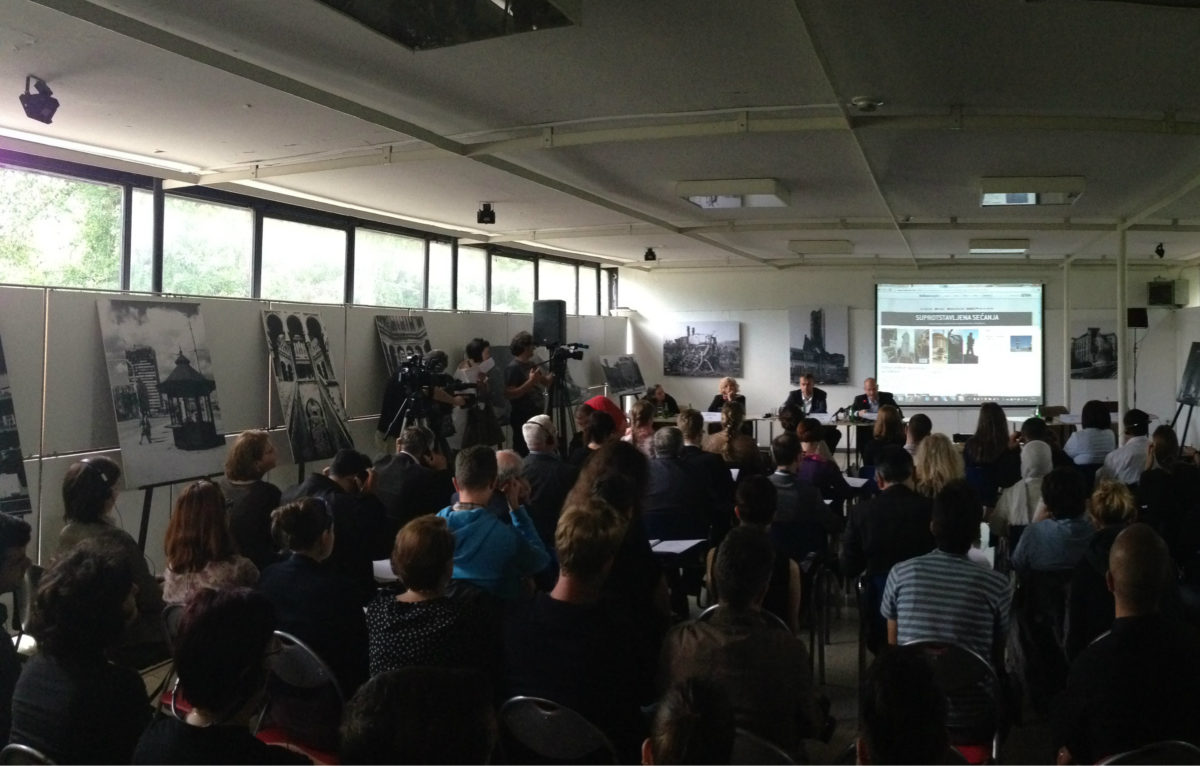
BIRN presented the results of its investigation into memorialisation in the Balkans at a round-table debate in Sarajevo on Thursday, where participants discussed the problems caused by the post-war monument-building boom in the former Yugoslav region.

The in-depth investigation examines how different states and ethnic groups use monuments to promote their own versions of past events, how governments use them to manipulate history for political advantage, and how they are used as a tool for nation-building in the region.

It was put together by reporters from BIRN’s Balkan Transitional Justice project in seven countries across the region.

The debate was led and moderated by Sarajevo-based researcher and memorialisation expert Nicolas Moll.

Participants included by Amra Custo from the Institute for Protection of Cultural, Historical and Natural Heritage of the Sarajevo canton, Petar Todorov from the National Institute of History from Skopje, Ljubinka Petrovic Ziemer from forumZFD, Almina Jerkovic from the Ministry for Human Rights and Refugees of Bosnia and Herzegovina, as well as representatives from an organisation called Four Faces of Omarska.

For more information, see the Conflicting Memories focus page: http://www.balkaninsight.com/en/page/balkan-transitional-justice-memorialisation-conflicting-memories


BIRN launches special focus page on memorialisation

The ‘Conflicting Memories’ focus page presents the results of an investigation into the post-war Balkan monument-building boom, put together by BIRN’s Balkan Transitional Justice team of journalists from seven countries across the region.

The investigation examines how different states and ethnic groups use monuments to promote their own versions of past events, how governments use them to manipulate history for political advantage, and how they are used as a tool for nation-building in the region.

The focus page includes six features and an interactive map – a guide to the number of memorials built across the Balkans, their cost, and which of them have proved the most controversial and unusual – as well as a photo gallery.

All content is presented in Macedonian, Albanian and Bosnian/Croatian/Montenegrin/Serbian as well as in English. 

The focus page was launched ahead of a BIRN debate in Sarajevo which will bring together a panel of experts to discuss memorialisation issues in depth. The event will take place on June 27 at the Historical Museum of Bosnia and Herzegovina.

To find out more: www.balkaninsight.com/en/page/balkan-transitional-justice-memorialisation-conflicting-memories.

University of Pristina honours US and EU envoys

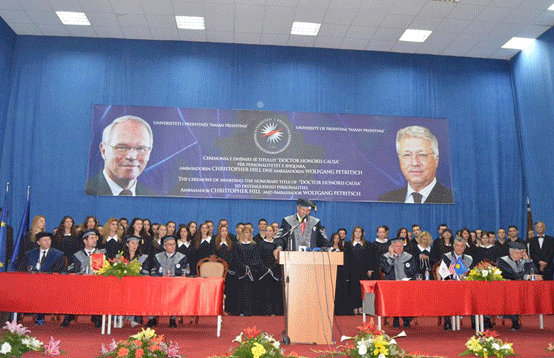
Hasan Pristina University honoured former special envoys Christopher Hill and Wolfgang Petritsch on Wednesday with the title of Doctor Honoris Causa in a ceremony held at the faculty of philology. They were awarded the title for their contribution to the resolution of the Kosovo conflict.

Hill and Petritsch, who worked as the special envoys of the United States and the European Union respectively during attempts to stop the Kosovo conflict in the late 1990s, were honoured for their outstanding contributions to creating conditions for peace, justice, freedom and democracy and increasing opportunities for the development of education, science and academic freedoms in Kosovo.

The rector of Hasan Pristina University, Ibrahim Gashi, opened the ceremony.

“We were lucky to have you and your peoples as our friends during our worst, hardest time,” said Gashi.

Prime Minister Hashim Thaci praised the two former envoys for bringing together the Albanian political spectrum.

“Mr. Hill and Mr. Petritsch stood by Kosovo when Kosovo needed friends the most,” said Thaçi.

The two former envoys also addressed the gathering.

“Kosovo has changed a lot since the time when I was here. You cannot choose your neighbours, but you can live in peace with them,” said Hill.

“The European Union is facing many problems, but Kosovo is moving towards the EU,” said Petritsch.

Petritsch and Hill acted as mediators during the talks between Kosovo Albanians and the Yugoslav authorities at the Rambouillet Conference in 1999 before the NATO bombing campaign ended the conflict.

Petritsch, from Austria, is also a member of BIRN’s Regional Board.

BIRN holds debate on post-war memorialization

BIRN’s Balkan Transitional Justice team will hold a debate on memorialisation and the findings of a wide-ranging investigation into the post-war Balkan monument-building boom put together by its journalists from seven countries across the region.

Hundreds of monuments and statues have been built since the conflicts in the former Yugoslavia amid a largely unregulated memorialisation spree that has sometimes exacerbated the divisions that led to war in the first place, rather than promoting reconciliation.

The investigation examines how different states and ethnic groups use monuments to promote their own versions of past events, how governments use them to manipulate history for political advantage, and how they are used as a tool for nation-building in the region.

As part of BIRN’s Balkan Transitional Justice project, the BIRN investigation also examines the question of what kind of monuments should be built to promote peace rather than reviving past disputes.

The debate will be held on June 27, 2013, at Historical Museum of Bosnia and Herzegovina in Sarajevo.

Debate will bring together a panel of experts to discuss these issues in depth, such as Ljubinka Petrovic – Ziemer, Programme Manager at forum ZFD, expert group on Bosnia’s Transitional Justice Strategy, historians and NGO representatives.

Dowload full Agenda.