BIRN Launches ‘Invisible Art’ Project in Belgrade

Journalists from across the Balkans gathered in Belgrade from December 5 to 6 to discuss the contemporary Balkan art scene and have their stories commissioned for BIRN’s ‘Invisible Art’ project, supported by the Prince Claus Fund.

The two-day meeting that started on Friday was held as a part of BIRN’s cultural project Culture Watch, under this year’s topic of ‘Invisible Art’.

The focus of the meeting was on the stories that 12 journalists from Albania, Bosnia and Herzegovina, Macedonia, Montenegro, Kosovo and Serbia will write for an upcoming webpage that will deal with contemporary art projects and artists across the region who are marginalised by the state authorities, the market, the media and other factors.

The meeting began with an introduction from BIRN director Gordana Igric and a short training session about the writing of longer feature stories for the project.

After this, the journalists explored the possibilities of multimedia reporting within the ‘Invisible Art’ webpage, which will be launched in March.

In the second part of the meeting, the journalists proposed stories that could best describe the situation that the project aims to explore.

The commissioned stories will deal with such topics as the spaces in which alternative scenes function, graffiti artists, performance artists, writers and small publishers and others who are excluded from the mainstream because of their ways of thinking and expressing themselves.

On Saturday, the journalists who will report for ‘Invisible Art’ undertook two study visits.

First they visited the photo gallery Opservatorijum for the opining of a new exhibition by photojournalist Saša Čolic, concentrating on social problems in Serbian society, but also the problem of power, its misuse and the visibility of non-mainstream culture.

The second visit was to the Zvezda cinema in Belgrade, which has been taken over and reopened by a group of young people who call themselves The Movement for the Occupation of Cinemas, who are protesting about the Beograd Film network of cinemas that was privatised and then shut down in 2007.

The Zvezda occupation highlights a new type of social resistance by creative people and artists against the underfunding of culture and the fact that all kinds of cultural institutions are currently not functioning at all across the Balkans.

‘Invisible Art’ is a further step towards the same goal: to use the capacity created by the three year BICCED (Balkan Initiative for Cultural Cooperation Exchange and Development) project to create a regional network of cultural journalists who will monitor the cultural scenes in their own countries.

The project is intended to give people a more colourful insight into the troubles facing artists in the Balkans and help to shape future cultural policies.

The project was initiated by Balkan Investigative Reporting Regional Network, BIRN Hub and is being implemented with the financial support of the Prince Claus Fund.

Twelve feature articles from all participating countries will be published from March to September 2015 within the Balkan Insight site.

New BIRN Project Explores Balkans’ Alternative Culture

‘Invisible Art’, a new project from the Balkan Investigative Reporting Network, will be launched with a regional meeting of participating journalists in Belgrade.

Twelve journalists from Albania, Bosnia and Herzegovina, Macedonia, Montenegro, Serbia and Kosovo will meet on Friday at the Jump In Hotel in Belgrade for two days of training, discussions and the commissioning of stories about the Balkan contemporary art scene.

They will prepare to start research and about the phenomena that define the Balkan contemporary art scene, such as the marginalisation of alternative artists and groups; political, party or religious control over art; ideological conflicts among artists and groups, and obstacles to artistic freedom of speech and expression.

The journalist will try to explore these phenomena in their countries through individual examples from the various spheres of art – from visual arts and literature to music and film – thus uncovering ways in which the social situation affects artists and how it is reflected in their work.

The selected countries are all non-EU states, characterised by a high tolerance for crime and corruption, conflicts between traditional and liberal values, and strong political and party interference in all spheres of life including art. This, together with the lack of a market for contemporary art and the selective state financing of contemporary art projects, serves to marginalise those with alternative approaches to cultural work.

With this project, the Balkan Investigative Reporting Regional Network, BIRN Hub, continues the mission it started with the Balkan Initiative for Cultural Cooperation Exchange and Development, BICCED project (2010-2012), whose main aim was to train journalists in writing analytical and investigative articles dealing with culture policies in ex-Yugoslav countries.

‘Invisible Art’ is a further step towards the same goal: to use the capacity created with BICCED to provide a detailed and colourful insight into the forces that affect art in the Balkans.

The project was initiated by Balkan Investigative Reporting Regional Network, BIRN Hub and is being implemented with the kind support of the Prince Claus Fund.

Twelve feature articles enriched with videos, photos and audio from the alternative culture of the Balkans, each authored by one of the participating journalists, will be published on the Invisible Art focus page within the Balkan Insight website from March to September 2015.

BIRN Fellowship First Prize Goes to Jeta Abazi

The top prize in the 2014 Balkan Fellowship for Journalistic Excellence has been awarded to Jeta Abazi, journalist from Kosovo at a closing ceremony held in Belgrade, on Friday.

Abazi was awarded for her article “Fighting for their fair share”, showing that women across the Balkans still face a battle to overcome discrimination and exercise their legal rights to inheritance. Abazi said that “I believe that good journalism can truly make a difference in our societies, as the phenomena I was exploring is widespread, beyond ethnic and religious boundaries”.

The second prize and 3000 EUR went to Kostas Kallergis from Greece, for his article “The great leap rightward”, where he presented a generation of Greeks that have embraced the far right despite having long leftist family traditions or relatives killed by the Nazis.

The third prize and 1000 EUR was awarded to Krassimir Yankov from Bulgaria, for his article “Syrian refugees leave Bulgaria for German limbo”. Yankov covered the story of Syrians who use Bulgaria as a stepping stone to the heart of Europe — although EU rules say refugees are meant to stay in the country where they entered the EU.

The publication of ten articles under the title Generations:  Stories of Social Change in the Balkans is the product of original research of ten journalists selected from South East Europe to participate in 2014 Balkan Fellowship for Journalistic Excellence. ” By taking part in the fellowship, these journalists have chosen not just to use their considerable skills but to improve them, to push themselves to their limits, to learn both from their experiences and the feedback of the editorial team. Taken together, these 10 stories offer a much more vivid and varied portrait of the region than media coverage often provides.”, said programme editor Andrew Gray.

The Balkan Fellowship for Journalistic Excellence, which was launched in 2007, promotes journalistic excellence and encourage cross-border research projects. Scholarships are awarded with the aim to provide financial and professional support in developing and strengthening the quality of reporting in the Balkan countries. Program participants have the opportunity to collaborate with colleagues from neighbouring countries and comprehensively cover complex topics that are of vital importance for the progress of reforms in the region and cooperation with the European Union.

The jury members were Florian Hasel, Balkan correspondent for the German daily newspaper “Süddeutsche Zeitung”, Remzi Lani, executive director of the Albanian Media Institute, Gerald Knaus, founder and president of the European Stability Initiative, Milorad Ivanovic, executive editor of the weekly “New magazine”, Elena Panagiotidis, editor of Swiss daily newspaper “Neue Zurcher Zeitung”, and Gerfrid Sperl, columnist in the Austrian daily newspaper “Der standard”.

At the award ceremony held at Mikser House in Belgrade, a regional social media campaign for the protection of professional standards in the media #FreeBalkanMedia was launched by the alumni of the Balkan Fellowship for Journalistic Excellence. The campaign will go viral in the entire region.

The next year’s contest will be open for applications as of January 2015.

Balkan Fellowship for Journalistic Excellence is implemented by the Balkan Investigative, supported by ERSTE Foundation, Open Society Foundations, and Prague Freedom Foundation. For more information, please visit fellowship.birn.eu.com.

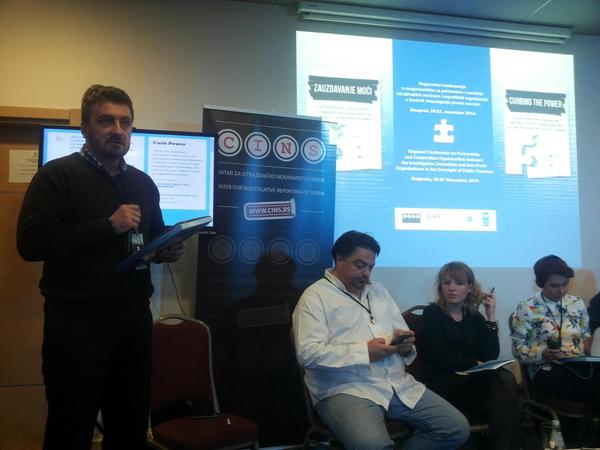
Curbing Power – A Regional UNDP Conference

BIRN Serbia and CINS (Center for Investigative Reporting of Serbia) are organising a conference entitled ‘Curbing Power’ about partnership and cooperation opportunities between investigative journalists and non-profit organisations in the oversight of public finances.

The two-day conference will bring together more than 70 journalists and CSO activists who will share their experiences of joint investigative activities and analysing alternative perspectives on current events. The conference will be held at the Holiday Inn hotel in Belgrade on November 26th and 27th.

Participants and speakers from seven countries in the region will discuss subjects including:
–    The government’s attitude towards media and journalists in the region and ways to improve the relationship.
–    Overcoming the illusion of transparency – establishing priorities for opening data sets that should serve as a source of information for investigative journalism and advocacy campaigns, and indirectly as an advocacy tool in order to encourage states in the region to make their data open.
–    “The response to the floods” – investigating the floods in Serbia. Monitoring organisations and investigative journalists look at an alternative picture of the disaster as opposed to the official one.
–    If you follow the money, will the money follow? – Funding the partnership projects between investigative journalists and non-governmental organisations. Is it an opportunity or a trap?
–    The story behind exposing the inner workings of a bizarre dictatorship – Ukrainian journalists’ and activists’ efforts to document a corrupt regime – a story on activism as a symbol of the Ukrainian revolution.
–    The art of investigating public procurements in the completely closed institutions of Macedonian political system.
–    Ethical boundaries between journalism and activism.
–    Experiences in investigating new coal power plants and pollution.
–    New methodologies in the monitoring of public finances and the establishment of a transparent and accountable system resistant to corruption, based on integrity and participation.

BIRN Fellowship to be Presented in Belgrade

For the eighth year in a row, 10 promising journalists from across the region will present the investigative reports they developed at part of BIRN’s annual Balkan Fellowship for Journalistic Excellence scheme.

This year’s topic is ‘Generations’, and the 10 reporters who were selected to take part have been working hard for the past few months to complete their cross-border investigations.

The best three works will be chosen by a selection committee and awarded a cash prize of 4,000 euros for first place, 3,000 euros for second place and 1,000 euros for third place.

The while award winners will be announced at the Balkan Fellowship for Journalistic Excellence closing event and award ceremony in Belgrade on November 28.

This year’s final event will also be attended by more than 60 Fellowship alumni from nine countries in the region.
They will gather at the BFJE Alumni meeting, organised every second year with the aim of enabling networking and providing a platform for the sharing of experiences as well as providing funds for joint regional journalistic projects.  
At a time when media across the region are under strong political and economic pressures, the Fellowship programme enables journalists to work on projects of their own choice with editorial and professional support, serving as an example which the media industry could emulate.  

BIRN Documentary Sparks Debate in Washington DC

BIRN’s latest documentary ‘The Majority Starts Here’ was given its Washington DC premiere at the National Press Club on November 3, sparking a debate about transitional justice and reconciliation processes in the Balkans.

The screening of the film, which follows six young people from the Balkans as they travel around the region to survey the legacy of the 1990s conflicts, was facilitated by Myron Belkind, the National Press Club’s president and Molly McCluskey, chair of the National Press Club’s International Correspondents’ Committee.

The event was also attended by Srdjan Darmanovic of the Embassy of Montenegro, Ivana Mangov of the Embassy of Serbia, Adnan Hadrovic of the Embassy of Bosnia and Herzegovina and Janer Rabin Satter of the National Endowment for Democracy, as well as US journalists who have formerly worked in the Balkans.

After the screening, Molly McCluskey was joined by Petar Subotin, BIRN Regional Development Officer, for a discussion.

Questions were raised about current transitional justice processes in the region in light of shared narratives which, judging by the documentary, are clearly missing.

Participants in the debate wanted to know whether is it possible to put current government officials at the same table to come up with joint history books that would bring together younger generations in the Balkans, and whether these shared narratives might be able to bridge the gaps created by the individual histories that each country has shaped in accordance with its political agenda.

The audience was also eager to hear what the film’s young protagonists are doing now, and whether they got along during the documentary shooting despite their different backgrounds.

The overall audience impression was that the documentary was optimistic and offered hope, suggesting that younger generations are key players in the ongoing reconciliation processes and that it is only they who can overcome the legacies of the wars.

Vesna Bjekic, Longtime Pillar of BIRN, Dies

A stalwart of our organisation since its foundation – and a much loved, respected and valued colleague – passed away on Wednesday.

“Vesna Bjekic was a trustworthy colleague, a dear friend and in a sense our guardian, always ready to remind younger journalists in BIRN about the Milosevic era and about what journalism was like back then, always warning us about the dangers recent history repeating itself. She was our very own institutional memory bank, ever ready with names, dates and explanations,” said Gordana Igric, BIRN’s regional director.

“We will miss her so much. It will be painful for many years to leave the office in the evening without seeing her in her familiar chair, always staying behind to finish the day’s tasks – but I will always try to imagine her as she imagined herself – swimming out to sea, further and further towards the horizon.”

Born in 1952 in Arilje, near Cacak, over the course of a long career in journalism, Vesna worked with Politika, 4 Jul, YU Panorama, Revijalna Stampa, many local Serbian newspapers, and with the Croatian weekly Danas.

In 1992, as Yugoslavia fell apart, unwilling to compromise or bend to any kind of pressures, she lost her job under the regime of Slobodan Milosevic. She was a regular at all the protests in the 1990s against the late former leader of Serbia.

In 1993, she began working as a freelance journalist, and until 2000 was a key member of the regional Alternative Information Network, AIM. At the same time, she became a regular contributor to IWPR’s Balkan Crisis Report, and after a while took up the position of IWPR Serbia Office Manager.

Jovanka Matic, a close friend, said: “She was a journalistic encyclopedia. You could always rely on her memory for a variety of information about events, people and places. Above all she was a person you could rely on, one you know would never let you down. Everything about her personality was grand: curiosity for everything in life, her thoroughness and dedication to her job, her loyalty to her organization, her unselfishness towards her friends, in relationships that had lasted for decades.

“She was a critical and analytical thinker, she differentiated between form and substance, she was relentless in her quest for key information. Never afraid, she knew how to enjoy beauty, travel, books and little things in life. She confronted her personal struggles, whether financial or health-related or other matters, with dignity. She celebrated success in others. She made wonderful cakes even though she couldn’t eat them herself. She was able to recognize the good in people and to be good to people in an unimposing manner.”

During the past ten years, Vesna managed the BIRN Hub / BIRN Ltd. office in Belgrade and coordinated translation and editing for all of BIRN’s reports in Serbian, Bosnian and Croatian.

Through all these years she was a crucial member of the BIRN team and a shining example of dedication, accountability and support. People came and went, the organisation grew several-fold in size and activity, but Vesna was always there, in good times and bad, in crisis and for celebrations, witnessing and taking part in all of our battles and victories.

Often first to come to the office and the last to leave, Vesna was a department of her own, with a phenomenal memory for events in Serbia and the region in the past 30 years. She was always up for a political debate, but also for a good laugh. The only thing she was equally passionate about, apart from her work, was yoga. She would not miss a yoga session for the world.

She was a person to go to for many things, the only one to fully master the intricacies of Serbia’s bureaucracy and administration. She single-handedly organised all of our official and in-house events and orchestrated each migration of our office as the organisation grew bigger in terms of staff and equipment. She was also the only person with the formula to overpower the monster printer that gobbled up everyone else’s prints, and had the best advice on how to eat healthily, lose weight or give up smoking.

The office will never be the same. We will miss her immensely. May she rest in peace.

Albanian Press Praises BIRN Expose on Corruption

An investigation by BIRN Editor Lawrence Marzouk and local journalists in Albania and Serbia has received widespread republications and praise in the Albanian press and broadcast media.

The investigation ‘Albanian Telecoms Deal Cost ‘$1m to Buy Off Politicians’, Claim US Businessmen,’ uncovers how controversial Bosnian businessman Damir Fazlic, a fixer with powerful friends in Washington DC and the Balkans, requested $1m in ‘investment’ from its US partners for Albania’s Democratic Party, in order to secure a lucrative telecoms contract.

The investigation is part of a series of hard-hitting stories on Fazlic reported in the last few months by Marzouk and his team, focusing on the businessman’s ties to former Albanian Prime Minister Sali Berisha and his family.

The last investigation received dozens of republications in the Albanian online, print and broadcast media and provided food for thought for local political commentators.

In an editorial in the daily Tema on October 23, publisher Mero Baze called for an official investigation by prosecutors based on the latest report published by BIRN.

“The prosecutors cannot turn a blind eye on the declarations made in a prestigious media by two American citizens,” Baze wrote.

“If the prosecutor’s office will not launch a probe…then it’s the prosecutor’s office that should be investigated,” he added.

The investigations on Fazlic are part of a project called “A Paper Trail to Better Governance”, financed by Austrian Development Agency to hone investigative journalism in the Balkans, hold officials to account and improve the implementation and use of freedom of information laws.

The stories published as part of the project have sparked political debate and led to calls for investigations of Albania’s former premier Sali Berisha and his family.

Reacting to a BIRN investigation which revealed how the inner circle around Berisha earned millions of euros from suspect land deals with Fazlic, Albanian Socialist MP Erjon Brace called on tax authorities to launch a probe.

“The tax and money-laundering authorities should verify the transactions of these oligarchs,” Brace wrote on his Facebook page.

“The new evidence is challenging and totally proves the allegations,” he said, referring to BIRN’s report.

New Webpage Unmasks Balkans Energy Sector

Power Games, an unprecedented investigation into the murky world of energy deals in the Balkans, has been launched by the Balkan Investigative Reporting Network.


BIRN formed a team of six journalists covering Albania, Bosnia, Kosovo, Montenegro and Serbia in November 2013 to investigate key companies, players and state officials involved in this lucrative, secretive, and critical sector of the economy

The reporters have been working over the past year not only to unravel the intricate links between politics and business in the energy market, but also delve into its inner workings.

The bespoke webpage www.balkaninsight.com/en/page/power-games includes the latest investigations, news, blogs, as well as an interactive in-depth section on how the energy sector really works.

The hard-hitting series of stories already published as part of the Power Games project has generated widespread interest across the region.

The revelations have hit the front pages of Albania’s newspapers, have been aired by leading television stations and have led to calls for a tax investigation to be opened into the family of former prime minister Sali Berisha.

The investigation was also picked up in Bosnia and Herzegovina, Serbia and Kosovo, where it was republished in more than 20 media outlets.

Power Games is part of a project called “A Paper Trail to Better Governance”, financed by Austrian Development Agency to hone investigative journalism in the Balkans, hold officials to account and improve the implementation and use of freedom of information laws.

Lawrence Marzouk, the project editor, said: “The bespoke website which we launch today not only provides a slick forum for our brilliant investigations into the energy sector, but also ensures readers can consult the core, source documents and get a panoramic view of how this critical industry works.

“In the next few months, we will be publishing a range of new material, including interviews, comments and some more groundbreaking investigations.”

BIRN Documentary Gets US Premiere in New York

BIRN’s documentary The Majority Starts Here was screened for the first time in the United States on Thursday, at Columbia University in New York.

The public screening at the university’s Schemerhorne building was followed by a lively discussion between panellists and the audience about stability in the Balkan region and steps that must be taken in order to foster reconciliation and historical dialogue.

The event was attended by students of human rights, transitional justice and historical dialogue practitioners and professors, as well as consular representatives of Kosovo and Montenegro and the permanent representative of Bosnia and Herzegovina to the UN.

The panel debate after the documentary was moderated by Tanya Domi, Adjunct Professor of International and Public Affairs at Columbia University’s School of International and Public Affairs, while the panelists included Elazar Barkan, Director of the Human Rights Concentration at Columbia’s School of International and Public Affairs, Refik Hodzic, Director of Communications at the Inernational Centre for Transitional Justice, Raba Gjoshi, Director of Youth Initiative for Human Rights Kosovo and Petar Subotin, BIRN Regional Development Officer.

The debate explored questions about the current relations between Kosovo and Serbia in the light of the recent row over incidents at the Serbia-Albania football match. The role and efforts of the European Union in supporting reconciliation processes in the Western Balkans was also questioned. The topic of collective memory in the former Yugoslavia was also brought to the table, as well as the question of whether positive human stories from that era can aid the current situation and lead towards reconciliation.

A conclusion was that a broader space has to be created so that more people can be included in the reconciliation processes. This cross-regional space has to established with the help of states, as governments in the region have to start facing the past immediately, without waiting for pressure from Brussels in order to continue the process.

The panel was organised by Petar Subotin with help from the Institute for the Studies of Human Rights and the Harriman Institute.

BIRN’S next screeening of The Majority Starts Here will be held on November 3 at the National Press Club in Washington DC. For more information, follow this link.