BIRN Publishes Radovan Karadzic Trial E-Book

Ahead of the former Bosnian Serb political leader Radovan Karadzic’s war crimes verdict this week, BIRN has compiled all its reports on the landmark case into a free, downloadable e-book.

BIRN published a new e-book on Tuesday entitled ‘Radovan Karadzic: Wartime Leader’s Years on Trial’, ahead of the former Bosnian Serb wartime president’s final trial verdict on March 20.

The e-book, which is downloadable free of charge, contains all BIRN’s reports on the case, from the period when Karadzic was on the run to when he was caught and extradited, and throughout the whole of the trial that followed.

Published in English and in Bosnian/Croatian/Serbian, it includes over 570 articles and runs to more than 1,100 pages.

This is the third e-book published by BIRN. The first was an in-depth e-book containing reports and analyses about the Kosovo Specialist Chambers, while the second one was a compilation of reports on Ratko Mladic’s trial.

Karadzic’s trial began in 2009, lasted for 499 days and heard 586 witnesses.

He was initially indicted by the International Criminal Tribunal for the Former Yugoslavia in 1995. He then spent 12 years on the run, and was finally arrested in Belgrade in 2008 and extradited to the UN tribunal.

The first-instance verdict in 2016 found him guilty of the Srebrenica genocide, the persecution and extermination of Croats and Bosniaks from 20 municipalities across Bosnia and Herzegovina, and being a part of a joint criminal enterprise to terrorise the civilian population of Sarajevo during the siege of the city. He was also found guilty of taking UN peacekeepers hostage.

To download the e-book, click here.

Source: Balkan Insight

Royal Norwegian Embassy

DONOR
The objective of the Norwegian support to the Western Balkans is to promote development stability and democracy.

Norway supports many initiatives in Kosovo as well as the region to encourage regional cooperation, good governance through the development of rule of law, civil society, and the media, socio-economic development as well as reconciliation and implementation of transitional justice.

Web: www.norway.no/en/kosovo

Egypt to Probe Fake ‘Cleopatras’ After BIRN/ARIJ Revelations

After BIRN/ARIJ reports lifted the lid on the way millions of fake ‘Cleopatra’ cigarettes were being smuggled into North Africa from the Balkans, Egypt’s parliament has demanded an official probe.

The Egyptian parliament’s Industry Committee has urged the country’s state prosecutor to start a criminal investigation into cigarette smuggling – after a series of in-depth investigative reports published by BIRN/ARIJ revealed that the country’s most popular brand was being mass-produced and smuggled in from the Balkans.

The committee said prosecutors needed to look into whether Eastern Company managers had neglected to stop the flow of counterfeit cigarettes from Montenegro and Albania into the country.

“The defaulters [must be held] accountable for what they did due to inaction and not guarding public money, and so the subject should be referred to the General Prosecutor to investigate it and find out the truth,” the committee said in the official report obtained by BIRN, issued in February.

A series of BIRN/ARIJ reports in December 2018 detailed how both state-owned and private factories in Albania, Bosnia, Kosovo, Montenegro and Greece were involved in a contraband business that has netted vast profits and cost a number of countries significant losses in tax revenues.

Egypt’s No 1 brand cigarette, Cleopatra, was born in 1961 when then ruler Gamal Abdel Nasser asked for a local version of the smuggled American Kent brand that he liked to smoke. Created by the Eastern Company, Cleopatra is now one of the most widely smoked cigarettes in North Africa and a top seller globally.

The BIRN/ARIJ investigations noted that Egypt, the UK and the EU’s anti-fraud office, OLAF, had considered the flow of cigarettes coming out of Montenegro’s Duvanski Kombinat Podgorica, DKP, “counterfeit”, suspecting they were being channeled to Libyan smugglers who distributed them illegally across North Africa.

Egypt asked repeatedly through diplomatic channels for Montenegro to shut the operation down.

Production did stop finally in 2016, but only after the factory was privatised and came under new ownership.

But the offshore firm that contracted the factory to produce the cigarettes has not given up, according to the BIRN/ARIJ investigations; it set up new production lines in Kosovo and invested 1 million euros in a new operation in Montenegro.

Muhammad Faud, a member of the Egyptian parliament, told the hearing that Eastern’s management had not protected the local Cleopatra brand, which had led its products being counterfeited in Albania and Montenegro.

This had “led to a waste the public money” he said, and to “falsified Cleopatra products that were not manufactured by the Eastern Company taking about 30 per cent of the market”.

Eastern’s parent company, Chemical Industries Holding, has insisted it has done its best to protect the brand. It said registering as many as 548 special trademarks around the world would have cost billions.

It also said that it had a complete dossier of exchanged communications between it and the Foreign Ministry, the Ministry of Trade and Industry, and the Egyptian embassy concerning measures taken to stop violations of its trademark and the manufacture of fake Cleopatra cigarettes.

“As a result of the efforts made, the factory producing forged products in Albania was stopped in 2015 for one year, but later started functioning again,” the company said.

The BIRN/ARIJ reports said the counterfeit cigarettes would have been virtually indistinguishable from the originals produced by Eastern Company in Cairo.

The labels bear the words “Made in Egypt”, as well as Egyptian health warnings and a claim to be produced by “Eastern Company”.

The BIRN ARIJ reports said increased taxes on cigarettes in Egypt from the 2010s onward had created a booming black market for the product.

Meanwhile, lawlessness in neighbouring Libya since the 2011 overthrow of dictator Muammar Gaddafi has turned the country into a smuggler’s paradise.

Source: Balkan Insight

BIRN Holds Transitional Justice Reporting Course in Ukraine

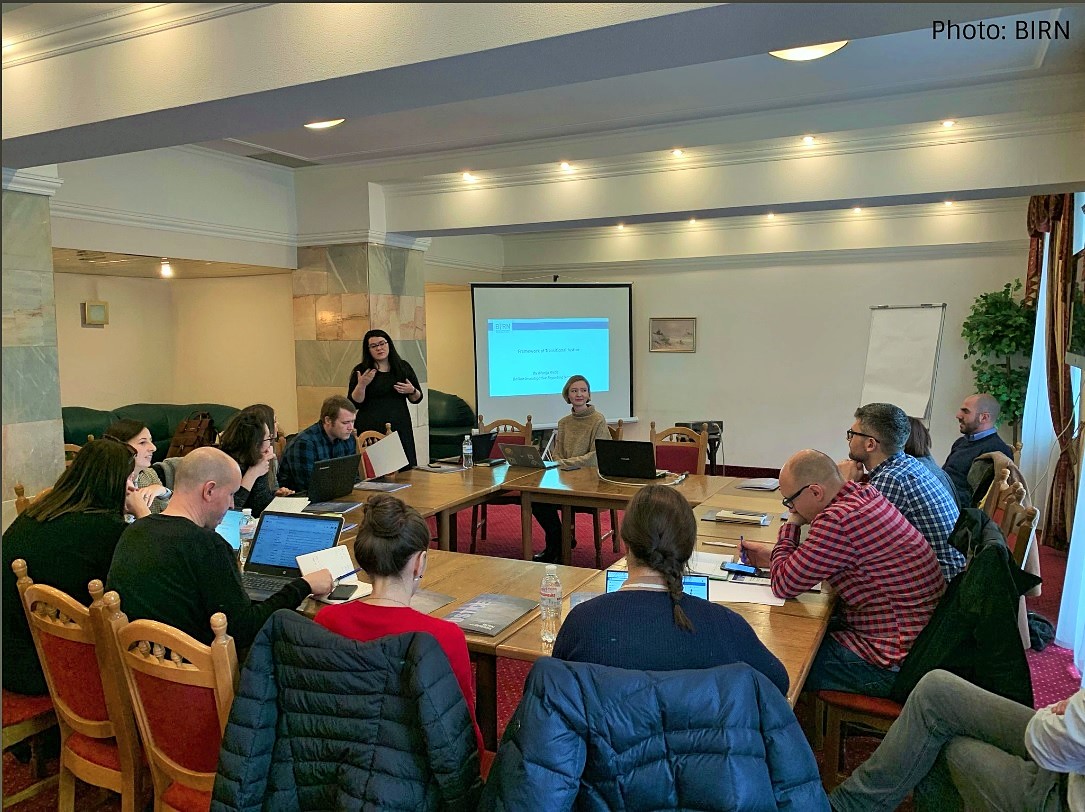
A two-day training course on how to report transitional justice issues, organised by BIRN Hub and Hromadske, was held in the Ukrainian capital from March 4-6 as part of BIRN’s Transitional Justice Programme – Justice Report Ukraine.

Ten journalists – five fellows awarded through the BIRN’s grant scheme and five journalists from Hromadske – were trained by BIRN’s international pool of editors to understand the full breadth of transitional justice topics and to develop techniques to cover them.

The course included guidance on the sources used for transitional justice stories, video storytelling in transitional justice, and writing in-depth features on the issue. The journalists then had an opportunity to pitch stories and discuss them with the trainers and the other participants.

The aim of the project is to strengthen in-depth reporting on transitional justice, in order to contribute to a more informed citizenry that is engaged in the democratic process, while the journalists are assisted to build skills and knowledge to cover topics related to conflict, truth, justice, accountability, memory, institutional reform and other issues related to transitional justice.

Resonant Voices Fellows Selected

Twelve journalists, activists and researchers will spend the upcoming months exploring the many facets of radicalisation and violent extremism in the EU and neighbouring states to help chart a more secure and inclusive future.

We are pleased to announce our very first group of Resonant Voices Fellows who will start working on their topics development during the upcoming workshop in Berlin. Over the next six to nine months, Aggelos AndreouYiannis BabouliasMirza BuljubasicMichael Colborne,  Dimitar Ganev, Barbora Hola, Akos Keller-Alant, Nenad RadicevicAleksandar RoknicEbi SpahiuKatarina Tadic and Eleonora Vio will conduct research, collect stories and untangle the web of influences to expose and challenge extremist messaging targeting vulnerable audiences.

The selected Fellows will look at more than 15 different countries in the EU and its immediate neighbourhood and will cover a wide range of topics. The research will track the evolution of links, networks and cooperation between extremist groups across borders, investigate disinformation campaigns run by governments and extremist groups and their effects on polarisation and radicalisation, analyse narratives of victimisation and injustice among Western Balkans diaspora communities and examine inter-generational transmission of war legacies.

The Resonant Voices Fellows will shed light on extremist messaging and evolving transnational radicalising influences eroding the fabric of our society and undermining our values. Their work will also contribute to vital communication strategies and targeted outreach as a means to combat these threats.

Learn more about the Resonant Voices Initiative and follow the work of RVI Fellows.

UK Govt Declines Comment on Arms Shipments Reported by BIRN

The British Government declined to comment on whether it will prosecute the brokers responsible for shipping ammunition from Bosnia to Saudi Arabia, as revealed in an article published by BIRN last year.

The government said it “cannot comment on individuals or companies that have previously been, or are currently being investigated”.

“HM Revenue and Customs, on behalf of the Government, investigates all credible allegations of strategic export control offences, which can proceed to a full criminal investigation. HMRC investigators will recommend prosecution when and where there is clear evidence of a serious criminal offence,” the government wrote in an answer to a question raised by the Labour MP Lloyd Russell-Moyle.

In his question, Russell-Moyle cited BIRN’s last year’s article, according to which the UK failed to warn Sarajevo that almost 30 million Bosnian-made bullets sold to Saudi Arabia would end up in the wrong hands.

The deal was brought to the UK’s attention because two British-based brokers had requested – and were eventually refused – licences to mediate in the Bosnia-Saudi deal.

Though Bosnian officials said they had no record of a broker being involved in the export, a BIRN investigation has established the shipment that left Bosnia in two parts in November 2015 and January 2016, with the approval of Sarajevo, matched the deal for which the UK refused brokering licences in terms of timing, quantity, origin, destination and type of ammunition.

Following BIRN’s investigation into the deal, the British parliament’s committee on arms export controls requested internal correspondence related to the shipment of ammunition from Bosnia to Saudi Arabia.

The committee said it would write a formal letter outlining the information it needs as part of an inquiry into UK arms licences issued in 2016.

Ivana Jeremic

Based in Belgrade, Ivana is an editor of BIRN’s Digital Rights Programme.

Before assuming the new role, Ivana spent five years as Balkan Insight’s deputy editor. Previously she worked as an investigative reporter/fact-checker at the Center for Investigative Journalism of Serbia during a five-year period between 2012 and 2017 and was Deputy Editor-in-Chief at the same organisation between 2017 and 2018.

As a part of the Center for Investigative Journalism of Serbia team, Ivana is the European Press Prize and Anthony Lewis 2017 laureate. She has also received the Balkan Fact-checking Award 2017, which under the auspices of the International Fact-Checking Network, was established with the aim to encourage citizens and journalists in Serbia, Bosnia and Herzegovina and Croatia to focus on the articles based on fact-checking. Ivana has been fellow and the 2nd place prize winner of BIRN’s 2018 Balkan Fellowship for Journalistic Excellence.

Ivana studied at the the Faculty of Political Sciences in Belgrade.

She speaks Serbian, English, and Spanish.

Applications Open for 2019 Balkan Fellowship for Journalistic Excellence

Do you know of a brilliant story that is begging to be reported? Do you want to take your skills as a journalist to another level, receiving close editorial support and a generous allowance to research a subject in depth?

If the answer to either of those questions is yes, you should consider applying for the Balkan Fellowship for Journalistic Excellence. The Application Form and Guidelines are on the BFJE website.

Each year, 10 journalists are chosen through open competition to receive funding and professional support to conduct in-depth research and write journalistic stories that reveal something new about our world – or that reveal the familiar in a new light.

The theme for this year’s fellowship is FREEDOM. We are open to applications from journalists from Albania, Bosnia and Herzegovina, Bulgaria, Croatia, Kosovo, Republic of Macedonia, Montenegro, Romania, Greece and Serbia. Please make sure you send us your application, including your proposal for a story based on this year’s theme, by March 6.

Applicants selected by an independent committee to take part in the fellowship will receive a €2,000 bursary and up to another €2,000 for travel and research expenses. They will also attend international seminars and receive continuous one-to-one mentoring for their stories.

Stories from the programme will be published by BIRN and by prominent regional and international media outlets. The top three stories, as selected by an independent jury, will also receive cash awards.

The Balkan Fellowship for Journalistic Excellence was launched in 2007 to promote high-quality, cross-border reporting. The programme provides fellows with financial and editorial support, enabling them to travel, report and write their stories and develop their journalistic skills.

Aimed at promoting the development of a robust and responsible press, the Balkan Fellowship for Journalistic Excellence has evolved into a signature programme that has helped shape journalistic standards across the Balkans while boosting the careers of participating reporters.

Global Focus

PARTNER
Global Focus Center is an independent think tank based in Bucharest, Romania, which produces in-depth research and high quality analysis on foreign policy, security, European affairs, good governance and development. Its purpose is to advance expertise by functioning as a platform for cooperation and dialogue among individual experts, NGOs, think-tanks and public institutions from Romania and foreign partners.

Web: http://www.global-focus.eu

The ERSTE Foundation NGO Academy

PARTNER
The ERSTE Foundation NGO Academy was founded in 2013 with the goal of strengthening the civil society sector in Central and South-Eastern Europe by providing further educational opportunities.

The Academy offers a range of high-quality capacity building programmes designed specifically for executive managers and staff members of NGOs.
Web: http://ngo-academy.erstestiftung.net/