History Overshadowed by Trivia: Regional Media Coverage of the Radovan Karadzic Arrest

History Overshadowed by Trivia focuses on media reports on the arrest of Radovan Karadzic in five countries: Bosnia and Herzegovina, Croatia, Kosovo, Montenegro, and Serbia.

The media analysis covered the first two weeks of reporting on the arrest, and showed that deep territorial, national and ideological divisions remained in the region’s media landscape.

The findings discuss the lack of investigative reporting in the media, misrepresentation of facts, as well as the presence of sensationalist and political propaganda.

Languages: Bosnian/Croatian/Serbian (BCS) and English

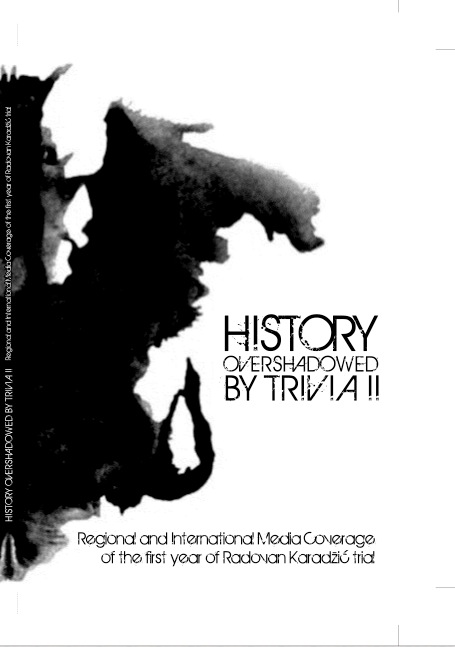
History Over Trivia II: Regional and International Media Coverage of the First Year of the Radovan Karadizc Trial

For the production of the second volume of History over Trivia, BIRN BiH analysed one thousand articles published during the first year of the Radovan Karadzic trial.

The media interest, bias, and style of reporting were among the main things monitored in the reports.

The study included articles from Bosnia and Herzegovina, Croatia, Montenegro, Serbia as well as the major news outlets based

in Europe, USA, and Asia. The publication also features an exclusive Justice Report interview with Radovan Karadzic.

Languages: Bosnian/Croatian/Serbian (BCS) and English Language


Time for Truth: Review of the Work of the War Crimes Chamber of the Court of Bosnia and Herzegovina 2005-2010

Time for Truth provides the first complete summary of all ongoing and closed cases at the Court of BiH and the Appellate Court from 2005 – 2010.

The publication presents information about indictees, brief descriptions of the criminal act(s) cited in the indictment or sentence, and profiles of those still at large.

Special attention was given to the wording of final verdicts issued by the court because the verdicts contain facts of historical value.

Languages: Bosnian/Croatian/Serbian (BCS) and English

Download the report as a PDF file in English

The Transparency of Judiciary and Responsibility of the Media: Report from the Regional Conference

This regional conference, organised by BIRN in September 2009, aimed at bridging the gap between the judiciary, local government and media representatives from the Balkan region.

The participants exchanged their views and experiences with regards to professional media reporting about war crimes, and mechanisms in place for dealing with such cases.

The report provides main conclusions and highlights of the conference.

Languages: Bosnian/Croatian/Serbian (BCS) and English.

Download the report as a PDF file in English
Download the report as a PDF file in BCS

Denis Dzidic

Denis Dzidic is the Director of the Balkan Investigative Reporting Network in Bosnia and Herzegovina (BIRN BiH), a Sarajevo-based media NGO specializing in reporting on transitional justice, corruption, human rights, and security.

With over 18 years of journalistic experience, he has dedicated his career to amplifying the voices of war-crime victims and marginalized groups in Bosnian society.

Under his leadership, BIRN BiH has developed innovative tools and databases, such as “Mapping Hate,” “Months of Siege,” and the “Database of Judicially Established Facts”, which document war crimes, counter denial and revisionism and serve as educational and research resources, both locally and internationally.

Džidić spearheaded the creation of the memorial room “Lives Behind the Fields of Death” with the Srebrenica Memorial Centre, recording 100 testimonies of genocide survivors. His project “Crime Scenes” revisits former mass killing sites through photography and survivor testimony, deepening public understanding of Bosnia’s wartime legacy.

He has led advocacy efforts to improve transparency in Bosnia’s judiciary, collecting thousands of citizens’ signatures demanding public access to court rulings, which resulted in the Prosecutor’s Office beginning to publish corruption indictments online.

He is also author of a documentary movie Justice and Truth, which examines Ukraine’s pursuit of justice over the war crimes committed by Russian forces following Russia’s 2022 invasion, drawing on lessons from Bosnia. He is the author and co-author of numerous guidelines and recommendations related to the transitional justice and rule-of-law topics.

Dzidic regularly represents BIRN BiH at high-level international meetings with the UN, the EU and OSCE, promoting democratic reforms and human rights. His work has earned accolades, including the Nino Catic Award and Goran Bubalo Peace Award, and he led the organisation when receiving the Special European Press Prize for advancing justice for war-crime victims.

Respect between Media, Judiciary Needed

BIRN BiH, the Association of Court Reporters and Association of Prosecutors of the federation of Bosnia and Herzegovina held a workshop for judicial institutions on “Transparency of Judiciary and Responsibility of the Media” in Banja Luka on November 30, 2011.

One of the recommendations and conclusions of the workshop, which was attended by representatives of judicial institutions from Banja Luka area and journalists, was to improve the cooperation in order to enable the media to get access to information for the public more easily and quickly.

Dragica Tojagic, spokesperson of the Special Prosecution from Banja Luka, mentioned the fact that no press conferences were held and no direct contact between prosecutors and the media was established, adding that “the Special Prosecution has not organized any press conferences since 2008 and prosecutors have been persuaded to appear in the media as guest speakers only twice”.

In that sense, Tojagic stressed that it was necessary to initiate seminars for prosecutors, which would focus on the importance of giving information to the public and addressing the public.

Tihomir Jurko, Deputy Chief Prosecutor of the Federation of Bosnia and Herzegovina and member of the Association of Prosecutors of FBiH, stressed the importance of judicial institutions addressing the media, adding that, by doing this, they reduced the risk from “wrong” information being conveyed by the media. Jurko said that all representatives of judicial institutions were obliged by law to offer public information to the media.

During the workshop the media representatives spoke about problems facing them in their cooperation with judicial institutions, specifically mentioning the lack of media advisories or war-crimes trial schedules on courts’ web pages.

Marija Anicic-Zgonjanin, Acting President of the District Court in Banja Luka, mentioned a series of problems in their relations with the media, adding that, despite the fact that the District Court did not have financial resources to recruit a spokesperson, its still had “excellent cooperation with the media”.

Anicic-Zgonjanin said that she was planning to improve her direct contacts with the media, adding that the war-crimes and other trial schedules would be soon available on the Court’s web page.

“There has to be mutual respect between the media and judiciary. When there is such respect, none of the parties will certainly make mistakes,” Anicic-Zgonjanin said.

Media representatives said that journalists had to be trained on court reporting, because they often made mistakes in their reports. They further mentioned sensationalistic titles of objective reports as a problem, pointing out that journalists were not responsible for those titles.

Erna Mackic, Editor of BIRN BiH Justice Report, said that the need for additional training of journalists and editors would be included among the conclusions and recommendations of this workshop.

The Banja Luka workshop is the first in a series of workshops, which will be organized by BIRN BiH in collaboration with the Association of Prosecutors of the Federation of Bosnia and Herzegovina, within a project focusing on transparency of judiciary and responsibility of the media implemented with support from USAID’s project on Judicial Sector Development – JSDP II.

The aim of the cooperation is to try to improve the cooperation by sharing knowledge and experience at future workshops and discussions between representatives of the media and judicial institutions and have the judicial institutions open themselves towards the public and journalists understand their responsibility.

Annual Plan of Association of Court Reporters

Members of the Association of Reporters from the Court of Bosnia and Herzegovina, cantonal and district courts in Bosnia and Herzegovina, AIS, met on November 19 in order to summarize the activities conducted and results achieved during 2011 and make a work plan for next year.

Erna Mackic, AIS Coordinator, made a presentation of AIS’ activities during the past year and results achieved. Mackic said that the removal of indictments from judicial institutions’ web pages was one of the biggest obstacles faced by AIS over the past year.

The meeting participants stressed the problem related to fact that neither the Court of Bosnia and Herzegovina not other courts in the country held regular press conferences. The restricted issuance of photographs during the entire course of court proceedings was mentioned as another issue posing limitations on reporting from courts.

Considering the fact that AIS members held a series of workshops and roundtables on transparency of judiciary and responsibility of the media reporting from courts during 2011, they shared their experiences with other AIS members, saying that, at all those workshops judicial representatives demonstrated readiness to cooperate with the media.

On the basis of experiences from those workshops, it was concluded that the lack of transparency of judicial institutions arose from their fear of potential mistakes in publishing the information they offered to the media. In that sense, all AIS members agreed that the dialogue should be continued by all means and that further efforts had to be invested in training journalists on reporting from courts.

When it comes to general cooperation with prosecutors’ offices, the AIS members agreed that they often gave generalized statements to the media, without providing them with any new pieces of information. The participants concluded that, due to this reason, the media turned to other sources of information, which were not always correct and lead to mistakes in their reports.

In AIS members’ opinion, the establishment of public relations services or appointment of spokespersons with judicial institutions will not only improve and facilitate the work of the media, but also improve the work of the judicial institutions, as well as judges and prosecutors as individuals.

The second part of the meeting was dedicated to making a plan of activities for next year. The recommendations and conclusions related to activities to be undertaken next year indicate that there is a need to improve objective reporting from cantonal and district courts in Bosnia and Herzegovina. It was noted that few journalists reported from those courts, which leads to a low level of information among the general public. Therefore, the training of journalists on court reporting should be continued.

In addition, the AIS members concluded that meetings with media editors were needed, because the lack of interest in the work of the judiciary often came as a result of editorial policies.

The AIS Coordinator said that the training of journalists in collaboration with the OSCE office in Serbia, which would include a training of journalists from Bosnia and Herzegovina and Serbia at The Hague, was one of the most important activities.

Over the past two years AIS has had lectures for students at the Faculty of Political Sciences of the Sarajevo University. The experiences derived from those lectures demonstrated that students knew very little or nothing about the work of the judiciary. For this reason, the AIS members concluded that the practice should be continued and that similar lectures should be held not only at the Sarajevo University, but also in other towns in Bosnia and Herzegovina. Finally, the AIS members agreed that they would hold a total of six lectures for students during 2012.

Symposium for Prosecutors in Bosnia and Herzegovina

17 October 2011 Participants of a symposium for prosecutors in Bosnia and Herzegovina, which was held from October 11 to 13 this year, discussed the “transparency of judiciary and responsibility of the media” and concluded that both parties had to cooperate with each other more in order for the public to get timely information.

Representatives of the media, prosecutions and human rights organizations discussed the “transparency of judiciary and responsibility of the media” during a panel discussion.

“When dealing with prosecutors’ offices, Bosnian journalists often cannot obtain the information they need, because those institutions do not have spokespersons or expert associates with whom they could interact,” said Erna Mackic, journalist with BIRN – Justice Report.

Tihomir Jurko, Deputy Chief Prosecutor with the Prosecution of the Federation of Bosnia and Herzegovina, FBiH, said that, recruiting spokespersons had proved to be a good thing in the past, adding that prosecutors’ offices should appoint staff members, whose task would be to interact with the media.

“The media should get timely information that will not have detrimental effect on investigations conducted by prosecutors’ offices,” Jurko said.

Zekerijah Smajic, longtime journalist, expert in the European Union issues and representative of SENS Agency, discussed the responsibility of journalists and their activities related to reporting from judicial institutions.

“It is not a journalist’s role to misuse information. We must take the ethics into account,” Smajic said.

Earlier this year BIRN Office in Bosnia and Herzegovina, with support from USAID, established cooperation with the Association of Prosecutors of the Federation of Bosnia and Herzegovina with the aim of putting focus on transparency of judiciary and responsible reporting by the media. These activities are aimed at improving the cooperation between the media and judicial institutions by sharing knowledge and experience at a series of lectures, workshops and discussions and having judicial institutions open themselves towards the public and journalists realize what their responsibilities are.

“What we can see in Bosnia and Herzegovina is the media spreading the language of hatred and investing exceptional efforts into causing negative impact on and destructing war crimes trials before domestic judicial bodies by publishing distorted articles based on their comments. Also, the Hague Tribunal issue is exclusively related to a negative sensationalism,” said Anisa Suceska-Vekic, Director of BIRN BiH.

Suceska-Vekic maintained that journalists had the power to destroy or create, adding that this had been proved by verdicts passed down before international courts.

At this year’s symposium Sasa Madacki, Director of the Center for Human Rights of the Sarajevo University, spoke about the verdicts passed down by the European Court for Human Rights.

“It is true that the media have contributed to the degradation of the importance of war crimes processing in the common citizens’ perception, but we still believe that objective reporting on war crimes trials can help overcome the collective responsibility stigma and help the future generations in Bosnia and Herzegovina and the region avoid being victims of a factual and imposed ignorance,” said Suceska-Vekic.

During the symposium BIRN BiH screened a ten-minute documentary about the significance of transparency of judiciary and responsibility of the media.

Other topics that were discussed at this symposium for prosecutors included: detection and processing of human trafficking, criminal aspects of proving bribery, taking over of verdicts passed down by foreign courts, extraditions with particular emphasis on temporary extradition and cooperation with the Prosecutor’s Office of the Hague Tribunal.

The symposium was organized by the Association of Prosecutors of the Federation of Bosnia and Herzegovina in collaboration with centers for education of judges and prosecutors of FBiH and Republika Srpska with support from OSCE in Bosnia and Herzegovina, USAID in Bosnia and Herzegovina and Government of FBiH.


Progress in War Crimes Processing

The representatives of authorities and prosecutions, as well as victims, regard that certain progress has been made in processing of war crimes in Bosnia and Herzegovina, but victims, who testify at those trials, still do not receive adequate support

During a conference on the “Processing of war crimes in Bosnia and Herzegovina – How much time do we have?”, which was organized by the Youth Initiative forHuman Rights, YIHR of Bosnia and Herzegovina, victims said that, despite the fact that the processing of war crimes perpetrators in Bosnia and

Herzegovina was protracted, certain improvements in the work of judicial institutions could be noticed.

Edin Ramulic of the “Izvor” Association from Prijedor says that witnesses who testify before the Court of Bosnia and Herzegovina, receive support only during the course of the trials, while Sacir Srebrenica, Deputy President of the Association of Detainees of Bosnia and Herzegovina, thinks that it is hard to ensure full protection of victims.

“Victims often say that, once they leave the courtroom, they feel as if nobody cares about them any more. What happens to victims after they have completed their testimonies is one of the key issues,” said Selma Korjenic of the TRIAL Association, who is involved in the Programme for support to victims of sexual violence.

Goran Simic, advisor with the Ministry of Justice of the Federation of Bosnia and Herzegovina, says that, despite the good work done by the State Court, we should know that the institution has limited capacities, so a certain number of cases have to be processed at the local level.

Branko Mitrovic, Chief of the War Crimes Section with the District Prosecution in Banja Luka, says that many war crimes cases have already been processed in that town.

During the course of the conference victims pointed out that the media should speak more about this subject, maintaining that media reports could actually help speed up the processing of war crimes in Bosnia and Herzegovina.

“The general public is interested in war crimes issues, but those stories scarcely reach out to citizens. The media rarely produce reports on this issue and, even when they do, the reports are badly written, leaving space for manipulation,” said Erna Mackic, Editor-in-Chief of BIRN-Justice Report.

Dzenana Karup-Drusko, Editor of Dani magazine, too thinks that the public is interested in war crimes issues, but daily information about the trials is lacking in the daily newspapers and public service.

Predrag Curkovic, a journalist with the Alternative TV from Banja Luka, says that the lack of material and human resources is one of the problems causing such poor coverage of war crimes issues in the media.

S.U.

Support to War Crimes Trials

On September 16 this year a regional conference on war crimes trials was held in Belgrade with the aim of calling on the governments in the region and general public to provide support to war crimes trials as the key instrument in coming to terms with the past.

The conference participants stressed the need for a better regional cooperation and encouraging witnesses to come out and speak about what they saw or experienced. Besides that, they stressed the importance of establishment of a residual mechanism at the Hague, which will, among other things, make sure that fugitives will be processed and serve their imprisonment sentences.

The participants paid special attention to problems related to protection of witnesses, who have not been institutionally accepted. This happens not only in Serbia, but in the entire region too.

Anisa Suceska-Vekic, Director of BIRN Office in Bosnia and Herzegovina, spoke about war crimes trials and the need for public support, as well as the relation of media towards this issue that has a historical importance.

Besides judges and prosecutors from the region, representatives of international and local NGOs, who follow war crimes processing, took part at the conference.

The conference was organized by the Humanitarian Law Center from Belgrade, Office for Democratic Institutions and Human Rights with the OSCE in Serbia and BIRN BiH.