Al Jazeera produces documentary based on BIRN BiH story

After BIRN BiH presented three stories relating to Bosnia and Herzegovina’s wartime past at the‘True Stories Market’ at the Sarajevo Film Festival in 2016, Al Jazeera decided to produce a documentary based on one of them.

The first ‘True Stories Market’ was held at the 22nd Sarajevo Film Festival as part of the Dealing with the Past project, intending to serve as an inspiration to directors, producers, film and television professionals to turn genuine and rarely-told stories into feature and documentary films.

BIRN BiH was informed that Al Jazeera will make a documentary about one man’s daily search for bones of the victims of the Srebrenica genocide, story we presented at one of our TV Justice episodes. BIRN BiH will provide all the necessary support to the Al Jazeera team and help the realization of this project.

BIRN BiH Participates in Information Law Consultations

Representatives of the Balkan Investigative Reporting Network in Bosnia and Herzegovina participated in a public debate on a draft revision of the Law on Free Access to Information, held in Sarajevo on February 23. 

The debate was organized by Transparency International and the Ministry of Justice of Bosnia and Herzegovina, and involved representatives of the authorities, non-governmental organizations and the media.

A several-hour session during which the participants discussed all the changes in the new draft law resulted in a joint conclusion that the existing law was a better platform for revisions than the draft law.

NGO representatives objected to the draft law’s insistence on the obligation to indicate the purpose of any access to information

Media representatives said they considered the existing deadline for submission of information requests, 15 days, too long, adding that they thought the proposal to extend the deadline by an additional 15 days was unacceptable.

PR officers employed with state institutions said that the law should define who could deal with requests related to this specific legislation.

Following the receipt of written proposals, which the debate’s participants submitted to the Ministry of Justice later on, the ministry will inform the public of its final decisions.

BIRN BiH Widens Focus, Addresses New Challenges

In its 11th year, the Balkan Investigative Reporting Network Bosnia and Herzegovina (BIRN BiH) began reporting on corruption, organised crime and terrorism, while maintaining a leading role in monitoring war crimes and the judiciary.

Over the past year, BIRN BiH has published a total of 2,258 news articles, reports and analysis pieces, and achieved a record number of republications in other media – more than 12,500.  

In January this year, BIRN BiH began reporting on corruption, organised crime and terrorism.

BIRN BiH used the same methodology it has already used for years when reporting on war crimes, so as well as reports from courtrooms, we have also done analysis and research in order to point out the challenges facing law enforcement agencies and judicial bodies.  

More than 320 articles covering these subjects were published. At the beginning of June this year, we also organised a conference at which analyses of the situation in the field of terrorism, organised crime and corruption were presented.  

Through its work, BIRN BiH showed that institutions dealing with organised crime cases at the state level faced a problem related to the confiscation of illegally-acquired assets and that the Prosecution of Bosnia and Herzegovina targets minor corruption cases.

We published a number of analysis articles and several pieces of research in which we pointed to violations of the law on public procurement in institutions in Bosnia and Herzegovina, violations of regulatory plans when building Arab-funded hotels, as well as problems related to illegal weapons and child trafficking.

Srdjan Blagovcanin of watchdog organisation Transparency International said BIRN BiH has pointed out some pressing problems in society during the past year.

“BIRN is an excellent example of how professional and responsible journalism can play an important role in society in terms of raising and addressing key social issues and, by doing it, making the first step towards resolving those issues,” Blagovcanin said.

A regional conference on terrorism was organised in Sarajevo in the spring, where figures were presented detailing the number of people from Yugoslav countries fighting in the Middle East, as well as information about the challenges facing these countries in fighting radical extremism.  

Continuity in monitoring war crimes

During the past year, BIRN BiH continued monitoring all war crime trials held before the Bosnian state court. As many as 1,037 articles from its courtrooms were published.

A total of 72 analysis articles were published, including 17 analyses of war crime cases completed before the Court of Bosnia and Herzegovina.

Besides the analysis of specific cases, we wrote about problems facing women who had been raped and can never become mothers, the destruction of war crime files in Prijedor, as well as problems facing lawyers, witnesses and defendants who admit their guilt in war-crime cases.

A regional conference on cooperation in war-crime cases, as well as a training session for a group of journalists on reporting from courtrooms and covering transitional justice issues, was held in the autumn.  

Reporting on war crimes cases and on corruption cases at entity courts also continued. A total of 334 articles was published.  

Tarik Crnkic, a prosecutor with the District Prosecution in Eastern Sarajevo, said that BIRN BiH reported from trials in a professional manner.  

“I think BIRN BiH’s reporting is objective and based on legal standards, which enables the general public to be informed about the work on those cases,” Crnkic said.

Besides prosecutions of war crimes in Bosnia and Herzegovina, we continued reporting on trials at the Hague Tribunal, with more than 100 articles published.

The first-instance verdict in the trial of former Republika Srpska President Radovan Karadzic, as well as an interview he gave to BIRN BiH just beforehand, generated the most attention.  

Under the first-instance verdict, Karadzic was sentenced to 40 years in prison for committing genocide and other crimes in Bosnia and Herzegovina. His interview was republished by more than 100 international, regional and local media.  

Monitoring the judiciary

Over the past year, BIRN BiH followed disciplinary proceedings against judges and prosecutors, as well as sessions of the High Judicial and Prosecutorial Council.

We pointed to deficiencies in the system of evaluation of judges and prosecutors, which discourages them from working on complex cases. We also wrote about the suspension of chief prosecutor Goran Salihovic and the selection of a new president of the state court.

In the middle of the year, BIRN BiH launched its new web page: detektor.ba, which offers far more advanced search options than the old domain.  

In the 12 episodes of BIRN BiH’s ‘TV Justice’ magazine programme, which were broadcast by around 20 TV stations in Bosnia and Herzegovina and via satellite, our viewers could watch footage on the disciplinary proceedings against judges and prosecutors, the origins of the Sarajevo Film Festival during the war, women in uniform, Roma at war and in peace, as well as the first TV show in the country dedicated to terrorism.

BIRN BiH’s editors also gave more than 100 statements as commentators to various media.

N1 News TV channel editor Dzejna Habibovic said these statements assisted in deepening public understanding of the issues.

“The topics BIRN covers, such as war crimes, terrorism, are so sensitive, so the professionalism BIRN brings into these stories is so helpful for our audiences”, Habibovic said.

Over the past year, BIRN BiH has cooperated with the following donors: the Norwegian Ministry of Foreign Affairs, the Swiss Feeral Department of Foreign Affairs, the National Endowment for Democracy (NED), the Swedish International Development Cooperation Agency (SIDA), the US Embassy in Sarajevo, Peace Nexus, the Dutch MATRA programme, as well as the Robert Bosch Stiftung via BIRN Hub.

Young Danish Journalists Visit BIRN BiH

Journalists and students who work with Danish daily newspaper Politiken visited BIRN BiH in Sarajevo. 

BIRN BiH editor Denis Dzidic met 18 students and journalists from Denmark on November 12 and gave them a two-hour presentation on the organisation and the everyday work of its journalists.

Dzidic spoke about the experience and knowledge that BIRN BiH has gained so far, its transitional justice archive, and the challenges facing investigative reporting in general. 

The journalists expressed particular interest in finding out about criminal cases in the fields of corruption, terrorism and organized crime, as well as the challenges associated with this type of investigative journalism in Bosnian society.  

Dzidic also told the young journalists how local and regional media republish with BIRN BiH’s articles on a daily basis, pointing out that independent, professional and unbiased journalism is the only way to get such a good response and to gain the trust of counterparts at other publications.

BIRN BiH will continue to organize international training sessions for young journalists.

On November 17, it will present its work to participants in a study tour organized by the European Commission. 

Sarajevo Students Visit State Court with BIRN BiH

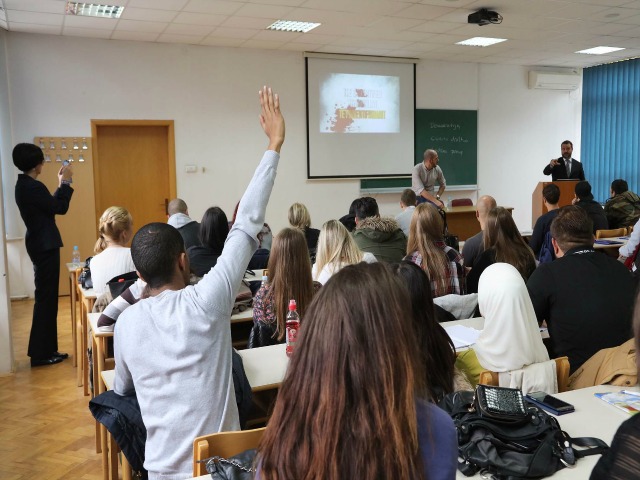
Students studying at the Faculty of Political Sciences in Sarajevo attended a war-crime trial at the state court with journalists from the Balkan Investigative Reporting Network Bosnia and Herzegovina (BIRN BiH).

First- and second-year students at the Sociology Department and Security and Peace Studies Department of the Faculty of Political Sciences on Tuesday attended the trial of Djordje Ristanic, who has been charged with committing crimes against humanity in the municipality of Brcko during wartime.

For most of them, this was their first visit to a judicial institution.

The students were led by Emir Vajzovic, a professor and representative of the Institute for Social Research at the Faculty of Political Sciences in Sarajevo.

Erna Mackic, BIRN BiH’s editor-in-chief, addressed the students and explained to them the history of the Bosnian state court’s work in trying war crimes.

The students spoke to Vajzovic and Mackic about the importance of trying war crimes irrespective of the ethnicity of the defendants, as well as the importance of informing the public about the work of one of the highest-level judicial institutions in Bosnia and Herzegovina.  

The students agreed that trying all crimes and coming to terms with the past was necessary for implementing the reconciliation process and sustaining peace in this area.   

The visit to the Bosnian state court resulted from a collaboration between the Faculty of Political Sciences in Sarajevo and BIRN BiH, which involves various joint projects and the education of students in all of the faculty’s departments.  

BIRN Joins Countering Violent Extremism Panel

Balkan Investigative Reporting Network Bosnia and Herzegovina (BIRN BiH) editor Denis Dzidic took part in a panel discussion on methods of countering violent extremism online.

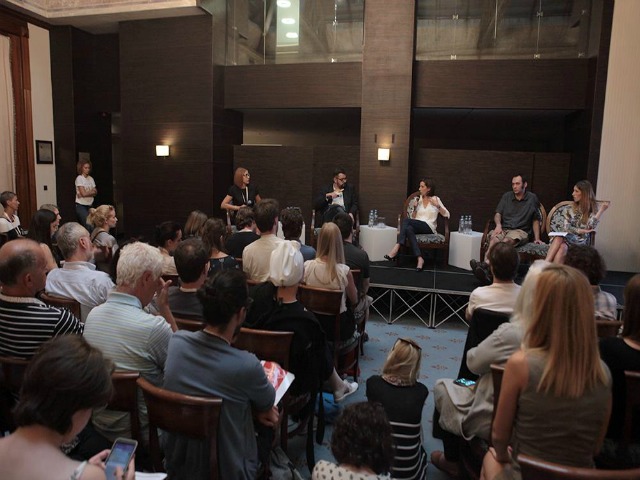
BIRN BiH Denis Dzidic took part in a panel discussion entitled ‘Countering violent extremism online and protection of the right to freedom of speech’ on Friday at the Sarajevo Bristol Hotel, as part of the second annual Bosnian Forum on Internet Management. 

The panelists discussed terrorist propaganda and threat of social media being used to radicalise young people. 

Dzidic said that it is vital for media, when reporting on violent extremism, to be wary of sensationalism, but also added that state institutions should be more open towards journalists. 

“What we are seeing in Bosnia today is that the system is confusing and the way they communicate with journalists is also confusing, so whenever an incident happens, you have on one side institutions that do not want to give any information and even when they do, often different levels give different statements, which leads to sensational headlines,” he said. 

Mario Janacek from the Security Ministry said that Bosnia and Herzegovina was looking for a systematic solution for preventing abuse of the internet for terrorist purposes or any other types of propaganda and hate speech. 

Janacek said that terrorists had moved ahead in terms of using internet platforms, adding that they invested in marketing more than individual corporations. 

“What we currently see in European practices is not promising. It does not look like it might offer any results in terms of removing such material from the internet. It is mainly focused on a certain type of censorship. According to practices applied in most of the countries, such materials are removed without too much thinking about the consequences. In some European countries, police block such content even without court warrants, so we are also considering such possibilities,” Janacek said. 

Analyst and theologian Muhamed Jusic spoke about violent extremism justified by religion, primarily the practice of the so-called Islamic State, as well as giving an analysis of content published and quickly spread on social networks. 

“The internet is not a key factor in radicalisation, which has to go through personal contacts and happen inside smaller circles. There must be someone whom you trust when you speak to them. However, the internet has a great importance in reinforcing those stances and additionally persuading yourself that what someone told you during a closed meeting was true,” Jusic said. 

The participants at the panel discussion also discussed projects aimed at creating positive narratives via the network of ‘Super Citizens’, who are fighting against hate speech, as well as the role of the media in reporting on radicalisation and terrorism.

BIRN’s Kosovo War Film Screened at Sarajevo University

Sarajevo University’s law and political sciences faculties screened BIRN’s documentary ‘The Unidentified’, about the Serbian fighters responsible for some of the worst atrocities of the Kosovo war in 1999.

‘The Unidentified’, which investigates attacks on Kosovo villages in 1999 and names those involved in an attempted cover-up operation to conceal the crimes, was screened for students of communications, security, journalism and law at Sarajevo University on Tuesday and Wednesday.

“My idea was to make sure that, when people hear and watch this film, be it in Belgrade, Novi Sad or Kragujevac, they will not be able to say that no crimes happened in Kosovo,” the film’s director Marija Ristic said in a video message to the students.

‘The Unidentified’ was made as a result of two years of research, and takes viewers back to the villages of Ljubenic, Cuska, Pavljan and Zahac, near Pec/Peja in Kosovo, in the spring of 1999, when Serbian forces killed more than 118 Albanian civilians.

The victims’ bodies were burned or removed, and some of them were subsequently found in a mass grave at a police raining centre in Batajnica, near Belgrade, in 2001. Eleven former members of Serbian forces are on trial in Belgrade for committing those crimes. In February 2014, nine men were sentenced to a total of 106 years in prison, but the appeals court quashed the verdict in March last year, saying it was “incomprehensible and contradictory”, and ordered a retrial.

Midhat Izmirlija, a professor at the Faculty of Law, said after the screening that ‘The Unidentified’ was a great example of socially-engaged journalism.

“This is an excellent way for the media to work with the aim of determining the truth about certain events and presenting the truth to the victims and the public,” Izmirlija said.

Lejla Turcilo, a professor at the Faculty of Political Sciences, said it was very important for young journalists to be exposed to such works of research works during their studies.

“Our students do not come across these type of stories while studying theory. Our goal is to offer them practical experiences, which they lack during their education, but it is important not to always engage in daily journalism, but in investigative journalism, which is scarce,” she added. She said such projects could motivate students by “showing them there is a possibility for making changes in society”.

Following the screening of the documentary, the Law Faculty students had a lecture and held a discussion on the legal challenges involved in monitoring war crime trials, while the students at the Faculty of Political Sciences had a discussion on journalism and transitional justice with BIRN Bosnia and Herzegovina editor Denis Dzidic.

BIRN Presents War Stories at Sarajevo Film Festival

The first ‘True Stories Market’ aimed at film and TV professionals at the Sarajevo Film Festival included three stories from BIRN relating to Bosnia and Herzegovina’s wartime past.

The first ‘True Stories Market’ was held at the 22nd Sarajevo Film Festival on Wednesday as part of the Dealing with the Past project, after a screening of ‘Depth Two’ by Ognjen Glavonic from Serbia.

The market is intended to serve as an inspiration to directors, producers, film and television professionals to turn genuine and rarely-told stories into feature and documentary films.
 
At the first market, the Balkan Investigative Reporting Network Bosnia and Herzegovina (BIRN BiH) presented three stories, created out of BIRN journalists’ long-term work on dealing with the past, documenting war crime trials and collecting the testimonies of survivors.
 
BIRN BiH director Mirna Buljugic familiarised the directors and producers with a story about the village of Baljvine, where no conflicts between Bosniaks and Serbs have ever happened, about the phenomenon of how numerous victims of sexual abuse cannot get pregnant, and about one man’s daily search for bones of the victims of the Srebrenica genocide.
 
A total of seven stories about the recent past and unhealed wounds were presented at the market that the Sarajevo Film Festival organised in collaboration with institutions from Bosnia and Herzegovina, Croatia, Montenegro, Serbia and Kosovo.  
 
The Dealing with the Past project was launched last year under the auspices of the Robert Bosch Stiftung with the aim of using the film industry to intensify dialogue in the region and promote peace through raising awareness and spotlighting indisputable facts about the 1990s conflict.

The project encourages the participation of the public, primarily the younger generation, to foster understanding, acceptance and the tolerance of mutual differences.  

The Dealing with the Past project continued on Thursday with screenings of the films ‘The People vs. Fritz Bauer’ by Lars Kraume and ‘Unwanted Heritage’ by Irena Skoric. The screenings are being followed by debates. 

BIRN Bosnia Becomes Sarajevo Film Festival Partner

The Balkan Investigative Reporting Network Bosnia and Herzegovina (BIRN BiH) will participate as a partner in the “Facing the Past” at this year’s Sarajevo Film Festival.

As of this year, the Sarajevo Film Festival is starting its Facing the Past project, within which testimonies and stories about the war in the former Yugoslavia and the unhealed wounds in the society will be presented.

As part of its activities during the past 11 years, BIRN BiH has contributed to the process of facing the past and getting justice for victims of crimes committed from 1992 to 1995.

By continuously monitoring war crime trials, working with victims and reporting on their personal stories, BIRN BiH has gathered a unique archive of testimonies and untold stories, which is the reason why it has been selected as the only partner from the country to participate in the new Festival project.

Testimonies and stories to be provided by BIRN BiH will serve as a source of ideas for experts and film-industry professionals, who can use them to help promote peace-building in the region and throughout the world.

Using cinema as a tool, the project attempts to accentuate the importance of facing the past and determining the truth about wartime and post-war events and their influence on society.

The testimonies will be presented at the Market of True Stories on August 17.

Out of a total of seven stories to be presented at the Market, three will be provided by BIRN BiH.

Organisations from Montenegro, Serbia, Croatia and Kosovo are also participating in the project.

This year’s Sarajevo Film Festival will run from August 12 to 20.

BIRN BiH Joins European Integration Monitoring Initiative

The Balkan Investigative Reporting Network Bosnia and Herzegovina (BIRN BiH) has joined the Initiative for Monitoring the European Integration of Bosnia and Herzegovina, which is intended to help develop the democratic process and the rule of law. 

BIRN BiH has become a member of the Initiative for Monitoring the European Integration of BiH and joined efforts intended to monitor reforms and provide an overview of the implementation of the policies, laws and standards of the European Union, focusing on the issues of democratisation, the rule of law, human rights and the rights of minorities.

The Initiative focuses on monitoring, documenting, reporting, research, members’ capacity building, advocacy, promotion and education.

The Initiative is seen as an important factor in Bosnia and Herzegovina’s European integration process. It plays an active role in creating policies that contribute to the democratic process and the rule of law.
Civil society organisations involved in the work of the Initiative share values based on human rights, the rule of law, equality and democracy.

The Initiative’s work is coordinated by the Sarajevo Open Center.