
This year marks BIRN’s 20th anniversary. From exposing corruption to promoting human rights, BIRN’s investigative journalists collaborate across borders to find out the facts and tell people’s stories.
It all started in 2005, when five women from countries recovering from brutal wars defied the odds to establish what would become a major independent media organisation, the Balkan Investigative Reporting Network, in the traditionally patriarchal region of the Western Balkans.
Maras recalls how he first heard about BIRN and what his initial impressions of the organisation were at the time.
“I heard about BIRN a long time ago. I was a civil activist and one of the leaders of the most influential anti-corruption NGOs in Montenegro. BIRN was a synonym for investigative journalism and quality reporting in the Balkans and beyond,” says Maras. “At that time, I also met my first BIRN person, Albulena Sadiku from BIRN Kosovo, with whom I partnered on a project.”

However, before becoming the Director of BIRN Montenegro, he worked within the regional office (Hub) . That experience shaped his understanding of BIRN’s mission and way of working.
“Sometimes it is easier to understand BIRN from the outside than when you join the team. At first, the complexity of the structure and procedures was a bit frightening, but it made me realise it is the only way to maintain such a complex yet effective network, which covers so many topics and areas. I could not be more grateful to Regional Director of BIRN Marija Ristic and Managing Editor of Balkan Insight Dusica Tomovic for all their help and assistance to blend in, despite their busy schedule and the amazing job they were doing,” says Maras.

In 2022 the decision was made to open the BIRN Montenegro office.
“When starting BIRN Montenegro, our idea was to create the most influential investigative outlet in the country, which would be able to tackle all the important topics others cannot, or are simply not willing to do, due to the fear of politicians, advertisers, or others. The idea was simple, and so far, nothing has changed that will drive us off that mission,” Maras recalls.
Looking back over the past three years, Maras shares his perception of whether the BIRN Network has changed.
“Like in every big family, there are always challenges that people with goodwill overcome easily. I tend to believe that most of us, if not all, really do our best to make this big family work as well as it can,” says Maras.
He sees BIRN Montenegro’s biggest strengths, but also where it still needs to grow and invest more effort.
“While BIRN Montenegro is the youngest member of the network, I am lucky to have colleagues who are experts in their respective fields and who have a lot of professional experience. Heading such a team makes it way easier to achieve goals we put in front of us. That is to make Montenegro a fairer, freer, and more democratic country, which will serve the needs of its citizens, be a proud member of the EU and NATO, and embrace western standards,” Maras explains.
“Of course, with developments happening in the digital world, IT, including AI, global disinformation campaigns, and other problems we are facing, it has been harder than ever to reach the truth. We have to make sure that more effort, work and expertise is put into each and every assignment we start doing,” says Maras.
And speaking of his team, there are some investigations from BIRN Montenegro that he wants to highlight.
“I am proud to say that despite being a new media outlet and a small team, we were able to cover a number of issues and create positive social change. BIRN journalists have already received several awards and fellowships, which point out how quickly we have become the most credible media outlet in Montenegro.
“We have stopped biometric surveillance in our country, we revealed a Russian hidden society in Montenegro, investigated arms trafficking. We reported on stories covering human rights, transitional justice, illicit financial flows, unregulated cryptocurrencies, and many more,” says Maras.
But, it is essential to emphasise that investigative journalism isn’t the sole activity of BIRN Montenegro.
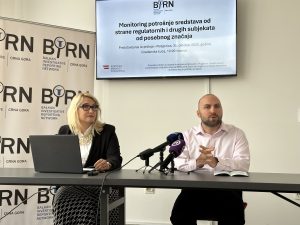
“BIRN Montenegro has a strong monitoring and analytics component, which allows us to track expenditures in several sectors – energy, transport, and with independent agencies and regulators. Additionally, based on our initiatives, several high-profile events were organised, including parliamentary hearings, meetings with key ministries, the President of Montenegro and national anticorruption forums,” Maras explains.

One of the key aspects of BIRN Montenegro’s work is the Open Data Portal.
“BIRN Montenegro partnered with the Government of Montenegro and the UN’s Development Programme regarding the re-establishment of the Open Data Portal, which should serve as a focal point for citizens, businesses, and organisations in need of access to different data. The portal was launched a year ago, and so far has been updated with different datasets,” adds Maras.
When he thinks about the media landscape in Montenegro, he explains the unique role BIRN Montenegro plays and should continue to play in the years ahead.
“BIRN Montenegro is and will remain free from any political or other influence, and this will allow us to be the only ones responsible for our editorial policy. While I am sure the topics we cover will change over time, depending on needs and priorities, our journalists will be among the very few who are fully free to select and investigate any topic or issue, while caring only about the professional standards. It is what we already do and will be doing in the years ahead,” says Maras.
Speaking of his dream scenario for BIRN in the next 20 years, both as a network and in Montenegro, he knows what he would like it to look like.
“I hope that in 20 years Montenegro will not need the form of BIRN there is now, as the country will become significantly more developed, democratic, and advanced, and that those people working in BIRN Montenegro in 2045 will be happy to investigate and cover some lighter and more joyful topics, but with the same level of professionalism,” concludes Maras.