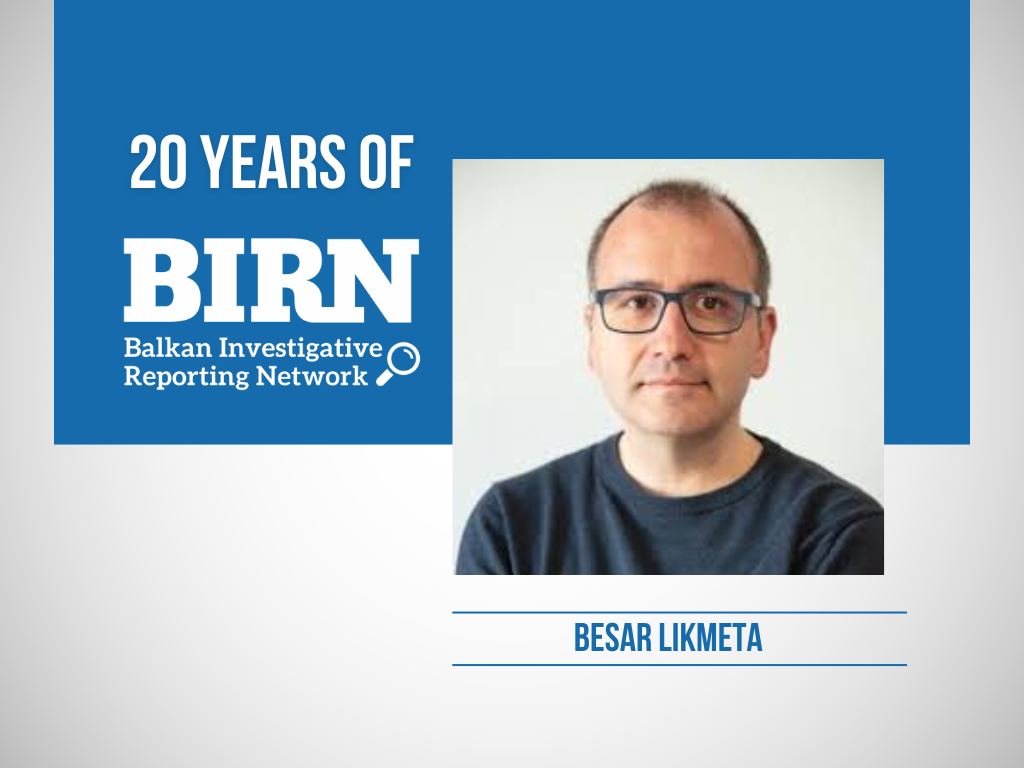
Besar Likmeta has been the editor of BIRN Albania almost from the beginning of BIRN, since 2007, and was also the country correspondent for Balkan Insight.
Having studied philosophy at the University of North Florida, he explains how that shaped his thinking and influenced his path in journalism and investigative work.
“The quest to make sense of the world, to understand its underlying truths, and to engage with the study of ideas, has instilled in me a deep appreciation of the role the media – now increasingly social media – plays in shaping our beliefs as individuals and as a community,” he says.
“I grew up in a country where freedom was constrained by propaganda and where no independent press existed, and I learned at an early age the importance of free speech and the right to be informed – not only as pillars of a democratic society, but also as prerequisites for personal freedom and intellectual inquiry,” he adds.

He has extensive experience in journalism, having worked in print, television and electronic media in both the US and Albania since 2003. Besar started his career reporting for the Florida Times Union in Jacksonville, Florida. He moved back to Albania in 2005 where he worked as a features editor for the Tirana Times, and as world news editor for the 24-hour news channel TV Ora News.
He has contributed stories to various publications, including The Christian Science Monitor, Global Post, Transitions Online, The Diplomatic Courier and World Politics Review.
In 2009, Besar received the CEI/SEEMO Award for Outstanding Merits in Investigative Journalism and in 2010 he was runner-up for the Global Shining Light Award, presented at the Global Investigative Journalism Conference in Geneva.
He recalls when and how he found out about BIRN.
“I first heard about BIRN in 2006, as one of the handful of media development organisations in the region supporting coverage of current affairs in English through its newsletter, Balkan Insight. At the time, there was little local reporting in English, and the region’s narrative abroad was largely shaped by major Western media outlets, often relying on parachute journalism and reproducing clichés and stereotypes,” he explains.
One thing was significant for him when it comes to our organisation.
“What drew my attention to BIRN was the consistently high quality of its in-depth reporting, along with the professional editing of news analysis, investigations, and features,” he says.
When he started working for BIRN, he expected it to sharpen his skills as a reporter.
“Over the years, BIRN has proven to be both a challenging and rewarding professional experience – not only for me, but also for many of my colleagues and for hundreds of other journalists across the region,” he says.

Having worked with BIRN for nearly 19 years, Besar saw firsthand how BIRN Hub and BIRN Albania complemented and built on each other within the network over the time.
“BIRN Albania was established in 2014 by a group of journalists who had participated in BIRN Hub’s regional projects, such as the Fellowship for Journalistic Excellence. The aim was to introduce to the Albanian-language media landscape a professional publication where local reporters could benefit from strong editorial support and mentorship, enabling them to produce in-depth, hard-hitting investigative journalism. Through the dedication and hard work of its staff and contributors, BIRN’s local outlet, Reporter.al, has become a media source of record in Albania,” he explains.
In the current Albanian media landscape, BIRN Albania has a specific role.
“BIRN is the leading media development and investigative journalism organisation in Albania. It plays a crucial role as a bridge between journalists, media outlets, and civil society, helping to strengthen their collective impact as agents of change in the fight against corruption and organised crime, and in the defence of human rights and fundamental freedoms. In the years ahead, we aim not only to uphold but also to expand this role, particularly in the face of the profound generational technological transformation brought about by artificial intelligence,” Besar says.
Looking back over BIRN’s first 20 years, he has seen big changes and challenges within the network and in Albania.
“Its size has certainly expanded, from a handful of ambitious and passionate journalists and editors into a powerhouse of hundreds of media and development professionals, programme managers, and researchers. The organisation’s impact and influence have grown accordingly. Today, BIRN is a household name in the Western Balkans and in Brussels. It has taken 20 years and a great deal of hard work to get here. Along the way, we have overcome many challenges – from funding crises to SLAPP lawsuits, while also benefiting from significant support,” he says.
Since BIRN Albania’s establishment, it has produced many award-winning investigations, he notes.
“The most influential investigations over the years have been those that succeeded in shaping the public narrative on specific issues, generating sustained public debate and prompting authorities to act, including by launching investigations and issuing indictments.
“In this regard, the series of investigations into the waste management scandal – linked to the construction of three waste-to-energy plants through public-private partnerships – has had the greatest impact.
“Other significant areas of investigation have included migration (Airport Ordeal Sheds Light on Plight of Migrant Workers in Albania, Italy to Albania, and Back: A Migrant’s Journey Through Italy’s Asylum Experiment) healthcare (Patients Pay Price for Albania’s Drug Reform), political financing (Missing Millions: Albanian Parties Underreport TV Election Ad Spending, ‘Untold Story’: Dark Money, Israeli Advisers and an Albanian Election, and arms (Speculation Swirls Around Sudden Death of Polish Arms Dealer in Albania).
However, investigations aren’t the only BIRN Albania work that deserve attention, he says.
“BIRN Albania is widely known for its investigative reporting, but this represents only the tip of the iceberg. The organisation has also come to play an important role in monitoring the use of traditional and social media during elections, producing research on propaganda and foreign information manipulation and interference (FIMI), monitoring the justice reform in Albania, advocating for freedom of expression and media freedom, and assessing the country’s overall progress toward European Union integration,” Besar outlines.

Speaking of BIRN’s next 20 years, he has his “dream scenario”.
“My ideal scenario is that, 20 years from now, we will have passed on our skills and ethical standards to a new generation of journalists and editors, and that the organisation will be more sustainable and resilient,” he explains.
Besar stresses what BIRN represents for him personally, and who is he outside BIRN.
“BIRN represents my life’s work – so far – with all its joys and tribulations, and outside of it, in the little time that remains, I enjoy spending it with friends and family,” he concludes.