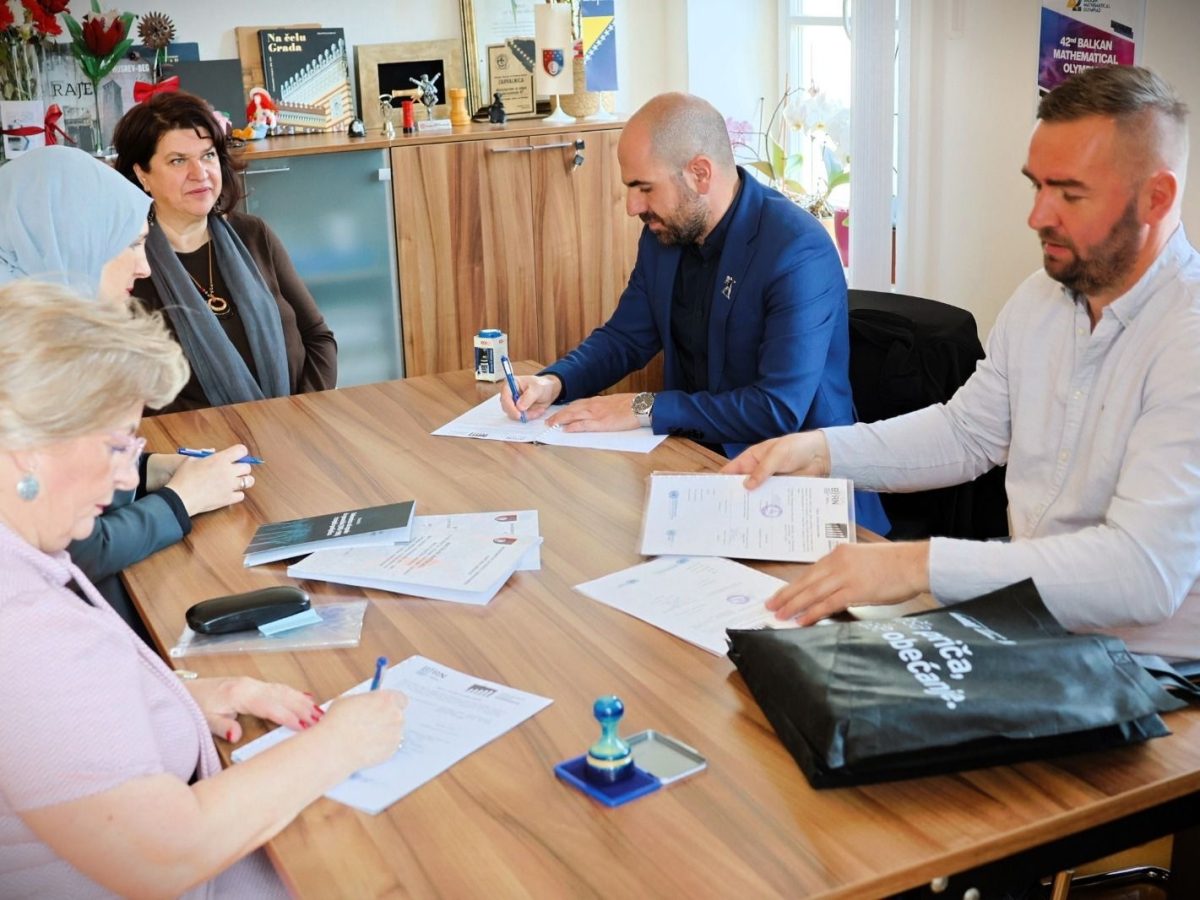
On March 13, the Balkan Investigative Reporting Network in Bosnia and Herzegovina, BIRN BiH, the Srebrenica-Potocari Memorial Centre, the Institute for the Development of Pre-University Education, and the Ministry of Education of the Sarajevo Canton concluded a Memorandum of Cooperation on strengthening the quality of teaching about the wartime past and developing a responsible approach to teaching about sensitive historical topics.
The cooperation is focused on improving the methodological approach to history teaching about the war in Bosnia and Herzegovina from 1992 to 1995 through the use of judicially established facts and relevant sources.
“It is important that students learn about the genocide and war crimes based on judicially established facts and credible sources. Such cooperation further strengthens professional support for teachers and contributes to the development of a responsible approach to teaching about these topics as an important part of building a culture of remembrance in the upbringing and educational system,” said Sarajevo Canton’s education minister, Naida Hota-Muminovic.
Teachers and schools in the canton will have access to professional resources and educational material based on verdicts of international and domestic courts, including the Database of Judicially Established Facts about the War in Bosnia and Herzegovina developed by BIRN BiH, as well as manuals and educational content developed in collaboration with the Srebrenica Memorial Centre.
With the support of the UN Secretary-General’s Peacebuilding Fund, BIRN BiH, together with the Srebrenica Memorial Centre and the Association of Forgotten Children of War, is implementing the project “Building Long-Term Peace in Bosnia and Herzegovina: Investing in the Future”, which aims to transform the way young people learn about the war in Bosnia through facts, empathy, understanding and a multimedia approach.
As part of the project, the database was created, based on which the manual on “How to Learn and Teach about the War in Bosnia and Herzegovina” was developed.
“By signing the Memorandum of Cooperation, we have institutionalized support for history teachers at the level of the Sarajevo Canton, and put the materials developed by BIRN BiH at disposal. In this way, we support the improvement of education in the field of studying war history in a factual, objective, multimedia, and multi-perspective manner,” said BIRN BiH’s Executive Director, Denis Dzidic. “This form of cooperation is also an important step in the process of exchanging experiences and good practices and building long-term peace,” he added.
The Director of the Srebrenica Memorial Centre, Emir Suljagic, said the Memorandum represents an important institutional step in improving education about the genocide and the culture of remembrance in Bosnia and Herzegovina.
“Education about the genocide and war crimes must be a systematic part of the educational process through the development of educational programmes and teaching content that allow young generations to understand historical facts,” Suljagic said.
The Memorandum foresees the organisation of professional training for teachers and professional associates, the exchange of teaching materials and professional consultations, as well as support for teachers in the preparation and implementation of lessons about the war in Bosnia and the 1995 genocide in Srebrenica.
“The Institute for the Development of Pre-University Education of the Sarajevo Canton will provide professional and methodological support to teachers so that the teaching process is based on verified, judicially established facts, and contemporary didactic approaches,” said the Institute Director, Senada Salihovic.
To create the Database, several hundred final court judgements were analyzed, including decisions of the Hague war-crimes tribunal, ICTY, the Bosnian state court, and other courts from Bosnia as well as the region relating to war crimes committed in the 1992-1995 period.
Last year, the Sarajevo Canton education ministry presented a revised and extended edition of teaching materials on the history of the war in Bosnia, the siege of Sarajevo and the Srebrenica genocide, which have been integrated into primary and secondary school curricula in the canton.