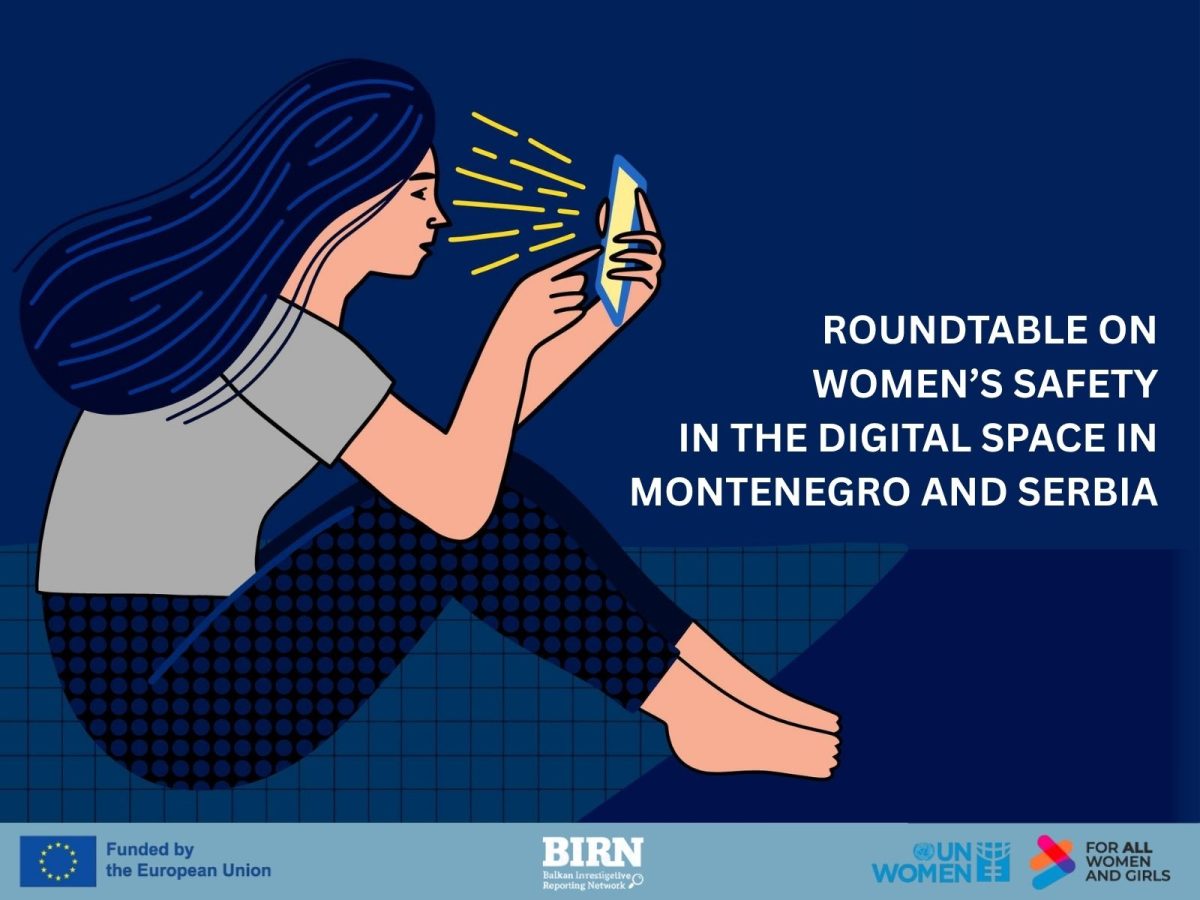
Opening the event, Amina Mahovic, Digital Rights Programme Manager at BIRN, highlighted the importance of addressing digital violence against women in both countries and pointed to the rise in online threats, gender-based harassment, hate speech and the misuse of emerging technologies, including artificial intelligence, AI, to facilitate violence against women.
During the first session, monitors Tijana Uzelac from BIRN Serbia and Djurdja Radulovic from BIRN Hub presented key findings from the digital rights violations monitoring in Montenegro and Serbia.
The presentation highlighted trends and the disproportionate impact of digital violence on women participating in public life, including journalists, activists and politicians. The session included an overview of media reporting on these issues, examining how cases were covered and the dominant narratives used in reporting.
At an open discussion moderated by Jakov Ivanovic from BIRN Montenegro, speakers included Mirjana Mitic from ASTRA, Brankica Jankovic from EQUITAS – Centre for Policies and Human Rights, Jevrosima Pejovic, Member of Parliament of Montenegro, Neda Radovic, Director of the NGO Sistem, journalist Dragana Scepanovic and Nina Pavicevic from Kriticki platform.
Participants emphasized that online violence against women is often rooted in gender inequality and directed at women simply because they are women, regardless of their profession or social status. The discussion highlighted direct forms of online harassment, including threats and abusive messages, as well as gender-based attacks amplified through tabloids.
Participants addressed the growing misuse of AI tools to create manipulated or non-consensual content that targets, humiliates and intimidates women.
The discussion further examined institutional responses and the role of digital violence. Participants noted concerns with delays in investigations, inconsistent responses by authorities and the need for stronger legal and policy frameworks. Examples from across the region were presented to illustrate the challenges victims continue to face when seeking protection and accountability.
The roundtable concluded with a discussion on the need for stronger cooperation between institutions, civil society organisations, media and technology platforms to improve responses to online violence against women and enhance protection for victims.
This event is organised by BIRN in the framework of the “EU 4 Gender Equality: Women’s Economic Empowerment and Ending Violence against Women” regional programme, funded by the European Union and implemented jointly by UN Women and UNDP.