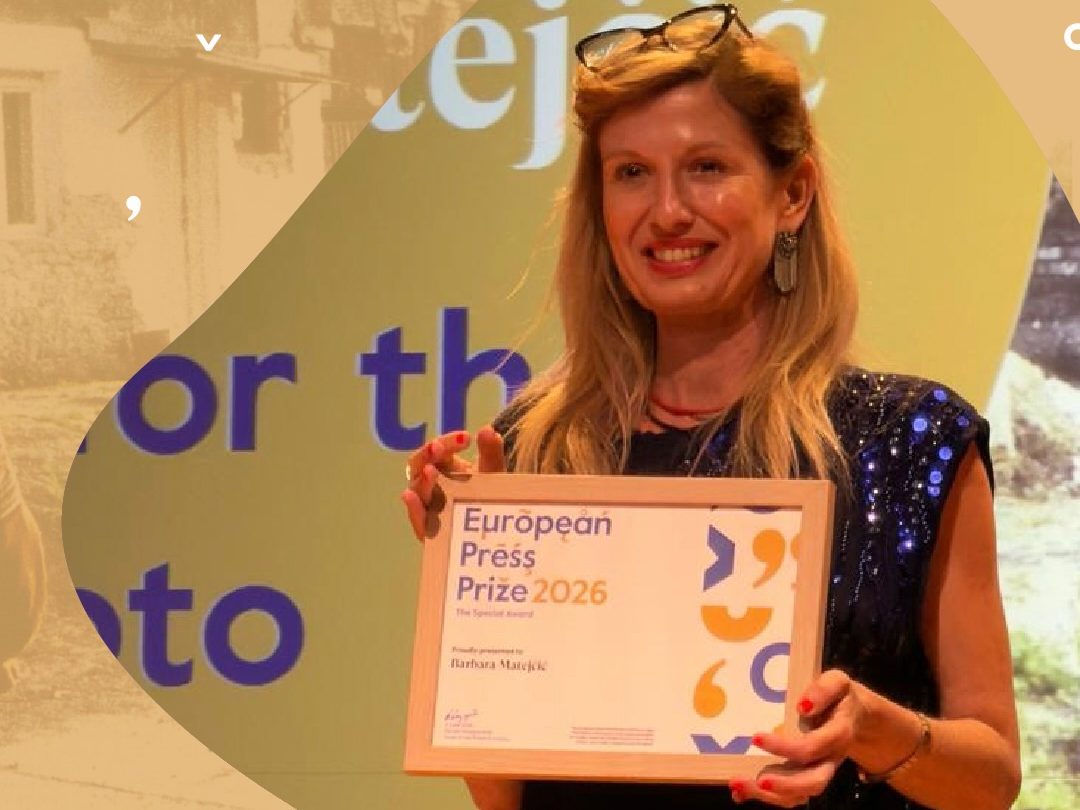
The award was presented in Lisbon as part of the European Press Prize, one of Europe’s most prestigious journalism awards. Each year, the jury grants the Special Prize to an outstanding project that transcends conventional categories and disciplines.
Matejcic’s investigation examines a photograph taken during 1993 in the war in Bosnia, in which a Belgrade photographer documented an execution from extremely close range.
Those images were distributed worldwide by Reuters and later won a World Press Photo award, becoming part of the visual record of the conflict. But for more than three decades, key questions surrounding the circumstances in which the photographs were taken remained largely unexplored.
How was the photographer able to capture the killing from such close proximity through a sequence of images? Did the presence of the camera influence what happened?
Drawing on nearly 30 firsthand sources, as well as court records and war crimes documentation, Matejcic reconstructs the events surrounding the photograph while confronting ethical questions that remained outside the frame. The article explores war, photography, accountability and the role of witnesses.
The jury described the investigation as “a fascinating story that raises many previously unexplored questions” and “a fantastic piece of journalism with perfect dramaturgy.”
“Killing for a Photograph” was also published in the Croatian weekly Novosti and generated significant regional attention. The investigation prompted extensive discussion among readers and within the professional communities of journalists, photographers, editors and researchers in Serbia, Bosnia and Herzegovina, and Croatia. It has been widely regarded as one of the most important and thoroughly researched investigative stories produced in the Balkans in recent years.
One of the most significant outcomes of the investigation was the correction of a decades-long injustice toward the victim and his family.
After Matejcic contacted the World Press Photo Foundation and presented evidence gathered during her reporting, the foundation amended the original caption accompanying the photograph, which had incorrectly identified Husein Krša as a sniper for more than 30 years.
Following publication of the investigation, the Independent Journalists’ Association of Serbia, acting with the consent and at the request of Krsa’s family, initiated proceedings before the World Press Photo Foundation seeking the withdrawal of the photographer’s award. The process remains ongoing.
In May 2026, the investigation also received the prestigious Dejan Anastasijevic Award for the best investigative story published in Serbia during the previous year.