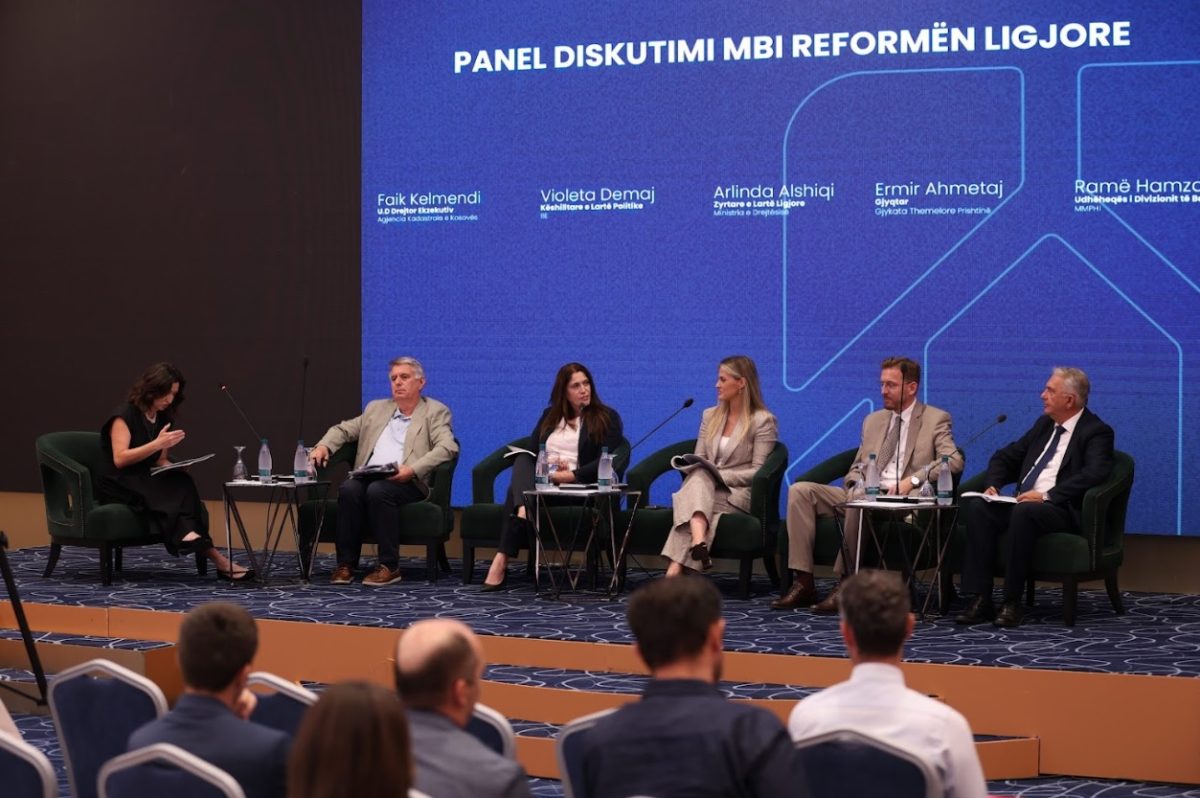
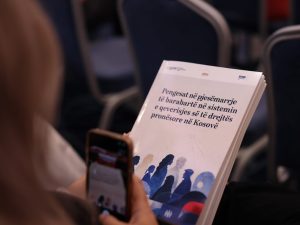
On June 24, BIRN Kosovo launched the research report “Barriers to Equal Participation in the Property Rights Governance System in Kosovo” during a conference organised in cooperation with the Advocacy Training and Resource Center (ATRC), with support from the World Bank’s State and Peacebuilding Fund (SPF).
The report examines the structural, legal and administrative obstacles that prevent citizens from exercising their property rights equally, with a focus on women, non-majority communities and other citizens affected by unresolved inheritance procedures and informal construction.
Opening the conference, ATRC Executive Director Kushtrim Kaloshi said that while Kosovo has a legal framework for the protection of property rights, implementation remains the key challenge.
Dhurata Gutaj, Chief-of-Staff at the Ministry of Justice, reaffirmed the ministry’s commitment to legal reforms, including the adoption of the Civil Code, which is expected to further clarify and consolidate legislation on property and inheritance rights.
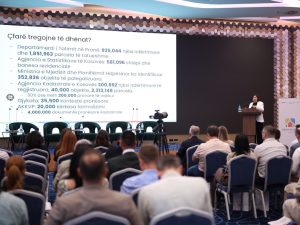
The report’s main findings were presented by PIAKOS Programme Manager, Odeta Naks, who said Kosovo’s property crisis largely stems from delayed inheritance procedures, properties remaining registered in the names of deceased owners, the exclusion of women from ownership despite legal guarantees, documentation barriers affecting non-majority communities, and the widespread informality resulting from unlegalized construction.
The research found that nearly 30 per cent of registered property owners in Kosovo have died without inheritance procedures being initiated, leaving around 200,000 properties effectively frozen outside the formal market. At the same time, women own only 21 per cent of registered properties, while more than 350,000 buildings across the country remain unlegalized.
The report also points to a significant burden on Kosovo’s justice system. As of January 1, 2026, courts were handling 35,496 unresolved property disputes, while the Special Chamber of the Supreme Court would require at least another 15 years to resolve its current caseload if the pace of adjudication remains unchanged.
Digital interoperability between institutions was identified as one of the key reforms necessary to address these challenges. Report co-author and digitalization expert Marko Arula explained Estonia’s transition from paper-based administration to a fully digital governance model, emphasizing the role of electronic registries, digital identity systems and secure data exchange between institutions.
Representatives of public institutions, the judiciary, international organisations, local government and civil society attending the event discussed the report’s findings through two expert panels aimed at promoting a more inclusive and efficient property rights system in Kosovo. There were 54 participants in total.
The first discussion panel, moderated by BIRN Kosovo Director Jeta Xharra, focused on inheritance procedures, legalization of informal construction and institutional coordination in the property sector.
Panelists featured Hajzer Bublaku, Legal Specialist at the Kosovo Cadastral Agency, Violeta Demaj, Senior Political Adviser at the European Union Office in Kosovo, Arlinda Alshiqi, Senior Legal Officer at the Ministry of Justice, Ermir Ahmetaj, Judge at the Basic Court in Prishtina, and Rame Hamzaj, Head of the Housing Division at the Ministry of Environment, Spatial Planning and Infrastructure.
The discussion focused on progress and remaining challenges in Kosovo’s property sector, including the increase in property registration by women following recent legal reforms. Panelists also discussed unresolved cadastral issues, delays in property-related court proceedings, and the need for stronger digital interoperability between institutions.
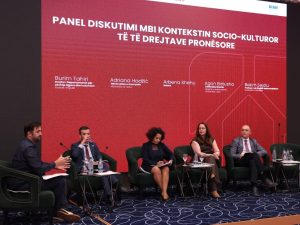
The second panel, moderated by Kreshnik Gashi, Editor-in-Chief of KALLXO.com and co-author of the research report, featured Burim Tahiri, Director of the Department for Legal Affairs and Research at the Ombudsperson Institution, Adrijana Hoxhić, Deputy Mayor of North Mitrovica Municipality, Arbena Shehu, notary, and Bekim Sejdiu, Professor of International Law at the University of Prishtina.
The discussion focused on the systematic discrimination faced by women and non-majority communities in exercising property rights, challenges related to property registration and legalization, the functioning of institutional mechanisms, and the impact of judicial delays on the realization of property rights.
This report was produced by BIRN Kosovo) for the Public Information and Awareness Services for Vulnerable Communities (PIAKOS) project, financed by the World Bank-State for Peace Building Multi-Donor Trust fund, and implemented by the Advocacy Training and Resource Center (ATRC).