BIRN Conference: Media Freedom Being Rolled Back in Balkans

Threat to media freedom in the Western Balkans demands immediate action, BIRN’s 10th anniversary regional confercence in Sarajevo heard.

BIRN directors and media experts highighted the main obstacles to media freedom in the region and offered their own recommendations on how to improve the situation at the regional conference of the Balkan Investigative Reporting Network, entitled “Media Freedom Challenges”, on Friday in Sarajevo.

“It is not just media freedom that has been in regression in the Western Balkans over the past years but democracy as well. Each year things get worse, bit by bit, which calls for immediate action before it is too late,” Florian Beiber, from the University of Graz, said.

Beiber presented a list of recommendations to governments in the region to improve the situationof the media. They include stronger legal protection for journalists and curbing the practice of offering them only short term contracts, which keep people working in the media on a tight leash.

A moratorium was also proposed on state advertising, in order to reduce state influence and interference with the editorial policies of media outlets.

Another key recommendation was to establish clearer rules determining the ownership and the finances of media outlets – transparency issues – and prevent monopolies.

Regarding state broadcasters, clearer rules to ensure their independent funding and functioning were urged as a way to keep them out of the hands of governments.

Turning to hate speech and abuse of marginalized groups in the media, better training on hate speech as well as strengthening the power of the courts to tackle such issues was proposed.

The recommendations are a joint drive by more than 30 media professionals and experts who gathered in Sarajevo on Thursday at a regional freedom of expression workshop to discuss: working rights; the state funding of the media and public broadcasters; the the media market; transparency of media ownership; the representation of vulnerable and marginalised groups in the media.

The suggestions presented in Sarajevo will become part of a broader package of recommendations from the civil society sector that will be presented at the Western Balkans Summit in Vienna in August.

The summit will continue the so-called Berlin Process, which German Chancellor Angela Merkel initiated last August to demonstrate the EU’s ongoing commitment to enlargement..

BIRN country directors agreed that media freedom was in retreat in their own countries. This can be seen through examples of smears, acts of intimidation, campaigns against independent media and journalists, physical attacks on and threats to journalists, and lawsuits, they said.

David Hudson, from the European Commission, told the conference that Brussels plans to change the methodology of assessing the freedom of the media in the annual progress reports on the Western Balkan countries.

“The new methodology will be more precise, evaluating achievements of governments in key areas on a five-point scale. It will provide an objective comparison is the country prepared and to what degree for membership.

“We have introduced a degree of competition between governments, so that each country can see where it is compared to the region. We hope this will spur reforms,” Hudson said.

He warned that the EU’s leverage in the Western Balkans was not unlimited and depended on the strength of the desire of governments to move the EU accession process forward.

The conference saw a video message by the EU Enlargement Commissioner, Johannes Hahn, in which he congratualted BIRN on its first decade and said that media freedom in the Balkans remained “of particular concern” to the European Commission – particularly the issues of government interference and threats to the independence of public broadcasters.

“We face important challenges that need to be addressed urgently,” Hahn said.

“Apart from government interference, more efforts are needed to ensure the political and financial independence of public service broadcasters, the strength and independence of regulatory agencies and faster functional self-regulation,” he said.

“There is also need to tackle informal economic pressure on the media. This includes transparency of media ownership and preventing of its excessive concentration. Last but not least, transparent roles on the procurement of government advertising have to be in place.”

The Commissioner said he would keep pushing governments in the region on these issues.

The “Media Freedom Challenges” conference is a part of BIRN’s 10th anniversary celebration.

“This day is very emotional for us. Ten years ago, a handful of people met in this town [Sarajevo] and agreed to form BIRN on the shared belief that we should nurture good journalism, and work to change something,” BIRN’s regional network director, Gordana Igric, said in her address to the conference.

Ten years on from those humble beginnings, the BIRN network employs over 200 journalists and media professionals.

The organisation also musters more than 300 associates, including journalists, experts and civil society groups.

BIRN today has a presence across the Balkan region, with country-based organizations in Albania, Bosnia and Herzegovina, Kosovo, Macedonia, Romania and Serbia, as well as correspondents in Montenegro, Croatia, Bulgaria, Greece and occasionally Moldova.

Hahn Presses Balkan Govts on Media Freedom

EU enlargement commissioner Johannes Hahn told a BIRN conference that media freedom in the Balkans has become a major concern that must be addressed urgently.

Hahn said on Friday that media freedom in the Balkans “remains of particular concern” to the European Commission – particularly the issues of government meddling and threats to the independence of public broadcasters. 

“We face important challenges that need to be addressed urgently,” Hahn said in a video address to BIRN’s regional media conference in Sarajevo.

“Apart from government interference more efforts are needed to ensure the political and financial independence of public service broadcasters,strength and independence of regulatory agencies and faster functional self-regulation,” he said.

The EU commissioner said that he would keep pushing governments in the region to make progress.

There is also need to tackle informal economic pressure on the media. This includes transparency of media ownership and preventing of its excessive concentration. Last but not least, transparent roles on the procurement of government advertising have to be in place,” he said.

Hahn said that freedom of expression and the media are at the core of the EU integration process.

“Free speech and an informed, professional press are essential for democratic society, they are fundamental to the choices that citizens make about the future of the country,” he said.

“Without them, the public cannot weigh up options or judge the leaders; without them, dangerous prejudices and misperceptions grow, which undermine chances of peace and stability,” he added.

The regional media conference, entitled ‘Media Freedom Challenges’, is being held as part of the celebrations of BIRN’s 10th anniversary.

“I’m personally committed to congratulate and thank BIRN for its precious contribution and efforts in terms of freedom of expression and media in the Balkans,” Hahn said.

“You know far better than I the power of freedom of expression and media and the complex threats it faces in your countries. In this respect, supporting professional journalism and journalist training is of key importance. With its aim to build and strengthen a dedicated, close-knit team of journalists across the Balkans, BIRN acts as strong partner in the region offering an impressive variety of services,” he added.

BIRN’s directors and media experts gathered in the Bosnian capital to discuss crucial issues affecting the sector.

The conference also came up with a list of recommendations to the governments in the Balkans to improve the media situation in the region.

The recommendations are a joint effort by more than 30 media professionals and experts who gathered in Sarajevo the day beforehand at a regional freedom of expression workshop to discuss labour rights, state funding of media and public broadcasters, the media market, transparency of media ownership and the representation of vulnerable and marginalised groups.

The experts gathered in Sarajevo as a part of the Western Balkan Civil Society Forum, a joint project of the ERSTE Foundation, the Friedrich-Ebert-Stiftung and the Karl Renner Institute, in close cooperation with the Austrian Federal Ministry for Europe, Integration and Foreign Affairs.

The Western Balkan Civil Society Forum offers a unique opportunity to civil society representatives from south-eastern Europe to voice their opinions and formulate concrete demands for high representatives of the European Union, its member states and the governments of the countries of the Western Balkans.

The suggestions that will be presented in Sarajevo will become part of a broader package of recommendations from civil society at the Vienna Western Balkans Summit, which will be held in August.

The summit is a continuation of the so-called ‘Berlin Process’ which was initiated in August 2014 by German Chancellor Angela Merkel to show further political commitment to the future enlargement of the European Union into the Western Balkans.

BIRN Hosts Media Freedom Conference

Celebrating its 10th anniversary, BIRN will host a regional media conference to discuss crucial issues affecting the sector and present recommendations from Balkan civil society to governments to improve the media situation.

The Balkan Investigative Reporting Network’s regional media conference, entitled ‘Media Freedom Challenges’, will be held on Friday June 12, in Sarajevo, where BIRN’s directors and media experts will debate the main obstacles to media freedom in the Balkans.

“Media across the region are in complete slavery to both business and politicians. In some countries the situation is alarming,” said Gordana Igric, BIRN Regional Network Director.

“I believe it is important to look at the regional picture. Some of the problems are specific, but some are common all over the Balkans. In order to deal with them, we need a unique, joint initiative,” Igric said.

Johannes Hahn, the EU Enlargement Commissioner, will address the participants via video message, while Florian Bieber, a professor at the University of Graz, will present a list of recommendations to Balkan governments to improve the media situation in the region.

The recommendations are a joint effort by more than 30 media professionals and experts who gathered in Sarajevo the day beforehand at a regional freedom of expression workshop to discuss labour rights, state funding of media and public broadcasters, the media market, transparency of media ownership and the representation of vulnerable and marginalised groups.

BIRN Celebrates 10th Anniversary

The regional media conference ‘Media Freedom Challenges’ is a part of BIRN’s 10th anniversary celebration.

BIRN has a presence across the Balkan region, with country-based organisations in Albania, Bosnia and Herzegovina, Kosovo, Macedonia, Romania and Serbia.

For editorial purposes, it also has a network of journalists and editors in Montenegro, Croatia, Bulgaria, Greece and occasionally Moldova.

The organisation has a wide media presence – online, in print, on TV, and on radio. BIRN’s flagship website, www.BalkanInsight.com, one of 15 sites in different languages that BIRN runs, is read in more than 200 countries worldwide.

Key issues in the Balkans that BIRN has identified include lack of freedom of expression, loss of media independence, lack of good governance, an absence of anti-corruption efforts, poor access to justice and rights and civil society organisations’ inability to address issues of public interest.

Some of the experts who took part in drafting the recommendations were Remzi Lani from the Albanian Media Institute, Asja Roksa Zubcevic from the Bosnian Regulatory Agency for Electronic Communications, Sasa Lekovic, the president of Croatian Journalists’ Association, Sami Kurteshi, Kosovo’s Ombudsperson, Dejan Georgievski from the Macedonian Centre for Media development, and Tatjana Jakobi from the Serbian Centre for the Development of Trade Unionism.

The experts gathered in Sarajevo as a part of the Western Balkan Civil Society Forum, a joint project of the ERSTE Foundation, the Friedrich-Ebert-Stiftung and the Karl Renner Institute, in close cooperation with the Austrian Federal Ministry for Europe, Integration and Foreign Affairs.

The Western Balkan Civil Society Forum offers a unique opportunity to civil society representatives from south-eastern Europe to voice their opinions and formulate concrete demands for high representatives of the European Union, its member states and the governments of the countries of the Western Balkans.

The suggestions that will be presented in Sarajevo will become part of a broader package of recommendations from civil society at the Vienna Western Balkans Summit, which will be held in August.

The summit is a continuation of the so-called ‘Berlin Process’ which was initiated in August 2014 by German Chancellor Angela Merkel to show further political commitment to the future enlargement of the European Union into the Western Balkans.

BIRN Bosnia Director Interviewed on TV N1

Mirna Buljugic, the director of BIRN Bosnia and Herzegovina, appeared on regional CNN affiliate TV N1 to talk about BIRN’s regional conference on media freedom challenges in the Balkans which is taking place on Friday.

The regional media conference, entitled ‘Media Freedom Challenges’, is being held as part of the celebrations of BIRN’s 10th anniversary.

To see the full interview, follow this link.

The BIRN effect

So BIRN is ten years old, and I have been asked to write a few lines about what it has meant to me. I have so many memories of my time with this unique organisation, of fascinating people, hard lessons, and incredible experiences, that it’s difficult to know where to start.

I remember the first nervous decisions we took in an out-of-season hotel on Bjelasnica mountain to set up our own organisation; how we descended on Dragana’s summer house in Boka Kotorska to thrash out plans for a documentary on Kosovo’s future, something that may not seem so ambitious now, but when you remember how little infrastructure we had then, was really quite audacious; and how I seemed to be constantly on the road, going from capital to capital, and embassy to embassy, looking for funding to get us up and running.

In those first few years, we all did anything and everything we could to realise our ambition to set up an outlet for quality journalism that would inform both locally and internationally on the most important issues facing the Balkan region. It was hard, hard work, and there was little room for anything else.

After three years, first as director of BIRN’s regional hub, and latterly in charge of getting the Fellowship up and running, I decided to move on.

Although my aim then was to achieve better balance in my life, somehow to this day I still find myself regularly deep in excel spreadsheets and funding applications at ungodly hours. Maybe that’s the BIRN effect: once you have realised how hard you can push yourself, and what this can achieve, it is difficult to stop stepping up to the plate and striving for the best.

So, here’s to the next decade

Many years ago, a former colleague at the Independent newspaper, Steve Crawshaw, now a senior figure at Amnesty, invited me to go hear a talk in London by a Serbian journalist who had been forced out of Milosevic’s thuggish regime in Serbia. The room was hot, the microphone far away and I could barely hear what the distant blond-haired woman was actually saying.

“Who was that, again?” I asked Steve at the end. “Gordana Igric,” he said. I doubted we would meet again. I certainly never imagined that I would end up working with and for Goca Igric for the best part of a decade – in what has since become the most important cross-country regional portal in the Balkans.

Our paths did not cross for years. I had left the London Independent at the ripe old age of 40, fulfilling a vow I had taken not to cross that age threshold and remain stuck in a newsroom. A generous book commission from a US publisher gave me my freedom ticket and out I went. I stayed out for six years, as one commission led to another, but by 2006 my freedom ticket was expiring. I was still finishing my latest book on a Renaissance king of Hungary, but my dream of achieving economic sustainability on the back of writing books had fallen through. The sums just didn’t add up.

My path crossed with Goca’s once again. Now running the Balkan arm of IWPR, I started doing a little freelance work for her, in what was then the IWPR’s cramped office in Islington in north London. Goca, I now found out, was an exacting boss. She put me to work on a long investigation about Milosevic’s money, but long after I had sorted out the linguistic and flow issues, I discovered that ruthless attention to detail and rock-solid sources were needed before she would let anything go into print. It was a useful lesson.

At the time, the Balkan wing of IWPR was starting to emerge as an independent organisation but no one knew if BIRN would fly upwards or crash land. Rightly, Goca decided that the only course for her fledgling was grow or die, and soon after BIRN was established, offices were being opened up in the Balkans.

I jumped at the chance to join the Serbian team, then a humble affair run by Dragana Nikolic Solomon, alongside Danny Sunter and the late, much missed, Vesna Bekic. Dragana was inspirational. Dynamic and relentlessly positive, she was absolutely determined to get the message out that BIRN was alive and kicking. She also had a wicked sense of humour.

Interestingly, given the patriarchal culture of the Balkans, most of the other BIRN offices were also pioneered by young dynamic women: Jeta Xharra in Kosovo, Nerma Jelacic in Sarajevo and Ana Petruseva in Macedonia.

Those early years were fraught as well as exciting. Would anyone actually fund BIRN? What were we there to do exactly? Train journalists? Provide rolling news? Serve up expert analysis? Investigate Balkan corruption in depth? We knew what we wanted to be – a cross-regional media network of a type that had never existed in the Balkans. But how to flesh this out and make it work was another matter.

Besides that, each of the offices had a specific problem with its own national environment. In nationalist Serbia there was no tradition whatever of looking to “outsiders” to provide information or context on national affairs. Breaking down the wall of suspicion was tough. Bosnia in some ways was even more introverted and inward looking. Finding partners there was nightmarishly difficult. One giant newspaper, Avaz, ruled the media roost. Its rivals were all too bound up in their own battles for survival to be of much use as colleagues. Gaining visibility in Bosnia was going to be a struggle.

In Serbia, Dragana and Goca hit on the idea of initially going for training as a way to raise BIRN’s profile and cultivate donors. As I had never been trained myself and had learned to be a correspondent “on the job”, I was doubtful about being asked to run this side of things. In the end, I quite enjoyed designing courses and giving them. Off our little caravan went, to Novi Pazar, Sarajevo, Pristina…

Training is a hit and miss affair. You can end up with a class of people who just want to improve their English, or with people who have zero chance of ever realistically making it as journalists. We had our tragi-comic moments. In Novi Pazar, Dragana and I were enraged to find we had booked ourselves into a hotel that was just filthy. I was also informed at the last minute that hardly anyone attending this course spoke English, so would I mind teaching in Serbian? Gulp! God knows what they learned on that course!

In Kosovo, one woman wanted to enroll on the course but asked if her husband could come, too. It turned out she wasn’t allowed out of the house without her man being present. Hmmm… We had to inform her that, in that case, she probably wasn’t cut out for cutting edge journalism.

Still, some of that generation came, learned something and went on to bigger things. Indeed, that was one of the problems. BIRN trained people up and then they would soon go off to Vienna or Berlin. We had created a kind of finishing school!

It is incredible to think nine years have passed since I came back from Serbia to edit in London – and what has happened since then. New offices, much bigger offices – so much has moved on and so many people have changed. I feel a pang of nostalgia, thinking of Nerma standing by her unpacked boxes in her first office in Sarajevo, Vesna telling me for the tenth time not to throw coffee grinds down the sink, or Dragana and Danny arguing passionately about what chairs to buy for our noisy, cramped little office in Belgrade. Dragana has moved on, Nerma has moved on, and it all seems a long time ago. Still, organizations have to look forward, while reflecting on the lessons of the past, so here’s to the next decade. May it be just as good.

Ten years of BIRN

The Balkan Fellowship for Journalistic Excellence is an editor’s dream. You get to spend a year working with the brightest reporters in the region. You get to step outside the breaking-news cycle and do some truly meaningful journalism. And above all, you get BIRN, making it all possible.

The Fellowship is only slightly younger than BIRN – its first decade is still a year away. It is very much a child of BIRN, a reflection of what makes the organisation itself so special.

I spent two years as an editor for the Fellowship, from 2012-13. The annual process – from commissioning stories to publication – drove home the depth of BIRN’s expertise.

Our reporters drew upon the guidance of BIRN’s network of editors across the region as they researched their stories. At the climax of the process, as the deadlines closed in, the organisation also seemed to draw closer. Drafts were continually critiqued and refined, problems were identified, ledes were sharpened.

It was damned hard work – but Dragana, Goca and Ana made sure that it was never lonely work. As the saying goes, they led from the front.

The final stories were very well received. They were widely re-published, often provoking debate, some even picking up prizes. Each and every story bore the fingerprints of a remarkable organisation.

As BIRN celebrates its first decade, many will marvel at how long this media start-up has survived in the harsh Balkan climate. But for me, the real surprise is that BIRN is only ten years old. With all that it has done, it feels as if it has been around for a lot longer. The start-up has become an institution.

Neil Arun was the Editor of the Balkan Fellowship for Journalistic Excellence
Any views or opinions presented in this text are solely those of the author and do not necessarily represent any organisation.

We chose to be watchdogs, not lapdogs

With five women and one man sitting around a table a decade ago, a decision was reached in the spur of a moment without any concrete plan for the future. Balkan Investigative Reporting Network, BIRN was born. It was a sound of fury and exasperation – a stark reminder that endless negotiations on the future of IWPR’s Balkans programme had come to a fruitless end. That end was our chance for a new beginning.

As a favor to us, a graphic designer friend went ahead and created the BIRN logo with a magnifying glass spotlight on investigative journalism. The idea of naming our newsletter Balkan Insight Report was unanimously accepted and off we went. Our funds and ambitions at the time certainly did not match up.

One of the first concrete things we did was to produce a film on the future of Kosovo: “Does Anyone Have a Plan?” We encountered numerous obstacles. Tempers were rising high as we found ourselves often having to deal with comic situations laced with flaring egos and unrealistic demands. The film that we produced almost ten years ago was a huge success. The title as well as some of the content are still relevant.

It was just the first step of many more to be taken. We learned to work together and more importantly to understand that the interconnectedness of the issues in the Balkans creates a puzzle. Like almost everything in this region, the full picture of social, economic or political themes is revealed only when you look at it from various local angles.

This approach is reflected in the very structure of BIRN, a major regional network in the Balkans, where each office follows its own unique projects with possibilities of pulling together resources and skills for cross-border investigations into issues like organised crime and corruption. At the same time, we were made painfully aware that the “Brotherhood and unity” we were so indoctrinated about in former Yugoslavia was now fully operational and flourishing only in the criminal world.

At the beginning, we spent a lot of time thinking about the kind of reporting that we should be aspiring to. We asked ourselves many questions: if politicsis imagined as a football match, are we journalists just spectators, referees or fans of a particular club? Are we as human beings ever fully objective or do our own perceptions and views inevitably find their way into our writing?

“Write what you can prove” was the mantra we decided to follow from the beginning. In the ongoing journalistic battle of facts vs opinions, whilst reporting we strove to stick to the facts.

This is the core of inquisitive journalism that is focused on public interest. This is also the core misunderstanding between the political establishment and journalism in the Balkans, where politicians traditionally treat the press as a transmission channel that exists for the sole purpose of conveying their messages to the people, unchallenged, it goes without saying.

However, journalists should be watchdogs not lapdogs. It is the facts and public interest that they are after. BIRN’s noble principles in publishing, media training and promoting public debate are quality, reliability and impartiality.

This commitment has never wavered in the past decade as a dedicated and close-knit team of journalists across the Balkans continues to probe and analyse key transitional issues while providing objective, balanced and comprehensive reporting.

There is a price to pay for such an approach. Some of the recent attacks on the organisation as a direct consequences of its reporting are evident, from the murky decisions to ban the distribution of Belgrade Insight newspaper to articles alleging various conspiracy theories, written on the orders of those who would rather shut BIRN down than face the truth.

BIRN is a network comprising of individual member organisations, registered in Bosnia-Herzegovina, Bulgaria, Kosovo, Macedonia, Romania, Albania, Serbia, Montenegro and Croatia.

Each office engages in relevant local media development projects. In Bosnia, for example, the focus is on war crimes reporting, whilst Serbia concentrates on public expenditure themes and Kosovo produces TV debates on current affairs.

The regional activities of the Network, such as editorial, operational and development work, are coordinated through the BIRN Hub registered in Sarajevo. The Hub coordinates projects such as Balkan Transitional Justice and Culture Watch, numerous cross-border investigations and regional trainings.

Can this kind of journalism be fully sustainable in non-existing media markets in the Balkans?

This is a question for policy makers. Media reforms are under way everywhere in the region and liberal media legislation is in place. The right to freedom of expression is enshrined in all constitutions. However, pressure on the media is becoming more sophisticated and more difficult to spot. To influence the media’s output, interested parties have to control their sources of income.

These financial rugs are routinely pulled from under the feet of the press by withdrawing advertising contracts or banning their distribution. Popular current affairs programmes are taken off air to punish critical reporting. This happens on a regular basis and in a blink of a powerful eye.

One thing is certain: there is no independent editorial policy without an independent source of income. And there is no democracy without a free press, just as there is no pluralism of political choices in a society where the media output is rigorously controlled.

Aware of this situation, BIRN established a company, BIRN LTD as far back as in 2007 with the intention to develop commercial products designed to feed its non-for-profits services. Though the income generated from this is steadily rising, it is still not sufficient to sustain this large network.

Here is food for thought for those supporting this and other similar journalistic enterprises around the world: the most groundbreaking and most important media investigative output often is simply not sustainable.

It is difficult to imagine a Coca Cola advert popping up whilst reading an on-line investigative piece about the unwanted children of rape victims during the Bosnian war. Similarly, it is just as difficult to evaluate the impact upon the spirit of reconciliation in the region created by a documentary, produced by Serbian journalist, which names Serbian officers who ordered attacks on Kosovo Albanian villages in 1999.

So, congratulations BIRN! A decade later you are maturing and growing. Some new talents are taking over, to the delight of the old guard. I am proud I once was part of you.

Dragana Nikolic Solomon is a co-founder of BIRN and the former director of BIRN Serbia. Any views or opinions presented in this text are solely those of the author and do not necessarily represent any organisation.

BIRN Kosovo Presented the Report on Implementation of Kosovo-Serbia Dialogue

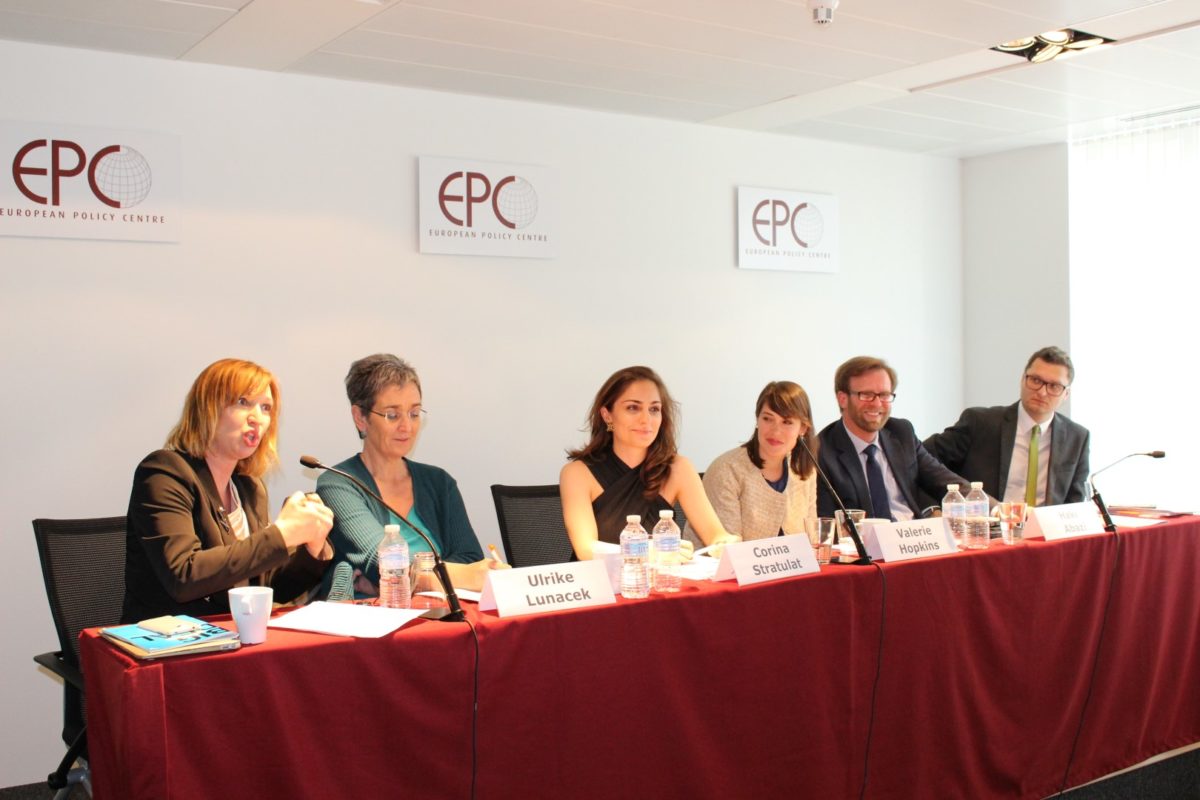
The European Policy Center (EPC) gathered authors of the “Big Deal” report, which exclusively talks about implementation of Kosovo-Serbia dialogue.

EPC Senior policy analyst, Corina Stratulat gave a few introductory remarks regarding to the report. She pointed out that Serbia’s relationship with Kosovo is central to the country’s EU accession talks, and that following the 2014 elections, both Belgrade and Prishtina agreed to integrate Kosovo’s police and judiciary.

BIRN Kosovo Executive Director Jeta Xharra, explained the methodology of the Big Deal report, its outline and some other key findings, including problems with the implementation of key agreements for the lives of citizens, like car insurance.

Ulrike Lunacek, Vice President of the European Parliament and member of the delegation for relations with Bosnia-Herzegovina and Kosovo noted that the BIG DEAL report was key to her understanding of the level of implementation of the agreements and said it was a valuable tool for her and other MEPs.

BIG DEAL report author Valerie Hopkins highlighted the difficulty in bringing the four northern Kosovo provinces under the control of Prishtina, with delays in unifying the judiciary, adopting municipal budgets and incorporating members of the Civil Protection Corps into Kosovo institutions. One success has been the integration of former Serbian police officials into the Kosovo police, and one complete failure has been mutual acceptance of diplomas.

The discussion involved also Rasa Nedeljkov, Programme Manager at the Center for Research, Transparency and Accountability (CRTA), based in Belgrade, who spoke about the value of creating one account of the implementation process for both Kosovo and Serbia.

Haki Abazi, Programme Director for the Western Balkans at the Rockefeller Brothers Fund, reminded attendees that neglecting Kosovo from an international perspective could have dangerous consequences, citing the ongoing political turmoil in Macedonia.

Click for more information about this report.   

BIRN Macedonia Launches Eight Call for Investigative Reports

BIRN Macedonia, together with Centre for Investigative journalism – SCOOP Macedonia and the Centre for Civil Communications launched the seventh call for investigative stories on June 1st.

The call is part of the ‘Project for Investigative Journalism and Cooperation Between Media and Civil Society’, part of a USAID programme for strengthening independent media in Macedonia.

In this call that closes on June 16, at least five journalists will be awarded a grant to cover their expenses while doing the investigation and writing the story.

Journalists will have about three months to dig deeper and research their ideas, but also will have the opportunity to work with experienced editors as their mentors to guide them through the process of writing to BIRN standards.

Topics for investigations include: health; cultural policy; education and youth; human rights; EU integration; good governance; inter-ethnic relations; environment issues; marginalised groups; quality of life.

The call only applies to journalists from Macedonia. More calls for investigative grants will follow.

Click for more information about the application procedure, with details in Macedonian.