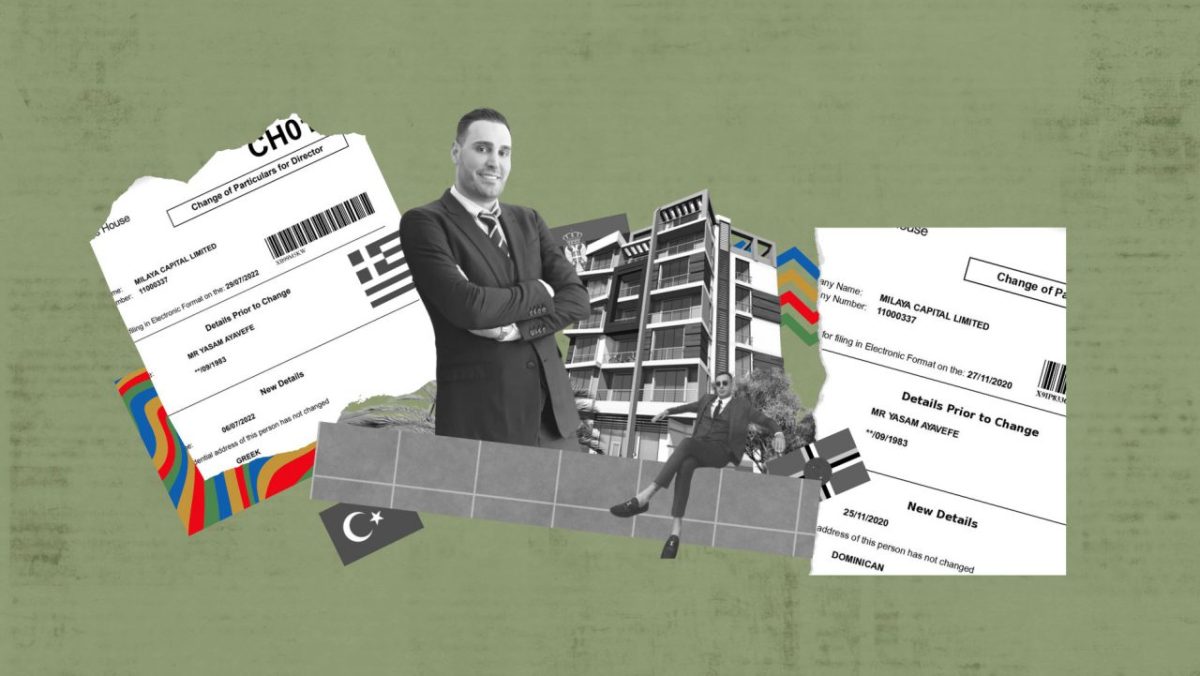
Turkish Fraudster Seeks to Delete BIRN Investigation Into Citizenship Acquisition

After Turkish courts ordered the removal of website articles about businessman Yasam Ayavefe, his representative called on BIRN to delete its investigation into how the convicted fraudster bought his way to honorary Greek citizenship.

A representative of Turkish businessman Yasam Ayavefe – a convicted fraudster who was revealed in an investigation by BIRN and Greek media partner Solomon to have acquired honorary Greek citizenship via his political ties – has asked BIRN to delete its report.

He also urged BIRN to delete articles about cyberattacks that targeted the Balkan Insight website after the publication of the investigation.

“These kinds of posts affect the business life of my client [Ayavefe]. He has invested in so many countries and posts like this cause my client material and moral damage,” Bener Ljutviovski, who introduced himself as Ayavefe’s representative, told BIRN in an email.

His request for the removal of BIRN’s reports came after Turkish courts, in two separate judgments in Istanbul and Ankara, ruled that Turkish online media articles about based Ayavefe’s activities in gambling, crime and business in Cyprus, Greece and Turkey should be removed.

The Turkish court rulings said that Ayavefe’s rights had been violated by the articles, citing “the presumption of innocence”.

BIRN has confirmed that at least 114 news pieces about Ayavefe have been removed from Turkish websites as a result.

Ljutviovski also said that a case had been launched in Greece to ask websites to remove articles about Ayavefe, but after checking with judicial authorities in Greece, BIRN could not verify this.

Ljutviovski further claimed that Ayavefe won a case in Greece to have arrests removed from his criminal record.

He said that all this proved that Ayavefe “has nothing to do with these accusations” and that he was being accused “without any proof” of being connected to the DDoS attacks on BIRN’s Balkan Insight website and Solomon’s site after the publication of the investigation.

He called on BIRN to take down the articles in line with the Turkish court rulings although one of the judgments clearly stated that domestic courts cannot remove content of “foreign origin”.

“Please help us in this situation and let’s fix this without prolonging… We are open to suggestions from your side,” Ljutviovski wrote.

He appeared to offer BIRN financial incentives in return for compliance: “My client Dr. Yasam Ayavefe has advertising company, if you help us in this case we can provide advertising service to your organisation, so you can grow to bigger organisation. We would love to cooperate with you,” he wrote.

BIRN declined Ljutviovski’s offer and rejected his repeated demands to remove the articles about Ayavefe.

Ljutviovski sent a series of requests to BIRN, initially from an email address under his own name but then from an email address under the name Igor Stefanov.

BIRN and its Greek partner media outlet Solomon’s websites came under DDoS attack by hackers in 2022 following the publication of the investigation into Ayavefe and how he acquired honorary Greek citizenship.

Solomon said on Twitter at the time that honorary citizenship is “a state honour long reserved for those who have significantly promoted Greek culture”, but has been “turned into a golden visa scheme for those with deep pockets”.

The investigative outlet Inside Story first broke the honorary citizenship story in July 2022, triggering a fierce debate over Ayavefe’s suitability for such an honour. Inside Story also came under DDoS attack after publishing its report on Ayavefe.

Nino Bilajac

Nino joined Detektor (BIRN BiH) in 2022 as a journalist. He is based in the Sarajevo office providing support to regional operations.

His main responsibilities include following developments related to corruption and crime at government institutions and public companies, as well as foreign malign influence. Previously, he worked in the media and NGO sector, such as the Center for Investigative Reporting (CIN), Face TV Sarajevo and N1 BiH as a reporter, editor and producer and was responsible for researching, investigating and authoring complex investigative stories, covering financial misuse in public procurement and public funds.

During this period, he also gained valuable experience in investigative reporting.

His awards include “Eco Journalist” 2022 – winner; European Union Award for Investigative Journalism in BiH 2021 – second prize; European Press Prize 2021 – selected in the top five; CEI SEEMO Award for Outstanding Merits in Investigative Journalism 2018 – winner; Thompson Foundation – Finalist for the Young Journalist Award, 2017 University and Languages.

Nino studied Communication and Journalism at the University of Sarajevo. His bachelor’s degree was in media and communication. In addition to his formal education, he attended various projects, courses and seminars on journalism and investigative reporting. Along with Bosnian, his mother tongue, Nino speaks English.

Nermina Kuloglija-Zolj

Nermina Kuloglija-Zolj joined BIRN BiH in August 2019. For the last four years, she has been researching extremism, terrorism, genocide denial and corruption.

She published many investigative stories about far-right groups in Bosnia and the Western Balkans, following the activities of at least five far-right groups operating in Bosnia. Before joining BIRN BiH, Nermina was a journalist at the Center for Investigative Reporting in Sarajevo, where she started her career in 2017, first as an intern, then as a journalist, focusing on researching corruption and organized crime.

Awards

In 2021, she was given a special mention by the judges of the CEI SEEMO journalism awards for outstanding merits in investigative journalism. That same year, she was a finalist for the Kurt Schork Awards in International Journalism.

She holds a master’s degree in Journalism and Mass Communication from the Faculty of Political Sciences at the University of Sarajevo.


Enes Hodzic

Enes joined BIRN BiH in May 2022 as a journalist/investigator. He is based in BIRN BiH’s Sarajevo office providing support to various projects.

He works as an investigative journalist and specialist court monitor. Since joining the team, he has contributed to various investigative pieces related to far-right extremism. During the past year, he has done several researches into harmful foreign influences in the Balkans and cyber security, including the first report on cyber security threats in BiH, which BIRN BiH presented in cooperation with CSEC.

Some of his investigative pieces, which were high on the media radar, were: “Bosnian Entity Road Company Ignores Sanctions, Promotes Gazprom Petrol Stations” – “Detektor, BiH ranjiva na cyber napade zbog nedostatka ključnih dokumenata” – “Detektor and “Kako su dvije desničarske organizacije spriječile mirnu šetnju povodom Dana bijelih traka u Prijedoru”.

He authored the first Detektor Magazine episode on cyber security, “Građani i institucije i dalje bez zaštite od cyber napada”, and co-authored an episode of the TV Justice show about the online monetization of hatred flourishing in Bosnia and Serbia.

Apart from journalism, he has high interest in technology and (cyber)security.

Previous Experience

Previously, he worked in various media outlets in Bosnia and gained extensive experience in journalism and investigative work, administration, financial and operational work.

Since 2012, he worked at the media outlets Visoko.co.ba, Radio Sarajevo and Federation Television as journalist and editor and was responsible for various projects and contents in those outlets.

He also worked as a project manager at VICOBA d.o.o., working on various media projects, including the Engaged Citizens Reporting project.

During this period, he also gained valuable experience in office management, project operations, field investigations, social media management and use of different digital tools needed for the jobs listed above.

 Awards

 He received an award for continuous reporting and contribution to witnessing the truth about the genocide in Srebrenica at the “Nino Catic” Journalist Award event in 2020.

University and Languages

Enes studied communication science at the Faculty of Political Sciences of the University of Sarajevo. His major was in communication sciences, journalism, PR and marketing. In addition to formal education, he has attended various project related and journalism courses/seminars. Along with Bosnian he speaks English.


BIRN Albania and SCiDEV Present Studies on Disinformation, Propaganda and Fake News

Reports on Russian, Chinese and Iranian propaganda welcomed by EU ambassador in Tirana who calls for a renewed emphasis on ethical journalism

The Balkan Investigative Reporting Network in Albania, together with Science and Innovation for Development Center, SCiDEV, on July 14 presented the findings of four reports on information manipulation in Albania and the launch of a new website against disinformation.

The study reports were financed by the European Union and analyze the circulation in Albanian-speaking media in Albania, Kosovo and North Macedonia of fake news on Russia’s war against Ukraine, Russian disinformation narratives, as well as Chinese and Iranian propaganda through state-sponsored media in Albanian language.

The presentation of the reports was greeted by the EU Ambassador in Albania, Christiane Hohmann, who emphasized the need for media owners to put quality journalism at the top of their agenda.

“We have to look into how we can actually improve the situation, fight misinformation and disinformation, while promoting ethical journalism,” said Hohmann.

The reports were presented at Europe House in Tirana by BIRN Albania Editor Besar Likmeta and SCiDEV’s Executive Director Blerjana Bino in the presence of media, journalists, civil society activists and media experts.

The reports are published in the newly launched website: DisInfo.al, which also contains a database on fake news on the war in Ukraine, as well as educational resources against disinformation, fact-checking links, video tutorials, etc.

Download the reports in English and Albanian:

  1. For the report: “False News on Russia’s Invasion of Ukraine in the Albanian-Language Media” click here.
  2. For the report: “Russian State-Sponsored Narratives in Albania” click here.
  3. For the report: “Media Analysis: China’s Public Diplomacy in Albania” click here.
  4. For the report: “Media Analysis: Iran’s Propaganda in Albanian Language” click here.


BIRN Albania and SCiDEV Publish Study on Chinese Propaganda

New report explores the main narratives of China’s state-sponsored media in Albania at a time when Beijing’s economic and political presence worldwide is growing.

The Balkan Investigative Reporting Network in Albania, together with Science and Innovation for Development Center, SCiDEV, on July 14 published a reporter on Chinese propaganda in the Albanian language.

The report, “Media Analysis: China’s Public Diplomacy in Albania”, was authored Blerjana Bino and Besar Likmeta and funded by the European Union.

This analysis delves into the main narratives produced by Chinese state-sponsored media outlets operating within Albania, a topic which remains understudied despite its increasing relevance.

As China’s economic and political presence grows worldwide, understanding how it projects its influence and shapes local perceptions is becoming crucial.

This research is particularly relevant given the rise of China’s economic and cultural diplomacy in Albania, the geopolitical dynamics at play and the media’s pivotal role in transmitting narratives.

For an English copy of the report click here.

For an Albanian copy of the report click here.

BIRN Albania and SCiDEV Publish Study on Iranian Propaganda

New report looks at Iranian propaganda in the Albanian language, in the context of Iran’s ‘information war’ with the West.

The Balkan Investigative Reporting Network in Albania, together with Science and Innovation for Development Center, SCiDEV, on July 14 published a report on Iranian propaganda in the Albanian language.

The report: “Media Analysis: Iran’s Propaganda in Albanian Language”, was authored by Blerjana Bino and Besar Likmeta and funded by the European Union.

This study of Iran’s public diplomacy in Albania through its state-sponsored media outlets is a crucial and relevant task, particularly as information warfare forms a key component of modern geopolitical strategy.

In the context of growing tensions between Albania and Iran, this investigation into Iran’s messaging is a critical step towards understanding its influence and intentions.

For a copy of the report in English click here.

For a copy of the report in Albanian click here.

BIRN Albania Publishes Report on False News on Russia’s Aggression in Ukraine

New report warns that false news on the war in Ukraine proliferated in the Albanian-language media in the first eight months of this year.

The Balkan Investigative Reporting Network in Albania on July 14 published a study on false news and information manipulation on Russia’s invasion of Ukraine.

The report: “False News on Russia’s Invasion of Ukraine in the Albanian-Language Media”, was authored by Kristina Voko and Besar Likmeta and financed by the European Union.

This research found that, in contrast to what has been previously reported, false news on Ukraine has proliferated in the first eight-months of 2022 in Albanian-language media outlets in Kosovo, Albania and North Macedonia.

This false news output, which is mainly generated abroad and distributed on social media platforms, has been translated and republished by local media. These comprise digital native media websites, television, radio and newspapers as well as their social media channels, mainly for commercial reasons.

For an English copy of the report click here.

For an Albanian copy of the report click here

BIRN Albania Publishes Report on Russian Disinformation

New report maps Kremlin narratives’ reach and impact in Albanian-language media.


The report, titled “Russian State-Sponsored Disinformation Narratives in Albania”, was authored by Kristina Voko and Besar Likmeta and financed by the European Union.

The aim of the study is to outline and map the reach of pro-Kremlin narratives in the Albanian media by tracking the republication of statements and news by state-sponsored Russian media outlets and identifying key narratives.

In addition to the disinformation identified in the Albanian-language media outlets, the researchers also analysed posts made on the official Facebook page of the Russian embassy in Tirana in the first eight months of 2022 to identify recurring Russian disinformation narratives spread through this social media channel.

For an Enligsh copy of the report click here

For an Albanian copy of the report click here