EU Investigative Journalism Awards Presented in Turkey

Ceremony in Ankara sees awards going to three women reporters and their groundbreaking stories on drug trafficking, the plight of Yezidi women and abortion issues.

The EU Investigative Journalism Awards in the Western Balkans and Turkey awards ceremony for Turkey was held in Ankara on August 28, hosted by its local partner, the Association of Journalists.

The Austrian head of the EU Delegation to Turkey, Ambassador Christian Berger, attended the ceremony, marking his last event in Turkey, as his term in the country ended on August 31.

In his opening remarks, Berger stressed the importance of supporting quality journalism through different programs and awards and underlined the importance of cooperation between the EU Delegations in different countries and local partners.

“Journalists are a very important component of a living and vibrant democracy. Please keep writing, and we keep reading and watching what you dispatch from Turkey,” he said.

The president of the Association of Journalists, Nazmi Bilgin, in turn thanked Berger for his support over the years and congratulated the finalists.

Vice President of the Association and jury head Yusuf Kanlı said a total of 53 applications were received this year and the high number and diversity of applicants had given the jury the chance to evaluate a wide array of successful investigative journalistic endeavours.

Ten applications on various topics were shortlisted and three women journalists received awards.

First place went to Zehra Özdilek of Cumhuriyet newspaper for her story, “Zindaşti Bomb”, which unearthed the ties between the drug trafficker Naci Zindaşti and Burhan Kuzu, a former MP of the current ruling party. During her acceptance speech Özdilek said she was accepting her award “on behalf of all imprisoned journalists”.

Second place went to Hale Gönültaş of Gazete Duvar news site, whose story, “Yezidi Hadiya’s Fight for Justice”, raised nationwide and international awareness about the Yezidi genocide in the Middle East and about a Yezidi woman Hadiya’s struggle to become the legal guardian of her two siblings.

During her acceptance speech Gönültaş said she wished to “accept this award on behalf of women who are victims of genocide, refugee women and those who fight for justice”.

Third place winner was Burcu Karakaş of Deutsche Welle’s Turkish Service, for her story, “Abortion in Turkey: Practically banned”. Her meticulous research portrayed the way abortion has become practically inaccessible in Turkey, even though it is a legal right guaranteed since 1983. Karakaş said she dedicated her award to “journalists who work under difficult circumstances and to women who do not give up on their rights”.

The ceremony continued with a reception. Due to the COVID-19 pandemic, the events were held outdoors with limited attendance. Among those who attended were diplomatic representatives from various Balkan and EU countries, the president of the Journalists’ Union of Turkey, Gökhan Durmuş and journalists representing various media outlets.

Call for EU Investigative Journalism Award in Montenegro Reopened

Investigative stories published from January 1 to December 31, 2019, and related to freedom of expression, rule of law, transparency, abuse of power and fundamental rights, corruption and organised crime are welcome to apply.

The award fund in each country in 2020 (for achievements in 2019) is 10,000 EUR. The first prize will be 5,000 EUR, the second 3,000 EUR, and the third will be 2,000 EUR.

Individuals or groups of journalists are eligible to apply in all journalism forms (print, online, radio and TV) published or broadcast in the media in each country in official, minority or international languages.

Articles eligible for submission must appear in print, online, radio and TV media outlets during the 2019 calendar year.

The call was postponed in early March, but all applications previously received will be taken into consideration.

The application deadline is September 18.

EU Investigative Journalism Awards in the Western Balkans and Turkey aim to celebrate and promote the outstanding achievements of investigative journalists as well as improve the visibility of quality journalism in the Western Balkans and Turkey.

The awards are a continuation of the ongoing regional EU Investigative Journalism Award in the Western Balkans and Turkey and part of the ongoing project ‘Strengthening Quality News and Independent Journalism in the Western Balkans and Turkey’, funded by the European Union.

The project partners involved all have extensive expertise in the field of media freedom and have been recognised locally and internationally as strong independent media organisations.

The jury for the EU Award comprises media experts, some of them from the project consortia. Others are drawn from the extensive network projects that the consortium members have, such as editors, members of academia and journalists with merits.

The awards will be given annually in all six Western Balkan countries and Turkey.

For more details, deadlines and guidelines please download packages for individual countries below.


To download all necessary documents for Montenegro click here

BIRN Albania Publishes Report on Internet Governance

The Balkan Investigative Reporting Network in Albania has published a report entitled ‘Internet Governance in Albania and its Role in Media Freedom’.

This report was produced as part of the project ‘Towards Improved Labour Relations and Professionalism in the Albanian Media’, funded by the European Commission, represented by Delegation of the European Union to Albania and implemented by the partnership of the Albanian Media Institute (AMI) and the International Federation of Journalists (IFJ).

Through this study on internet governance, BIRN Albania aims to provide a realistic and easily-grasped review of the current legal landscape for online media and content providers, as well as explore the primary issues and processes that overlap between media development and internet governance, in order to inform stakeholders and the public debate.

The report explores a number of topics where internet governance and regulation intersect with online media, market conditions, financial regulations, ownership and competition, access to information and data protection, and copyright and cyber-security, while providing real-world examples of situations in which the abuse or poor definition of these regulations leads to restrictions on freedom of the media and freedom of expression in the country.

For an English-language copy of the report, click here.
For an Albanian-language copy of the report, click here.

BIRN Albania Publishes Report on Internet Governance

The Balkan Investigative Reporting Network in Albania has published a report entitled ‘Internet Governance in Albania and its Role in Media Freedom’.

This report was produced as part of the project ‘Towards Improved Labour Relations and Professionalism in the Albanian Media’, funded by the European Commission, represented by Delegation of the European Union to Albania and implemented by the partnership of the Albanian Media Institute (AMI) and the International Federation of Journalists (IFJ).

Through this study on internet governance, BIRN Albania aims to provide a realistic and easily-grasped review of the current legal landscape for online media and content providers, as well as explore the primary issues and processes that overlap between media development and internet governance, in order to inform stakeholders and the public debate.

The report explores a number of topics where internet governance and regulation intersect with online media, market conditions, financial regulations, ownership and competition, access to information and data protection, and copyright and cyber-security, while providing real-world examples of situations in which the abuse or poor definition of these regulations leads to restrictions on freedom of the media and freedom of expression in the country.

For an English-language copy of the report, click here.
For an Albanian-language copy of the report, click here.

Call for Applications for Training in Project Cycle Management

Media representatives, including journalists, editors, project coordinators, project assistants, as well as freelance journalists from six Western Balkan countries and without previous knowledge of project management, are welcomed to apply for this four-day practical training.

In our changing world, many media outlets are supporting their independent work by applying to calls for projects targeting different aspects of journalism. Implementing projects brings numerous benefits to the media organisation; not only does it help to cover the costs of production, but builds the organisation’s skills outside of the production set.

We are offering you our Project Cycle Management course, tailored especially for journalists, editors, producers and, in general, media organisations. The goal of this training is to show you the benefits of projects, to help you better understand project cycles and introduce you to the elements of project management which can be the most beneficial.

We are sure you have heard sentences like: “I am not interested in projects, but in journalism; let me do my job”, or “I do not understand project logic, its strange language; it is just empty words”. 

Our specifically tailored PCM training targeting media professionals follows a four-day programme and offers a contemporary learning experience through group work, presentations and two-way interactions. It will show you how a simple idea, that you may have over a coffee with a colleague, develops into something more meaningful and worthwhile, which complements your work rather than disrupts your routine.

The course is tailored to suit all levels of previous knowledge; it is well balanced and is not set to repeat information for those with more knowledge, but will not overwhelm those who are receiving this kind of information for the first time.

Having had first-hand experience with the struggle and resistance media organisations have with project cycles, our lead trainer Dusica Stilic, the Balkan Investigative Reporting Network’s Head of Regional Operations, has used her knowledge of the PCM and the media to develop this unique course. She has also worked as a journalist and understands how you might first feel about project management (because, she did, too!). Dusica has a pedagogical background in education and practice, which making her one of the most engaging and systematic trainers in the region. For more information see Dusica’s bio here.

Who can apply?

Media outlets’ representatives (including journalists, editors, project coordinators, project assistants) and freelance journalists from Albania, Bosnia and Herzegovina, Kosovo, North Macedonia, Montenegro and Serbia without required previous knowledge of PCM, who currently work on project implementation, or wish to do so in the future.

Please apply observing the information provided in the application form.

The number of participants is limited and we will give advantage to younger journalists, with less experience in the described field.

Only one individual per media will be admitted.

Minimum 12 and maximum 20 participants.

How to apply?

Applicants should complete and submit only one application that is attached to this CfA. All applications should be submitted in English to: [email protected] along with the applicant’s CV.

DATE OF TRAINING: October 12-16

TRAINING VENUE: Tirana, Albania, HOTEL Rogner**

CALL FOR APPLICATIONS: Download here

APPLICATION FORM: Download here

DEADLINE: September 13, at midnight Central European Time

REMARKS:

* For confirmed training participants, transportation and accommodation costs are provided, if required.

** Training should take place in Tirana, Albania, but due to the possible changes in travel restrictions caused by the COVID-19 pandemics, and with respect to the health recommendations, organisers keep the right to hold the online training instead.

BIRN Annual Report: Rule of Law, Accountability and Transparency in Troubled Times

Readers recognise the importance of “uncompromising investigative journalism” in an era of disinformation and media control.

Against a backdrop of democratic backsliding and the erosion of media freedom, the Balkan Investigative Reporting Network, BIRN, last year continued its rigorous and award-winning coverage of political developments, corruption, human rights violations, environmental neglect and the legacy of war, according to BIRN’s 2019 annual report.

By reporting on and investigating governments and individuals, public and private companies, BIRN has contributed to the fight for accountability and good-governance by providing the people of South-East Europe with the information they need to take decisions, the report says.

The report highlights the political and media landscape in which BIRN operates, its expansion into Central Europe, the investigations and stories that mattered most, the donors who supported them and the impact made.

“In an era of disinformation and controlled media, people also recognised the importance of uncompromising investigative journalism that holds governments accountable and exposes wrongdoings,” BIRN Regional Director Marija Ristic wrote.

“We at the Balkan Investigative Reporting Network are proud to have revealed numerous corrupt deals, instances of nepotism and abuse of power and many human rights violations.”

Ristic highlighted the fact that in 2019 BIRN expanded into Central Europe with the aim of connecting journalists from the Balkans with other colleagues in Europe, to tackle together the challenges facing democracy and monitor digital rights and freedoms across the wider region.

While democracy is being eroded in the region, 2019 also brought an increase in civic activism, protests and demands for accountability and change, Ristic wrote.

Local communities took the streets to demand clean rivers and less air pollution, women spoke out and united against powerful abusers, while citizens came together to offer assistance to refugees and asylum-seekers.

Click here to read the full report.

Nicholas Watson

Nicholas was appointed editor of Reporting Democracy in 2020.

An award-winning journalist, he has worked for almost 30 years in Asia, the US and Europe, writing for publications such as the Financial Times, Politico Europe, TheStreet.com, Axios, International Herald Tribune TV and Knight-Ridder News. He was also co-founder and managing editor of Business New Europe

SEE Digital Rights Network Established

Facing a rise in digital rights violations, more than a dozen rights organisations have agreed to work together to protect individuals and societies in Southeast Europe.

Nineteen organisations from Southeast Europe have joined forces in a newly-established network that aims to advance the protection of digital rights and address the growing challenges posed by the widespread use of advanced technologies in society.

Initiated by Balkan Investigative Reporting Network, BIRN, and SHARE Foundation, the SEE Digital Rights Network is the first network of its kind focused on the digital environment and challenges to digital rights in Southeast Europe.

The network brings together 19 member organisations – from Albania, Bosnia and Herzegovina, Croatia, Greece, Kosovo, Montenegro, North Macedonia and Serbia – dedicated to the protection and promotion of human rights, both online and offline.

Each is committed to advancing their work on issues of digital rights abuses, lack of transparency, expanded use of invasive tech solutions and breaches of privacy.

Since the onset of the COVID-19 pandemic, Central and Southeast Europe has seen a dramatic rise in the rate of digital rights violations, in countries where democratic values are already imperiled.

“This endeavour comes at a moment when we are seeing greater interference by state and commercial actors that contribute to the already shrinking space for debate while the exercise of basic human rights is continuously being limited,” said BIRN regional director Marija Ristic.

“The Internet has strong potential to serve the needs of the people and internet access has proved to be indispensable in times of crisis such as the COVID-19 pandemic. Our societies are becoming more digital, which presents a powerful incentive to increase the capacity of organisations dealing with digital developments and regulations in our region.”

During a first joint meeting, the members of the network agreed that the challenges posed by the fast-evolving tech solutions used by states have led to infringements of basic rights and freedoms, while false and unverified information is flourishing online and shaping the lives of people around the region. The online sphere has already become a hostile environment for outspoken individuals and especially marginalised groups such as minorities, LGBTIQ+ community, refugees and women.

“Digital technology is profoundly changing our societies as it becomes an important part of all spheres of our lives, so we see the diversity of organisations that joined this network as one of its biggest strengths,” said Danilo Krivokapic, director of the SHARE Foundation.

“We can learn so much from each other’s experience, as we have similar problems with governments using technology to exert control over society, especially in times of crisis such as the COVID-19 pandemic,” he said. “It is also important that we act together when we are trying to restore the balance between our citizens and big companies (Facebook, Google etc) that hold enormous amounts of our personal data and through this exert significant power over us.”

The network’s aim is to build on the skills, knowledge and experience of its members to achieve common goals such as strengthening democracy in the region and protecting individuals in the digital environment.

While cherishing the values of safety, equality and freedom, the work of the SEE Digital Rights Network will be directed at achieving the following goals: to protect digital rights and internet freedoms, enable people to access accurate information, make the internet a safer place, detect and report hate speech and verbal violence online, especially against women and other vulnerable groups, identify online recruitment, which can lead to exploitation, take control of  personal data, work to prevent the implementation of intrusive surveillance systems, hold governments accountable for the use and abuse of technology and improve digital literacy in order to prevent violence and exploitation.

The network will aim to increase the level of understanding of complex and worrying trends and practices, trying to bring them closer to the general public in a language it can understand. By creating a common space for discussion and exchange, organisations and the media will be able to increase the impact of their individual efforts directed towards legislative, political and social changes.

For more information about the network please contact: [email protected] or/and [email protected].

Here you can find the full text of the SEE Digital Right Network Declaration. The Declaration is also available in BCS, Macedonian and Albanian.

The organisations that have joined the network are as follows:

  1. A 11 – Initiative for Economic and Social Rights – Serbia
  2. Balkan Investigative Regional Reporting Network (BIRN) – Bosnia and Herzegovina
  3. Civic Alliance (CA) Montenegro
  4. Center for Internet, Development and Good Governance (IMPETUS) – North Macedonia
  5. BaBe.hr– Croatia
  6. Civil Rights Defenders (CRD)
  7. Da se zna – Serbia
  8. Gong – Croatia
  9. Homo Digitalis– Greece
  10. Open Data Kosovo (ODK) – Kosovo
  11. Media Development Centre (MDC) – North Macedonia
  12. Metamorphosis Foundation – North Macedonia
  13. Montenegro Media Institute (MMI) – Montenegro
  14. NGO Atina – Serbia
  15. Partners Serbia – Serbia
  16. Sarajevo Open Centre – Bosnia and Herzegovina
  17. Share Foundation – Serbia
  18. Vasa prava BiH – Bosnia and Herzegovina
  19. Zašto ne? – Bosnia and Herzegovina

Check our in-depth coverage on these topics on the new Digital Rights focus page. Find out more about the latest digital rights developments, the use of invasive tech solutions, privacy breaches and other online rights violations in the countries of Central and Southeast Europe.

BIRN Movie About Underground Hospital Premieres at Sarajevo Festival

A film about a remarkable hospital that functioned underground during the war in Bosnia – directed by BIRN BiH’s deputy editor – has its first showing at this year’s online Sarajevo Film Festival.

A documentary titled “Underground” directed by Dzana Brkanic, deputy editor of the Balkans Investigative Reporting Network in Bosnia and Herzegovina, BIRN BiH, will be premiered at this year’s Sarajevo Film Festival, taking place from August 14 to 21. The film about a wartime underground hospital will be screened as part of the BH Film programme. 

The film is about a hospital in the town of Olovo that was set up below ground during the 1992-5 war in Bosnia because the town’s old hospital had become exposed to everyday shelling during the war. 

The underground hospital handled more than 1,300 patients each month. Doctors saved hundreds of lives by surgeries and other interventions while midwives delivered around 500 babies. The film follows the young people who were born in the underground hospital during the war. 

“Some time ago I learnt about a hospital built below ground in a very short period of time during the war. Fascinated by the idea, I proposed making a screening of the story, so BIRN BiH produced the story about the superhuman efforts of doctors and other medical staff to save hundreds of lives in inhumane conditions,” Brkanic said.

“It is interesting to note that so many children from Olovo and its surroundings were born there without any complications, four meters below ground, with no electricity and sometimes with no necessary light. We found some of them proudly going through life, claiming that being born in such conditions actually sent a message that ‘they can do anything,’” Brkanic added.

Brkanic was the film director, Denis Dzidic was the producer and Semir Mujkic was the editor. Amel Djikoli, helped by cameramen Faris Dobraca, Jasmin Jatic and Mario Ilicic, was director of photography. Samir Hrkovic and Adis Bazdarevic handled sound while Adnan Musanovic and Elma Selimovic were in charge of music. The song used in the film was written by Mujo Hodzic.

“I am happy to have had the opportunity to be the author of this film and work with these great people, interlocutors and the crew, all of whom shared my enthusiasm for this story and the idea, and agreed that it should be shared with the world,” Brkanic said.

“It is an honour to see this film screened at the SFF alongside the great figures of domestic and world cinematography, and it is a stimulus to BIRN to continue making stories, because they kind of preserve history and the events that happened in this area,” Brkanic noted.

The Association of Filmmakers of Bosnia and Herzegovina organizes BH Film programme as part of the Sarajevo Film Festival, presenting films produced in Bosnia and Herzegovina as well as those made by domestic authors living abroad.

This year’s 15th BH FILM programme features 42 films, 31 of which will have their world premieres at the festival.

Due to the coronavirus pandemic, the 26th Sarajevo Film Festival will be screened online on ondemand.sff.ba. Through the platform the audience will have access to accompanying content, such as lectures and interviews with directors.

Serbian Authorities Seek Bank Data of Rights Groups, Investigative Media

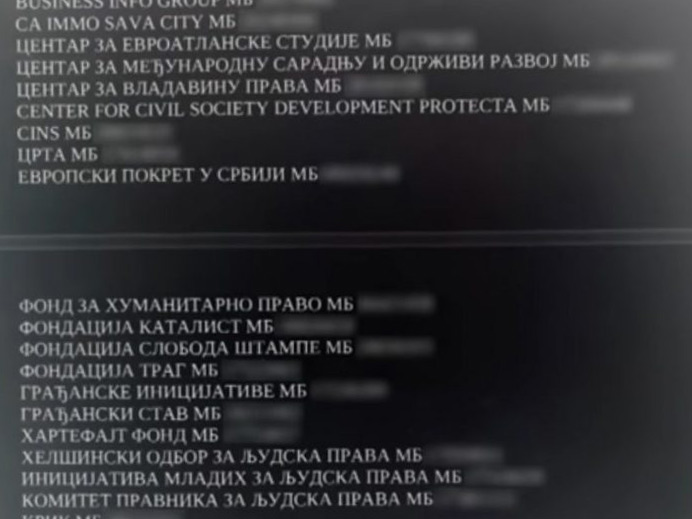
A department of Serbia’s finance ministry tasked with tackling money laundering and terrorism financing has asked banks to hand over data about the transactions of dozens of individuals and NGOs known for their work on human rights, transparency and exposing corruption.

Journalists and civil society representatives in Serbia have accused the government of trying to silence its critics after it emerged that the finance ministry’s Administration for the Prevention of Money Laundering has sought access to bank data dating from January 1, 2019, for 20 individuals and 37 NGOs, including a number of investigative media outlets and high-profile human rights organisations.

The order was first published by TV Newsmax Adria Serbia. It cites the need “to determine whether the listed organisations and individuals have anything to do with terrorist financing or money laundering.”

The list includes Balkan Investigative Reporting Network, BIRN, the Centre for Investigative Journalism of Serbia, CINS, Crime and Corruption Reporting Network KRIK, the Novi Sad Journalism School, both of Serbia’s major journalism associations and a host of rights groups including Civic Initiatives, YUCOM, the Belgrade Centre for Security Policy, the Helsinki Committee for Human Right and the Humanitarian Law Centre.

The individuals include a number of BIRN employees, CINS director Branko Cecen, TV Newsmax Adria Serbia head and former BIRN editor Slobodan Georgiev and journalists Biljana Stepanovic and Vukasin Obradovic. Opposition politician Vuk Jeremic is also named.

Cecen told TV Newsmax Adria Serbia that the government, led by the Progressive Party of President Aleksandar Vucic, was “reckoning with its critics”. Zeljko Radovanovic, the head of the Administration for the Prevention of Money Laundering, said it was simply conducting “regular activities”.

‘Criminalising people’

Civic Initiatives, which was founded by anti-war activists in 1996 to promote democratic values and human rights, called on the government to “immediately stop the abuse of the mechanism for preventing money laundering and terrorist financing in order to intimidate organisations, media and individuals acting as controllers of the government”.

The law, it says, only allows authorities to seek bank data if it suspects an individual or organisation is involved in money laundering or financing of terrorism.

“The confrontation with organisations and critical media in this way is an abuse of the legal mechanism and state resources,” it said.

Milos Nikolic, head of Libertarian club – Libek, which is also on the list, expressed surprise, describing the non-governmental sector in Serbia as one of the most transparent in the country.

“Many of these organisations receive grants through competitions,” he told BIRN. “They cannot spend funds outside the described activities; there are contracts that regulate this relationship, often with very precise budget specifications of costs.”

“I really don’t see how an organisation like Libek or related organisations from the list that operate according to the law, keep proper financial books and have many years of achievements in the field of educational and research work behind them could raise suspicions about money laundering and terrorist financing.”

Georgiev, the head of TV Newsmax Adria Serbia, said the move was “a way of criminalising people”.

“People need to understand that this is what the Administration [for the Prevention of Money Laundering] does when investigating criminals, so now we are all placed in the same basket as criminals,” he told regional broadcaster N1 TV.

“That way you criminalise people when I try to detect crime with my work,” he said. “That Administration for the Prevention of Money Laundering has the same donor as BIRN – the European Commission. So I ask the public question: ‘Will the Administration for the Prevention of Money Laundering examine itself’? It’s horrible.”