Balkan Investigative Reporting Network
PARTNER
Kafkadesk is focused on ultra-local news from Central Europe. It relies on a wide network of contributors and partners scattered all over Central Europe to keep the readers up-to-date with the most recent news and events.
PARTNER
Internews Ukraine is an organisation that has expertise in media, communications, education, and consulting.
 Innovation, professionalism, and efficiency are three pillars of the organisation. Serving the Ukrainian society has been its priority since 1996.
PARTNER
Insight Hungary provides English language information about Hungary’s current social, political and economic environment.
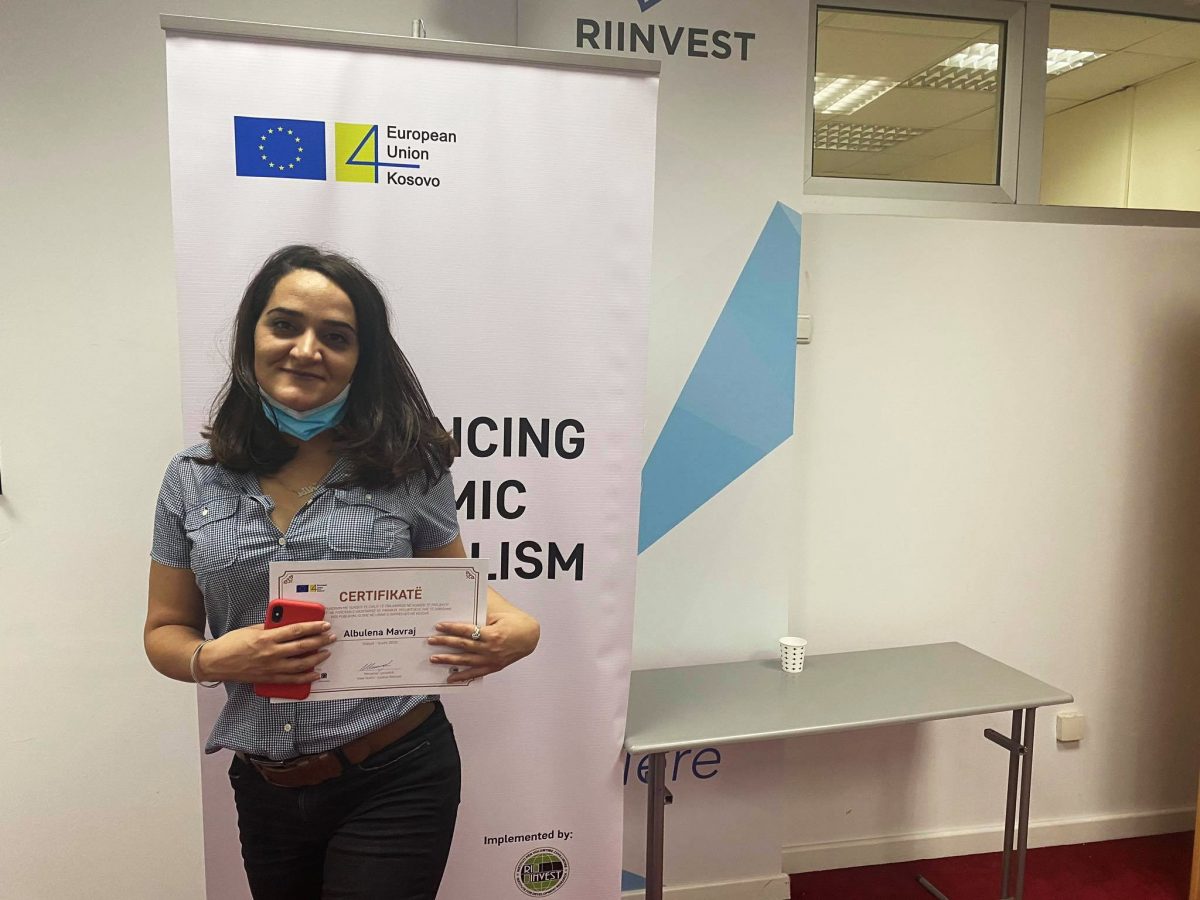
The RIINVEST Institute, a Kosovo think-tank, presented awards on Friday for the three best articles covering issues related to the economy that were produced following training sessions held by the institute.
The training and awards were made possible by a grant from BIRN, as part of the ‘Contribute to Strengthening Independent, Investigative and Publicly Beneficial Journalism and Freedom of Expression in Kosovo’ project, which is being implemented in cooperation with the Association of Kosovo Journalists.
First prize was won by Albulena Mavraj for her article evaluating government plans to allow citizens to withdraw ten per cent of their savings in the Kosovo Pension Fund as a means to help combat the economic effects of the coronavirus crisis.
According to the jury, the article provided credible information to the public about a topic which was not thoroughly covered or explained in most of Kosovo’s media outlets.
Albione Hajdari was awarded second place for her article exploring the hardships that young people in Kosovo face in searching for work following graduation. Third place went to Lulzim Ahmeti, whose story outlined some of the economic damage caused by the coronavirus crisis.
The project, which is supported by the EU, seeks to develop journalism that is independent, impartial, unbiased and beneficial to the public interest, while equipping the beneficiaries with the required skills and resources to implement creative, investigative stories.
BIRN Kosovo held a town hall conference on Wednesday about the impact of the pandemic on municipal revenues and expenses, the first such event to be organised within the framework of the ‘Promoting the Auditor General/National Audit Office’s Role in Kosovo’ project.
Supported by the Embassy of the Kingdom of the Netherlands in Pristina, these town hall conferences are intended to examine the difficulties that municipalities face in collecting revenues and spending their budgets. They also present the findings of the Auditor General, with a particular emphasis on those relating to public finances.
The conference was attended by the mayor of the municipality of Dragash, Shaban Shabani, Assistant Auditor General, Emine Fazliu, the managing editor at KALLXO.com, Visar Prebreza, as well as representatives of civil society and municipal assembly members. The conference was streamed live on BIRN’s anti-corruption platform KALLXO.com.
Prebreza gave a brief presentation about an analysis of the auditor’s findings, noting that “the pandemic has complicated the issue of revenues and the expenditures of public money in this municipality.”
Assistant Auditor General Fazliu stated that the opinion the National Audit Office provided on the annual financial statements for the Municipality of Dragash for 2019 was an unmodified opinion, which means that the annual financial statements present a true and fair view in all material respects.
Mayor Shabani assessed that “holding this debate contributes to increasing the transparency of the municipality”, adding that the municipality considers the Auditor General a very important mechanism for improving governance.
Similar town hall conferences will be held in other municipalities in Kosovo with the aim of presenting BIRN’s analysis of the implementation of the auditor’s recommendations and public finances. All of them will be held in the municipal buildings of the municipalities in question, and will be livestreamed by BIRN Kosovo.
As part of the regional ‘Media for All’ project, Balkan Investigative Reporting Network will hold a virtual midday debate on September 23 to discuss online media regulation and self-regulation in the Western Balkans.
As concerns grow in the region over fake news, disinformation and propaganda – particularly amidst the COVID-19 pandemic – some governments are pushing forward legislative initiatives to regulate online media outlets’ content through administrative bodies. At the same time, journalists, editors, media stakeholders and civil society organisations have strengthened their efforts to raise the bar of online journalism through improved ethical guidelines and self-regulatory bodies.
BIRN will host a star group of experts from across the region, to discuss the way government and the civil society sector are responding to these new asymmetrical threats to professional journalism in cyberspace and the impact that the COVID-19 pandemic is having on media freedom in the region.
The debate “Online Media Regulation: Between the Legal Gap and Government Pressure”, moderated by BIRN Albania editor Besar Likmeta, will discuss the pitfalls government and administrative bodies come up against in trying to regulate online media ethics and the efforts made to self-regulate by Balkan media and civil society, as a response to state oversight and the threat of censorship.
The debate will also focus on the impact that restrictions, imposed by these countries’ governments to fight the spread of the novel coronavirus, are having on media, the freedom of expression and right to information.
How are online outlets and the industry coping amidst a shortfall of advertising revenue? Is government aid necessary for the media’s survival, or a threat to its independence?
Experts from six Balkan countries will take part in this discussion:
To join our first debate within a series of discussions on online media regulation in the Western Balkans region, connect with us on the platform ZOOM on Wednesday, September 23, at noon CET.
Save the date and register HERE.
As part of Media for All Project, the Balkan Investigative Reporting Network, BIRN, wants to connect students and young journalists who wish to gain practical knowledge in the field by working with media organisations in the Western Balkans, which will host this four-month traineeship programme.
If you are a senior journalism student, recent graduate or a young journalist at the beginning of your career and are looking for an opportunity to learn from highly dedicated media workers and editors in some of the most respected outlets in the Western Balkans, you are welcome to apply for this programme.
Most media receive applications for internships on a rolling basis, but rarely do they have the time and resources to offer a structured programme, with interns usually missing out on proper training, mentoring and feedback. This four-month-long programme, however, will first provide key theoretical foundations, followed by a systematic, yet very practical and realistic demonstration of work in an ever-busy newsroom.
Selected candidates will receive online training on the basics of journalism from an experienced international trainer at the beginning of the programme and spend the traineeship in one media outlet, where they will receive support from senior staff to understand and learn about some of the most relevant editorial procedures.
Trainees will become full-time members of the newsroom for four months, they will attend editorial meetings, learn how to pitch ideas, chose relevant angle for a story, learn how to cover daily events, how to perform different kinds of interviews, write analyses, feature stories, etc.
We are offering 12 traineeship placements in six Western Balkans countries: Albania, Bosnia and Herzegovina, Kosovo, Montenegro, North Macedonia and Serbia (two placements per country, see the full list of host media here).
Due to the travel restrictions and health concerns caused by COVID-19, applicants will be placed in the outlet in their country of residence. Applicants may express their preferences as to which media outlet they would like to spend their traineeship with, but the organisers maintain the right to make the final decision about placement.
Who can apply?
Senior year journalism students, recent graduates or young journalists from Albania, Bosnia and Herzegovina, Kosovo, Montenegro, North Macedonia and Serbia may apply.
Applicants must be between 18 and 26 years old.
Candidates from all parts of the country in question are encouraged to apply, as the project can provide funds for travel within one country, as well as accommodation costs.
How to apply?
Applicants should complete and submit only one application that is attached to this CfA.
All applications should be submitted in English before October 4, at midnight Central European Time to [email protected] along with the following documents:
The motivation letter should show how you would benefit from this programme and your motivation to participate.
Applicants who do not have any published work can submit their student assignments from practical courses in journalism.
Applicants should provide evidence of their current status – whether they are students, recent graduates or working as journalists. This evidence includes, but are not limited to, confirmation of enrolment for the following year OR confirmation of graduation in the last two years OR evidence of your current employment.
Language:
All applications must be submitted in English, as well as applicants’ CV and motivation letter, while work samples and proof of status may be in local languages.
Working language of the initial online training on the basics of journalism will be English, so advanced knowledge of English language is required.
Traineeship programme will be delivered in local languages.
Financial support:
All selected participants will receive financial support during their placement to cover minimum living costs.
In case candidates need to travel or relocate within the country during the course of the programme, travel and accommodation costs will also be covered by the organisers.
COVID-19 restrictions:
Initial training will be delivered online, due to the different travel restrictions in the region, as well as relevant health recommendations.
Traineeship programme is set to be delivered in person, if possible, or as a combination of conventional offline approach and online, remote work.
Our main priority is to protect the health of all involved in this process, including the trainees and their mentors in the host media, so we will continue to closely monitor coronavirus-related developments and adjust relevant activities accordingly.
DURATION OF TRAINEESHIP: November 2020 – February 2021
ONLINE TRAINING: Two weeks, November 2020
CALL FOR APPLICATIONS: Download here
APPLICATION FORM: Download here
LIST OF HOST MEDIA: Download here
In its 2020 Investment Climate report on Kosovo, the US State Department has listed BIRN and its executive director Jeta Xharra as a useful resource for reporting corruption.
The US State Department has listed BIRN Kosovo and its director Jeta Xharra as a resource for reporting corruption in a report on the global investment climate in 2020. In 2012, BIRN and Internews Kosova established the KALLXO.com platform for reporting corruption and other irregularities in the provision of public services.
The report states that “opinion polls attest to the public perception that corruption is widespread in public procurement, and local and international businesses regularly cite corruption, especially in the form of political interference, as one of Kosovo’s largest obstacles to attracting investment.”
The State Department emphasizes that Kosovo has adopted strong legislation to fight corruption, but that successive governments have so far been unsuccessful in its efforts to investigate, prosecute, imprison and confiscate the assets of corrupt individuals.
However, the report does cite the work of the previous government headed by former prime minister Albin Kurti in the fight against corruption, referencing the dismissal of boards of public enterprises due to mismanagement.
“The Kurti government, which started its mandate in February 2020, but fell in March 2020, took a number of concrete steps to combat corruption and political interference, but given its short tenure was not able to institutionalize all of its measures and change the perception of political interference in public administration and the judicial system,” the report states.
The US State Department lists the Anti-Corruption Agency and the Office of the Auditor General as government agencies mandated to fight corruption, and states that the country’s laws protect NGOs investigating corruption.
Other resources for reporting corruption listed by the State Department are Shaip Havolli, the director of the Kosovo Anti-Corruption Agency, the Ombudsperson Hilmi Jashari and Ismet Kryeziu, the director of the Kosovo Democratic Institute.
This article was originally published by Prishtina Insight.
Applications are now open for submission of investigative articles from Bosnia and Herzegovina and Kosovo for the annual EU Investigative Journalism Award.
Investigative stories published from January 1 to December 31, 2019, and related to freedom of expression, rule of law, transparency, abuse of power and fundamental rights, corruption and organised crime are welcome to apply.
The award fund for BiH and Kosovo in 2020 (for achievements in 2019) is 10,000 EUR. The first prize will be 5,000 EUR, the second 3,000 EUR, and the third will be 2,000 EUR.
Individuals or groups of journalists are eligible to apply in all journalism forms (print, online, radio and TV) published or broadcast in the media in each country in official, minority or international languages.
Articles eligible for submission must appear in print, online, radio and TV media outlets during the 2019 calendar year.
EU Investigative Journalism Awards in the Western Balkans and Turkey aim to celebrate and promote the outstanding achievements of investigative journalists as well as improve the visibility of quality journalism in the Western Balkans and Turkey.
The awards are a continuation of the ongoing regional EU Investigative Journalism Award in the Western Balkans and Turkey and part of the ongoing project ‘Strengthening Quality News and Independent Journalism in the Western Balkans and Turkey’.
The project partners involved all have extensive expertise in the field of media freedom and have been recognised locally and internationally as strong independent media organisations.
The jury for the EU Award comprises media experts, some of them from the project consortia. Others are drawn from the extensive network projects that the consortium members have, such as editors, members of academia and journalists with merits.
Deadline for the submission of application is 18.10 2020.
For more details, contact [email protected]
Individual packages for Bosnia and Herzegovina and Kosovo can be found below.
To download all necessary documents for Kosovo in Albanian click here.
To download all necessary documents for Kosovo in Serbian click here.
To download all necessary documents for Bosnia and Herzegovina in BHS click here.
BIRN Kosovo held two training sessions with prospective journalists on September 2 and 4 aimed at developing their ability to monitor audit reports.
The training sessions were held as part of the ‘Promoting the Auditor General/National Audit Office’s Role in Kosovo’ project.
Supported by the Embassy of the Kingdom of the Netherlands in Pristina, the training courses are designed to improve the skills of journalists and monitors
The courses are also aimed at encouraging young journalists to enter the field of investigative journalism.
The first training course was attended by 14 prospective journalists, while the second was attended by seven.
The course was divided into two sessions. The first session was held by Kreshnik Gashi, managing editor at KALLXO.com and Labinot Leposhtica, the legal office coordinator at BIRN, while the second was held by Visar Prebreza, an editor at KALLXO.com.
Gashi and Leposhtica explained the importance of following the correct protocol when monitoring audit reports and outlined the purpose and process of sending legal letters and monitoring legal documents.
Meanwhile, Prebreza elaborated on the process of researching and reading the auditor’s reports, and stressed the importance of illustrations and infographics within an investigation.