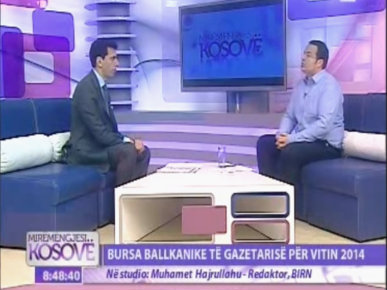
BIRN Kosovo director discusses fellowship programme on Klan Kosova

Jeta Xharra, country director of BIRN Kosovo, was invited to the morning programme of Klan Kosova on Feb. 25 to discuss the 2014 programme for the Balkan Fellowship for Journalistic Excellence. 

Jeta Xharra on Klan Kosova.

Xharra described the programme and encouraged journalists to apply for it. This year the programme’s theme is “Generations”.

“The journalists that apply for this fellowship are privileged because their articles will be published in different international media, and they will be guided and mentored by a group of experienced local and international journalists and editors”, Xharra said.

“The ones who win the fellowship will investigate and write about this particular topic for the whole year. Journalists will not only write and investigate the topic within Balkans; they will have the possibility to go to EU countries and investigate the topic there”, Xharra continued.

Journalists will be provided with 2,000 euro for trips to EU countries and 2,000 euro for the story. The individual who wins first place will receive a prize of 4000 Euro.

Find more at: http://klankosova.tv

‘The Majority Starts Here’ Premieres in Oxford

BIRN’s road-movie documentary ‘The Majority Starts Here’ had its British premiere on Monday at SEESOX (South East European Studies at Oxford), part of the European Studies Centre at the University of Oxford.

The producers of the film, BIRN regional director Gordana Igric, BIRN Kosovo director Jeta Xharra and Balkan Insight managing editor Ana Petruseva, were in Oxford for the screening and took part in a panel discussion afterwards chaired by professor Kalypso Nicolaidis.

Gordana Igric explained that the main idea behind the film was to discover how much young people knew about the past and gauge the prospects of them becoming the creators of a better future. The production team said they only realised during the screenings of the movie how little knowledge there is in the region about the suffering of other ethnic groups, which is a major obstacle in overcoming the experiences of the war.   

Regarding the actual making of the movie, Ana Petruseva said that the production team simply wanted to see “what is going to happen when six people from these six countries end up stuck in a minivan for several weeks”.

Jeta Xharra explained that only the participant from Kosovo was over 25 because it was necessary to find someone older who understood at least some Serbian/Croatian/Bosnian so that they would not feel like an outcast among the others who shared the same or very similar languages.

Managing Editor of BIRN Kosovo Discusses Fellowship Programme on RTK

Muhamet Hajrullahu, managing editor of BIRN Kosovo, was invited to the morning programme of the national broadcaster, RTK, on February 27 to talk about the 2014 Balkan Fellowship for Journalistic Excellence.

This is the eighth time that BIRN in cooperation with the ERSTE Foundation and the Open Society Foundation is providing 10 journalism fellowships in Balkans. The annual theme for this year’s programme is “Generations”.

Hajrullahu said this is a great opportunity for journalists to apply for this fellowship and to create new contacts in the region and beyond. Hajrullahu also explained this year’s fellowship has expanded to include journalists from Greece – in addition to those from other Balkan countries.

“Every journalist from different Balkan countries has the possibility to present their work/proposals and in the end they will be selected by professionals on a board of experienced journalist and editors”, Hajrullahu said.

Fellowship Selection Committee to Judge Applications

Following the close of the call for applications to the Balkan Fellowship for Journalistic Excellence, the selection committee is set to choose 10 journalists to participate in this year’s programme.


More than 160 journalists from 10 eligible countries applied for the 2014 fellowship programme under the topic of GENERATIONS.

The decision on participants in the programme will be reached based on the following criteria:

Article proposal – Relevance/ Feasibility/ Originality

Candidate – Professional qualifications/ Motivation/ Journalistic approach

The Balkan Fellowship for Journalistic Excellence partners thank all applicants for their interest in the programme and the effort invested in the application process and are also grateful to everyone who helped spread the word about the fellowship across the region.

The results of the selection will be announced on March 28 on the Balkan Fellowship programme web site. 

BIRN Journalist Takes Part in Huffpost Live Cast on Bosnia Protests

Balkan Insight journalist Elvira Mujkic Jukic was one of five guests on a Huffpost Live cast about the Bosnian protests that was aired on March 5.

Mujkic Jukic spoke about what was needed Bosnia, emphasising the necessity of reforms that can be implemented in the immediate future.

“These reforms are in the economy, in making the environment easier for investments or starting a company and creating new jobs that could probably satisfy some of the demands of the protesters. If we put the focus on reforms of the constitution, that could take years, while there are many other things that can be done now,” she said.

Other speakers included Muhamed Sacirbey, former foreign minister and ambassador to the UN for Bosnia and Herzegovina , Aldin Arnautovic, activist and freelance journalist, Haris Alisic, new media analyst at Al Jazeera Media Network and Nadja Skaljic, senior fellow for Europe at the Carnegie Council for Ethics in International Affairs.

View the entire Huffpost Live cast:

BIRN Opens Office in Albania

The Balkan Investigative Reporting Network has appointed Kristina Voko as country director of its newly established office in Albania, which officially opens in April 2014.

“I am excited to be joining an organisation with a great reputation and excellent journalists, and look forward to expanding the network’s activities in Albania,” Voko said.

Voko has years of experience in organisational development and program cycle management in the IGO and NGO sectors.

Through the new office in Albania, BIRN plans to apply its signature media development and journalism training programmes in a country where freedom of expression and information, quality of journalism and a general lack of funding and support for the media remain important issues.

“BIRN’s presence in Albania answers a demand from local journalists who have been involved in its regional projects and appreciate the hands-on approach to training, publishing and media freedom,” said BIRN editor Besar Likmeta.

Balkan Fellowship Shortlisted for European Press Prize

The editor of the Balkan Fellowship for Journalistic Excellence, Neil Arun, has been shortlisted for the European Press Prize 2013.

The nomination, in the category of Investigative Reporting, was made for stories produced by the Fellowship, an annual bursary for analytical and investigative journalism. The stories covered themes ranging from corruption to the legacy of conflict and communism.

Ten journalists are selected for the Fellowship every year to receive funding and professional guidance to help them report on topics that are central to the region and to the European Union. Applications for the 2014 round of the Fellowship are currently being sought.

The programme is managed by the Balkan Investigative Reporting Network, BIRN, with the support of ERSTE Stiftung and the Open Society Foundations.

Arun was also shortlisted for the 2012 edition of the European Press Prize. Having completed two years with the Fellowship, he is now leaving the programme to pursue new opportunities.

He will remain involved with the Fellowship as a member of its selection committee, and with BIRN as a special projects editor.

“The credit for this nomination must be shared,” he says. “This is recognition for those who have reported for the Fellowship, and for those whose hard work and generosity have supported it.”

The awards were created by the representatives of seven European media foundations in order to reward excellence in journalism across 47 European countries.

Each award carries a prize of 10,000 euros, to be spent on a project that may enrich the practice of journalism.

The winners will be decided by a panel of judges, chaired by Sir Harold Evans. The prize giving ceremony takes place in London on March 17, 2014.

Investment Insecurities

Bab Club is one of the most frequented clubs in Prishtina, but it is built in an occupied property.

This object which was privatized by Xhevat Sadriaj, who operates in the business of real estate and insurance in Swizerland, now is occupied from Rrustem Rukolli, owner of Bab Club.

This property is located infront of New Born Obelisque and beaneth Grand Hotel. Sadriaj’s property is now a business area owned by the company “R and Rukolli” that won more than 5 million euro bid from the municipality of Skenderaj and around 15 million euro from other public authorities.

Rukolli is also coordinator of the security team of the mayor of Skenderaj, Sami Lushtaku, which is detention for war crimes, from EULEX.

Sadriaj who is partial owner of the company COEB which bought the place in 2011 from Property Privatization Agency, has no access to his property.

Property Privatization Agency and Mr. Rukolli had a deal which gave right Mr.Rukolli to use this property till the moment that it is privatized. From the moment this property was privatized AKP informed the holder that the property was sold, said Mr. Ylli Kaloshi, spokesperson of AKP. From that moment we have no obligation toward investors to liberate the properties, he added.

If the investors have problems with the properties they can present the case to the court, says Kaloshi.

Sadriaj paid 147 thousand euro to buy this place. The whole history began at the platform of Grand that used to be public property.

The documents of AKP showed that the 3 places where Bab Club was build used to be property of the public enterprise Rilindja.

Sadriaj bought this property in 2011 through a bid with the cost of 147 thousand euro. After getting the papers that show him as the owner, he went to visit the place. There he realized that the place was being used from Rrustem Rukolli owner of “R and Rukolli.

According to Sadriaj, Rukolli offered him to buy the place with the same price but he refused. After this Rukolli told Sadriaj that he will have to deal with God. He also said that Rukolli refused to pay the rent for using the property for 2 years.  

“I told him that my Swiss partners doesn’t want to sell the property, thats why you have to pay the rent, but after this he didn’t answer the phone anymore”, said Sadriaj.

The lawyer of Rukolli Arianit Koci does not deny the possibility that Rukolli offered to buy the place from Sadrijaj.

“It’s possible; there is nothing bad in offering to buy the place. In fact with this offer he recognizes that the property belongs to Sadriaj” said Koci, juridical representative of Rrustem Rukolli.

Justice in Kosovo talked with Mr.Rukolli, but he recommended that for this case they should talk with his lawyer Mr.Arianit Koci.

Koci said that his client does not know which part of the place is owned by Sadriaj, that’s why he is waiting for a court decision.

According to the officials of AKP, Rukolli knew precisely where the borders of Rilindja were.

The biggest problem is that Sadriaj’s Swiss Partners started to feel insecure for their investments in Kosovo.

Justice in Kosovo also prepared a short report on legislative changes in Kosovo Chamber of Advocates. From December, 2013, every citizen that chooses a lawyer to protect him/her will know if the lawyer has a criminal background. The Kosovo Chamber of Advocates decided to publish all the disciplinary decisions for advocates/lawyers.

From  the moment that a citizen needs a lawyers, they can look in the Kosovo Chamber of Advocates if they want to find out if there is any open disciplinary file for that particular lawyer/advocate.

The court ordered raids

On January 20 and 26, 2013, Justice in Kosovo broadcast, in the segment “Police”, the court ordered raids.

Kosovo Police, ordered by court, organized and action called the court ordered raids. During this operation many cafeterias and bars were controlled. This operation was initiated because the number of penal acts in near these bars increased. The police also was searching for illegal drugs and weapons. Around 80 police officers were engaged in this operation.

In the first part of the programme were raided 7 bars, whereas in the second part 2 bars were raided. During this operation police found many small bags of marihuana and some cold weapons such as knives and iron sticks. 

The Kosovo Police operation went well and there was no complication during the operation.