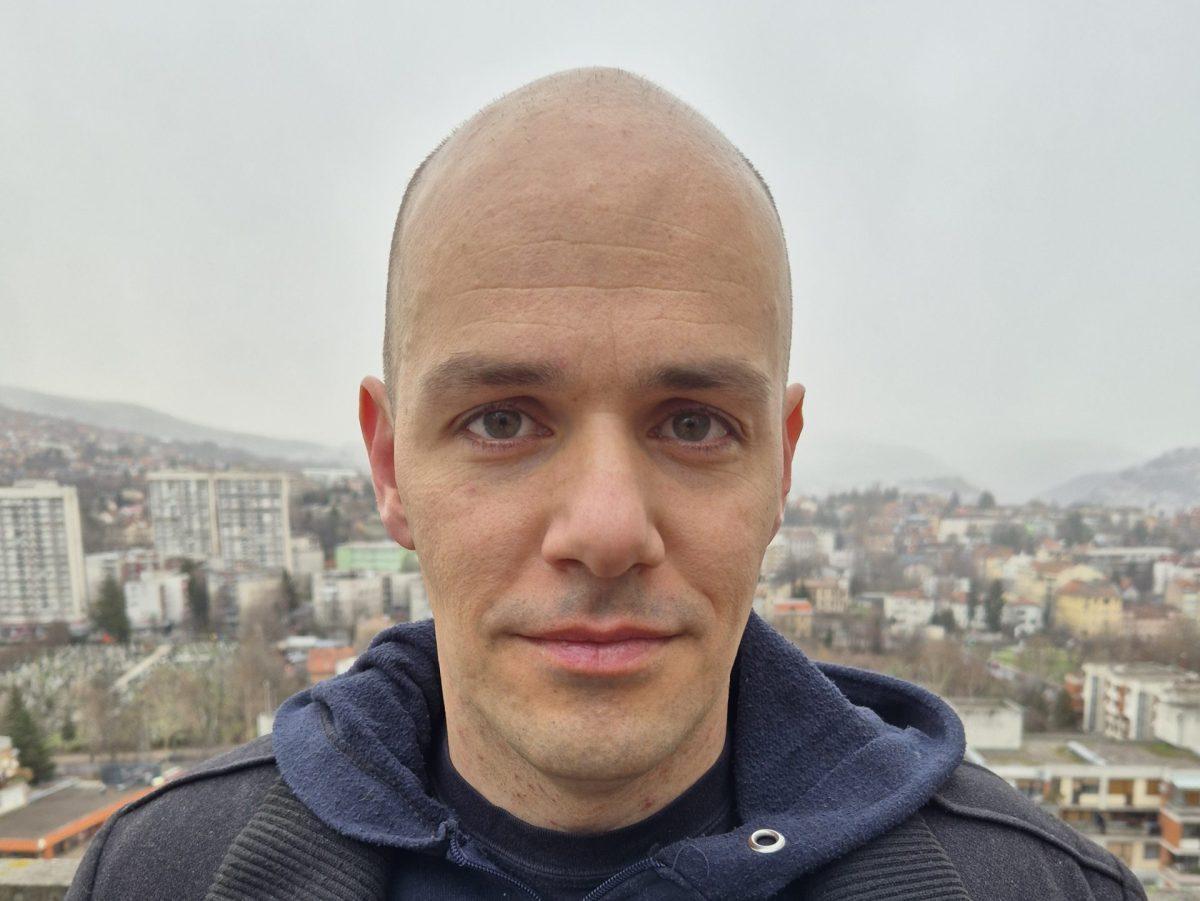
Meet the People Behind BIRN: Perparim Isufi

Perparim Isufi is Balkan Insight’s editor and Kosovo correspondent. He joined BIRN Kosovo in 2014, as an editor of KALLXO.com.

Before Perparim started to work as a journalist at several media outlets in Kosovo, he studied political science at the University of Prishtina. Explaining how he imagined his career when he studied, he says:

“They are not far away from each other. Studies have been done on the juncture and disjuncture between political sciences and journalism, and when I look at them, I see that both sides have their points. However, I kept my determination to stick to my passion with journalism, despite sporadic attractions elsewhere.”

Speaking of that, he worked as a Press Assistant at the OSCE Mission in Kosovo, maintaining contacts with the Kosovo media, but it was difficult for him to adjust to working with the press from that perspective.

“But it served as a good lesson for me. Before my experience with the OSCE, I often became upset with the press offices of different organisations, when my questions were not addressed properly or were ignored. I found a different reality, a complex machine, which means press officers often are unjustly criticized by journalists,” he says.

“Switching to the other side came as work for journalists started to become more and more difficult and unaffordable. I started with the OSCE exactly on the day when I turned 10 years in journalism,” he says.

And then, life had some other surprises for Perparim; he started working with BIRN.

“I knew it would be a challenge, and I was right. I came to BIRN in May 2014, and in the first six years worked as editor with BIRN Kosovo’s flagship news site Kallxo.com. Over the years, I used to contribute to Balkan Insight, so when the opportunity came to fully switch to Balkan Insight, I grabbed it with both hands. It came very naturally. I am under the same roof, I just changed the room,” he says.

In his own words, he would lie if he said his expectations had been to stay in BIRN for such a long time.

“Eleven years and counting! Since day one, working with BIRN has always been intriguing to me. Different countries, cultures, and even time zones. A different approach to the job compared to local newsrooms in our geographical area is something I would have missed if I had not experienced it in my career,” he says.

Every journalist has their favourite and least favourite topics. Living and reporting from a country with an enduring political and security crisis, Perparim’s career has been dominated by current affairs stories, be they news, analysis, features, or interviews.

“When I need a fresh restart, I happily switch to culture stories. They are refreshing to me and offer me the chance to be more creative. Yes, it is the light stories I would want to re-read, when I am no longer in this job,” he says.

As in any other profession, journalism has its ups and downs. In Perparim’s view, they are intertwined.

“Your day starts from scratch. No matter how well you did the day before, today you have a new day ahead, which demands your full availability. And as the day goes by, you feel the best part of the job is when you switch off, with concrete results from your work – until the next morning.”

Perparim also mentors young journalists on the Media Innovation Europe project that BIRN implements.

“I have a feeling that both I as mentor and the journalists I mentor cherish it. It is always exciting to get the perspective of a young journalist. It takes me back to my old self, when I was in need of a more experienced journalist, an editor, to guide me throughout the work.”

Working with different editors in the past helped him shape himself as a person, a journalist, and now as an editor. He understands well what young journalists find hard in their profession nowadays.

“So many things have changed. In our region, young local journalists face more difficulties than before because the market is no longer the same. But when I work with them, I see their eagerness to prove themselves outside their usual boundaries,” he says.

And for any young person striving to become a journalist in the region, he has a clear message.

“Be resilient! It is common in our region to feel neglected, but just try to see who wants to make you feel that way. There will always be a powerful person or government who will try to threaten or even tempt you, just to prevent you from doing the job properly. There will always be someone who does not want your article to get across. Remember that many before us had it far more difficult, and succeeded through their resilience.”

Speaking of finishing his professional career, he explains: “Did the time come to think about it? I don’t see it coming in the future, but when the day comes, I will have many things to reflect upon. As the saying goes, once a journalist, always a journalist.”

One passion will occupy his attention and time – reading.

“When that day comes, besides my family duties, I am already planning the reading list. I recently came across an expression: Tsundoku. It is about a person who buys books but piles them up and waits for another time to read them. My pile of books of all sorts is already waiting on the shelves.”

BIRN at POINT 13 Conference: Digital Security for Activists, Media, and CSOs in Western Balkans

Sarajevo conference puts focus on increasing challenges in protecting freedom of speech, privacy and security in the digital environment.

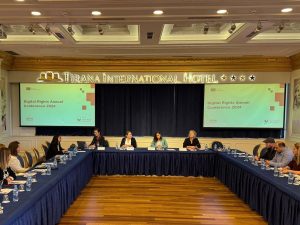
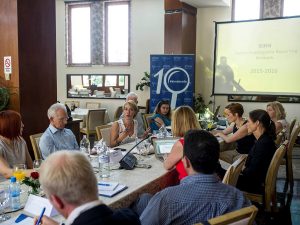
BIRN participated in the POINT 13 conference held on May 29-30, 2025, in Sarajevo, which brought together key participants from civil society, journalism, technology and activism, focusing on digital security and infrastructure for journalists, activists and civil society organisations in the Western Balkans.

On the first day, Azra Milić, Digital Rights Programme Coordinator at BIRN Hub, moderated the panel session “Digital Security and Infrastructure for Activists, Media and CSOs in the Western Balkans”. The discussion focused on the increasing challenges in protecting freedom of speech, privacy and security in the digital environment. The panelists were Nikola Ristić, activist and co-founder of OG Sviće, Andrijana Ristić, a researcher from the Share Foundation, and Michael J Oghia from the Journalism Cloud Alliance. Two of the speakers were directly targeted in smear campaigns by the Serbian tabloid Informer due to their participation in the conference.

Nikola Ristić, in addition to being targeted because of his participation at the conference, had previously been a victim of digital surveillance, including the hacking of his phone by the Serbian Intelligence Agency (BIA) and the release of footage from security cameras at Belgrade airport to the tabloids. He noted the importance of protecting privacy and data, highlighting basic measures like strong passwords and selecting the right devices.

“You need to understand the infrastructure you use. For instance, those little keys you get at POINT Conferences to secure your data and passwords – they’re simple, but important. And yes, it matters who manufactures your phone,” he said.

In the discussion about the challenges faced by civil society organisations, it was pointed out that attacks on individuals often lead to broader attacks on the organisations themselves. Andrijana Ristić, who was also target of smear campaign last week, noted that while there is a growing focus on digital security, more attention needs to be paid to data privacy, which is often overlooked.

“Right now, it feels like the focus is overwhelmingly on security — but we need to think more about protecting our privacy too,” she warned.

Another key issue raised was the importance of secure cloud services for journalists, especially those working on investigative reporting and data analysis. Michael J Oghia stressed the significance of these tools, speaking about a project launched last year at the International Journalism Conference in Perugia. The project aims to bring together members and partners from various sectors with the goal of making cloud services more secure, accessible, and sustainable, which would help reduce costs.

The POINT 13 conference served as an important platform for exchanging experiences and solutions. Speakers agreed that progress in digital security and privacy protection is essential, as well as building the infrastructure that enables secure work in the digital environment, free from the fear of attacks, censorship, or violence.

Kosovo Fellowship for Journalistic Excellence – Applications Open

BIRN Kosovo is pleased to announce the official launch of the Kosovo Fellowship for Journalistic Excellence 2025. The program is modelled on the renowned Balkan Fellowship for Journalistic Excellence, which has been supporting investigative journalism since 2007.

Funded by the European Union, the six-month fellowship offers a unique opportunity for 10 aspiring and mid-career journalists aged 18–35 to develop in-depth, high-quality investigative stories on issues of public interest.

Fellowship benefits:

  • €2,000 bursary to support the production of a long-form investigative article;
  • Professional editorial mentorship from award-winning BIRN Kosovo editors with long experience of investigative journalism;
  • Wide publication opportunities, including republication on leading BIRN platforms such as KALLXO.com or Prishtina Insight.

Topics of focus:

Fellows will investigate and write stories that explore critical issues including:

  • Corruption and public procurement
  • Public spending and transparency
  • Environment, healthcare and education
  • Human rights (minorities, women, workers, LGBTI+ community)
  • Media financing and interethnic media cooperation

Fellows will produce one original investigative article in Albanian, Serbian, or English, and select the media outlet for publication. BIRN Kosovo will ensure the article reaches a broad audience through its partner platforms – KALLXO.com or Prishtina Insight.

Who can apply?

  • Journalists with at least three years of professional experience;
  • Applicants from broadcasting, online, public and private media outlets;
  • Journalists working in Albanian, Serbian and minority languages are encouraged to apply;
  • Women and members of non-majority communities are strongly encouraged to apply. BIRN is committed to ensuring that at least 50 per cent of selected fellows are women, and at least three fellowships will be awarded to journalists from non-majority communities.

Application details:

  • Deadline: Midnight, June 16, 2025
  • Submit to: [email protected]
  • Languages: Applications may be submitted in Albanian, Serbian or English

For questions about the fellowship or the application process, please contact: [email protected] by June 8, 2025.

Application form in English

Application form in Albanian

Application form in Serbian

Sample Class on Srebrenica Genocide Held, Based on BIRN BiH’s Database of Judicially Established Facts

History professor Melisa Foric Plasto and Detektor journalist Haris Rovcanin held a class on the Srebrenica genocide based on materials from the Database of Judicially Established Facts about the war in Bosnia – with the aim of using this knowledge to avoid misinterpretations.

On May 29, the Srebrenica Memorial Centre and Balkan Investigative Reporting Network of Bosnia and Herzegovina, BIRN BiH, organised a sample class in Potocari for teachers, representatives of education ministries and pedagogical institutes and students. The class was dedicated to the case study of the genocide committed in Srebrenica.

Speaking about the history of studying the conflicts in the 1990s in Bosnia and Herzegovina, Professor Melisa Foric Plasto, from the Faculty of Philosophy at the University of Sarajevo, recalled that the first content was introduced in textbooks in 1993 and 1994, and that following the signing of the 1995 Dayton Peace Agreement, the media became active about having content about the war reviewed and parts considered potentially offensive removed.

She added that, in 2000, the Parliamentary Assembly of the Council of Europe advocated the temporary suspension of teaching about the 1992-1995 period until historians in Bosnia had established a common approach to studying this period in schools.

She explained that the Sarajevo Canton was the first to introduce the study of the War in Bosnia into the educational system in 2018. After that, it was introduced in Republika Srpska, and then also in other cantons in the Federation entity.

Analyzing the available textbooks, Foric Plasto said that there was a noticeably different interpretation of the nature of the 1992-1995 war, and a selective presentation of facts, and the qualification of the war itself varied depending on where the topic was studied.

Where students learn Bosnian and Croatian languages, textbooks state that aggression was committed in Bosnia and Herzegovina, she said, while in Republika Srpska, they state it was a civil war.

She added that in cantons with Bosniak majority, the term “genocide” is mentioned in textbooks, while this term is not mentioned in textbooks in Republika Srpska or in cantons with a Croatian majority.

“I would like to recall the role of history, especially in conflict and post-conflict societies, as it can actually help better understanding, tolerance and trust among peoples, and can be a means of supporting peace,” Foric Plasto said, after which she presented what a school class could look like and suggested performing certain activities with students aimed at teaching them about the genocide committed in Srebrenica.

BIRN BiH journalist Haris Rovcanin presented the Database of Judicially Established Facts for the region of Srebrenica, where, as he said, the facts about genocide and other crimes were established in 11 verdicts delivered by the International Criminal Tribunal for the former Yugoslavia, ICTY.

He added that the Database was not intended only for ministries of education, professors and students, but also for everyone who was interested in the topic of the War in Bosnia and the genocide committed in Srebrenica, and that the goal was to create a tool for a joint fight against denial and minimization of crimes and established facts.

“The goal was not to determine who was convicted for which individual act, but to record what trial chambers established in several cases, regardless of whether individual criminal responsibility was determined or not,” Rovcanin said, adding that the verdicts stated a huge number of crimes in the area of Srebrenica and the wider region.

BIRN BiH director Denis Dzidic recalled that this agency was founded principally to monitor all war crime trials, and that it represented a pioneering process of striving to make the knowledge, expertise, and what has been established by court judgements, more accessible to the educational system.

“We visited all education ministries in the past few months hoping that this will be accepted as a platform that would depend mostly on your work, because you are the ones who have the knowledge and can make this alive,” Dzidic told the participants, including representatives of the education ministry, pedagogical institutes and teachers.

Emir Suljagic, Director of the Srebrenica Memorial Centre, said there was nothing that had a permanent effect on reality like knowledge, adding that the goal of the sample class was to come up with a document or framework from which “students in Bihac and Gorazde will learn the same about Srebrenica”.

He said one basic problem was the fact that the dominant part of what we know about Srebrenica has emerged from court proceedings, which do not focus on the broader historical context and establishing the truth, but on witnesses and survivors recounting only what was relevant for the acts charged against the defendants in court.

This year, BIRN BiH is a strategic partner of the Srebrenica Memorial Centre in marking the 30th anniversary of the genocide.

BIRN Launches Database on Religious Communities’ Assets in North Macedonia

A new BIRN database puts a spotlight on the property portfolios of North Macedonia’s two main faith institutions.

From forests and meadows to lakeside hotels and mountain slopes, the Macedonian Orthodox Church – Archdiocese of Ohrid (MPC-AO) owns roughly 100 square kilometres of property in North Macedonia, according to a new BIRN database that sheds fresh light on the Church’s assets.

In “Religious Properties Uncovered”, BIRN identified a total of 14,757 individual pieces of property in cadastral records over which the Macedonian Orthodox Church, its dioceses and individual churches owns, or has other rights to.

The Islamic Religious Community (IRC), its muftis’ offices and mosques, are listed as having ownership or other rights over 5,363 properties, covering 13 square kilometres.

The Religious Properties Uncovered database allows readers to view several parameters, such as the number and land area of ​​the properties of the two religious communities.

They can also search the properties by purpose, the municipality in which they are located, or the diocese or mufti whose jurisdiction they fall under.

Other key findings from the database:

  • MOC-AO controls about one-third of the Galicica mountain and large parts of the Macedonian side of the Jablanica mountain range. The IRC’s largest land parcel is located on the southern slopes of Vodno mountain, near the capital.
  • Over 80 per cent of the MOC-AO’s property consists of forests, meadows and pastures, covering around 8,100 hectares, while the IRC holds 3,200 hectares of forest.
  • MOC-AO owns 1,300 hectares of agricultural land, while the IRC controls 1,700 hectares.
  • MOC-AO has about 140,000 m² of residential space, and the IRC holds over 37,000 m², including new residential buildings in Skopje, Bitola, Tetovo, and other cities.
  • The Church owns commercial properties in the old bazaars of Skopje, Bitola, Ohrid and Prilep, while the IRC manages Debar’s market, a shopping complex in Gostivar, and properties in Struga, Tetovo and Bitola.
  • MOC-AO is the registered owner of the Izgrev and Biser hotels on Lake Ohrid, while the IRC owns an apartment in the Park Lakeside hotel in Ohrid.

The “Religious Property Uncovered” database was prepared over one year, is publicly accessible and aims to promote transparency and raise awareness about the scale and structure of religious institutions’ property holdings in the country.

Fellowship for Journalistic Excellence Winners Announced at Ceremony in Vienna

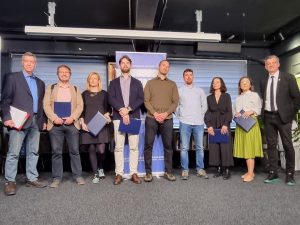
The winners of the Fellowship for Journalistic Excellence were announced at a ceremony in Vienna on 16 May, honouring three powerful stories that reveal pressing environmental, political, and social challenges across Europe.

First prize of €3,000 was awarded to Zuza Nazaruk, a journalist from Poland currently based in the Netherlands, for her compelling story on the escalating crisis in the Białowieża Forest. The story examines how this UNESCO World Heritage site is being transformed into a militarised zone, where environmental degradation, heightened military presence, and migration converge. Through vivid reporting, Nazaruk reveals how thousands of migrants and soldiers are clashing in a forest once celebrated for its rich biodiversity, now caught in the crossfire of geopolitical tensions.

Jury member, and a correspondent for the Austrian daily, Der Standard, Adelheid Wölfl said: “Zuza Nazaruk shows the impact of geopolitical battles on the vulnerable and abused. She sheds light on those invisible in the thicket and portrays colourfully parts of our nature: plants, animals, and humans. She not only shows how much money and effort is spent in today’s Europe on preventing migration, but also the impact this has on our ecosystem. Zuza Nazaruk proves that we need journalism that gives a voice to those we cannot hear, and simultaneously safeguards something we all need: dignity.”

The second award of €2,000 went to Greek journalists Ioanna Louloudi and Paschalina Kapetaniou for their investigation into the Greek state’s repeated failure to accept responsibility and deliver justice to victims of police brutality, accidents, and disasters. Despite existing laws that mandate state compensation, the authorities frequently appeal rulings and prolong legal proceedings, forcing citizens into years-long battles for recognition and redress. Their story highlights the frustration and mistrust that this persistent denial of accountability fosters among the public.

“It is a Kafkaesque story, which happens now, in a democracy, where paradoxically the state fights against its citizens. It is a story about a human battle for dignity and civil rights,” said the jury member and Director of the Albanian Media Institute, Remzi Lani.

The third award of €1,000 went to Zuzana Vlasata from the Czech Republic for her story about a toxic leak on a Czech river. Her report shows how a factory linked to former Prime Minister Andrej Babiš should have been a prime suspect over the incident, but evaded official scrutiny. Jury member and editor at Bellingcat, Gyula Csák, said: “Zuzana Vlasata’s powerful and engaging investigative piece demonstrates state capture and systemic failure through the story of a factory accident in the Czech Republic.”

The ceremony marked the conclusion of the 2023 edition of the Fellowship.

In addition to jury members Adelheid Wölfl, Remzi Lani and Gyula Csák, this year’s panel included Milorad Ivanović, representing the FJE alumni network; Florian Hassel, Central and Eastern Europe correspondent for the German daily Süddeutsche Zeitung; Elena Panagiotidis, editor at the Swiss daily Neue Zürcher Zeitung; and Kristof Bender, deputy chairman of the European Stability Initiative.

With the end of this year’s programme, seven fellows join the FJE alumni network – consisting of more than 150 journalists from 14 Central and Eastern European countries who promote the highest standards of professional journalism.

Launched in 2007, the Fellowship for Journalistic Excellence is now in its eighteenth year. The programme fosters professional growth, cross-border cooperation, and in-depth reporting on key issues across central, eastern and south-eastern Europe. Each year, ten fellows receive financial and editorial support to develop long-form stories on complex regional and European topics.

The Fellowship is implemented by the Balkan Investigative Reporting Network and supported by ERSTE Foundation.

Strengthening the Role and Capacities of Investigative Journalism in Kosovo

BIRN Kosovo

The project aims to strengthen independent media and civil society in Kosovo by enhancing their capacity for professional, fact-checked investigative reporting on democracy, human rights and European integration. It supports freedom of expression, media literacy and digital rights through training, legal support and targeted sub-grants and fellowships.

Summary:

Kosovo’s legal framework guarantees and protects freedom of expression, freedom and pluralism of media and access to public information. However, in practice, Kosovo and its media sector still face numerous systemic, economic and social constraints, creating obstacles to the dissemination of objective, professional and fact-checked information to the public. 

Kosovo’s media sector is in a difficult economic situation. It depends on political power and business groups and is also criticised by international organisations for lack of professionalism. According to Reporters Without Borders, media in Kosovo are financially fragile and therefore vulnerable to political influence. The Media Ownership Monitor found that “the market, through relatively small, is crowded, intensifying competition for limited advertising revenue and rendering media outlets vulnerable to external influences, including political and business interests”.

In recent years, Kosovo’s media landscape has seen a profound transformation as a result of the digital age. Information sharing has changed dramatically as a result of the internet and social networking sites like Facebook and Instagram, especially for young people. While TV is still the major source of information, with a long story in Kosovo’s media landscape, some radio stations now transmit their material online, so radio has, in some ways, also embraced the digitalization of media. On the other hand, online journalism is rapidly evolving as technology and internet use increases. However, journalists often report harassment and intimidation, especially on social media. To address the issues stated above, BIRN Kosovo in partnership with the Press Council of Kosovo (PCK) and TV Mreza, a network of local Serbian-language TV and online media in Kosovo, aim to strengthen the role and capacities of investigative journalism in Kosovo by bringing local, regional and international experience to investigative journalism, media development, fact-checking, capacity building and professional experience within the proposed action.

Donor:

European Union

Main Objective:

To strengthen the capacities of the media and NGOs on quality, professional, investigative and fact-checked reporting on democracy, good governance, human rights and European integration topics, and expose disinformation and biased reporting.

Specific Objectives:

– Strengthening freedom of expression and the capacities of independent media to produce qualitative investigative journalism and qualitative programmes; 

– Raising awareness in the media on the implementation of media laws related to Freedom of Information, defamation, whistleblowing, cyber-security, crises/hostile environment reporting, copyright and others;

– Assisting capacity building and qualitative and impartial investigative journalism of the media in Kosovo through workshops, trainings, sub-granting and fellowship programmes; 

– Promoting media literacy, fundamental human rights and European integration through capacity building and investigative reporting.

Main activities:

Activity 1: Produce and broadcast 30 in-depth investigative reports, 4 TV debates, 40 articles, 10 solutions journalism stories, and 2 documentaries that will tackle a wide range of public interest issues such as rule of law, the justice sector, mismanagement of public funds, local governance, labour law enforcement, organised crime, migration, trafficking, education, health, women and minority rights, disability and the European agenda, etc.

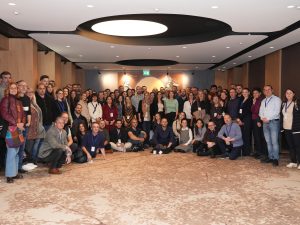
Activity 2: Organise 9 workshops, 3 training sessions and a 5-day camp for at least 200 journalists and students of journalism to equip them with professional journalism tools and knowledge and share experiences on important current topics such as media ownership, media financing, women’s presence in the media, media regulations, ethics, gender-sensitive reporting, disability and LGBTQI+ issues, and legally safe and crisis/hostile environment reporting.

Activity 3: Organise the “Kosovo Fellowship for Journalistic Excellence” by awarding EUR 2,000.00 each to 20 investigative journalists to write in-depth investigative stories related to important topics.

Activity 4: Sub-granting programme for national and local media in Kosovo to provide financial support for about 10 media organisations and outlets chosen through an open call for proposals, with a comprehensive range of topics, including those prioritised in the European Reform Agenda (ERA) Strategy.

Target groups:

  • Media organisations
  • Outlets and journalists working in Albanian, Serbian, Roma, Ashkali, Egyptian or any other minority language, both in public and private media organisations
  • Students in the final year at public or private universities in Kosovo from the media, journalism, and/or production departments and young journalists working in media organisations and/or outlets; 
  • Media regulatory bodies – IMC, PCK and AJK.

Main implementor:

BIRN Kosovo

Partners:

TV Mreža, Press Council of Kosovo

BIRN Journalists Win Two Prestigious Awards For Investigative Journalism

The first prize for the Dejan Anastasijevic Award, named after the late highly respected Serbian journalist, in investigative journalism was handed to Aleksa Tesic for the series on the wiretapping of Serbian activists. The third prize was won by Sasa Dragojlo and Avi Scharf for their series on Serbia’s arms exports to Israel.

Aleksa Tesic, a BIRN Serbia journalist, received the prestigious first Dejan Anastasijevic Award for investigative journalism, which was awarded on May 8 by the Independent Journalists Association of Serbia (NUNS). 

The award was given to him for the series of articles “Silent Spying: How Serbian Intelligence Hacks Activists’ Phones – Without Them Knowing”, in which it was revealed Serbia’s Security Information Agency (BIA) used the Israeli technology Cellebrite to unlock the phones of activists it interrogated. Some phones were infected with NoviSpy, a spyware developed in Serbia. The research used the findings of a digital forensic analysis conducted by Amnesty International.

“For me, this award is an incentive to continue doing investigative journalism,” said Tesic. “This story revealed the core of espionage in Serbia, which started with the appearance of mobile phones and their mass usage in our country, from the purchase of spyware as early as 2012. 

“Today, our whole lives are on the phone. The phone knows more about us than our parents, our closest people. The police, the government, and the secret services want to discover our deepest secrets. It is one of the biggest topics currently in the digital space, it should be the focus of investigative journalists,” said Tesic. 

“We will continue to work on this topic. This is not the end, there is still a lot to say. Thank you to Amnesty International, the partners in the project, and the newsroom for their absolute support. I would also like to thank the editor, Milorad Ivanovic, who made all this possible, with whom I worked on this story. We don’t stop here, our appetites are big. Competitiveness is healthy in the journalistic world because it brings better stories.”

The jury described Tesic’s story as “terrifying and complete in equal measure”. It continued: “A society that can produce such stories and such journalists cannot be without hope for the future. Ironically, it is a story about those who try to extinguish that hope.” 

The jury consisted of BIRN founder and investigative editor Gordana Igric, investigative reporter and founder of CINS, Branko Cecen, Radio Free Europe investigative editor Mirjana Jevtovic, and reporter, editor and trainer Sasa Lekovic.

The second prize and audience award went to KRIK newsroom journalists Stevan Dojcinovic and Bojana Jovanovic for their research “Sky messages: Struggle in Novi Sad’s SNS over money and affection of Andrej Vucic“.

Balkan Insight/BIRN Serbia journalists Sasa Dragojlo and Avi Scharf were awarded the third prize for their series of articles “Regardless of War Crimes Claims, Serbia’s Arms Sales to Israel Soar.”

“I am so glad that this story was awarded, because I think it is, or should be a number one topic globally,” said Dragojlo. “The Serbian ruling regime has increased its ammunition export to Israel by 30 times, in a year marked by one of the most horrific and cynical crimes in Gaza – crimes that have been ignored or even supported by the most powerful Western countries that often label themselves as bastions of humanism. 

“I am also happy because of the collaboration with Haaretz, a media outlet that faces pressures in Israel, as well as BIRN in Serbia. We showed that there are no taboo topics for us and that professional journalism is always at the forefront of the fight for truth and justice, no matter the obstacles.”

Special awards for investigative stories about the Novi Sad train station disaster, and for local journalists

Special awards this year were awarded to Nova Ekonomija journalists Filip Rudic and Aleksandra Nenadovic, and Forbes Srbija journalist Ivan Radak. The jury considered they deserved special recognition because of the subject of their reports.

“The fascinating speed with which they mastered a very complex – but also the most important – topic in Serbia did not affect their high standards in their continuous discovery of key facts about what we were all feverishly interested in – the reconstruction of the railway station in Novi Sad and its tragic collapse,” the jury said. “In short, they showed why there can be neither democracy nor justice without free and professional media.”

As a sign of support for local journalists who work in particularly demanding conditions, NUNS awarded Juzne Vesti journalist Tamara Radovanovic for the report: “Millions for two companies in the last 4 years of the SNS government in Nis“. In its explanation, the jury pointed out that the report was used as evidence by investigators in the indictment against the recent mayor of Nis, Dragana Sotirovski.

For 20 years, the Independent Journalists Association of Serbia has been giving awards for investigations on key topics for citizens, which reveal previously unknown facts using journalistic expertise. This year, there were 51 applications, and 14 were shortlisted. Among the shortlisted were two more BIRN stories: “Changes in public transportation: Private individuals close to Zvonko Veselinovic are preparing to take over the job in Belgrade” by Jelena Zoric and Gordana Andric, and “Parallel Government: How Vucic Turned Serbia’s Constitution on its Head” by Sasa Dragojlo.

Meet the People Behind BIRN: Aida Tinjak

Aida Tinjak is the Grants and Project Coordinator at the BIRN Hub.

Her professional path has taken her from art history and pedagogy through working with several non-governmental organisations, cultural and creative industries projects, and strengthening local self-government to her current position in the BIRN Hub. So, how did she manage all these positions?

Let’s meet her!

Aida’s academic background in Art History and Pedagogy from the Faculty of Philosophy, University of Sarajevo, shaped the foundation of her interest in how culture, memory, and narrative intertwine. She worked as a curator at Gallery 11/07/95, a memorial gallery dedicated to the memory of the Srebrenica genocide.

“It was there that I encountered the power of war photography through permanent and temporary exhibitions by renowned photojournalists such as Ron Haviv, Narciso Contreras, and Paul Lowe, whose work has shaped how the world sees and remembers the war. These exhibitions were not merely artistic displays—they were testimonies. They revealed to me how photojournalism, particularly war photography, operates at the intersection of art, truth, and justice. On one hand, such images preserve historical facts; on the other, they restore voice and presence to those who were silenced”, Aida explains.

This experience profoundly influenced her understanding of journalism as an active force in memory-making and truth-telling. After her time at the gallery, she worked with several non-governmental organisations on projects related to cultural and creative industries and the empowerment of local communities.

“At the same time, I tried my hand at journalism, exploring one of its many forms. However, I soon (and perhaps just in time) discovered that what resonates more deeply with me is supporting and empowering journalists—those who seek to deepen their knowledge, expand their skills, and explore new tools. I began writing articles focused on practical techniques and digital tools that journalists can use in their everyday work. The aim was not only to share useful resources, but to contribute, however modestly, to raising the overall quality of media content and building the competencies that a resilient, responsible journalism requires”, says Tinjak.

Joining BIRN felt like a natural progression for her. It allowed Aida to continue engaging with narratives that matter, with investigative journalism’s added urgency and responsibility:

“I believe that journalism and art are united by a shared impulse—to communicate, to preserve memory, and to question the world around us. Both serve as powerful tools for challenging oppressive systems and amplifying silenced voices, pushing boundaries and standing as unwavering beacons of truth in a world that often seeks to suppress them.” 

When she joined BIRN Hub as a Project/Programme Assistant in 2021, she expected hard work, persistence, and the need to grow into the responsibilities ahead.

”And that’s exactly what awaited me. The road wasn’t without its challenges, but each experience has left valuable lessons that have shaped my professional path. What I hadn’t dared to expect was the depth of connection within the team. It’s the people who make me proud to be part of BIRN—their trust, support, and understanding make every challenge easier and every success more meaningful”, explains Aida.

Now, as a Grants and Project Coordinator at BIRN Hub, her work revolves around coordinating and implementing project activities, and overseeing and managing the grant-making process. In practice, that means a great deal of communication, mostly with journalists who are grant recipients, and quite a bit of administration.

“What makes the role truly rewarding is the opportunity to connect and collaborate with journalists from different countries (even if mostly online), to read their story proposals, and to hear fresh, often powerful ideas. It makes me happy to be, even in a small way, part of the journey that leads to the production of those stories. The job requires solid organisational skills, which I’ve come to value more and more over time. I believe that when things are well structured from the start, it’s easier to navigate the unexpected. While plans sometimes shift and circumstances change, having a reliable structure in place helps me adapt and keep things moving”, says Aida.

One of the BIRN programmes Aida works on is the Fellowship of Journalistic Excellence, which covers a region spanning 14 countries, from Poland and the Czech Republic to Greece and Romania. It has been running since 2007, and more than 150 leading regional journalists have participated. The ERSTE Foundation co-funded it.

“The programme begins with a kick-off seminar in Vienna, where selected fellows from across the region meet, exchange ideas, and begin shaping their stories under the guidance of an editor. This is followed by a months-long process of research, reporting, writing, and revising, resulting in some truly exceptional stories. Many of these stories have been recognised with prestigious awards, which serve as a testament to the programme’s ability to nurture high-quality journalism in the region.

What truly stands out is that the programme doesn’t end once the story is published. Fellows who complete the programme join an expanding alumni network that offers a wealth of opportunities for collaboration, networking, and knowledge-sharing. This network plays a key role in enhancing professional growth and strengthening cross-border journalistic ties”, explains Tinjak.

BIRN is currently working on enhancing the programme’s website, which will feature some new additions, such as an alumni directory—a dynamic database where fellows can connect and showcase their professional biographies. In addition, BIRN will launch a Fellowship podcast series, designed to promote the programme’s brand and delve into the significance of long-form journalism.

Reporting Democracy is another BIRN project Aida works on, and is also supported by the ERSTE Foundation. It is focused on leveraging independent journalism to critically examine the issues shaping the future of democracy in Central, Eastern, and Southeast Europe. It has a network of regional correspondents and publishes a bi-weekly review of key democratic developments — the Twice podcast (Two Weeks in Central Europe).

“Reporting Democracy supports journalists in a variety of ways, including accepting pitches on a rolling basis, commissioning stories, and offering grants. These grants include those provided through the Fellowship for Journalistic Excellence, as well as the Travel and Reporting Programme, which funds journalists from the Visegrad region (Poland, Hungary, the Czech Republic, and Slovakia) to carry out field research and report on Balkan-related stories. In addition, we periodically offer grants for journalists from Central, Eastern, and Southeastern Europe, along with Fellowship Alumni grants available to members of the Fellowship alumni network”, said Tinjak.

In the end, we’re returning to the beginning of our story. Art history and museums’ educational functions remain Aida’s passions, but have evolved over time, although their essence remains unchanged:

“I see it as a continuous thread—quietly reminding me that there is always more to explore and uncover, and that growth often lies just beyond the familiar boundaries. I believe that a diversity of experiences and knowledge is what shapes and strengthens us, preparing us for whatever lies ahead.”

She also continued with her education, becoming a Certified New Media Designer a few years ago. Recently, she’s been revisiting that field, refreshing what she’s learned. After the work is done, Aida has her favourite activities during her spare time:

“I enjoy spending my free time with family and friends—whether that means hiking, catching a live gig, seeing a play, taking a shot at a pub quiz (with more enthusiasm than correct answers ), or simply going for a walk (and pretending it counts as exercise ). At other times, it’s about embracing stillness—giving myself and my thoughts the space to pause, regroup, and recharge for whatever comes next.”

BIRN Macedonia Holds Fourth Training Session for Young Journalists

Eleven young journalists took part in BIRN Macedonia’s latest investigative journalism training session in April.

The three days of training, the fourth session in BIRN’s year-long investigative journalism programme, were held between April 25 and 27 in Mavrovo, North Macedonia.  

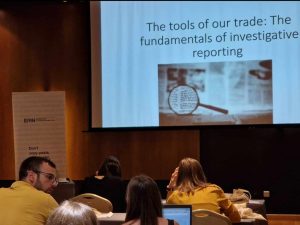
Journalists participated in building on the skills they have developed over the past several months, with teaching focused on strengthening their investigative and research skills and helping them pitch new, original investigative story ideas.

The training began with sessions on how to assess the scope of a story and identify strong starting points for investigation. This helped them map out the first steps in investigating a topic, how to ask the right questions, and identify the resources they would need.

On the second day, participants pitched their story ideas and received feedback from BIRN mentors and peers. The training then moved into exploring how to research different subject areas: such people, companies, and foreign entities. These sessions provided specific tools for gathering and verifying information from public records, open-source platforms, and social media, as well as ethical considerations when dealing with sensitive sources.

The final day was dedicated to learning how to use geolocation tools and online techniques to verify the exact location of an object. Through practical exercises, they worked on verifying locations with limited information, strengthening their observational skills and ability to analyse visual clues in the context of investigative reporting. The training concluded with a discussion on communication with sources, where the group exchanged methods and ethical best practices for approaching, interviewing, and protecting sources.

In the next month the young journalists will have the opportunity to pitch ideas for an investigative story. The best proposal will be developed with mentorship support from BIRN Macedonia journalist team. The summer training session, expected in June, will be the final event of the investigative journalism program.