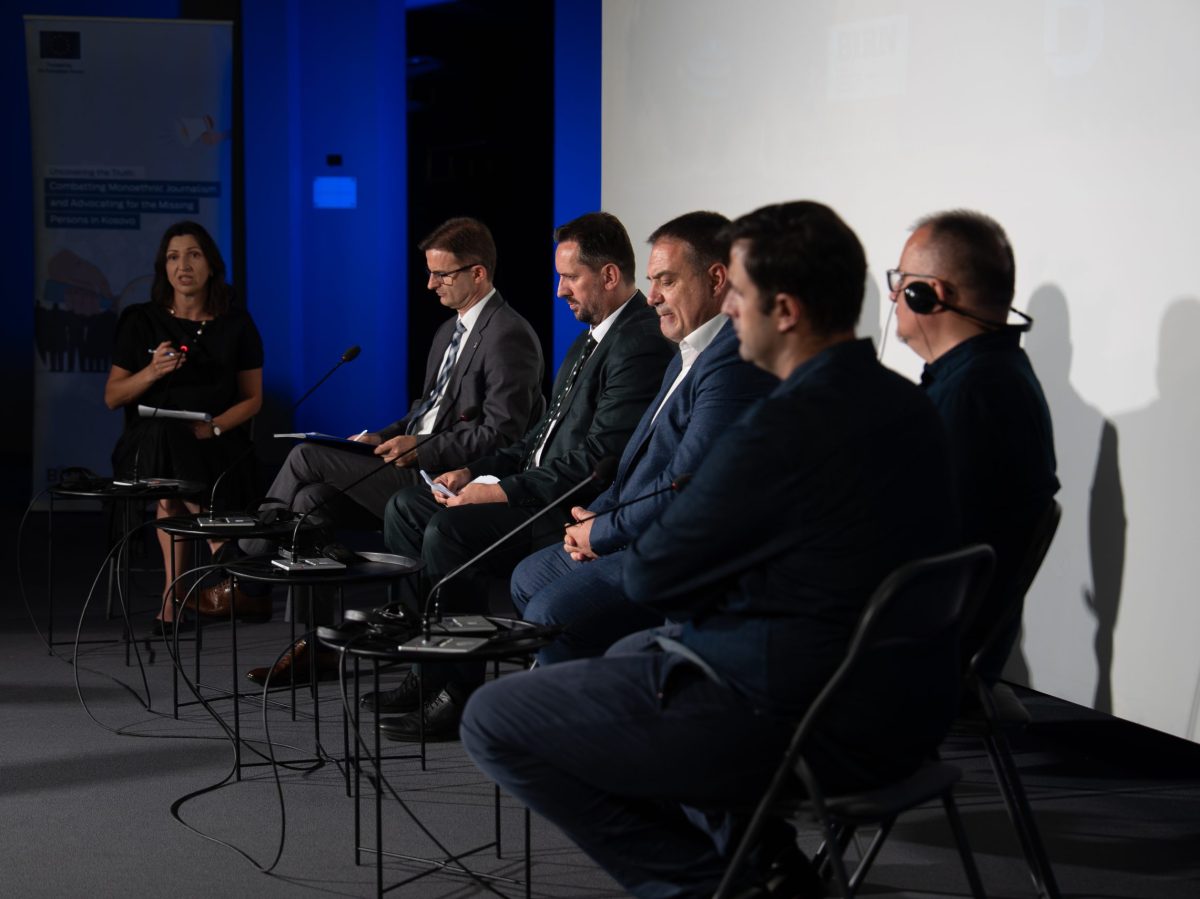
On June 25, BIRN Kosovo concluded its documentary series on missing persons from the war and the lasting trauma this has created in Kosovo society in front of an audience at Reporting House in Prishtina.
The documentary presents the stories of persons who disappeared during the war in Kosovo and the pain endured by families who, for more than two decades, continue to live with uncertainty, waiting and the absence of their loved ones.
Through personal testimonies and moving accounts, the film revisits the memories of those who continue to seek truth and justice for family members who remain missing.
More than two decades after the end of the war, the fate of around 170 people from Prishtina, Fushe Kosova, Obiliq, Lipjan and Gračanica remains unresolved. Behind every case are families who continue to live with the pain of loss and the hope of one day learning the truth about their loved ones.
This closing event was attended by Acting President of Kosovo Albulena Haxhiu, who said the conclusion of this project does not mark the end of the stories or of the families’ search for the truth about the fate of their loved ones who disappeared during the war.
According to Haxhiu, the documentaries and public discussions organised as part of the project “Unveiling the Truth: Combating Monoethnic Journalism and Advocating for Missing Persons in Kosovo” have helped bring renewed attention to the pain and uncertainty endured by families.
“For the families of forcibly disappeared persons, there is only one demand: to know where their loved ones are,” Haxhiu said. She added that while missing persons are often reduced to statistics, documentaries such as Unfolding the Truth restore the human stories behind the numbers.
Acting Deputy Head of the European Union Office in Kosovo Eva Palatova told the audience that while the event marked the conclusion of a project, it did not signify the end of the shared commitment to truth, justice and reconciliation.
She said the documentary and the discussions surrounding it serve as an important reminder that the search for truth and justice must continue.
“Remembering the missing and standing alongside their families is not only an act of solidarity, but also a responsibility. In the European Union, we care about the past, transitional justice and reconciliation,” Palatova said.
Palatova added that the EU has long supported transitional justice and reconciliation processes across the Western Balkans, including in Kosovo, stressing that such processes must be inclusive, locally led and grounded in international law.
Following the screening, a panel discussion brought together representatives of institutions and organisations working on issues related to missing persons and transitional justice.
Participants discussed the challenges to efforts to uncover the fate of missing persons, as well as the importance of institutional cooperation, accountability and preserving public memory.
The panel, moderated by journalist and BIRN executive director Jeta Xharra, featured Ilir Morina from the Special Prosecution Office, Kushtrim Gara from the Government Commission on Missing Persons, Ditor Haliti from the Institute of Forensic Medicine, Aleksandar Rapajić from the Advocacy Center for Democracy and Culture (ACDC), and Kreshnik Gashi from KALLXO.com.
The discussion focused on the challenges in uncovering the fate of missing persons, the importance of inter-institutional cooperation, the role of forensic investigations and prosecutions, and the need to preserve public attention on one of the most painful unresolved consequences of the Kosovo war.
The screening and discussion were attended by family members of missing persons, representatives of institutions, civil society organisations, international partners, diplomats, journalists and citizens, highlighting the continued public and institutional interest in resolving the fate of those who remain missing more than two decades after the war. Of the 49 participants, 26 were women.
This event was organised in the framework of “Unveiling the Truth: Combating Monoethnic Journalism and Advocating for Missing Persons in Kosovo”, a project funded by the European Union.