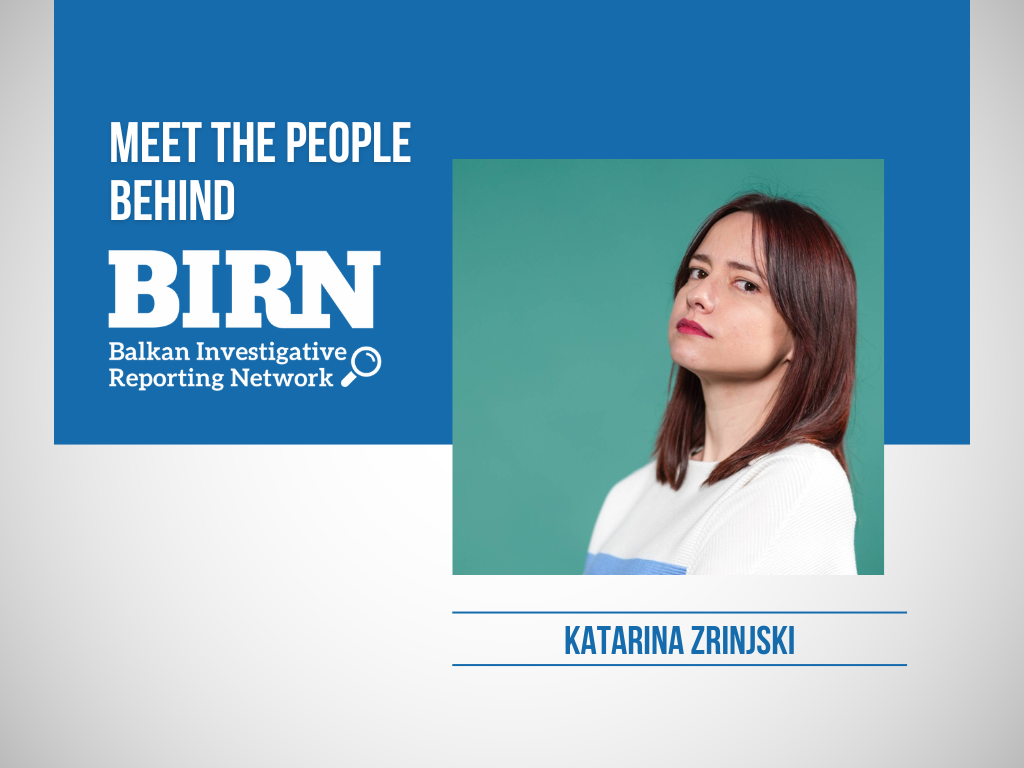
One reason why Katarina enrolled at the Faculty of Political Sciences at the University of Belgrade was because she didn’t know then what she wanted to do for a living.
“I studied international politics, which gave me a broad education in several fields related to social sciences. That suited me perfectly while I was figuring out what I wanted to become,” she says.
“Just before joining the MA program in Peace Studies, I realised that transitional justice was the field I wanted to explore further. Peace Studies definitely showed me the direction I wanted my career to take,” Katarina adds.
After completing her studies, she worked at the Humanitarian Law Center (HLC) in Belgrade for almost three years before joining BIRN BiH.
“My position was in outreach for HLC, as well as coordinating the REKOM process. That was actually my first contact with BIRN BiH, as we were receiving press clippings related to transitional justice topics from the former Yugoslavia — and the majority of articles from BiH were BIRN BiH court reports,” she recalls.
“Just a few months after I left HLC, I got a call from the former BIRN BiH director asking if I would be interested in joining the team. Within two weeks, I moved to Sarajevo.”
But when she started to work at BIRN as a Project Officer in 2014, she didn’t know what to expect. Her relocation to a new country, city and job happened in less than two week – a challenge in every sense.
“I was excited about everything: exploring a new environment and taking on new tasks one by one. Very quickly, my role became more like that of a project manager than a project officer, as I was responsible for the whole project portfolios,” she recalls.
“When I joined BIRN BiH, transitional justice was the main and only field we worked on. Within the next year-and-a-half, we were already covering topics such as corruption, terrorism and the rule of law. It felt like BIRN BiH’s growth was mirroring my own, and I loved that process. It set standards from the very beginning – that we, as an organisation and I as an individual, must always strive for more. That’s still the case today,” Katarina explains.
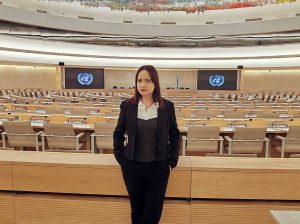
Her professional path led her to the Head of Programmes position. Since this is a new role, which no one held before, Katarina created the Terms of Reference for the position herself.
“The idea was to have one person responsible for planning and overseeing all projects, ensuring they align with the organisation’s strategic goals. Personally, I want to make things a bit easier for the editorial, finance, and executive leadership teams by assisting them however I can. We’ll see how this role develops, but I know I’m 100-per-cent ready for new challenges, and I’m truly grateful for this opportunity,” she says.
BIRN BiH has three main programmes that have evolved over the years: transitional justice, rule of law and foreign influence. Transitional justice, Katarina’s favourite, has remained BIRN BiH’s core focus.
“We are still the only organisation reporting on every war-crime trial related to BiH, which makes our archive invaluable,” she notes.
“In recent years, we’ve developed several databases and documentary films that have taken on lives of their own, such as The Lives Behind the Fields of Death and Samir Mehic Bowie – Letters from Srebrenica, which has been screened across Europe.
“At the end of last year, we updated our database of court-established facts about the war as well as a guideline document for history teachers, which is being integrated into school curricula in several cantons, which is one of the most important things BIRN BiH ever achieved,” she adds.
The second programme, which is becoming increasingly relevant, is on foreign malign influence in BiH. “We’ve produced several investigations that have had a major public impact and prompted reactions from institutions,” she says.
“For example, our journalists uncovered ways of recruitment in the Russian army and revealed that two Russian diplomats, expelled from European countries after the invasion of Ukraine, were accredited in Russia’s diplomatic mission in BiH — a story that drew international attention,” Zrinjski notes.
When it comes to the rule of law, BIRN BiH’s reports have prompted dozens of investigations by prosecutors’ offices and even verdicts in serious crime cases.
“We’re also the only organisation reporting on disciplinary proceedings against members of the judiciary. Recently, after a tragic tram accident in Sarajevo that claimed one life, we discovered that the tender documentation for tram maintenance didn’t require relevant experience – an example of how our journalists uncover systemic issues,” she says.
“I can confidently say BIRN BiH has become a respected organisation, both domestically and internationally, and is now a key player in monitoring and reporting on Bosnia’s most important social and political issues,” Katarina adds.
If she had to explain what BIRN BiH represents to someone unfamiliar with it, she would summarize it in its mission statement: “In our relentless pursuit of truth and justice, we stand as guardians of democracy, ensuring that the voices of the voiceless are heard and that the lessons of history are never forgotten.”
“This reflects the core drive behind our work. Although it’s often emotionally challenging and demanding, the satisfaction we feel when we see the impact of our work is priceless,” she says.
“Our greatest strength, besides the amazing professionals at BIRN BiH, is the trust we’ve earned from many different groups – from victims and their families to partner NGOs, fellow journalists, the international community, and even public institutions that see us as a trustworthy partner in our shared mission to improve life in BiH,” Katarina thinks.
However, she believes that there is still room for improvement.
“My mantra is that we can always do better. No matter how good we are, if we relax, we create space for mistakes. That’s why we constantly work to improve, to grow, and to find new ways to present our work. It’s a joint effort by many people at BIRN BiH, and I do my best to make these processes as smooth as possible,” Katarina says.
Some things make her most proud, such as how BIRN BiH continues to touch people with their stories, by motivating them to speak up, share, and trying to make a difference.
“I’m also incredibly proud of how important BIRN BiH has become. I truly believe that if we stopped working tomorrow, the impact on Bosnian society would be profound. It might not be visible immediately, but in the long run, our critical and constructive presence would be deeply missed,” Katarina reflects.
For all young people who would like to work at BIRN, she has one piece of advice: “Be prepared to work hard.”
In her personal life, she thinks she’s the same person privately as she is at work – with the same ambition and dedication to the people and things she loves.
“Nothing compares to spending time with my family; that’s when I’m most relaxed and happy. When I need to clear my head, I grab a basketball and shoot hoops at a nearby court,” she concludes.