BIRN Serbia Journalist Radmilo Markovic Wins Investigative Award

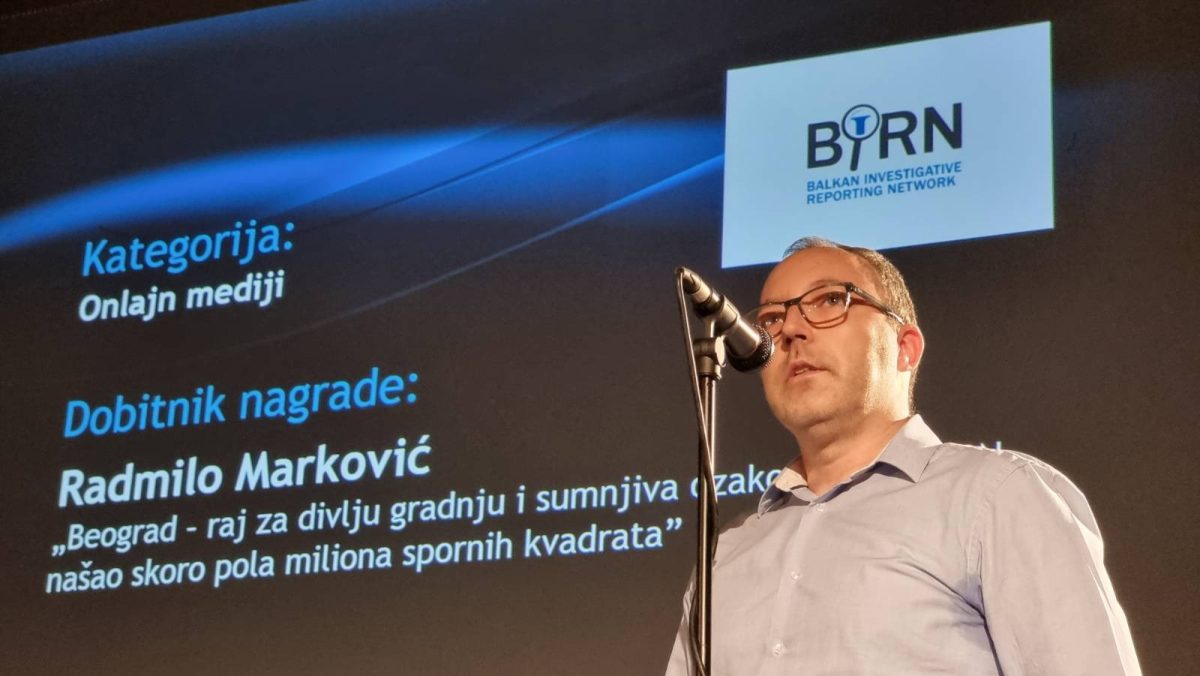
Radmilo Markovic, investigative reporter with BIRN Serbia, was awarded the prestigious Dejan Anastasijevic Investigative Award in the online media category for his reporting on illegal constructions in Belgrade.

Radmilo Markovic was announced as the winner of the award given by the Independent Journalists’ Association of Serbia and the US embassy in Belgrade on Tuesday.

The jury awarded him for his multimedia investigation that identified hundreds of buildings built in Belgrade without permits in the seven years since new construction legislation entered into force, and made legal via apparently illegal means.

“Investigations into this topic and numerous wrongdoings will continue. We and other media have already done some follow-ups. We wrote and we will continue to write on people who illegally obtained gain by damaging the citizens,” Markovic said after the ceremony.

“However, journalists’ work has its limits. From there, the state institutions should take over – thre prosecution, police and courts. Unfortunately, that other part of it is yet to actually start – for this and hundreds of other investigations that journalists have produced in the last decades,” he added.

This year’s winners included TV N1 journalist Maja Nikolic who received an award in the electronic media category for a documentary Below surface – The last honour and journalists Nemanja Rujevic, Ingrid Gercama, Nathalie Bertrams and Tristen Taylor who were awarded in print category for the story “Parrots worth as much as cocaine”, published by the weekly Vreme. The newly established audience award went to Dalibor Stupar, a journalist of the Independent Journalists’ Association of Vojvodina, for a documentary about heating and air pollution.

The Independent Journalists’ Association of Serbia organised the 18th annual award for outstanding investigative journalism and reporting on issues of public interest with the support of the US embassy in Belgrade.

This year, 45 stories were submitted for consideration.

Among the nine nominees were three more BIRN journalists. In online media category, the jury nominated  Sasa Dragojlo’s investigation “With Police Connections, Serbian-Syrian Translator Turned People-Smuggler” and Jelena Veljkovic for a series of articles about Nemanja Stajic, Belgrade’s former secretary for legalisation affairs.

Jelena Zoric was nominated in the print category for articles published in Vreme about the “Jovanjica case” – concerning a massive cannabis farm that allegedly enjoyed the protection of Serbian state security.


BIRN Serbia Awards Small Grants for Reporting on Artificial Intelligence and Surveillance

After BIRN Serbia trained ten journalists to report on the development and use of surveillance technology and artificial intelligence, AI, half of the participants have been provided with funding to work on stories on this topic.

The training was held on April 28 in Belgrade as part of the programe “Artificial Intelligence and Surveillance Technologies – Challenges of Media Reporting”.

Journalists learned how to recognise and monitor use of artificial intelligence and surveillance technologies. Following the training, five participants were awarded small grants of $480 US to report on this topic.

Grants were awarded to: Bojana Vlajović Savić (Res Publica), Slađana Majdak (BETA agency), Slaviša Milenković (Kruševacpress), Filip Mirilović (weekly Vreme), and Mila Tomić (Ozon press).

Surveillance is gaining more and more importance and while journalists should contribute to the transparency and accountability of the government’s use of these technologies, they often lack the skills needed to report on this topic.

That is why the training was aimed at strengthening the capacities of newsrooms to recognize and follow trends in the development and application of these technologies. Participants also received practical advice on how to improve reporting on the effects of surveillance on citizens’ rights.

“People often complain that the state and its institutions do not keep up with modern technology and the opportunities it provides us. Unfortunately, there are indications that they are keeping up, but they are not using these possibilities in the best interest of citizens,” says Radmilo Marković, one of the lecturers.

“Instead, these technologies are being used for who knows whose personal or group interests. That’s why it is important to draw attention to this and this workshop gave us some concrete tools and guidelines on how such things should be investigated,” he added.

Journalists were introduced to the concept of using algorithmic tools for automating decisions, surveillance equipment and other monitoring and profiling technologies, the consequences of their use for the rights of citizens, and how to follow the money trail and procurement of equipment and software for the aforementioned technologies.

The training leaders were experts in the field of the use of surveillance technologies and their impact on the realization of guaranteed rights: Ana Toskić Cvetinović, executive director of the organisation Partners Serbia, Danilo Ćučić, program coordinator of the A11 Initiative and Filip Milošević, from the SHARE Foundation.

Part of the training reflected the experience of BIRN’s newsroom. BIRN editor Milorad Ivanović and journalists Aleksa Tešić and Radmilo Marković shared the knowledge and techniques they applied while working on stories such as procurement of surveillance equipment by Serbian public energy company EPS and use of a software for espionage in Serbia.

BIRN Serbia Holds Training on Monitoring Local Govts’ Tender Spendings

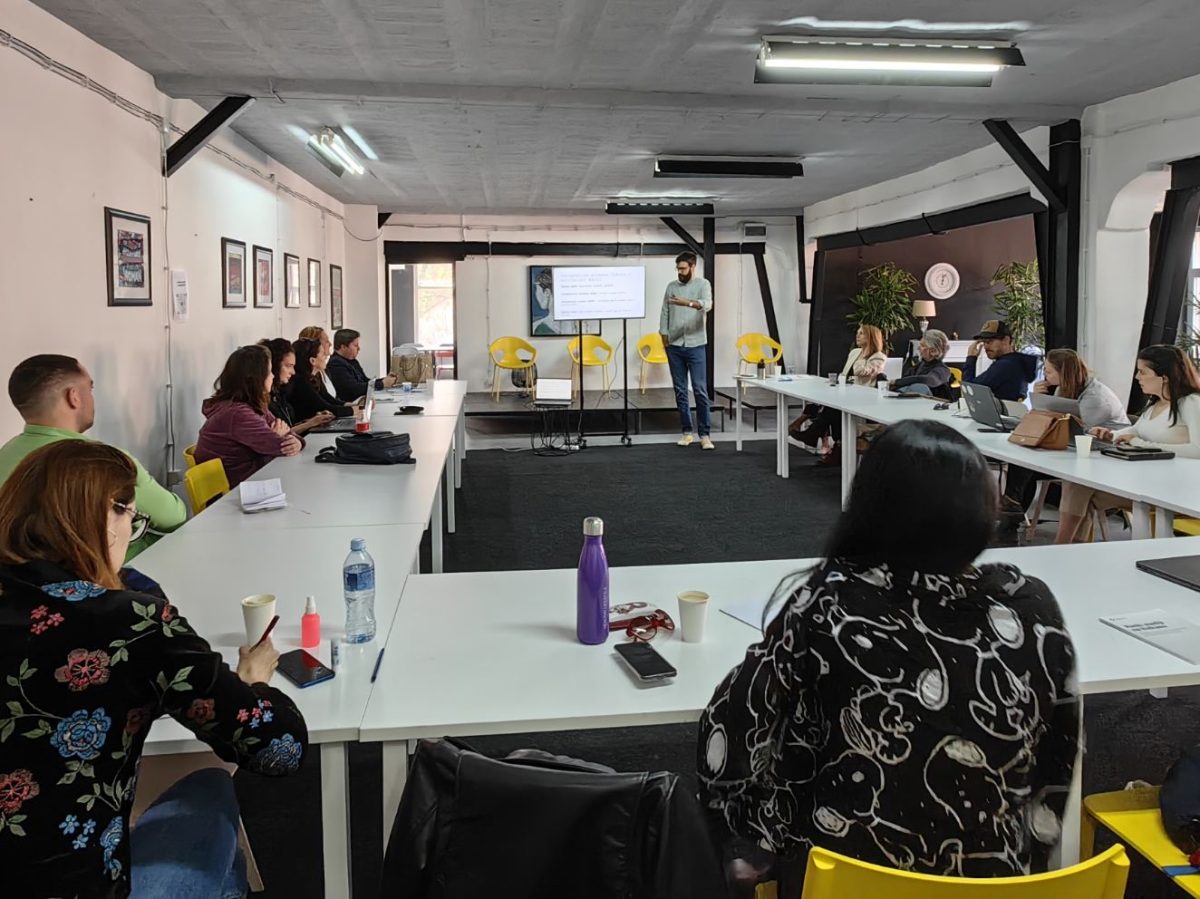
BIRN Serbia held a training on monitoring local government spending through public tenders for 13 local journalists and civil society representatives from Nis, Leskovac, and Vranje.

The workshop, entitled “Monitoring local public tenders”, was held in Nis and organised by BIRN Serbia, Civic Initiatives and the Committee for Human Rights Nis on May 12.

The training provided practical advice on data collection and processing techniques, publicly available resources that can help the media and civil society monitor how local governments allocate public funds through tenders, as well as information on risk points and possible abuses.

New data published in BIRN’s database show that during 2022, the Serbian state distributed 6.8 billion dinars, or about 58 million euros, through public tenders.

However, this money was often wasted and regularly used to finance GONGO organisations and tabloids.

During the workshop, BIRN, together with its partners, shared tools and knowledge with journalists and activists so they could report on public spendings through project financing, monitor money flows and analyse public finances, and thus contribute to greater transparency on budget spending and authorities’ accountability. The workshop program focused on previously identified problematic points:

  • stages of the competition at which abuses may occur – and how to report on this
  • the silence of institutions – how to use requests for access to information of public importance to obtain data
  • GONGOs – how to recognize them

“Our goal is to strengthen the local media and provide them with the methodology and knowledge we used in our research and database creation, so that they have the tools to follow and report on this topic,” said Tanja Maksić, BIRN Serbia program manager and the author of the methodology based on which BIRN’s database on public tenders was collected and presented.

“The more eyes that are focused on the spending of the state budget, the less room there will be for abuses. Empowered journalists are indispensable partners in this process,” she added.

The workshop was organised as part of the project “Publicly about public tenders”, which also created the largest database of open data on public tenders.

Central European University (CEU)

PARTNER
Central European University was founded in 1991 to support the democratic transitions in Central and Eastern Europe and the former Soviet Union.


The University is deeply international: it is home to students from more than 100 countries and faculty from over 50. The mission of the University, conducted through its 13 academic departments and its world-leading research centers, is to promote open societies and democracy through advanced research and research-based teaching, primarily in the social sciences and humanities.

Web : https://www.ceu.edu/


Belgrade Mayor Files Defamation Lawsuits Against BIRN Serbia

Belgrade mayor Aleksandar Sapic is suing BIRN Serbia over two articles about properties he owns, seeking 100,000 euros in damages – a move that the media organisation says is an attempt to discourage public interest reporting.

Aleksandar Sapic, the mayor of the Serbian capital of Belgrade, has filed two separate defamation lawsuits against BIRN Serbia, its editor and journalists, claiming that their reporting damaged his reputation and caused him mental anguish.

Sapic is suing BIRN Serbia, editor-in-chief Milorad Ivanovic and investigative reporters Jelena Veljkovic and Aleksandar Djordjevic for their reporting on his villa in the Italian coastal city of Trieste

He is also suing BIRN Serbia, Ivanovic and investigative reporter Radmilo Markovic over an article about the legalisation of extensions to Sapic’s mansion in Belgrade’s Bezanijska Kosa neighbourhood.

He is seeking six million Serbian dinars (around 50,000 euros) in damages in each case – a total of around 100,000 euros.

“By publishing falsehoods, the accused have caused irreparable damage to the plaintiff in terms of mental anguish due to the violation of [his] honour, reputation and human dignity, which called into question the plaintiff’s overall moral values, which he enjoys within a certain social environment,” both lawsuits allege.

BIRN Serbia editor-in-chief Ivanovic said the lawsuits were another example of Strategic Lawsuits Against Public Participation, SLAPPs, which are aimed at intimidating journalists and discouraging them from reporting about individuals and topics of public interest.

He added that court practice in Serbia shows that judges do not award damages in such large amounts as Sapic is seeking from BIRN, and that the aim of the mayor’s lawsuits is to expose the media organisation, its editors and journalists to financial costs in order to exhaust its resources.

“BIRN will continue to investigate topics of public interest, keep institutions, politicians and public officials in check, and publish stories that the public has the right to know about so that they can make informed decisions,” said Ivanovic.

The aim of SLAPPs is to drain the target’s financial and psychological resources and chill critical voices to the detriment of public participation, according to a report on SLAPP lawsuits in Serbia published in 2022 by Article 19, the American Bar Association Centre for Human Rights and the Independent Journalists’ Association of Serbia, NUNS.


Serbia Spends More on Often Untransparent Public Competitions, BIRN Serbia Reports

The Serbian state distributed 6.8 billions dinars, almost 58 million euros, on public competitions last year, a big rise on the year before and much of it spent in an untransparent way, according to a new BIRN Serbia report.

A new report by BIRN Serbia and Civic Initiatives, Publicly about Public Competitions: Overview of Project Financing in the fields of Media, Civil Society, Culture and Youth in 2022, shows that Serbia allocated 6.8 billion dinars, equal to 58 million euros, on public competitions last year.

Through such public competitions, the state should support the work of sectors dealing with the protection of the public interest. For many organizations and media, this type of financial assistance is an important potential source of money.

This is why it is crucial that this money is spent in a transparent and responsible manner.

However, the research and data collected by BIRN Serbia showed that the opposite is happening; this year, as in previous years, procedural and administrative errors, abuses and non-earmarked spending of money, were all recorded.

“Essentially, there is no real support for activism. The most significant amounts of money are being misspent in the areas that should be priorities,” said Tanja Maksić, one of the authors of the report.

Stagnation and the accumulation of inherited issue problems are a key feature of the competition in 2022.

The main findings from the report are:

  • Access to information in an open format improved compared to the previous research year. The researchers received more than half of the documents that the administration provided in Word or Excel format based on the request for data reuse.
  • Although the government’s strategic goal is accelerated digitization of the public administration, only a small number of data sets on public competitions can be found on the open data portal (data.gov.rs).
  • Administrative silence remains a big problem; one fourth of the institutions did not respond to BIRN’s request for data.
  • The distribution of money through public competitions did not follow set priorities in public policies. For example, despite the proclaimed fight for the birth rate and women’s rights, research shows that it is in this area that some of the biggest abuses of money took place.
  • Compared to previous years covered by the research, in 2022 there was an increase in total spending through public competitions. In 2021, about 5.1 billion dinars were spent; in 2022 this rose to 6.8 billion.
  • The civil society sector got the most money (over 3 billion in 2022, i.e. 44 per cent of the total allocated money), and almost all institutions have developed models of cooperation with associations.
  • Individual projects in the media sector were the most generously financed; the average value of these projects was twice as high as in other sectors.
  • A large number of organizations and media regularly receive money; 2,814 are repeating from year to year.
  • Regular activities are also covered by project financing – there were at least 308 projects in which the titles of the projects indicated the subject of financing of regular, annual activities of the organizations.
  • The most expensive project in 2022 was awarded to Japi com company from Novi Sad, almost 48 million dinars for digitization of archival materials. Among the top winners in terms of the total amount of money in 2022 were also organizations that have been on this list for years – OPENS, Exit festival, and four regional TV stations whose editorial policy is close to the government (TV Novi Pazar, TV Belle Amie from Niš, VTV Subotica and TV Zona Niš).
  • In the procedural sense, the biggest issue remains the lack of evaluation of what has been achieved, the publication of non-standardized and non-harmonized decisions on the allocation of funds, an inadequate appeals mechanism that cannot prevent abuses, and the non-transparency of the work of competition commissions, because documents on their appointment and work are almost non-existent.

BIRN’s previously published investigation showed that almost half of the money allocated by the Ministry of Family Welfare and Demography in the 2022 competitions – 1.3 out of 3 million euros – was allocated to a network of related organizations, and there are no results of their work.

“Some received per 30 million dinars (during 2021 and 2022), without knowing what they received the money for. We handed all the information to the Prosecutor’s Office and the police,” said Aleksandar Đorđević, one of the reporters that worked on the investigation, saying that the institutions must react and investigate possible fraud.

For the fourth year in a row, BIRN and Civic Initiatives have been monitoring the spending of state money through project financing, that is, competitions for the implementation of projects in the public interest.

The report was created on the basis of information from the database, which currently provides insight into over 22 billion dinars of public money spent at all levels of government in the period 2019-2022. It is the largest open database of this type.

Apart from BIRN and Civic Initiatives, 16 researchers from local civil society organizations participated in the research.


Belgrade Court Acquits Koluvija Lawyer of Threatening Jelena Zorić

Court rules that lawyer’s words grossly violated the ethical code, but did not constitute a direct threat to the journalist’s life – an outcome Zoric said she had expected.

A court in Belgrade has ruled that when Predrag Koluvija’s attorney Svetislav Bojić told the journalist Jelena Zorić that “nobody did well who made a mistake about Koluvija”, this was not a direct threat to her life but a gross violation of the ethical code of attorneys – but one that this court would not deal with.

Koluvia, on trial for illicit narcotics production, has accused BIRN of incorrectly reporting a past case in which he was mentioned.

Dragoljub Đorđević, representing Zorić, said he believed extra-institutional pressure was exerted during the trial.

Bojić was acquitted on March 20 before the Second Basic Court in Belgrade of threatening the journalist, i.e. the crime of endangering the safety of journalists.

At the pronouncement, the lawyer for the accused also said that three days earlier, the Belgrade Bar Association had ruled that Bojić was not responsible for what he had said and would not be subject to disciplinary action either.

According to the indictment, Bojić threatened Zorić at the end of December 2020. The prosecution sought eight months of imprisonment or three years of probation.

It submitted a written statement to the court, which stated that the entire context in which the event took place should be taken into account.

Explaining the acquittal, Judge Dragana Branković said that what Bojić said did not represent a direct threat to the journalist’s life and body. She said Bojić had clearly violated the Attorney’s Code of Professional Ethics, but the court could not deal with that.

Đorđević, representing Zorić, told BIRN that he believed extra-institutional pressure had been exerted during that trial.

He said the court had “put full faith” in Zorić’s words but still found no elements of a criminal offence in what was said. He had gained a “painful impression” after the presentation of Bojić’s defence as well as during the presentation of the closing arguments.

“That man shows no remorse at all and still tells a bunch of lies. I think that he and his defence tried in every way to belittle journalist Zorić; they tried to humiliate her in some way, which left a very bad impression on me,” Đorđević said.

Zorić received other threats

Koluvija was charged by the Prosecutor’s Office for Organized Crime after about 66,000 cannabis stems were found on the property of his company Jovanjica which weighed 1.6 tons after drying.

On December 28, 2020, Bojić approached Zorić while she was engaged in journalistic work with a cameraman and said: “Please be precise in your reporting, as my client Predrag Koluvija is an honest man and a great believer, this is what he told me when I went to visit him: ‘Zorić is destroying me and tearing me apart with her reporting, but I pray to God for her health, just as I pray for the health of the prosecutor Saša Drecun and the one who arrested him, Slobodan Milenković.’”

During the trial, it was also learned that the video recording of the conversation between Bojić and Zorić no longer exists, and so could not be part of the evidence.

Zorić reported the threats on December 29, 2020. Some 23 days later, on January 21, 2021, the prosecution requested the video footage from the Special Court building.

However, on January 25, the court responded that the footage had been stored for exactly 23 days, so they were unable to deliver it.

Đorđević said his client had received other threats as well. A photo of a pink piece of paper with a threatening message left in front of her apartment in January 2021 was shown to the court. It read: “This will go on until it’s over. You can’t escape from that”.

Đorđević noted that Zorić also received threats via social networks from Koluvija’s godfather and from his associate Sergej Mrđa while he was on the run, and for whom an Interpol warrant was issued for the Jovanjica case.

During the summer of 2022, during an appearance on television, while talking about the Jovanjica case, Zorić and her family, in this case her her brother, were also attacked by former Ministry of Interior State Secretary Dijana Hrkalović  who said she had heard from Zoric’s brother that she had had “problems in the newsroom” for allegedly covering up criminal correspondence.

Zorić: ‘Even in court, I knew the outcome’ 

Zorić said that she had expected the outcome. “Nevertheless, I reported the threats because as journalists we are obliged to fight for justice through institutions, even when we personally no longer believe in their work. From the moment I testified about the threats in the courtroom, and the judge asked me: ‘And why is that Jovanjica so important and you keep on writing about it?’ I felt what the outcome would be.”

Zorić added that “the most shameful of all is the move of the Belgrade Bar Association, which obviously knew exactly when the ruling would be handed down, so they decided exactly three days before not to impose a disciplinary penalty against their colleague”.

“All of this seems to me to be an institutional approval to attack independent journalism and stifle media freedom,” Zorić said.

After the parties receive the written decision of the court, the Prosecutor’s Office has the right to appeal; the injured party does not, because it is a proceeding conducted ex officio.

BIRN will monitor whether it appeals the court decision.


Tech Company Algorithms Changing Serbia’s Media for Worse, BIRN Report Finds

Visibility is replacing public interest as editors’ priority, while the media landscape is becoming ever more fragmented due to media drives to accommodate tech-companies’ algorithms, BIRN Serbia report finds.

The production and distribution of news and other media content in Serbia is changing in order to adapt to the platform environment of social networks and algorithms managed by large global tech companies such as Google and Meta – which also affect the economic viability of the media in the country – a new BIRN Serbia report, Algorithms, Networks and Media Sustainability: a Game of Big Numbers, finds.

The digital environment managed by a small number of global tech companies is the source of various negative phenomena in the media; the media are expected to produce large amounts of content that adapts to the logic of algorithms, and not always and necessarily to the public interest in information, according to the report. .

Journalistic practice is changing in the direction of producing as much content as possible, with little information value, and headlines are designed to cause psychological reactions in the audience and increase the number of “clicks“ and views.

This type of journalism turns out to be most profitable for generating money from digital advertising. Only a small number of media can follow the trends of the “big numbers” and make money from digital advertising, while the rest of the media still rely on government and other forms of donations, the report says.

Some of the key findings of the report are:

  • Platformization of journalism, which implies complete dependence of the media on the infrastructure of global social network platforms, as well as the mirroring of economic relations in the media sector.
  • Favouring the production of a large number of texts, of low-quality and “clickable“ content, which “feeds“ the algorithms with quick changes and contributes to greater virality and visibility. This content is of low quality, does not contribute to public information, and at the same time normalizes “clickbait” journalism as a legitimate product of an algorithmic environment.
  • Creating a gap between a small number of large media companies that can withstand the race for “big numbers” and the rest of the media that do not have the capacity or resources to adapt to this environment. There is also the creation of a concentration of a small number of publishers who can ensure sustainability from digital advertising, while other media continue to rely on government and other donations.
  • Media surrender their editorial role, relying on metrics and statistics in the selection of topics, while the public interest remains in the background.
  • In strategic and other relevant documents, the idea of “techno-solutionism” (the use of technology for economic progress) prevails, without critical reflection on its negative consequences, while the development of alternative models of sustainability that will not threaten the public interest in information is absent.

The report primarily deals with the media system of Serbia and its capacity to adapt to the digital and platform environment. It was created on the basis of in-depth interviews with digital platform experts and representatives of the media and advertisers.

“These findings, as well as the entire report, should be read through the prism of the situation in the media information system in Serbia, which has been burdened with a lack of media freedom for decades, captured by political structures and under constant economic pressure,” said Tanja Maksić, co-author of this report.

“Adapting to the conditions dictated by a small number of powerful tech companies, the media took over the design and logic of the platforms and subordinated the distribution of media content to platforms and search engines, and thus consequently also their economic viability, which increasingly depends on the policies and decisions of the tech companies,” she added.

The legislative framework in Serbia only somewhat regulates the position of online media and digital advertising, usually taking over the regulatory mechanisms of traditional media.

Current Law on Public Information and Media recognizes online media as one of the forms of public information and reflects almost all the rights and obligations of traditional media to those in the digital sphere.

The same happens with the Law on Advertising, which treats digital advertising equally to all other forms of advertising, making no distinction between an advertising message in traditional or online media.

The media strategy devotes an entire chapter to the development of the media in the digital environment. The proposed measures are primarily concerned with raising the digital competencies of journalists. Without an adequate response, however, issues such as content distribution, billability and removal of content from platforms remain.

This as well as previous similar reports BIRN Serbia makes available to the media, experts and decision-makers, in order to advance the debate on media policies and on the quality of information and the change in professional standards in the digital environment.


Media Freedom Coalition: Stop Pressure on Jelena Zoric

Former State Secretary in Serbia’s Ministry of Interior Dijana Hrkalovic, who is accused of abusing her official position, in a guest appearance in the show Ćirilica (Cyrillic) on Happy Television, aired on Tuesday, presented a series of incorrect pieces of information about BIRN and Vreme journalist Jelena Zoric, and also mentioned her brother.

Addressing “this Jelena Zoric, whose confession we finally got a few days ago”, she said: “Vlada Gajic from the People’s Party says that Sasa Drecun, [deputy state prosecutor for organized crime and a prosecutor in the Jovanjica case] is the source of her information.

“Everyone is saying she has a very close relationship with him. I hear her brother saying she had a problem with the newsroom of the television where she previously worked because she’d covered up the correspondence between Drecun and a criminal … which had arrived at that newsroom’s email. Look, she hid it from her editors! What is that called? Selective investigative journalism, or what?”

Hrkalovic’s action was a continuation of the pressure on Zoric. Following a guest appearance on Pregled dana (View of the day) on NewsMax Adria, a few days ago, representatives of the opposition accused her of “selling out herself” because she had stated that, in the Jovanjiac affair, “there is no Andrej Vucic”, referencing President Vucic’s brother.

The Jovanjica affair is the case concerning the largest ever illegal marijuana plant discovered in Europe. Two trials are ongoing, Jovanjica 1, concerning the owner and employees, and Jovanjica 2, concerning police and secret service officers that were allegedly working with them. Jovanjica 2 trial has been repeatedly delayed, and although it has started more than a year ago, only one hearing was held so far. According to BIRN’s own findings, there were contacts between high officials of security services and Predrag Kuruvija, owner of Jovanjica.

The Media Freedom Coalition, a coalition of professional media and journalists’ associations in Serbia, said it sees Hrkalovic’s latest act as an attempt to discredit the multi-awarded journalist since Zoric published a story about the disputed correspondence for N1 television station, where she worked at the time, while the mention of her family can only be with the aim of threats and intimidation.

In earlier guest appearances in pro-government media, Hrkalovic used the opportunity to libel independent media. Journalists, such as N1, Nova, Danas, as well as Vukasin Obradovic, were already her target.

The Media Freedom Coalition said it strongly condemns the threats directed to Zoric as well as the libelling of journalists by Hrkalovic. Such acts can only further threaten the safety of independent journalists, it said, who have been the subject of a campaign for years by the authorities and media sympathetic to them.

It called on all political actors to stop putting pressure on the media and journalists, and for the police to protect them so they can do their job professionally and without fear.


Limits of Human Rights are Being Tested on Journalists

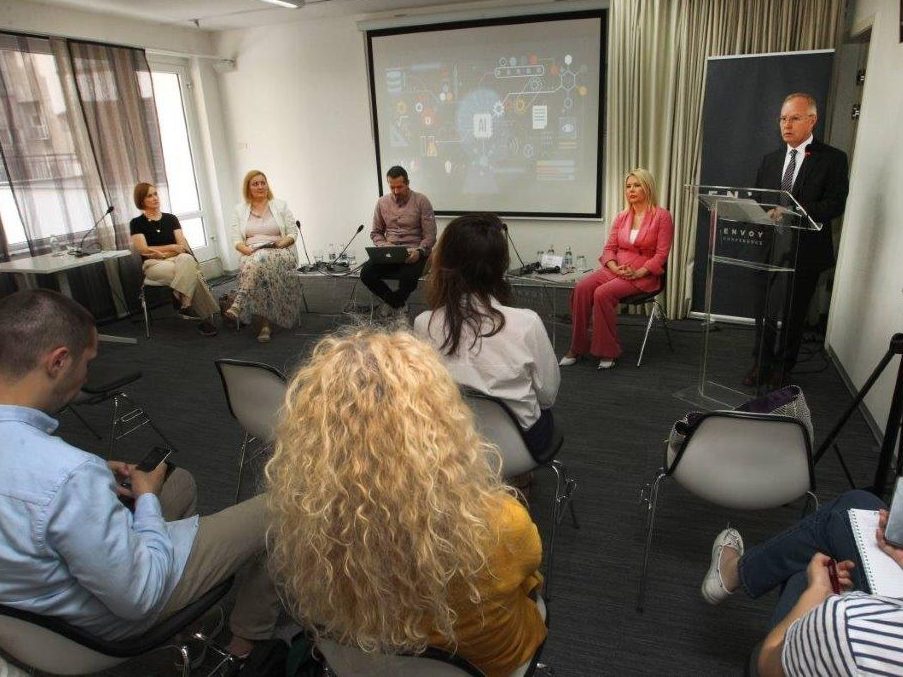
Untransparent and uncontrolled surveillance enables infringement of citizens’ privacy and changes how journalists work with sources, concluded the participants of the panel „Influence of new technologies, artificial intelligence and surveillance technology on freedom of expression and the media“, which BIRN organized in cooperation with OSCE.

The opening address was delivered by H.E. Jan Braathu, head of OSCE Mission in Serbia and Slavica Trifunović, assistant to the Minister of culture and information of Serbia. She noted that the Ministry is fully dedicated to the implementation of the new Media strategy that recognizes the issue of protection of journalists’ sources, and said that the Ministry has already taken numerous steps in the field of media literacy.

The OSCE ambassador underscored that the problem of surveillance and its impact on media freedoms is not just an issue for the Serbian government, but for European countries as well. Those who control information, control the future. Surveillance technologies created by global online corporations now have a decisive impact on journalistic reporting, protection of sources, and the audience, Braathu said.

Bojana Kostić, author of the report „Uncontrolled surveillance, uncontrolled consequences: Short overview of the impact on freedom of expression and media freedoms“ said that citizens do not truly have the freedom of choice: if you wish to find a job, you must use social network platforms, if you wish to get informed, you also use social media, etc. The democratic society is caught between a rock and a hard place – rising corporate power on one hand, and the power of the state on the other. Surveillance is at the root of their influence.

Surveillance also plays a role in the everyday work of journalists, especially when it comes to sources’ right to protection, which is maybe the most important legacy of media freedoms, said Tanja Maksić, author of the research „Uncontrolled surveillance, new form of pressure“.

Rade Đurić, a lawyer for NUNS reminded participants that last year civil society prevented the introduction of a new law on police that would allow biometric surveillance. The introduction of biometric surveillance would have threatened the existing freedoms of citizens and journalists.

The conference and the report are part of BIRN’s programme that focuses on digital rights and media freedoms.

The conference was organized within the project „Action for digital rights – promoting free flow of information and integrity of the media“, which is implemented in partnership with BIRN Serbia and the SHARE Foundation, with the financial support of the Balkan Trust for Democracy and the MATRA programme.