Montenegrin Journalists to Investigate Environmental Issues

Three journalists from Montenegrin media have been selected to carry out multimedia journalistic investigations on the subjects of environment and sustainable development, which are covered by the Chapter 27 in the EU negotiation process.

Irena Rasovic, a journalist from public broadcaster Radio and Television of Montenegro, Matija Otasevic, a journalist from TV Vijesti, and Mustafa Canka, a freelance journalist from Ulcinj, were selected at the training course held in Podgorica after presenting their investigation proposals.

The investigative stories that were selected have a regional character and will deal with issues affecting not only the environment in Montenegro, but in neighboring countries as well.

A mixed domestic and international team will work with the selected journalists. All the stories will be published in the local and English language and will have multimedia component.

A call for investigative stories with an environmental angle was launched in March as part of a project to strengthen investigative reporting in Montenegro, which is being implemented by BIRN, CIN Montenegro and Monitor magazine. The project was funded by the EU Delegation in Podgorica.

Along with selected stories, journalists from CIN Montenegro and Monitor will publish a number of other investigations related to the environment and sustainable development within the project Media Investigations: Stop to READ (Regional Environmental Acts of Devastation).

Through intensive training, international mentoring and an investigative approach, this project aims to increase the capacities of CIN Montenegro, Monitor, and other media outlets whose journalists are taking part.

The project started on March 1 and will continue for 14 months.
BFJE 2018 kicks off in Vienna

Fake news merchants, corrupt officials and political thugs are just a few of the targets in the crosshairs of journalists chosen for the 2018 Balkan Fellowship for Journalistic Excellence.

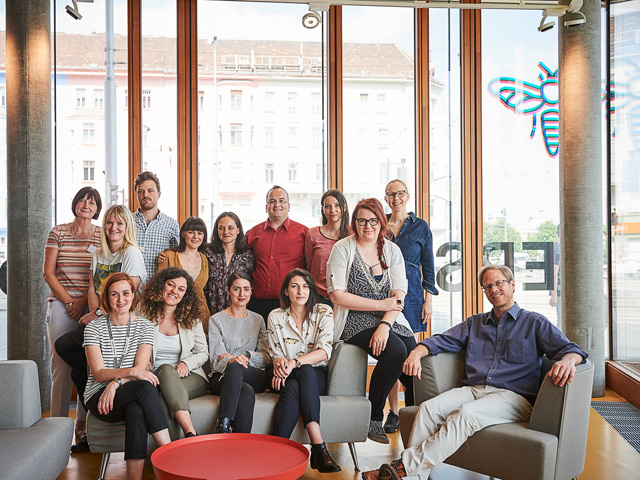
In its 12th year, the fellowship began with a four-day seminar in Vienna that brought together 10 new fellows from across the region, all committed to tackling this year’s theme: TRUTH.

Chosen from around 100 applications, they come from Romania, Croatia, Serbia, Montenegro, Kosovo, Albania and Greece.

Supported by ERSTE Foundation and Open Society Foundations and run in cooperation with the Balkan Investigative Reporting Network, BIRN, the fellowship aims to promote the highest standards of journalism. It gives mid-career reporters the funding and editorial support to pursue investigative stories that cut across borders.

Over the next four months, fellows will carry out in-depth reporting as they try to untangle the webs of power, influence and money that envelope their proposed stories.

In Vienna, they received practical tips from BFJE Editor Timothy Large on how to research, report and write long-form articles for international impact.

They then hammered out story ideas and reporting strategies during intensive editorial sessions with Timothy Large, Balkan Insight Editor Gordana Andric, BIRN Regional Network Director Marija Ristic and BFJE Programme Manager Dragana Obradovic.

The seminar also included a visit to the newsroom of Austrian daily Der Standard, a media partner of the programme, and a session on cross-border collaborative journalism by Brigitte Alfter, Managing Editor of Journalismfund.eu.

Barbara Trionfri, Executive Director of the International Press Institute, spoke on global press freedom and trends in media development while Gordana Andric from Balkan Insight shared pointers on multimedia storytelling.

This year’s fellows are Arlis Alikaj (Albania), Iona Burtea (Romania), Claudia Ciobanu (Romania), Alexander Clapp (Greece), Ivana Jeremic (Serbia), Lorelei Mihala (Romania), Andrea Milat (Croatia), Andjela Milivojevic (Serbia), Leonida Molliqai (Kosovo) and Dusica Pavlovic (Montenegro).

BIRN Bosnia Cited As Example of Lawsuits Used as Tool

BIRN Bosnia’s own experience of lawsuits used as a tool to silence the media features in a new report on defamation cases against journalists.

The number of defamation lawsuits against journalists is rising in Bosnia and Herzegovina, although many of them get withdrawn, the online magazine about the media of the Media Center Sarajevo writes.

BIRN Bosnia and Herzegovina recently experienced this, after it published an article about the public procurement process for buying an official car for a state ministry.

As the texts notes, referring to media freedom reports by Reporters Without Borders, local politicians often try to intimidate journalists by suing them for defamation, so deterring them from pursuing their work. Data from Bosnia’s journalists’ association and experiences from newsrooms also show that numerous lawsuits are used as a form of pressure.

Mirna Buljugic, director of BIRN Bosnia and Herzegovina, recalled what happened in the case of her organization.

“The minister did not want to talk to us, but directed us to his secretary, but after we published the article, he called to talk. We asked whether there was something problematic in the article and he said, ‘No’. Twenty days later, there was a lawsuit against BIRN, the journalist and editor who worked on the story.

“During the course of the lawsuit, when we were supposed to answer the lawsuit, they went further, suggesting making a deal with the minister never to write about him again and never to write about that ministry, either, or about public procurement, which we refused immediately, after which the whole process continued.

“In the last week before we sent the answer, the minister gave up the lawsuit. This then went into BH Journalists’ statistics about politicians who influence the media and create pressures this way through defamation lawsuits.”

Professionalism remains the best protection when tackling political pressures through lawsuits, she and other media professionals conclude.

BIRN Albania Holds Workshop On Health

The Balkan Investigative Reporting Network in Albania on Thursday May 3rd held a workshop on corruption, mismanagement and abuse of office in the health sector in Albania.

About 25 journalists, civil society activists, representatives of the office of the Ombudsman and the High State Auditing Office in Albania attended.

The workshop was part of “Transparency on Healthcare through data and investigative journalism”, a project supported by the United States Development Agency, USAID.

The goal of the workshop aimed to identify topics for the upcoming call of BIRN Albania for investigative grants in the health sector, but also sought to build bridges of cooperation between civil society organizations, journalists and independent institutions.

During the course of the workshop, representatives of the High State Auditing Office and the Ombudsman presented the methodologies they use to monitor public institutions and together with civil society representatives discussed ways in which the media can cooperate in fighting corruption in the health sector.

The workshop will be followed by a call for investigative stories that will be published on BIRN Albania’s award winning website, Reporter.al.

BBC and Al Jazeera English release BIRN-backed documentaries

The BBC and Al Jazeera English have produced investigative documentaries in recent months working alongside BIRN’s in-house investigative team.

BIRN has collaborated with the BBC and Al Jazeera English in recent months to investigate the far-right in the Balkans and a secretive arms pipeline to Syria.

The Al Jazeera English probe built on BIRN and OCCRP’s award-winning series of investigations, Making a Killing http://www.balkaninsight.com/en/page/balkan-arms-trade, which delved into how Balkan weapons were flooding the Syrian battlefields.

The “America’s Guns: Secret Pipeline to Syria” documentary was first broadcast in March on Al Jazeera’s People and Power show and involved filming in Croatia, Bulgaria and the US.

The report brought BIRN’s findings to a wider audience, revealed the human cost of the scramble to train and equip US-backed Syrian militia.  BIRN published two articles on the back of the research:  Death in Bulgaria: Pentagon Contractor’s Widow Fights For Truth and US Splurges More Cash on Balkans Arms for Syria.

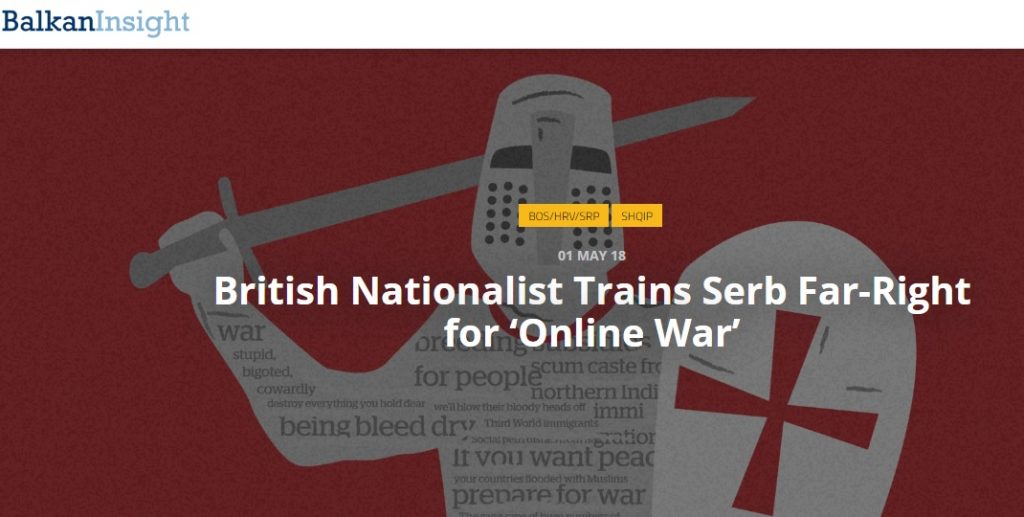
On May 1, the BBC and BIRN published the fruits of its collaboration into the British nationalists operating in the Balkans. The BBC produced television and radio documentaries focussing on “the invisible man of Britain’s far right” – Jim Dowson – and his activities in Hungary, Bulgaria, Serbia and Kosovo: Is this Britain’s most influential far-right activist?

BIRN released its own investigation, focussing on how Jim Dowson and an organisation he is closely linked to are increasingly active in Serbia: British Nationalist Trains Serb Far-Right for ‘Online War.

As part of the research, BIRN also employed a cyber forensic expert Andrej Petrovski of the Share Foundation, who is helping journalists improve their investigations by using cutting edge technologies.

These collaborations are part of BIRN’s Paper Trail to Better Governance programme, funded by the Austrian Development Agency.

BIRN Reports Nominated for Investigative Awards in Serbia

Two BIRN reports have been nominated for this year’s Investigative awards from the Independent Journalistic Association of Serbia in the categories for on-line media.

The first is The Coyote’s Trail – A Machine Gun’s Path from Serbia to Syria, produced within BIRN Hub’s project Paper Trail for Better Governance and in cooperation with OCCRP, and written by Ivan Angelovski, Jelena Cosic, Lawrence Marzouk and Maria Cheresheva.

It explores how heavy machine guns travelled from a Serbian state-owned factory to Syrian rebels, via a Bulgarian arms tycoon and a Saudi training camp.

The second is BIRN Serbia’s investigative story (part one and two) about illegal construction at the Kopaonik National Park, written by Slobodan Georgiev.

The report shows that a building under construction did not fall into line with the directions of the Institute for Nature Conservation of Serbia.

The report initiated a rapid-response inspection by the Ministry of Construction, Transport and Infrastructure of Serbia, which ordered the investor to knock down the building and clean up the area, which lies at the highest point of Kopaonik mountain. A restaurant was built at the site despite the order, but the case is still ongoing.

Journalists Trained for Environmental Investigations in Montenegro

BIRN, CIN Montenegro and Monitor magazine held a training course in Podgorica from April 26-28 for journalists, teaching the investigative skills needed to produce stories covering environmental issues.

Topics covered by the course included investigative journalism techniques, online storytelling, multimedia training, video and photo editing, as well as information on domestic and EU politics in the sphere of environmental protection.

A call for investigative stories with an environmental angle was launched in March as part of a project to strengthen investigative reporting in Montenegro, founded by the EU Delegation in Podgorica.

Three journalists have been awarded grants to cover their expenses while carrying out investigations and writing stories on the environment and related to Chapter 27 within the EU accession process.

The journalists will have nine months to dig deeper and research their ideas, and will also have the opportunity to work with experienced editors as their mentors to guide them through the process of writing to BIRN standards.

BIRN BiH Contributes to Report on EU Application

The Initiative for Monitoring the European Integration of BiH presented ‘Alternative Analytical Report on the Application of BiH for EU Membership: Political Criteria 2018’ at a press conference in front of Bosnia and Herzegovina’s Parliamentary Assembly on April 24.

BIRN BiH actively participated in producing the report, providing a set of answers covering transitional justice and domestic judiciary topics.

Mirna Buljugic, BIRN BiH’s country director, spoke on behalf of the Initiative about dealing with the past, stressing the key problems of non-existent cooperation between the countries of the former Yugoslavia in processing war crimes, the non-transparent judicial institutions in the country, attacks on the media, and the growing problem of rising extremism and foreign influence in Bosnia and Herzegovina.

After the presentation, representatives of the Initiative sent the report to all the members of the Parliamentary Assembly and to members of Council of Ministers.

More information about the report is available here .

Between Pressures and Praises – BIRN Network Annual Report 2017

In 2017, BIRN Network operated in an environment of declining media freedoms and unregulated media markets, where authorities and pro-governmental media outlets pressured members of the Network and its journalists; nevertheless, BIRN received national and international prizes as well as different kinds of informal praise.

An unfavourable media situation and the lack of proper cooperation with institutions—sometimes even hostile attitude towards BIRN—occasionally hinders the work of the organisation. However, through this report, we also underscore the best results of BIRN’s work, including the praise it has received.

The report shows what the organisation did to offer high quality journalistic work and to provide citizens with reliable, timely and in-depth reporting as well as BIRN’s contribution to improving media freedom and openness of public institutions. It also highlights the instances in which BIRN’s work had a strong political and social impact, showing that—despite difficulties—professional journalistic reporting can conclude in tangible results.

The whole report is available here [link].

BIRN Serbia Holds ‘Public Money’ Workshops and Training

Two evaluation workshops, for researchers and local partners in BIRN Serbia’s ‘Public Money for Public Interest’ project, were held from April 19 to April 20 at the Park Hotel in Belgrade.

From April 18 to April 20, additional training was held at the same venue for civil society organisations on the topic “Public participation in the process of defining, implementing and monitoring public interest in the field of local public information”.

Five local civil society representatives attended the training course. The main goal was to provide participants with skills and knowledge in the field of participatory processes in order to include citizens in the process of defining, implementing and monitoring public interest in the media.

Three of the five organisations will have the opportunity to continue working on the ‘Public Money for Public Interest’ project as subgrantees.

The evaluation workshops were organised in order to find out how organizations and researchers included in the project saw the processes in which they participated.

The training and the evaluation workshop for local partners were held by a consultant on the ‘Public Money for Public Interest’ project, Radmila Mikovic.

During the evaluation, seven local partners gained insight into the changes that result from the implemented project initiatives in their local communities. They also discussed the challenges they faced and ways to overcome them.

The evaluation workshop for researchers was held by Tanja Maksic and Lada Vucenovic from BIRN. During the workshop, the researchers analysed their own progress and talked about new skills and knowledge which still need to be acquired.