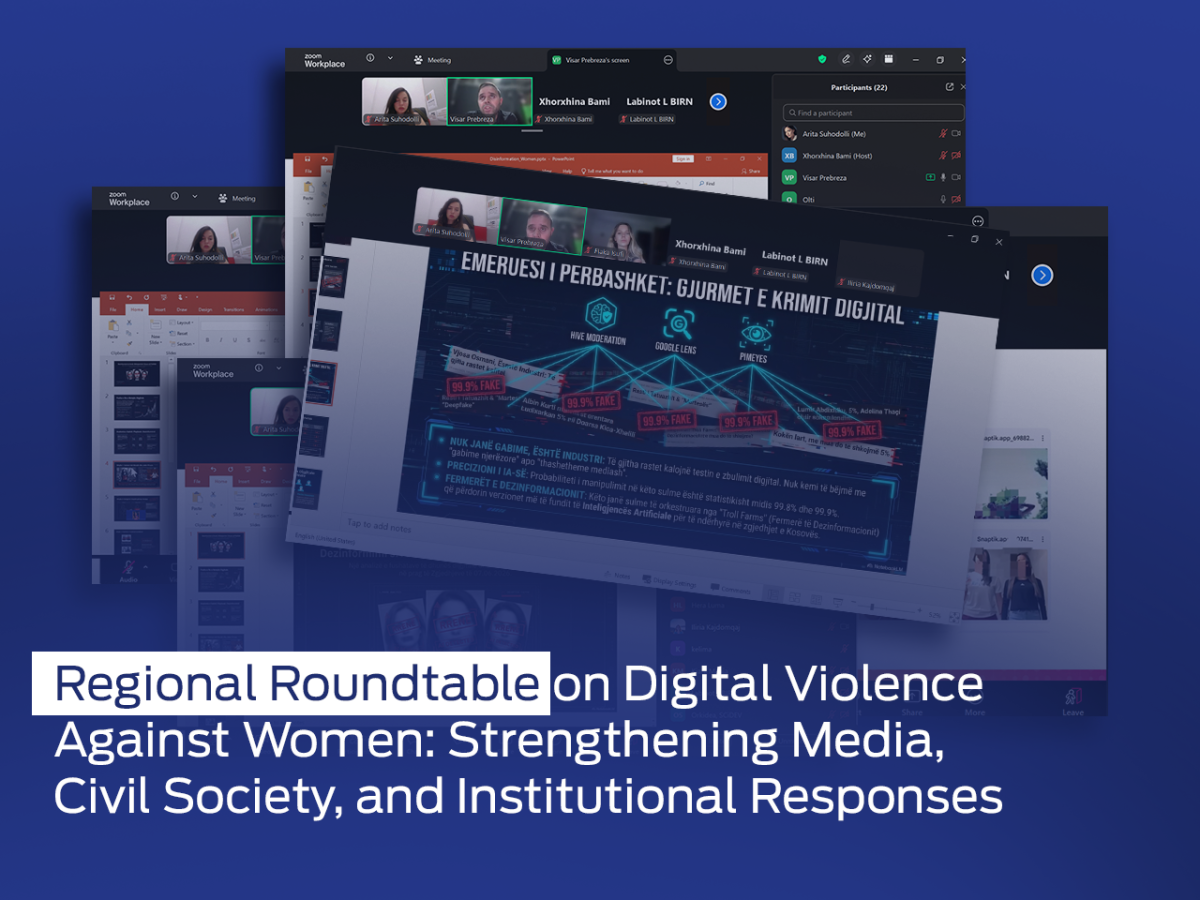
The online event focused on the growing challenge of technology-facilitated violence against women (TFVAW) and explored ways to strengthen regional responses through improved media reporting, legal protections and cross-sector cooperation.
Opening the roundtable, Arita Suhodolli, Program Manager at BIRN Kosovo, presented the objectives of the project and highlighted the increasing prevalence of digital violence against women and girls, emphasising the need for coordinated action by media, institutions and civil society actors.
Flaka Isufi, Researcher and Monitor at BIRN Hub, presented the first session on the monitoring of digital violence against women, featuring cases and media reporting practices The presentation highlighted various forms of online gender-based violence, including online harassment and the non-consensual sharing of intimate content, while also examining how media outlets report on such cases. The findings identified both positive reporting practices and challenges related to victim protection, privacy and adherence to ethical standards.
Labinot Leposhtica, Legal Office Coordinator at BIRN Kosovo, led the second session, which focused on the legal and regulatory framework governing media reporting on violence against women. Participants discussed relevant legislation, ethical obligations and institutional responsibilities, while also addressing gaps in implementation and the need for greater compliance with professional standards to ensure responsible and victim-sensitive reporting.
During the third session, Visar Prebreza, Managing Editor at BIRN Kosovo, examined the role of disinformation in media reporting on violence against women cases. The discussion focused on how inaccurate or sensationalised reporting can influence public perceptions, contribute to victim-blaming narratives, and undermine trust in justice processes. Participants emphasised the importance of fact-based reporting and responsible editorial practices when covering cases of gender-based violence.
The final thematic session featured a case study presented by Xhorxhina Bami, journalist at Balkan Insight, on the AlbKings network and TikTok-facilitated online abuse. The presentation explored the ways online platforms can be used to target and exploit women and girls, the mechanisms through which harmful content spreads, and the challenges journalists face when investigating and reporting on online abuse networks.
The event concluded with an open discussion, during which participants exchanged experiences and perspectives on regional trends, challenges and opportunities for cooperation. Discussions underscored the importance of responsible journalism, effective legal safeguards and coordinated institutional responses to address digital violence against women.
A total of 21 participants attended the online roundtable, including journalists, civil society activists and researchers from Kosovo and Albania. Of the participants, 17 were women.
The roundtable contributed to raising awareness of technology-facilitated violence against women and fostering dialogue among key stakeholders on strengthening prevention, improving media reporting practices, enhancing accountability and supporting survivors of digital violence. It also encouraged greater regional cooperation in addressing the challenges posed by online gender-based violence.
This activity is organised by BIRN in the framework of the regional programme “EU 4 Gender Equality: Women’s Economic Empowerment and Ending Violence against Women,” funded by the European Union and implemented jointly by UN Women and UNDP.
The views and opinions expressed in this press release are those of the organizers and do not necessarily reflect the official policy or position of UN Women, the United Nations, or the donor.