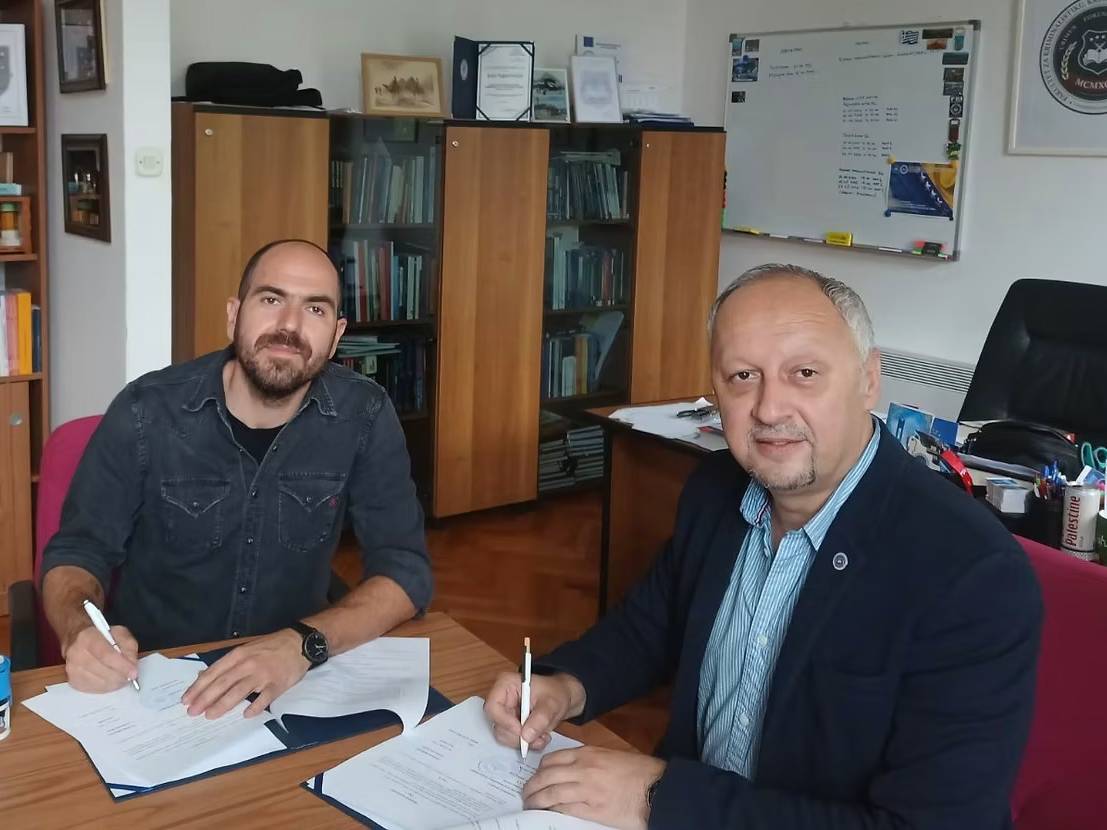
On June 4, the Balkan Investigative Reporting Network of Bosnia and Herzegovina, BIRN BiH, and the Faculty of Criminalistics, Criminology and Security Studies, FKKSS, at the University of Sarajevo signed an agreement on scientific, educational, and professional cooperation, marking a step forward for joint research and education.
The agreement will establish a partnership between FKKSS and BIRN BiH in professional, educational, and scientific research fields. Among other activities aimed at strengthening cooperation in education and research, the agreement foresees jointly organising scientific research activities, conferences, symposia, seminars, workshops, as well as summer and winter schools.
The Dean of FKKSS, Jasmin Ahic, said the agreement is very important for the development not only of academic programmes but also of the faculty’s professional and specialized programmes. A particularly important aspect, according to him, relates to cooperation, especially with research centres dealing with specific areas in which the faculty has direct engagement.
“The segment related to the activities of law enforcement agencies, whether those focused on preventing or suppressing crime or addressing new and emerging phenomena within security challenges, and especially research centres, such as BIRN BiH/Detektor, allows us to say that the studies we conduct and the skills we provide to our future police, intelligence, and military professionals would not be complete without this component,” Ahic said.
Denis Dzidic, Director of BIRN BiH/Detektor, said the agreement represents an important step in strengthening cooperation between institutions and non-governmental organisations, and that joint efforts can contribute to the development and education of students.
“Through joint activities, we can provide opportunities for students and researchers and contribute to their development and education. Students will gain access to practical experience and the work of Detektor, and I expect that this cooperation will contribute to advancing the fields that the faculty focuses on, as well as investigative journalism in our country,” added Dzidic.
The agreement also includes joint projects in the areas of transitional justice, rule of law, extremism and the protection of human rights.