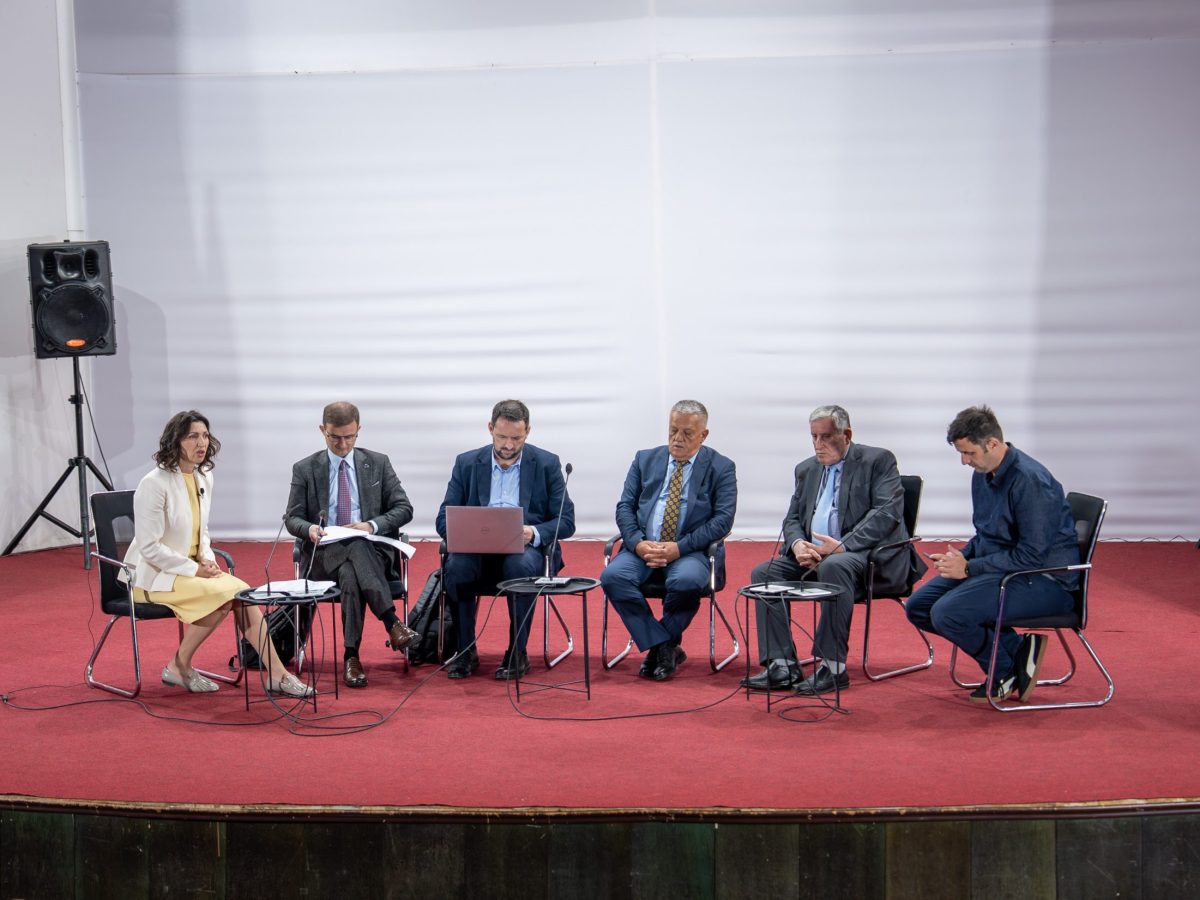
At a public debate on missing persons in Kosovo on May 12 held in the municipality of Drenas, institutional representatives, journalists, family members and citizens discussed the challenges in the search for missing persons and the role of transitional justice within the regions of Drenas, Skenderaj, and Vushtrri.
This event was organised as part of a broader series of public discussions on transitional justice and missing persons in Kosovo.
The debate was preceded by the screening of a documentary produced by BIRN Kosovo, which addresses the stories of persons who disappeared during the Kosovo war through testimonies from family members still searching for their loved ones from both Albanian and Serbian communities.
Produced as part of the EU-funded project “Unveiling the Truth: Combating Monoethnic Journalism and Advocating for Missing Persons in Kosovo,” the documentary highlighted the lasting impact of war crimes on families and communities across Kosovo.
According to the data presented, 1,560 persons remain missing in Kosovo, while 145 people from the Drenas, Skenderaj and Vushtrri region are still unaccounted for.
The discussion that followed the film was moderated by BIRN Kosovo Executive Director and journalist Jeta Xharra and included representatives from Kosovo institutions and civil society organisations involved in the process.
Panelists included Ilir Morina, from the Special Prosecution, Kushtrim Gara, from the Government Commission on Missing Persons, Ahmet Grajqevci, from the Association of Families of Missing Persons, Arsim Gerxhaliu, from the Institute of Forensic Medicine, and Kreshnik Gashi, from KALLXO.com.
They emphasized the importance of keeping public attention on the issue and strengthening accountability and cooperation as part of Kosovo’s broader transitional justice process.
Participants discussed institutional challenges in locating and identifying missing persons, the importance of interinstitutional cooperation and the need for continued support for families still seeking information about their relatives.
The event was attended by 53 participants, of whom 16 were women. Participants included representatives from local authorities in the Municipality of Drenas, civil society organisations, students, media representatives and family members of persons missing from the war.
This event was organised in the framework of “Unveiling the Truth: Combating Monoethnic Journalism and Advocating for Missing Persons in Kosovo” project, funded by the European Union.