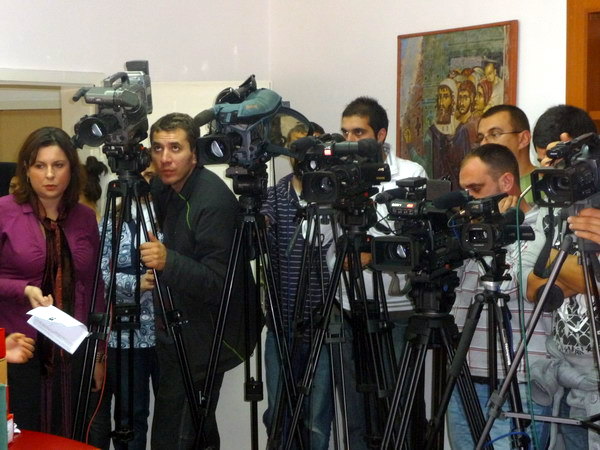
BIRN Macedonia Launches Fourth Call for Investigative Reports

BIRN Macedonia, together with Centre for Investigative journalism – SCOOP Macedonia and the Centre for Civil Communications launched the fourth call for investigative stories on May 5th.

The call is part of the ‘Project for Investigative Journalism and Cooperation Between Media and Civil Society’, part of a USAID programme for strengthening independent media in Macedonia.

In this call that closes on May 26, at least five journalists will be awarded a grant to cover their expenses while doing the investigation and writing the story. More calls for investigative grants will follow, for a total of 40 stories until June 2015.

Journalists will have about three months to dig deeper and research their ideas, but also will have the opportunity to work with experienced editors as their mentors to guide them through the process of writing to BIRN standards.

Topics for investigations include: health; cultural policy; education and youth; human rights; EU integration; good governance; inter-ethnic relations; environment issues; marginalised groups; quality of life.

The call only applies to journalists from Macedonia.

Click for more information about the application procedure, with details in Macedonian.

BIRN Macedonia Launches Third Call for Investigative Reports

BIRN Macedonia, together with Centre for Investigative journalism – SCOOP Macedonia and the Centre for Civil Communications launched the third call for investigative stories on January 10.

The call is part of the ‘Project for Investigative Journalism and Cooperation Between Media and Civil Society’, part of a USAID programme for strengthening independent media in Macedonia.

In this call that closes on February 4, at least five journalists will be awarded a grant to cover their expenses while doing the investigation and writing the story. More calls for investigative grants will follow, for a total of 40 stories until June 2015.

Journalists will have about three months to dig deeper and research their ideas, but also will have the opportunity to work with experienced editors as their mentors to guide them through the process of writing to BIRN standards.

Topics for investigations include: health; cultural policy; education and youth; human rights; EU integration; good governance; inter-ethnic relations; environment issues; marginalised groups; quality of life.

The call only applies to journalists from Macedonia.

Click for more information about the application procedure, with details in Macedonian.

BIRN Macedonia Holds Promotion For Balkan Fellowship

The Balkan Investigative Reporting Network office in Macedonia on December 25 organized a reception to promote the 2013 Balkan Fellowship for Journalistic Excellence.

BIRN Macedonia Director Ana Petruseva explained the program to representatives of different media and non-governmental organizations and encouraged Macedonian journalists to apply for next year’s program, which opens in January under the topic “Generations”.  

In the premises of the Journalism Club in Skopje, two Macedonian Fellows for 2013, Meri Jordanovska and Goran Rizaov, shared experiences of working and investigating in the framework of the Fellowship.

Both agreed that it had been a valuable experience for them and had offered them important opportunities to conduct in-depth research.

“This was a one of the best experiences for me. It was hard and exhausting but very interesting and valuable,” Jordanovska said.

The Balkan Fellowship for Journalistic Excellence program was founded in 2007. It is supported by Erste Foundation and implemented by the Balkan Investigative Reporting Network.

BIRN Macedonia Launches Prizma.mk Website

The Balkan Investigative Reporting Network in Macedonia has launched a new website designed to mutually benefit the independent media and the civil society sector.

The website, launched on Tuesday, is part of the project for investigative journalism and cooperation between media and civil society, which is part of USAID’s program for strengthening independent media in Macedonia.

Prizma is a project website designed to promote investigative journalism as well as cooperation between journalists and non-governmental organizations.

The interactive website will publish investigative stories, analysis, reports, blogs, but also news from civil society organizations as well as publications, tools, books and guides published by the NGO sector.

The core idea is that Prizma will foster the creation of networks between journalists and editors as well as between media workers and NGO representatives with the goal of closer cooperation, which will then encourage publication of more credible and more precise reports by journalists while increasing the visibility of NGOs. 

Pulitzer Prize-Winner Leads BIRN Training in Macedonia

The Pulitzer Prize-winning US journalist and editor, John Ullmann, was the key trainer at BIRN’s investigative journalism training session in Berovo, eastern Macedonia, at the weekend.

Fourteen Macedonian journalists spent the weekend sharpening their investigative reporting skills and gaining insights into ways of gathering and managing information and writing up their stories.

Thoughts were also shared on journalistic research methods and ethics.

Ullmann praised journalists in countries like Macedonia who pursued their stories despite pressure on them to stop.

“I have nothing but admiration for any journalists anywhere who continue to try to do what’s right against the pressure that exists to keep them from doing it,” Ullmann told BIRN.

“I am sure there are many more journalists who care about the craft of journalism and about doing it right, the best they can, and I just hope they’ll keep at it,” he said.

Ullmann, 68, was the first executive director of Investigative Reporters and Editors, IRE, an international network of journalists, and started most of its programmes during his six years there, including The IRE Journal, its database, and other projects.

Projects that he supervised have won more than four dozen awards, including the 1990 Pulitzer Prize for investigative reporting. Two other stories that he worked on were Pulitzer finalists in other categories.

Speaking about the importance of journalism in a democracy, Ullmann said that it was crucial to hold those in power accountable for their actions and to boost public debate on important issues.

“There is not a single example that I am aware of in the world today where democracy works well without a strong free press. And those in power, who have the ability to quash it, must realise that those journalists are playing an important role, even when they do something ‘I don’t like’,” Ullman said.

“I am sure that President Obama probably has a whole list of journalists he would like to ship over here and not have to put up with anymore for the rest of his life,” Ullmann continued.

“But he knows he does not have that kind of power. Nor does he wage economic war on them, nor does he come around and try to get them fired from their jobs, or any kind of thing that sometimes happens in Macedonia,” he said.

As part of the training, journalists also heard a lecture on public information access from German Filkov, the co-founder of the Macedonian NGO Centre for Civil Communications, one of the leading anti-corruption NGOs in the country.

Filkov is an analyst and researcher in anti-corruption work and institutional transparency and has trained more than 250 journalists in investigative journalism and reporting on corruption.

The participants also picked up useful tips on how to pitch a story from Ana Petruseva, BIRN’s Macedonia country director and Balkan Insight’s managing editor.

The training, aimed at empowering Macedonian journalists with key investigative reporting skills, is part of BIRN’s ‘Project for Investigative Journalism and Cooperation Between Media and Civil Society’, part of a USAID programme for strengthening independent media in Macedonia.

The investigative process: from information gathering to an investigative story

BIRN Macedonia announces a call for journalists for an upcoming training session for investigative journalists.

The training programme is supported by the US Embassy in Macedonia, and is part of the Project for Investigative Journalism and Cooperation between Media and Civil Society, which is being implemented in the framework of the USAID programme for strengthening the independent media in Macedonia.

The invitation is restricted to journalists from Macedonia.

Click for more information about the application procedure, with details in Macedonian.

BIRN Macedonia Launches Second Call for Investigative Reports

BIRN Macedonia, together with Centre for Investigative journalism – SCOOP Macedonia and the Centre for Civil Communications launched the second call for investigative stories on September 16.

The call is part of the ‘Project for Investigative Journalism and Cooperation Between Media and Civil Society’, part of a USAID programme for strengthening independent media in Macedonia.

In this call that closes on October 4, at least five journalists will be awarded a grant to cover their expenses while doing the investigation and writing the story. More calls for investigative grants will follow, for a total of 40 stories until June 2015.

Journalists will have about three months to dig deeper and research their ideas, but also will have the opportunity to work with experienced editors as their mentors to guide them through the process of writing to BIRN standards.

Topics for investigations include: health; cultural policy; education and youth; human rights; EU integration; good governance; inter-ethnic relations; environment issues; marginalised groups; quality of life.

The call only applies to journalists from Macedonia.

Click for more information about the application procedure, with details in Macedonian.

BIRN’s ‘Digging Deeper’ Published in Macedonian

BIRN’s investigative journalism guide “Digging Deeper”, written by Sheila Coronel, director of the Stabile Center for Investigative Journalism and professor at Columbia University, New York, has been published in Macedonian.


The guide for the investigative journalists in Macedonian, entitled “Pod povrshinata”, will be distributed to universities and libraries across Macedonia but also to journalists involved in different projects implemented by BIRN Macedonia. The handbook’s translation and print was funded by the Foundation Open Society Institute Macedonia.

Digging Deeper” is a product of BIRN’s Investigative Reporting Initiative, an educational programme that includes cooperation with international universities and local partners with the aim of putting the guide into commercial use as a curriculum for investigative reporting.

In the guide, journalists’ articles, coupled with interesting advice, skills, investigative stories, databases, case studies, exercises and tips and techniques inspire readers to take up the challenge of a career in investigative journalism.

BIRN’s “Digging Deeper” is part of the curriculum of the BIRN Summer School of Investigative Reporting LINK. BIRN has published two editions of the book in English, which has been translated into Serbian and Albanian as well as Macedonian.

All who are interested in obtaining free copy of this valuable guide for investigative journalists should contact BIRN Macedonia office at this email address: [email protected].

See the full text in Macedonian here.

BIRN Macedonia Project Has Visible Results

BIRN Macedonia has recorded visible successes and made an evident impact with its Project for Investigative Journalism and Cooperation between Media and Civil Society.

The project, forms part of the USAID Programme for Strengthening the Independent Media in Macedonia.

The first visible results are the outcomes of a series of debates organized over the past three months aimed at strengthening cooperation between journalists and civil society.

Ten common issues were detected at a debate in mid-April where about 90 NGO representatives and journalists debated for almost three hours, suggesting different topics of common interest.

Each debate was based on a specific topic on which journalists and NGO representatives with expertise in the selected topic were invited to share experience and knowledge, discuss obstacles and positive aspects from their cooperation, and share ideas for further, more intense collaboration.     

Ana Colovic Lesoska, from Ekosvest, an organization involved in several of the debates, says the meetings were more than necessary.

“I can only share positive impressions from these debates. I was surprised by the number of journalists attending them, especially the debate on the environment, having in mind the complexity of this topic,” she said.

“Being aware that the aim of these events was to stimulate investigative journalism and reinforce cooperation between journalists and civil society, I believe the linkage established between those two parties will serve as a base for successful future cooperation between them,” Lesoska added.

The events provided an opportunity for many organizations working on a local, regional and national level in Macedonia to meet the journalists covering these topics, and so improve communications while boosting their own public profile.

Irena Cvetkovic, from the Sexual and Health Rights of Marginalized Communities organization noted real improvements in the reporting on marginalized groups following the debate on marginalized communities in Macedonia.

“After a long period there was an article on drug users that did not stigmatize this marginalized group and brought in opinions from various experts in this field,” she noted.

“This article resulted from a conversation I had with a journalist from Dnevnik (a Macedonian daily) at one debate, which was followed by my recommendations for relevant sources and experts. The article was rapidly shared on social networks, and recognized as a rare example of correct media coverage on the topic of the war against drugs,” she added.

“This might look like a small step, but I believe it is a big step forward for journalism in Macedonia,” Cvetkovic concluded.

The debates provided many opportunities for journalists as well. Kristina Ozimec, a young journalist who attended most of the debates, said: “It was an advantage to sit at the same table with activists and people from NGOs and openly discuss all issues, from human rights and education to inter-ethnic relations and European integration,” she said.

“For me, as a journalist, it was helpful to get tips and leads into many of the problems mentioned in the debates, because most of them can be developed into good stories,” she added.

“Hopefully, this cooperation over time will intensify and be more noticeable through higher-quality journalism and the visibility of some significant NGO projects that are important to citizens.”

Ozimec said she had written several articles based on information shared in the debates she attended, such as one on higher education in Macedonia, entitled “More faculties, less knowledge.” 

Veteran journalists were also actively involved in the debates. Mence Toci, a journalist with more than 20 years’ experience, awarded at the first call for investigative stories from this same project, used the opportunity to film short interview  with Andrej Senih from HERA on the treatment that patients with HIV and AIDS are having in the hospitals in Macedonia and the risks from the lack of medicine that they are facing. The interview was filmed during the debate dedicated on health.

“These debates were an appropriate place for journalists to address their need of fresh information, studies, analysis and statements that can be used as sources, coming from the NGOS,” she said.

“Journalists these days are in a very tough position, facing a lack of information, especially when it comes to politicians, who usually cooperate only with a few media,” Toci noted.

The Project for Investigative Journalism and Cooperation between Media and Civil Society was lunched in February 2013 and it will end in July 2015.

In the first phase of the project implementation, 11 debates were organized. The first, on April 17, focused on detecting common issues, while the last was on June 20, where the main topic was Macedonia’s EU Integration process.

All debates reached high visibility and outreach by involving more than 200 NGO representatives and journalists as visitors and active participants.

As result of their involvement dozen of articles were published in the media, such as an analysis on internal migration from smaller cities in Macedonia to Skopje, which was published as a result of the debate on the quality of life, and the columns of Koco Andonovski, an LGBT activist working for the Helsinki Committee from Macedonia as well as the column of Magdalena Manevska from the youth organization Center for Intercultural Dialogue from Kumanovo on youth and tolerance.

Asked to sum up the experience of the debates, Cvetkovic said: “These meetings and debates were excellent opportunity for both journalists and civil society representatives to understand and reinforce cooperation.”

Photo gallery from all events is available at the BIRN Macedonia Fan page.

See the full text in Macedonian here.

Annual meeting of BIRN Assembly and Steering Board

BIRN brought together its Steering Board and Assembly members for their annual meeting in Belgrade from July 9-12.

The meeting takes place each year in the Serbian capital to enable Board and Assembly members to discuss BIRN’s ongoing activities and its plans for strategy development.

During the three-day meeting, a new BIRN statute that was presented last year at the Board meeting and an audit of BIRN HUB was endorsed.

Ana Petruseva, one of the founders of the BIRN regional network and BIRN Macedonia, said: “This helps us get clear picture how to proceed with new and ongoing BIRN activities.”

Local BIRN directors presented also all their country activities and strategic and operational issues to the members of the Assembly.

The possibility of opening a BIRN office in Albania was also discussed.