Aleksandra Vrbica

Based in Belgrade, Aleksandra joined BIRN in October 2023 as a Communications Manager. Her main responsibilities include developing and implementing communications strategies and work plans, designing promotional campaigns, and working closely with the programme departments, social media team and editorial team to ensure its content reaches target audiences.

Previously, Aleksandra worked as a journalist and a Social Media manager and has extensive experience in journalism, communications and Social Media.

For three years, she worked at the EU Info Centre in Belgrade as a Social Media Officer and was responsible for the EU Delegation’s SM accounts, amongst other things. During this period, she also gained valuable experience in project communications.

She has been awarded by the Serbian Public Relations Society and the 2020 EU Delegation to Serbia for the campaign “They Are Heroes”.

Aleksandra studied at the Faculty of Political Sciences, at the University of Belgrade. Her major was Journalism and Communications. Also, she has an MA degree in Social Policies. In addition to her formal education, she has attended various Social Media courses and seminars.

Along with her native Serbian, she speaks English.

BIRN’s Citizen Reporting Tool Presented in Greece

BIRN’s Engaged Citizen Reporting tool was presented at the International Journalism Forum in Greece for the first time.

In the context of the International Journalism Forum 2023, an annual journalistic meeting organised by Greek non-profit iMEdD (incubator for Media Education and Development), Balkan Insight’s Managing Editor, Dusica Tomovic, presented BIRN’s Engaged Citizen Reporting ECR tool.

“ECR tool is the fastest way to get to the real people, as our main scope is to report with them, not only about them,” Tomovic told the audience of journalists and journalism students from Greece and other countries.

ECR is not only a citizens’ engagement tool; it is an original, trustworthy and inspiring mechanism that creates bonds among society members and impactful stories that matter.

Presenting some of the most successful stories created through ECR, such as “Flight Delayed: Air Serbia Faces Capacity and Quality Questions,” “Childbirth Often Traumatic in CEE, But Few Women Seek Redress,” and “TikTok Balkans: Alarm Bells over Child Access to Video App,” Tomovic explained how it works. Besides the callouts for engagement, journalists must analyze the data they collect, verify and fact-check them and then produce the story.

In the past four years, BIRN has trained 75 media outlets from six Western Balkan countries on how to use the ECR; a total of more than 400 videos, articles, features, and podcasts on health, environment, social issues, etc, was produced through ECR.

Users of the BIRN investigative reporting tool say it has transformed the way they communicate with their audiences who feel empowered by helping shape the content of their own media.

BIRN continues to support local media to further develop their skills in engagement journalism and raise their editorial standards, with a focus on storytelling, data analysis, verification and fact-checking, contributing to the fight against misinformation and disinformation.

The International Journalism Forum 2023, an annual journalistic meeting organized by iMEdD, was held in Athens from September 28 to 30. iMedD is a non-profit founded in 2018 with the exclusive donation of the Stavros Niarchos Foundation.


Ten Media Outlets Complete Projects Under Audience-engaged Journalism Grants Scheme

After eight months of dedicated work, ten media outlets have successfully completed their projects under the Audience Engaged Journalism Grants scheme. This program stands as a cornerstone of the Media Innovation Europe project, which aims to strengthen media outlets in an ever-evolving media landscape. Simultaneously, these outlets strive to attract new audiences while delivering high-quality content that resonates with their communities.

At the heart of this initiative lies the concept of audience engagement. The ten grant recipients from Balkan and Visegrad countries directly involved their communities in the storytelling process, utilising an audience-engagement digital tool developed by the Balkan Investigative Reporting Network, BIRN.

“The audience-engaged tool was a very positive and useful way of letting people be heard and finding out what’s important to them,” Budapest-based Atlatszo testified. They used BIRN’s platform to collect personal health information from hundreds of patients, revealing the existence of unofficial waiting lists in Hungary – a concerning crisis in the country’s healthcare system.

Through innovative methods such as crowdsourcing personal experiences, data, photos and engaging with sensitive communities, the media outlets have produced impactful investigative stories. The collaborative effort has resulted in numerous successful narratives that shed light on critical issues affecting their local and regional communities.

Srebrenica-based UPS sought to understand the unemployment challenges faced by young people in a small local community devastated by high rates of youth emigration. They turned to crowdsourcing personal experiences, echoing the approach taken by the Kujto Foundation, which used human stories and institutional confrontations to expose Albania’s neglect of the missing persons issue during the communist regime – a three-decade-long silence that left families to search for their loved ones’ remains on their own.

The investigative approaches employed in these initiatives have shown exceptional effectiveness in engaging communities on important issues and shedding light on matters of significance to them.

In Skopje, Lice v Lice reached out to women victims of domestic violence, with the aim of influencing decision-makers to improve protection. Kosovo 2.0 delved deep into the subject of revenge porn, a topic that increasingly affects women. Montenegro’s Roditelji collected thousands of testimonies from women who had experienced obstetric violence, amplifying the voices of women who “are not heard”. “The project encouraged a large number of women to speak about their experience,” said the journalists of Roditelji.

The Audience Engaged Grants project is designed to encourage media outlets to engage diverse audiences, with a particular focus on women, youth, and minorities. Vis and Oko engaged with youngsters in Serbia and North Macedonia to uncover the problem of school violence in the online world, casting a spotlight on this concerning issue in the region. “TV Channel VIS reached more young audience on social media profiles, and awareness for our media outlet grew among young people,” said the TV VIS journalists from Strumica, North Macedonia.

Subotica-based Subotičke and Prague-based Romea involved the Roma community in their reporting to combat prevalent stereotypes. “We have seen a strengthening bond with the Roma community, fostering mutual understanding and trust,” said Subotičke.

Romea journalists received audience suggestions through BIRN’s tools, contributing to their award-winning show, “Desetminutovka puls”, while investigating inequalities in Roma representation in the Czech media. The Romea TV show featured ten Roma characters in order to provide a counter-narrative to prevailing stereotypes about the community.

To empower these outlets to effectively tell their stories, the participants received funding for their individual or cross-border story, access to the audience-engaged tool and four days of training. They also were assigned a BIRN mentor to work closely with them on story development.

Launched on June 1, 2022, “Media Innovation Europe: Energizing the European Media Ecosystem is a two-year program led by the Vienna-based International Press Institute, IPI. The consortium brings together the Berlin-based Thomson Foundation, the Kyiv-based Media Development Foundation, MDF, and BIRN.

During the first cycle of the Audience Engaged Journalism grants run by BIRN, more than 30 journalistic products were made, including podcasts, investigative articles and radio and television shows.

As the first cycle project concludes, the broader impact of the stories created by the grantees will continue to resonate, promising a more informed future for both media and their audience.

Co-funded by the European Union. Views and opinions expressed are however those of the author(s) only and do not necessarily reflect those of the European Union or European Commision. Neither the European Union nor the granting authority can be held responsible for them.

EU Awards for Best Investigative Journalism in Serbia Announced

On September 28, in the EU info centre in Belgrade, the winners of the EU Awards for Investigative Awards for Investigative Journalism in Serbia were announced.

KRIK, CINS and a BIRN team of Jelena Zorić and Vuk Cvijić were selected from many colleagues as this year’s winners for their stories published in 2022.

The jury consisted of Tamara Skrozza a journalist who has worked for radio, press and TV productions and engaged with a number of different media outlets; Snjezana Milivojevic, a professor of public opinion and media studies who chaired doctoral and master’s programs at Bayan College in Oman and the University of Belgrade; and Sasa Lekovic, President of the Investigative Journalism Centre, based in Croatia, a reporter and editor and a licensed investigative reporting trainer and lecturer.

The first prize went to the KRIK team (Stevan Dojčinović, Bojana Jovanović, Milica Vojinović and Ana Adžić) for their stories on the Darko Šarić clan.

The second prize was shared between CINS and BIRN. The CINS team (Stefan Marković, Teodora Ćurčić, Jovana Tomić, Ivana Milosavljević and Vladimir Kostić) was awarded for their stories on political party financing.

Jelena Zorić from BIRN was awarded for her stories about medical malpractice in the sensitive area of psychiatric health.

The third prize went to Vuk Cvijić of NIN for his investigations into the connections between criminal circles and state officials, and CINS/BIRN (Dina Đorđević, Marija Ristić, Jovana Tomić and Saša Dragojlo) for “Paths of Serbian weapons”. Part of this series is the investigation “Serbian Rockets Sent to Myanmar Even After 2021 Coup”, a cross-border collaboration between BIRN, CINS, Myanmar Witness and Lighthouse Reports, originally commissioned at the BIRN Summer School of Investigative Reporting in Dubrovnik in 2021.

Manuel Munteanu, Head of Press and Info and Deputy Head of Political Section of the EU Delegation in Serbia, gave a speech highlighting the importance of independent media and extending congratulations to the winners.

Davor Marko from Thomson Media introduced the project and the importance of the EU awa for supporting investigative journalism in the Western Balkans and Türkiye. Snjezana Milivojevic, representing the jury, provided a detailed explanation of the award selection process and announced the recipients of each awarded position.

More information can be found here.

The EU Award for Investigative Journalism 2023 is part of the project “Strengthening Quality Journalism in Western Balkans and Türkiye II”. This aims to recognise and promote outstanding achievements in investigative journalism as well as improve the visibility of quality journalism in the Western Balkans and Türkiye.

The project is funded by the European Union and it is implemented by a consortium composed of Balkan Investigative Reporting Network – BIRN Hub, Central European University (CEU) – Hungary, the Association of Journalists (AJ) – Türkiye, Thomson Media (TM) – Germany, University Goce Delcev Stip (UGD) – North Macedonia, The Independent Union of Journalists and Media Workers (SSNM) – North Macedonia, Media Association of South-East Europe (MASE) – Montenegro, and Balkan Investigative Reporting Network Kosovo (BIRN Kosovo).

Meet the People Behind BIRN: Sasa Dragojlo

Each month, BIRN introduces you to a different member of its team. For September, meet Sasa Dragojlo, Balkan Insight’s Serbian correspondent.

Sasa Dragojlo, 33, wanted to write poetry with rhythm and hip-hop music but at the same was curious about people and the world. Eventually, he decided to become a journalist because it combines all of these.

Before journalism, he did many jobs from working in call centres to warehouses; however, in April 2015 he grasped the opportunity to work for BIRN. Since then, he has never quit this “nutjob profession”, as he calls it.

His favourite topics to work on are about corruption, crime, human trafficking, etc. Together with BIRN’s Kosovo correspondent, Xhorxhina Bami, he worked on an investigative story on the weaponry seized from Serb gunmen in northern Kosovo.

Recently, he won third prize as part of a team of BIRN and the Centre for investigative journalism of Serbia CINS for an investigation into Serbian arms exports to Myanmar following the army coup in that country. He also won third prize in the EU investigative awards for a story on a translator for the Serbian police who led a people-smuggling gang.

Let’s meet him!

  1. Why did you become a journalist and work for an investigative non-profit like BIRN? What do you like most in your job, and what is the most challenging thing?

I always wanted something linked to writing – from literature to poetry with rhythm, etc., like hip hop music. However, I have also been curious about the world in general and why we, as individuals, act like we act and that led me to the politics of our communities and the ideologies that shape them. But I also like to be active, learn about real people and ‘fight the power’. And when you combine all that, you get journalism – an eclectic field that combines all of that. However, when I got my degree at the Faculty of Political Science the future in journalism was not so clear. I wrote columns, essays and free-form prose in multiple online media, but could not live off it, so I worked multiple ‘real jobs’ – from call centres to warehouses. I thought I would never find a media that wanted me, have enough money, or where I wanted to work (I would not want to work in 90 per cent of the media; a construction job looked more attractive). But in April 2015 I got a chance to work for BIRN and since then I never quit this nutjob profession.

  1. What kind of stories do you prefer to work on?

I like to work on stories where, along with big corruption or crime, you have a story of ordinary small people. During my career I noticed that many colleagues would avoid stories about labour exploitation, human trafficking, or the housing crisis, but chase procurement frauds or dirty things concerning big names in politics, etc. But I find it wrong, and it’s one of the reasons people do not trust old-school media. Since I started working, I always emphasized those topics and they are the ones I’m proudest of. I would not name one, because there are really a lot of them.

  1. Together with Xhorxhina Bami, you worked on an investigative story on the weaponry seized from Serb gunmen in northern Kosovo last month. Would you like to tell us more about this?

This story is a classic reaction to an event that shook the whole region and even further. We wanted to see what we can do as a proper and professional newsroom. Since both sides – Belgrade and Pristina – are not trustworthy actors and are looking for their propagandist angle, we decided to take a look at the material evidence – the weapons arsenal seized by Kosovo Police. After days of close looks at the weapons, we found our angle – a pile of weapons whose marks suggested they were made in Serbian institutions or arms factories in recent years, which made them easier to trace. Our story was the first independent evidence in this case and many regional media were interested in reporting about it. I gave numerous interviews in Serbia and a few in the region and I hope the impact will not end at that.

  1. Recently, you won third prize as part of a team of BIRN and the Centre for investigative journalism of Serbia CINS for an investigation on Serbia’s arms exports to Myanmar. Also, you won third prize in the EU awards for a story on a Serbian police translator who led a people-smuggling gang. Tell us more about these investigations.

The investigation about Serbia’s arms export to Myanmar following the army coup in that country was a great example of collaboration between different media organisations. When we found out we were working on the same story, we decided to cooperate and not to go into competition. That is the main reason I really like that story, beside it shows how business and especially the arms industry are always looking to bypass legal and ethical norms. Tackling that is one of the key goals of professional journalism.

The story “With Police Connections, Serbian-Syrian Translator Turned People-Smuggler” is one of my favourite stories. I spent months working on it, meeting sources in the crime underworld, informants of security services and police, and lost a lot of nerves to prove my claims. But the results have been rewarding. This story shows how our world works – hypocrisy and fake humanitarians, criminals and police as two sides of the same coin, violence and human rights violations as a norm – the refugee crisis as a global phenomenon we cannot escape from. As much as we ignore it, it will not stop. Things seem to get much worse, considering the ongoing ecological and social crisis, along with bloody wars all over the globe.

  1. Can you advise fellow journalists from the region on how to investigate arms trafficking? 

First, I would tell any journalist to develop sources. Go out there and speak to the devil itself. Not for exhibitionism, but to understand and collect information you will use in the public interest. You need to touch the heart of darkness in order to write about it. In our world, where the few rule the many, good contacts are essential. Important information, unfortunately, is rarely obtained through FOI requests. OSINT methods are necessary and really essential to investigate arms trafficking, but without good sources, in most cases, you are just touching the surface.


BIRN Seeks AI Researchers from Croatia and Hungary

BIRN is seeking applications for multiple positions of Country Researcher for the Global Index on Responsible Artificial Intelligence (GIRAI) project to support the development of a comprehensive set of benchmarks for measuring countries’ commitment towards responsible AI worldwide.

Who can apply?

Candidates from Croatia and Hungary are welcome to apply for this position.

Role overview

As a Country Researcher, you will be involved in gathering and assessing evidence on responsible AI commitments and progress in your designated country, contributing to advancing accountable and rights-based AI principles globally.

The main tasks and responsibilities include:

  • Collecting and evaluating data on your nation’s AI commitments and advancements.
  • Contributing to global best practices for responsible AI.
  • Attending essential training courses on GIRAI tools, methodology and data collection.
  • Complying with data quality standards, submission timelines and data collection processes set by GIRAI and BIRN.
  • Investigating key AI thematic areas: Gender Equality, Data Protection, Privacy, Bias, Discrimination, Labour Protection, Accountability, Transparency, etc.

Minimum requirements

  • Awareness of recent AI policy developments in your country.
  • Proficiency in English and at least one official language of your country.
  • Demonstrated experience in data collection and research.
  • Ability to work autonomously, meet deadlines and maintain data quality.
  • Full-time availability from mid-October 2023 to March 2024.

How to apply

Apply by completing the following application form before Friday, October 6, 2023, at 5pm (CET). Only shortlisted candidates will be contacted.

EU Awards for Best Investigative Journalism in Montenegro Announced

On September 25 in Europe House in Podgorica, the winners of the EU Awards for Investigative Awards for Investigative Journalism in Montenegro were announced.

Đurđa Radulović, Olivera Lakic, Dejan Milovac, Vladimir Otasevic, Jovo Martinovic, Marko Vešović and Andras Kiraly were selected from many colleagues as this year’s winners for their stories published in 2022 exposing offshore companies, healthcare and corruption in the justice system in Montenegro.

The jury consisted of Tena Perisin, Professor at the University of Zagreb with a working experience in CNN, who led projects like HRT news program digitisation and founded Student Television and the first Journalism Research Laboratory in the region; Nataša Ružić, an academic and a journalist who worked as a journalist at Radio Golos Rossii and as editor-in-chief of the youth paper Zerkalo;  Boro Kontic,  awarded journalist and Director of the Media Center in Sarajevo.

The first prize went to Đurđa Radulović from CIN-CG for her article “Silence Surrounding Violence – Maternity Wards Violate WHO Recommendations”.

The second prize went to Olivera Lakic of Libertas Press for her series of articles on corruption in the Montenegrin judicial system and on crime and corruption within Montenegrin police structures.

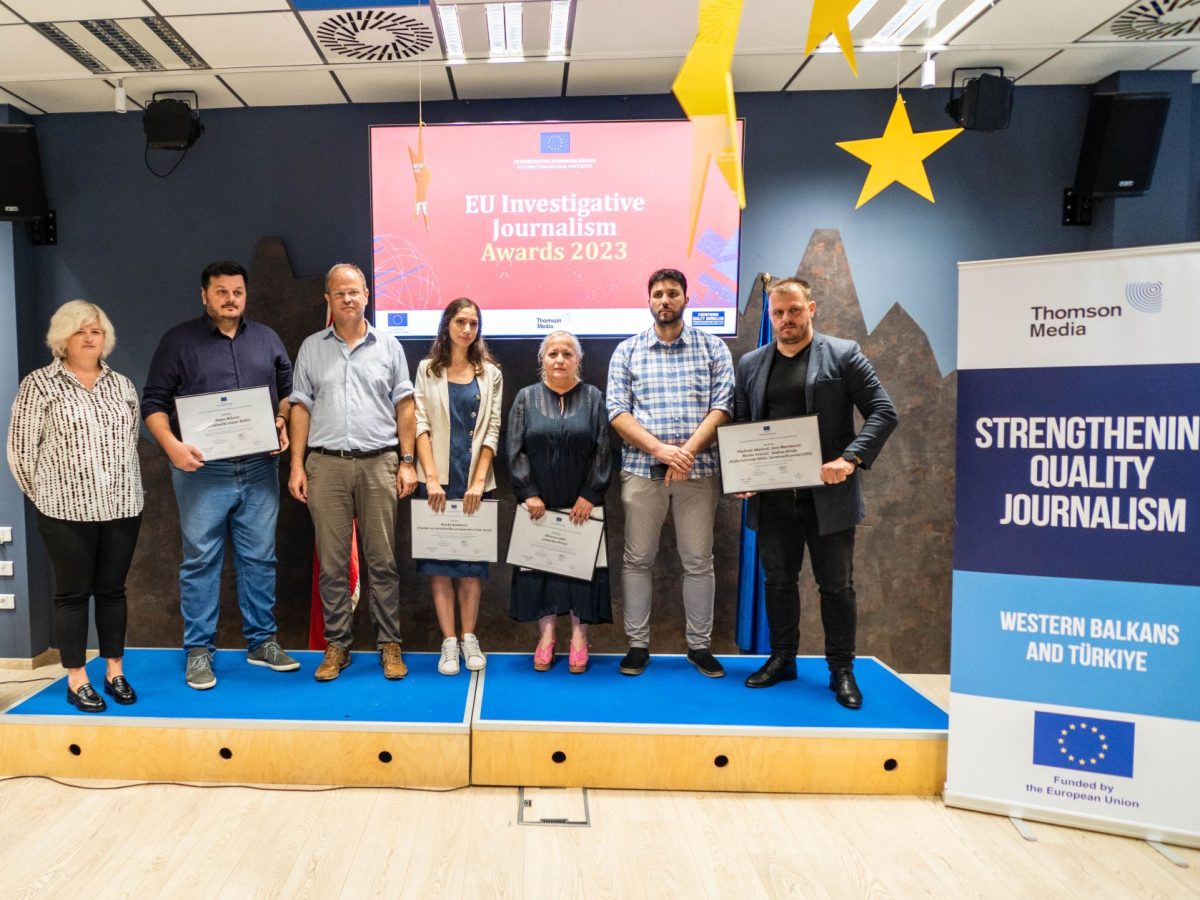
The third prize was divided between Dejan Milovac from NVO MANS   for his investigation into the Pandora Papers, revealing Russian offshore millions invested in luxury real estate in Montenegro, and Vladimir OtasevicJovo MartinovicMarko Vešović and Andras Kiraly (Istraživački portal LUPA, RTV Nikšić) for  their story, “Secret E-gambling Affair”.

Oana Cristina Popa, Head of the EU Delegation to Montenegro, greeted the participants via a video message highlighting the importance of the awards and investigative journalism. The jury members presented their decisions and announced the awardees.

More information can be found here.

The EU Award for Investigative Journalism 2023 is part of the project “Strengthening Quality Journalism in Western Balkans and Türkiye II”. This aims to recognise and promote outstanding achievements in investigative journalism as well as improve the visibility of quality journalism in the Western Balkans and Türkiye.

The project is funded by the European Union and it is implemented by a consortium composed of Balkan Investigative Reporting Network – BIRN Hub, Central European University (CEU) – Hungary, the Association of Journalists (AJ) – Türkiye, Thomson Media (TM) – Germany, University Goce Delcev Stip (UGD) – North Macedonia, The Independent Union of Journalists and Media Workers (SSNM) – North Macedonia, Media Association of South-East Europe (MASE) – Montenegro, and Balkan Investigative Reporting Network Kosovo (BIRN Kosovo).

BIRN Seeks AI Researchers: Applications Open

BIRN is seeking applications for multiple positions of Country Researcher for the Global Index on Responsible Artificial Intelligence (GIRAI) project to support the development of a comprehensive set of benchmarks for measuring countries’ commitment towards responsible AI worldwide.

Who can apply?

Candidates from Albania, Bosnia and Herzegovina, Croatia, Greece, Hungary, Kosovo, Montenegro, North Macedonia and Romania are welcome to apply for this position.

Role overview

As a Country Researcher, you will be involved in gathering and assessing evidence on responsible AI commitments and progress in your designated country, contributing to advancing accountable and rights-based AI principles globally.

The main tasks and responsibilities include:

  • Collecting and evaluating data on your nation’s AI commitments and advancements.
  • Contributing to global best practices for responsible AI.
  • Attending essential training courses on GIRAI tools, methodology and data collection.
  • Complying with data quality standards, submission timelines and data collection processes set by GIRAI and BIRN.
  • Investigating key AI thematic areas: Gender Equality, Data Protection, Privacy, Bias, Discrimination, Labour Protection, Accountability, Transparency, etc.

Minimum requirements

  • Awareness of recent AI policy developments in your country.
  • Proficiency in English and at least one official language of your country.
  • Demonstrated experience in data collection and research.
  • Ability to work autonomously, meet deadlines and maintain data quality.
  • Full-time availability from mid-October 2023 to March 2024.

How to apply

Apply by completing the following application form before September 25, 2023, at 5pm (CET). Only shortlisted candidates will be contacted.

BIRN Holds Data Journalism and OSINT Training in Montenegro

The Balkan Investigative Regional Reporting Network, BIRN Hub and partners from Germany, Georgia and Uzbekistan organised a three-day training course to boost the reporting skills of group of international journalists in Montenegro.

A total of 20 journalists from Bosnia and Herzegovina, Serbia, North Macedonia, Montenegro, Georgia, Uzbekistan and Tajikistan spent a weekend in the Montenegrin coastal town of Budva from September 7-11, honing their data journalism and open-source intelligence (OSINT) skills.

During the training course, which the participants worked with trainer Carolyn Thompson, a freelance journalist and editor who is an expert in data journalism and OSINT.

Thompson covered the core concepts of data journalism – what it is; how does coding contribute; how to think about data and where to find it.

She also talked about advanced techniques – pivot tables, practicing visualisations – and dedicated a full session to giving journalists the opportunity to try out these methods on their stories, with her mentorship and guidance.

Thompson also covered basic OSINT concepts and advanced techniques, also dedicating a full session to letting participants practice the skills they learned on the stories they are working on as part of the project.

In a separate session with regional editors, the participants discussed the progress of their cross-border and cross-regional projects, and were asked about the challenges and obstacles they came across while working on their joint projects.

Apart from the sessions, participants spent the afternoon at the luxury Porto Montenegro complex in the town of Tivat with Sinisa Lukovic, a prominent Montenegrin journalist.

Lukovic walked them through the complex and explained the origins of the investment and its positive and negative effects on Tivat and Montenegro in general.

The workshop is part of the project ‘Spheres of Influence Uncovered’, which is jointly being implemented by BIRN, German NGO n-ost, Uzbek media outlet Anhor and Georgia’s JAMNews.

‘Spheres of Influence Uncovered’ aims to contribute to a better understanding of the roles that three key international players – the EU, Russia and China – have on the seven project countries’ economies.

During the project, the participating journalists will map the economic activities of these three players and identify the main challenges and consequences for their countries. This project is partly a follow-up to BIRN’s previous work in the sphere of foreign economic activities, explored in its interactive map of China’s activities in the Balkans.

So far, the Balkan participants have produced three country-based stories – about the effect of Russia’s invasion of Ukraine on Macedonian agriculture, about the Macedonian automobile industry being boosted by investments, and about Serbian companies and individuals blacklisted by the US continuing to win public tenders. More will be published by the end of the year.


SEE Digital Rights Network Members from Kosovo, Croatia, and Greece Meet Online

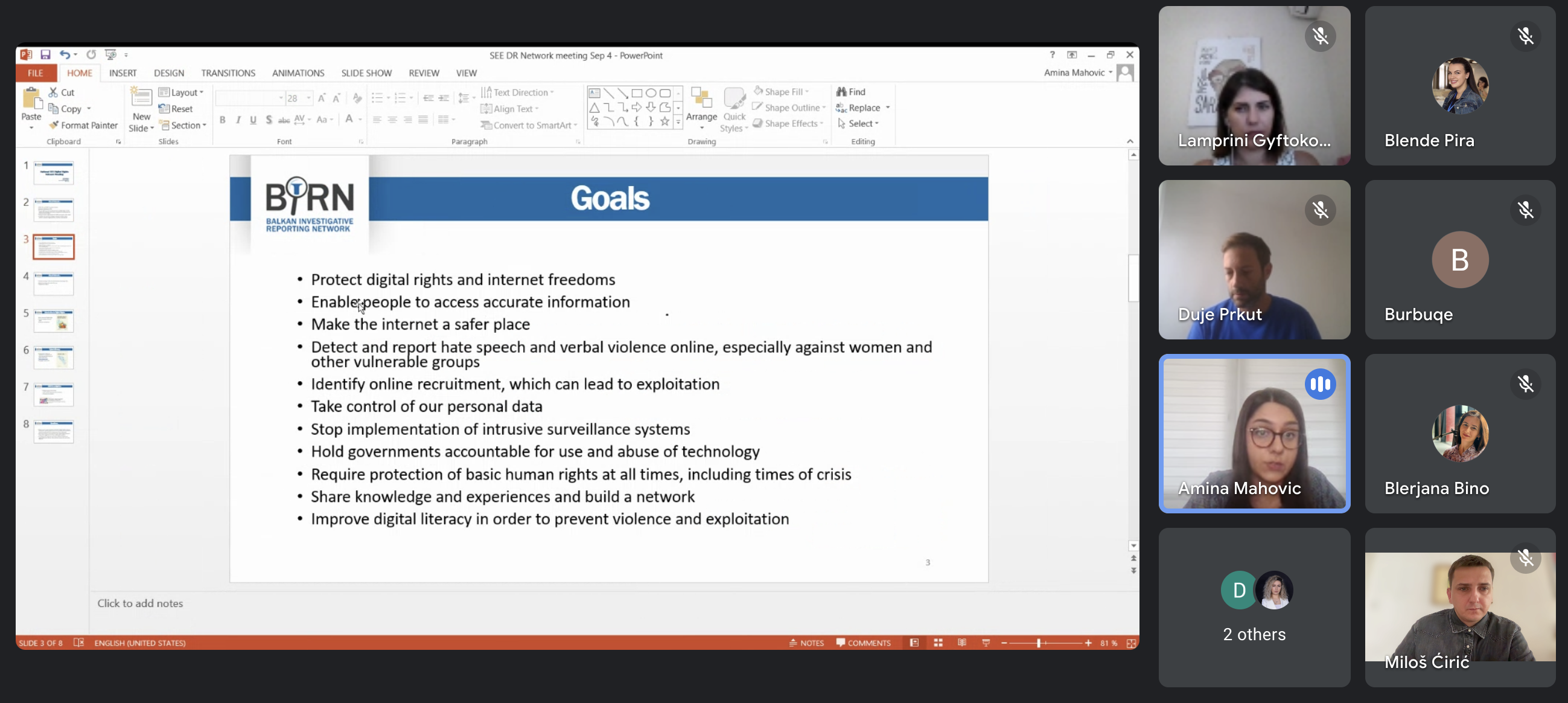
BIRN gathered SEE Digital Rights Network members from Kosovo, Greece, and Croatia to share their most recent digital rights-related projects and initiatives and talk about the future work of the SEE Digital Rights Network.


The meeting was held online on September 4, 2023, and was attended by representatives of seven organisations who shared recent experiences working in the digital rights field and showcased their plans. Representatives opened the dialogue to underline recent shared successes through the work with other SEE Digital Rights Network members, testifying about the Network’s collaborative and supportive spirit.

SCiDEV, actively working in Albania and the region, is currently working on its youth-oriented digital rights ERASMUS+ funded project by developing capacity-building programs tailored for the young from rural areas and disadvantaged groups. The project is implemented by SCiDEV and four other regional and EU-based organisations.

The organisation has its sights set on the future, hinting at upcoming collaborations with regional counterparts. While they praised the Network’s strides, they also called for enhanced communication via modern tools like Slack and a strengthened group identity.

The IPKO Foundation from Kosovo said it is excited about shaping the future of tech through its yearly event, DOKU.TECH, and empowering women and girls in the cyber world with their initiative, “Reshaping the Future”. Their ideas highlight the importance of regional meetings for generating new project ideas.

Levizja FOL, with its support for amplifying citizens’ representation in public discourse, shared insights from their recent dive into Kosovo’s cybersecurity and cybercrime landscape. They said that they focus not just on research but also advocate for tangible change, especially regarding anti-corruption measures and legal frameworks.

While YIHR Kosovo takes a broader view in its critical work in the human rights field, its partnership with the SHARE Foundation, which, together with BIRN, co-founded the SEE Digital Rights Network, has concentrated on strengthening the capabilities of activists in the digital age.

Politiscope from Croatia focused on privacy concerns, with an emphasis on protecting the nation’s youth. Its projects are charting new territories, especially in AI’s application in Croatia and Serbia. As newcomers to the Network, they’re open to mentorship and eager to share successful methodologies with fellow Network members.

Greece’s HOMO Digitalis spoke about their mission to shield digital rights. Through cooperation with EDRi and their diverse campaigns, HOMO Digitalis’ work encompasses advocacy, litigation and education in protecting digital human rights. In a spirit of unity, they proposed a shared map of all Network activities and the pooling of member publications.

Lastly, the Kosovar Centre for Security Studies, KCSS, shed light on its Emerging Threats Program, designed to demystify and tackle modern security enigmas. Their recent focus has been on the cybersecurity needs of Kosovo NGOs and fostering a cyber-aware environment for marginalized communities.

As the meeting concluded, the members committed to navigating the digital challenges together. The meeting ended with an announcement of the next gathering in December 2023, which will mark the first regional meeting of the SEE Digital Rights Network.