
Meet the People Behind BIRN: Aida Tinjak

Aida Tinjak is the Grants and Project Coordinator at the BIRN Hub.

Her professional path has taken her from art history and pedagogy through working with several non-governmental organisations, cultural and creative industries projects, and strengthening local self-government to her current position in the BIRN Hub. So, how did she manage all these positions?

Let’s meet her!

Aida’s academic background in Art History and Pedagogy from the Faculty of Philosophy, University of Sarajevo, shaped the foundation of her interest in how culture, memory, and narrative intertwine. She worked as a curator at Gallery 11/07/95, a memorial gallery dedicated to the memory of the Srebrenica genocide.

“It was there that I encountered the power of war photography through permanent and temporary exhibitions by renowned photojournalists such as Ron Haviv, Narciso Contreras, and Paul Lowe, whose work has shaped how the world sees and remembers the war. These exhibitions were not merely artistic displays—they were testimonies. They revealed to me how photojournalism, particularly war photography, operates at the intersection of art, truth, and justice. On one hand, such images preserve historical facts; on the other, they restore voice and presence to those who were silenced”, Aida explains.

This experience profoundly influenced her understanding of journalism as an active force in memory-making and truth-telling. After her time at the gallery, she worked with several non-governmental organisations on projects related to cultural and creative industries and the empowerment of local communities.

“At the same time, I tried my hand at journalism, exploring one of its many forms. However, I soon (and perhaps just in time) discovered that what resonates more deeply with me is supporting and empowering journalists—those who seek to deepen their knowledge, expand their skills, and explore new tools. I began writing articles focused on practical techniques and digital tools that journalists can use in their everyday work. The aim was not only to share useful resources, but to contribute, however modestly, to raising the overall quality of media content and building the competencies that a resilient, responsible journalism requires”, says Tinjak.

Joining BIRN felt like a natural progression for her. It allowed Aida to continue engaging with narratives that matter, with investigative journalism’s added urgency and responsibility:

“I believe that journalism and art are united by a shared impulse—to communicate, to preserve memory, and to question the world around us. Both serve as powerful tools for challenging oppressive systems and amplifying silenced voices, pushing boundaries and standing as unwavering beacons of truth in a world that often seeks to suppress them.” 

When she joined BIRN Hub as a Project/Programme Assistant in 2021, she expected hard work, persistence, and the need to grow into the responsibilities ahead.

”And that’s exactly what awaited me. The road wasn’t without its challenges, but each experience has left valuable lessons that have shaped my professional path. What I hadn’t dared to expect was the depth of connection within the team. It’s the people who make me proud to be part of BIRN—their trust, support, and understanding make every challenge easier and every success more meaningful”, explains Aida.

Now, as a Grants and Project Coordinator at BIRN Hub, her work revolves around coordinating and implementing project activities, and overseeing and managing the grant-making process. In practice, that means a great deal of communication, mostly with journalists who are grant recipients, and quite a bit of administration.

“What makes the role truly rewarding is the opportunity to connect and collaborate with journalists from different countries (even if mostly online), to read their story proposals, and to hear fresh, often powerful ideas. It makes me happy to be, even in a small way, part of the journey that leads to the production of those stories. The job requires solid organisational skills, which I’ve come to value more and more over time. I believe that when things are well structured from the start, it’s easier to navigate the unexpected. While plans sometimes shift and circumstances change, having a reliable structure in place helps me adapt and keep things moving”, says Aida.

One of the BIRN programmes Aida works on is the Fellowship of Journalistic Excellence, which covers a region spanning 14 countries, from Poland and the Czech Republic to Greece and Romania. It has been running since 2007, and more than 150 leading regional journalists have participated. The ERSTE Foundation co-funded it.

“The programme begins with a kick-off seminar in Vienna, where selected fellows from across the region meet, exchange ideas, and begin shaping their stories under the guidance of an editor. This is followed by a months-long process of research, reporting, writing, and revising, resulting in some truly exceptional stories. Many of these stories have been recognised with prestigious awards, which serve as a testament to the programme’s ability to nurture high-quality journalism in the region.

What truly stands out is that the programme doesn’t end once the story is published. Fellows who complete the programme join an expanding alumni network that offers a wealth of opportunities for collaboration, networking, and knowledge-sharing. This network plays a key role in enhancing professional growth and strengthening cross-border journalistic ties”, explains Tinjak.

BIRN is currently working on enhancing the programme’s website, which will feature some new additions, such as an alumni directory—a dynamic database where fellows can connect and showcase their professional biographies. In addition, BIRN will launch a Fellowship podcast series, designed to promote the programme’s brand and delve into the significance of long-form journalism.

Reporting Democracy is another BIRN project Aida works on, and is also supported by the ERSTE Foundation. It is focused on leveraging independent journalism to critically examine the issues shaping the future of democracy in Central, Eastern, and Southeast Europe. It has a network of regional correspondents and publishes a bi-weekly review of key democratic developments — the Twice podcast (Two Weeks in Central Europe).

“Reporting Democracy supports journalists in a variety of ways, including accepting pitches on a rolling basis, commissioning stories, and offering grants. These grants include those provided through the Fellowship for Journalistic Excellence, as well as the Travel and Reporting Programme, which funds journalists from the Visegrad region (Poland, Hungary, the Czech Republic, and Slovakia) to carry out field research and report on Balkan-related stories. In addition, we periodically offer grants for journalists from Central, Eastern, and Southeastern Europe, along with Fellowship Alumni grants available to members of the Fellowship alumni network”, said Tinjak.

In the end, we’re returning to the beginning of our story. Art history and museums’ educational functions remain Aida’s passions, but have evolved over time, although their essence remains unchanged:

“I see it as a continuous thread—quietly reminding me that there is always more to explore and uncover, and that growth often lies just beyond the familiar boundaries. I believe that a diversity of experiences and knowledge is what shapes and strengthens us, preparing us for whatever lies ahead.”

She also continued with her education, becoming a Certified New Media Designer a few years ago. Recently, she’s been revisiting that field, refreshing what she’s learned. After the work is done, Aida has her favourite activities during her spare time:

“I enjoy spending my free time with family and friends—whether that means hiking, catching a live gig, seeing a play, taking a shot at a pub quiz (with more enthusiasm than correct answers ), or simply going for a walk (and pretending it counts as exercise ). At other times, it’s about embracing stillness—giving myself and my thoughts the space to pause, regroup, and recharge for whatever comes next.”

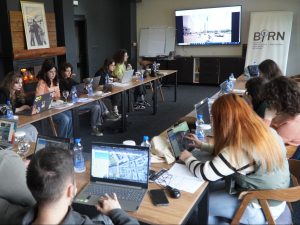
BIRN Macedonia Holds Fourth Training Session for Young Journalists

Eleven young journalists took part in BIRN Macedonia’s latest investigative journalism training session in April.

The three days of training, the fourth session in BIRN’s year-long investigative journalism programme, were held between April 25 and 27 in Mavrovo, North Macedonia.  

Journalists participated in building on the skills they have developed over the past several months, with teaching focused on strengthening their investigative and research skills and helping them pitch new, original investigative story ideas.

The training began with sessions on how to assess the scope of a story and identify strong starting points for investigation. This helped them map out the first steps in investigating a topic, how to ask the right questions, and identify the resources they would need.

On the second day, participants pitched their story ideas and received feedback from BIRN mentors and peers. The training then moved into exploring how to research different subject areas: such people, companies, and foreign entities. These sessions provided specific tools for gathering and verifying information from public records, open-source platforms, and social media, as well as ethical considerations when dealing with sensitive sources.

The final day was dedicated to learning how to use geolocation tools and online techniques to verify the exact location of an object. Through practical exercises, they worked on verifying locations with limited information, strengthening their observational skills and ability to analyse visual clues in the context of investigative reporting. The training concluded with a discussion on communication with sources, where the group exchanged methods and ethical best practices for approaching, interviewing, and protecting sources.

In the next month the young journalists will have the opportunity to pitch ideas for an investigative story. The best proposal will be developed with mentorship support from BIRN Macedonia journalist team. The summer training session, expected in June, will be the final event of the investigative journalism program. 

Request for Quotes for Digital Rights Policy Papers Development

The Balkan Investigative Reporting Network (BIRN) is seeking highly skilled experts to contribute to the Reporting Digital Rights and Freedoms project and to develop Policy Papers that will outline regulatory and policy paths to prevent digital rights violations, focusing on countries from the Western Balkans (Albania, Bosnia and Herzegovina, Kosovo, Montenegro, North Macedonia, and Serbia) and Turkey.

We specifically welcome applications from Turkey to explore the particular dynamic and evolving context in terms of digital rights and freedoms. Current policy and legislative framework in this field in the region is underdeveloped and/or obsolete. It fails to address existing challenges, let alone anticipate changes driven by the fast-changing world of technology. The aim is to identify existing regional policies that do not meet international standards and require significant changes, as well as highlight missing policies that need to be developed. These papers should offer structured, multi-sectoral approaches to identifying needs and opportunities for policy change and propose recommendations to prevent violations of digital rights.

Role Overview

BIRN is seeking proposals from qualified individuals or groups of individuals to develop a comprehensive policy paper on digital rights. The selected experts will be responsible for proposing relevant topics for the paper, conducting thorough analyses, engaging with stakeholders, and developing the policy paper. Their work will focus on providing recommendations to enhance digital rights governance, address policy gaps, and align policies with international standards.

This role requires a multi-sectoral approach, which will contribute to a deeper understanding of the needs of all stakeholders from diverse backgrounds, including journalists, researchers, activists, academics, industry players, vulnerable groups as well as decision makers. Furthermore, the selected experts will work closely with the BIRN team to incorporate insights from previous findings and monitoring cases into their work.

Main Tasks and Responsibilities

  • Conduct Desk Research: The expert will conduct desk research on digital rights issues, regional policies and the legislative framework relevant to the proposed theme. This includes reviews of existing regional and international frameworks related to digital rights and analysis of different regional case studies. The expert will analyse gaps, identify weaknesses and challenges within the current landscape, offering in-depth analysis to support further advancements in this field.
  • Conduct Interviews with Relevant Stakeholders: The expert will engage with all relevant stakeholders to gather necessary insights, which will serve to address the identified needs based on the feedback received and to incorporate them into the paper.
  • Develop the Policy Paper: The expert will develop the policy paper, ensuring it is structured, evidence-based and clearly understandable for all stakeholders. It is essential that the policy paper includes realistic and feasible recommendations, such as proposing specific amendments, new policies or legislative frameworks that can enhance digital rights protections to prevent digital rights violations in the region. Additionally, the policy paper must be grounded in international human rights standards, while being tailored to the specific context of the region.

Timeline

Work on this assignment shall start in June 2025.

Remuneration

The compensation for each Policy Paper may reach a maximum of 1,000 EUR.

Eligibility Criteria and Offer Evaluations

Applicants should have a proven experience in digital rights research, policy analysis, as well as strong understanding of digital rights. Also, applicants should demonstrate ability to produce high-quality policy papers or similar reports.

Selection Criteria:

Selection Criteria Points
Work Experience: proven experience in digital rights research and/or policy research with strong understanding of digital rights concepts 40 points
Proposed topic: relevance, clarity and feasibility of the proposed topic, demonstrating originality 40 points
Cost: Reasonable and lowest pricing in relation to the proposed Scope of Work 20 points

Offer Submission

To submit the offer, you must sign and complete Annex I – Procurement Form, Content Offer, Financial Form and Annex 2 – Declaration for Responsible Procurement. The Request for Quotes, along with the Annexes, can be downloaded here.

The complete offer with both Annexes filled and your CV must be returned to [email protected] by June 15, 2025 at 23:59 CET with the subject line: RfQ: Digital Rights Policy Paper Development.

Only shortlisted candidates will be contacted.

Regional Camp in Sarajevo Boosts Journalists’ Skills in Crisis Reporting

Journalists from across the Western Balkans participated in a three-day training course on safe reporting, crisis journalism, and digital security.

From April 28 to 30, a regional journalism camp was held in Sarajevo, focusing on legally safe reporting, crisis journalism and digital security. The three-day training brought together 25 journalists from across the Western Balkans, providing them with essential tools to navigate a complex and increasingly hostile media landscape.

Participants engaged in dynamic hands-on training sessions, expert-led panel discussions and interactive risk assessment exercises. The sessions offered practical knowledge in legally safe reporting, coverage of crises such as protests and elections and strategies to defend themselves against digital surveillance and censorship.

The training was led by three international safety experts, Sharbil Nammour, Russ Draycott and Michael Buddle, in collaboration with the ACOS Alliance.

Sessions focused on risk assessment and building real-world resilience, emphasizing both physical preparedness and digital threat mitigation.

“Our approach is very much hands-on,” Draycott said. “This is real-world training. We’re getting delegates out of their seats, onto the floor, and teaching life-saving medical skills. These experiences prepare journalists for the real problems they face today.”

Journalists in the region frequently face defamation in tabloid and social media, alongside challenges in maintaining both digital and personal safety. The camp addressed these risks through a cross-sectoral approach, drawing on expertise from multiple fields. With such training, journalist are better prepared to find interesting and hard-reaching stories.

“Sometimes these stories bring them in to conflict and even danger and what we are trying to do is to make them understand and have tools to mitigate those dangers and threats against them, whether they are personal, security or digital. Medical training is a great life skill and something that will hopefully make them feel better to cope with anything they deal with,” Draycott added.

One of the highlights was the presentation of the new BIRN report, “Surveillance and Censorship in the Western Balkans.”

The findings, presented by Megi Reçi, BIRN’s Digital Rights Research Lead, paint a troubling picture. The report reveals that governments in the region are increasingly leveraging technology to suppress dissent, censor online content, restrict access to digital platforms and carry out both mass and targeted surveillance. Read more about it here.

The camp was a joint initiative of the EU-funded project “Strengthening Quality News and Independent Journalism in the Western Balkans and Turkey II”, the Open Society Foundation-funded project “Surveillance and Censorship in the Western Balkans”, and the Austrian Development Agency funded-project “Paper Trail for Better Governance IV”. It was organised by the Balkan Investigative Reporting Network (BIRN).

The training programme has been developed in partnership with A Culture of Safety (ACOS) Alliance. ACOS works to embed a culture of safety within journalism, advance safety standards, and help journalists and newsrooms implement the Freelance Journalist Safety Principles through their safety training initiatives and resources.

Montenegro Still Awaiting Unlawful Surveillance Verdicts, BIRN Panel Hears

A BIRN Montenegro conference highlighted that court proceedings against those responsible for unlawful surveillance measures have dragged on for years – without reaching verdicts.

On April 28, BIRN Montenegro organised a panel discussion titled “Surveillance Measures and Censorship in the Digital Space,” which noted that no verdicts have been reached in cases concerning secret surveillance operations.

Former Prime Minister Dritan Abazovic recalled that court proceedings over unlawful surveillance conducted by the National Security Agency, ANB, in August 2020, have yet to conclude.

“To this day, we have no final court decisions regarding the wiretapping and surveillance activities carried out during the rule of the Democratic Party of Socialists … We exposed cases of unlawful monitoring by the ANB, and we [still] await the judiciary’s results,” Abazovic said.

Ahead of parliamentary elections, in August 2020, the portal Udar was launched, publishing articles aimed at discrediting opposition politicians, civic activists, clergy and journalists, calling them collaborators with foreign intelligence services, traitors and members of organised crime groups.

Authorities have never determined who was behind the portal, although some individuals targeted by Udar have been awarded compensation for violations of their reputation and dignity.

Journalist Petar Komnenic called the indicted former ANB director, Dejan Perunicic, “merely a pawn in the whole affair”. The indictment against Perunicic notes that ANB agents monitored Komnenic.

“These individuals certainly were not working for a private archive. It is essential to establish on whose orders they were operating,” Komnenic said.

Deputy Ombudsperson Mirjana Radovic emphasized that institutional reforms have not been swift enough – but noted that some individuals in the institutions are doing their jobs properly.

“We must find a way to overcome these challenges together, and we can only do so if institutions operate securely, efficiently and transparently,” Radovic said.

BIRN BiH and Partners Team up to Help Teach Facts about War

BIRN BiH, Srebrenica Memorial Centre and Forgotten Children of War Association launch joint initiative designed for students and teachers on judicially established facts about the Bosnian war.

This year, three organisations dedicated to transitional justice are leading study trips for students on the events of the 1992-5 war in Bosnia and are preparing materials for history teachers to teach about the past based on judicially established facts.

These facts will be supplemented by the verdicts of domestic courts, as part of activities within a broader project for building long-term peace in Bosnia and Herzegovina.

In collaboration with the Srebrenica Memorial Centre and the Forgotten Children of War Association, this year, the Balkan Investigative Reporting Network of Bosnia and Herzegovina, BIRN BiH, is launching an educational initiative for senior class students and teachers on judicially established facts about the war in order to foster dialogue and the fight against denial of judicially established facts about the war.

BIRN Bosnia and Herzegovina will draw on its experience from the past 20 years, during which it has focused on issues of transitional justice and reporting on war crimes.

“Although the prosecution of war crimes cases is now coming to a close, we continue to see historical revisionism, genocide denial, war crimes denial and relativization, as well as glorification of perpetrators, even among young people,” BIRN BiH director Denis Dzidic explains.

Following a recommendation of the Council of Europe to temporarily suspend teaching on the 1992-1995 period, since 2018 the topic has returned to curricula and textbooks.

“Research shows that there is no universal approach to this issue in schools throughout Bosnia and Herzegovina,” Dzidic notes.

It is for this reason that the three organisations wish to encourage critical perceptions among young people about the war in Bosnia through the education system and oppose historical revisionism, as well as emphasize the importance of factual knowledge of war circumstances.

BIRN BiH will expand its database of judicially established facts that includes verdicts of the International Criminal Tribunal, ICTY, in the Hague, with verdicts passed down by courts in Bosnia, Serbia and Croatia, with a focus on the suffering and war crimes rather than on the perpetrators. A new digital platform of the database will be developed, making it more accessible to children and young people.

“Based on this database, a handbook for history teachers on how to teach about the war in Bosnia and Herzegovina will be developed. This project is implemented in cooperation with education ministries across Bosnia and Herzegovina, and in consultation with history teachers. We want to create a space for dialogue, critical reflection on the past, and a healthier future for young people in Bosnia and Herzegovina,” Dzidic explains.

BIRN BiH, together with its other partners, will also organise study tours to Srebrenica, Tuzla and Sarajevo, and prepare trainings for history teachers on how to use the materials derived from this database in class when teaching about the past.

The project “Building Long-Term Peace in Bosnia and Herzegovina: Investing in the Future”, supported by the United Nations Secretary-General’s Peacebuilding Fund, PBF, promotes fact-based learning, the development of critical thinking, and intergenerational dialogue – to strengthen trust and build a more resilient and inclusive future for Bosnia and Herzegovina.

Since becoming eligible for the UN’s Peace Building Fund’s support, Bosnia has advanced six active peacebuilding initiatives focusing on social cohesion, transitional justice and the engagement of women and youth, with a total investment of about 16 million US dollars, Ingrid MacDonald, Resident Coordinator of the UN in Bosnia, explained.

“By fostering fact-based multi-perspective education about the past conflicts, this initiative in particular equips young people with the tools to think critically, confront denial and engage with diverse narratives, laying the groundwork for more informed, inclusive and resilient society,” MacDonald added.

This initiative is not only an investment in education, but in the future of Bosnia and Herzegovina, she added.

PBF is the UN’s leading instrument to invest in prevention and peacebuilding, in partnership with the wider UN system, national and subnational authorities, civil society organisations, regional organisations and multilateral banks. The Fund supports joint UN responses to address critical peacebuilding opportunities, connecting development, humanitarian, human rights and peacebuilding pillars.

BIRN Kosovo Trains Judges and Prosecutors on Violent Extremism and Terrorism Challenges

BIRN Kosovo, in cooperation with the Kosovo Academy of Justice, organized a four-day intensive training on the challenges of violent extremism, radicalism, and terrorism in Kavajë, Albania, from 13-16 April.

This training brought together judges and prosecutors, aiming at strengthen their professional capacities in identifying, prosecuting, and adjudicating terrorism-related offenses and enhancing their understanding of the evolving dynamics of violent extremism in Kosovo and the broader region, with a particular focus on right-wing and religious extremism.

The program was led by a distinguished group of experts, including Supreme Court Judge Burim Ademi, Basic Court Judge Valon Kurtaj, Special Prosecution Office Prosecutor Naim Abazi, and senior officials from the Kosovo Police, including Mensur Hoti, Fatos Makolli, and Nexhdet Haxhaj.

The start of the training was focused on the strategic objectives of Kosovo’s counter-terrorism efforts, presented by National Coordinator Mensur Hoti, followed by a documentary screening on right-wing extremism in Kosovo and a discussion moderated by Kreshnik Gashi.

Day two focused on the legal framework addressing violent extremism, an in-depth analysis of far-right extremism and its manifestation in public incidents, and a practical group exercise to analyze the push and pull factors behind radicalization.

On the third day, participants examined the overlap between terrorism and other criminal offenses and attended case studies on the spread of religious extremism and recruitment tactics in Kosovo.

The final day addressed investigative techniques and the use of alternative sentencing for cases regarding terrorism and identifying signs of extremism during the investigative phase. Participants were also presented with alternative sanctions and the sentencing process in terrorism trials, including the role of pre-sentencing reports. The training concluded with a discussion on the use of social media in spreading extremism and the balance between strategic communication and personal data protection.

By combining legal analysis, real case presentations, documentary screenings, and group exercises, the training provided a comprehensive and interactive environment for enhancing cross-sectoral collaboration in Kosovo’s response to violent extremism and terrorism.

This training was attended by 31 participants, including 14 women. The participants have actively engaged in this training by sharing experiences and asking questions on how to effectively deal with terrorism and violent extremism.

The training was part of the ‘Resilient and Inclusive Community Programme’ funded by GCERF, through ATRC and implemented by BIRN Kosovo.

BIRN’s Sasa Dragojlo to Join Panel on Corruption and Arms Diversion

On April 16, at 2.30 p.m., Transparency International US and Transparency International Defence & Security will launch a new report, “Under the Radar: Corruption’s Role in Fuelling Arms Diversion”.

The report sheds light on the often-overlooked threat of weapons falling into the wrong hands. States are realising that corruption significantly drives arms diversion, which undermines security, fuels violence and weakens military readiness.

Drawing on 400 cases of arms diversion across 70 countries, the report identifies common corruption schemes and uncovers how weak systems can be corrupted to divert weapons.

BIRN journalist Sasa Dragojlo is one of the panelists at this event, having worked as a consultant on this report. Serbia’s arms trade and corruption issues are often topics of his investigations.

“Serbia has a significant role in the global arms trade. Serbian-made weapons have found their place in many battlefields all over the world, including proxy wars,” he says.

“In that regard, for Serbia’s ruling elites, profits are the most important, as is fostering good relationships with powerful governments – mostly Western, but also those considered allies to Western powers.

“When that is the goal, turning a blind eye on corruption, or diversion of arms that end up in the wrong hands, is a small price to pay,” Dragojlo adds.

Other panelists include Colby Goodman, Senior Researcher; Mario Blanco, Project Coordinator, Transparency International Colombia; Kyrre Knutsen, Senior Adviser, Norwegian Ministry of Defence; Ara Marcen Naval, Independent Consultant, and Sarah Detzner, Independent Consultant, Security Sector Reform and Governance.

The panel will discuss the report’s main findings, share other important insights and suggest actionable steps to improve arms transfer risk assessments and strengthen institutional resilience against corruption.

The panelists will also consider the significance of international cooperation in ensuring that arms trade practices align with the objectives of the Arms Trade Treaty, ATT.

This cooperation is essential for promoting transparency and accountability, as well as for reducing the global risks associated with arms diversion.

Register HERE to attend this free online event.

Romania Faces Hidden Water Crisis, BIRN Investigation Reveals

Rural communities in Western Moldavia, a region of north-eastern Romania, face a growing water crisis, mainly due to depleted groundwater reserves and the poor management of water mains. A BIRN investigation shows that the people impacted attempt to adapt, but resolving this issue requires political solutions.

“The groundwater crisis, which particularly affects people in UW Moldova (a region in eastern Romania), did not emerge out of the blue,” says journalist Adina Florea, the author of the recent investigation published by the Balkan Investigative Reporting Network (BIRN) Fellowship program.

“Researchers have been warning for years about falling groundwater levels. But what I’ve seen is that this water crisis is also a crisis of social inequality—the most affected are people in rural areas.”

Drawing on interviews with residents and scientific experts, and supported by a comprehensive analysis of official data, Florea’s investigation presents a sobering reality: climate change is compounding the long-term effects of poor groundwater management and a broader societal failure to recognize water as a finite, vulnerable resource.

Last summer, Florea spent several weeks in over a dozen rural communities across Western Moldavia, documenting the challenges faced by locals.

Her findings reveal stark regional disparities. Nearly half the region’s population is not connected to a centralized water distribution system, relying solely on private wells or springs – more than double the national average of 23 percent. Furthermore, nearly 10 percent of the region’s rural population that relied on aquifers was facing disruptions to supply because their wells were close to drying up.

Strikingly, many of the villages hardest hit by water shortages are located just kilometers away from urban centers where water access is stable, underscoring the deepening social inequality tied to infrastructure and public investment.

Florea presented her findings during a public debate in Bucharest last week, hosted by Fundatia 9, a Romanian nonprofit that supports youth through cultural and educational programs. The event drew significant interest, particularly from attendees eager to understand what solutions might be implemented to combat water insecurity – an issue many rural residents are already trying to adapt to on their own.

In response, Florea emphasized that both central and local authorities must take the lead in developing long-term strategies for more efficient use of existing water resources. These could include rainwater harvesting systems and improved soil protection measures, aimed at enhancing natural groundwater recharge.

Citing expert insights, she also warned that “if extreme climate change causes groundwater levels to drop too far, reversing that trend may become impossible.”

Another critical challenge is water loss through deteriorating infrastructure. Official figures show that around 40 percent of water is lost through leaks and inefficiencies in Romania’s distribution networks – a figure that climbs above 50 percent in Western Moldavia. The causes, Florea noted, include aging pipes in urgent need of replacement and a system originally built for a smaller, less water-dependent population.

BIRN Launches New Digital Freedoms Monitoring Tool

On April 11, BIRN launched a new version of its Digital Freedoms Monitoring Tool to continue monitoring and documenting violations of digital rights across the region.

Since 2024, BIRN has monitored digital rights developments in ten countries: Albania, Bosnia and Herzegovina, Croatia, Hungary, Kosovo, Montenegro, North Macedonia, Romania, Serbia and Turkey.

To ensure the monitoring framework remains relevant and responsive to evolving digital rights challenges, a new methodology was developed in 2024 that has been implemented from September 2024. This builds on previous monitoring efforts while incorporating emerging digital rights violations, ensuring a comprehensive and systematic approach to documenting abuses in the online space. By continuously tracking incidents, BIRN provides crucial insights into how digital rights abuses evolve over time and how they may influence future policies and regulations.

The methodology groups digital rights violations into seven umbrella categories, applying a human rights-based approach:

  1. Freedom of expression and media
  2. Freedom, pluralism of information and protection from manipulation
  3. Personal data protection and security
  4. Digital civic participation and engagement
  5. Technological access and equity
  6. Threatening behaviour and harmful content
  7. Economic rights and digital asset protection

The methodology reflects BIRN’s commitment to media freedom, rule of law, transparency, transitional justice, internet freedom and victims’ rights. Find out more here: https://monitoring.bird.tools/

The new website was created and maintained with the financial support of the European Union, as part of the Reporting Digital Rights and Freedoms project. Its content is the sole responsibility of BIRN and does not necessarily reflect the views of the EU.