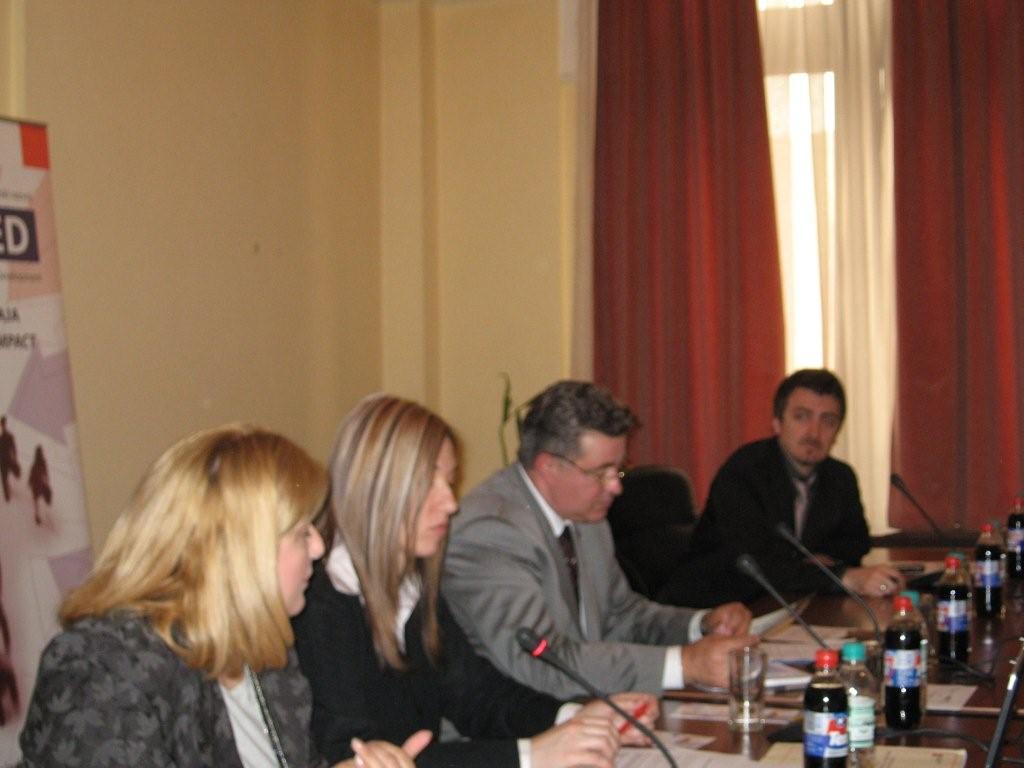
BIRN Debates Elections In Presevo Valley

As a regional network of investigative reporting, BIRN will discuss this week about the problems and challenges in the Presevo Valley. This week, three debates will be shown both in Kosovo and Serbia, aiming to inform the citizens of Presevo Valley about the platform of the political parties who run in the parliamentary and local elections in Serbia on May 11.

Few days before local and parliamentary poll takes place, BIRN will discuss with Albanian and Serb representatives from the fields of politics, economy and civil society about the main problems of both Albanians and Serbs living in southern Serbia

Has the Presevo Valley politics a self-identity or it is influenced by Pristina and Belgrade? Do local representatives have concrete projects for bettering the life of the Valley citizens? Why isn’t there potable water yet? Are there enough investments in this region? Why are Albanian and Serb youngsters leaving the valley? What is the perspective of the youth?

The debates will be broadcast in Presevo’s ALDI TV in the last week before the elections take place, in both Albanian and Serbian languages.

In addition, the same debates will be broadcast in the Kosovo public broadcaster, RTK. The debate on local elections in Presevo will be broadcast on Wednesday, May 7, whereas the debate on local elections in Bujanoc will be broadcast on Friday at 23:15.

The debate on parliamentary elections in Serbia and accountability of the local Albanian politicians towards their electorate will be broadcast on Thursday, May 8, 20:15 in RTK.

The following panellists will discuss on these debates:

The following panellists will participate in the general elections debate:

Ragmi Mustafa – Mayor of Presevo
Nikolla Llaziq – Editor of Vranjske Novonine from Bujanoc
Jonuz Musliu – Deputy Mayor of Bujanoc
Andrej Nosov – Youth Initiative for Human Rights
Baki Rexhepi – from SPEKTRI television channel and
Riza Halimi – Head of the election list from Party for Democratic Action and current member of the Serb Parliament

The following panellists will participate in the debate for local elections in Presevo:

Skender Destani – Democratic Union of the Valley, BDL
Dragolub Filipovic – ‘Serb List for Presevo’ Coalition
Riza Halimi – Party for Democratic Action, PVD
Naser Haziri – Citizens’ Group
Orhan Rexhepi – National Albanian Movement, LKSH
Basri Mehmeti – Democratic Alliance, AD and
Ragmi Mustafa – Albanian Democratic Party, PDSH

The following panellists will participate in the debate for local elections in Bujanoc:

Shaip Kamberi – Party for Democratic Action, PVD
Miodrag Milkovic – Citizens’ Group (Grupa Gradjana)
Nenad Mitrovic – Coalition for a Better Tomorrow (Koalicija za bolje sutra)
Jonuz Musliu – Democratic Progress Movement, LPD
Sali Salihu – PDSH- PDK Coalition (Albanian Democratic Party and National Democratic Party)
Dalibor Stanojkovic – Democratic Party of Serbia, DSS
Goran Taskovic- Democratic Party, Election List for Bujanoc – for a European Serbia – Boris Tadic
Mejdi Zeqiri – Albanian Democratic Union, UDSH

These debates have been endowed with the assistance of Youth Initiative for Human Rights, ALDI TV, a local television channel from Presevo, and Swiss Federal Department of Foreign Affairs.

BIRN Kosovo Director Participates In Press Freedom Debate

Jeta Xharra, BIRN’s Kosovo Director took part in the International Festival of Journalism in Perugia, Italy where she was on the panel for a discussion on Press Freedom and Human Rights, on 13 April 2008.

Image 3031

Xharra spoke about the experiences of establishing the most watched current affairs programme in Kosovo, “Life in Kosovo”, a show which tackles head-on the most pressing and controversial issues in Kosovo’s society, ranging from the lack of inter-ethnic tolerance, weak education system, corruption in the healthcare system and Kosovo’s main power supplier as well as topics such as political transparency and the much debated Kosovan identity.

Image 3034
Xharra was in a panel with Ahmat Zeidane Bichara, a journalist from Chad currently seeking political asylum in France because of the stories he has covered, Cai Chongguo, a Chinese expert on online censorship, Domenico Affinito a member of Reporters sans Frontières (Reporters Without Borders) in Italy and Enzo Nucci, the chief Nairobi correspondent with Italy’s RAI network.

The session was open to the public and the audience, mainly comprised of the students from the journalism school in Perugia, participated in the question and answer session.

Other international speakers at the 2008 festival included Carl Bernstein, Alastair Campbell, Christopher Dickey, Peter Eisner, Robert Fisk, Roy Greenslade, Bachi Karkaria, Eric Laurent, Ann Leslie, Robert Ménard, Anne Nivat, Fred Pearce, Knut Royce, Michael Specter, Alexander Stille, Philippe Val and many more.

Media represented included Al Jazeera International, BBC, Charlie Hebdo, CNN, The Daily Mail, The Daily Telegraph, The Economist, Le Figaro, France Presse, The Guardian, The Independent, The New Scientist, Newsweek, The New Yorker, The Observer, Le Point, Private Eye, Reporters sans Frontières, Reuters,
The Times, The Times of India, The Wall Street Journal, The Washington Post
and others.

More details can be found on:
http://www.journalismfestival.com/festivaldelgiornalismo.php?article162

Local media and election campaigning

BIRN Serbia, together with the Organisation for Security and Cooperation in Europe mission in Serbia organised in April, two workshops in Novi Pazar and Novi Sad for journalists and editors from local media in order to help them cover and understand the political campaign.

The event was separated into two sessions. The first focused on the legal framework, the obligations of the media in campaigns and the use of different kind of election polls.

Rade Veljanovski, a professor from Belgrade’s Faculty of Political Science gave a wide overlook of the actual conditions in Serbia and introduced participants to best European practice. He stressed that the situation in the Serbian media is not appropriately regulated because of the lack of good legislative and the absence of professional independent organisations.

Djordje Vukovic, a researcher from election monitoring body, CESID explained the difference between professionally-implemented research and false election polls whose authors are dubious. He said journalists must be aware when getting results of election polls from an undefined source.

Zoran Stanojevic from RTS presented his experience from covering the election campaigns. He compared Serbian media coverage practice with US-based media and said that here we do not have a thematic approach which is crucial in western media. He said that there was no space for real debates of the main political players because they did not show interest in taking part in that kind of programme.

Slobodan Basic and Nadezda Milenkovic gave the participants a possibility to look behind the campaign’s main stage and to understand how electoral teams work. They explained the point of view of party members and their chancellors and the way of formulating main ideas for the campaign. Basic and Milenkovic explained the different strategies and the importance of marketing and public relations in the campaigns in Serbia.

Fellowship Programme Kicks Off in Berlin

This year’s edition of the Balkan Fellowship for Journalistic Excellence was inaugurated on Thursday in Berlin.

Ten fellows from Albania, Bosnia and Herzegovina, Bulgaria, Croatia, Kosovo, Macedonia, Romania and Serbia, are taking part in events hosted by the Robert Bosch Stiftung in the German capital.

The fellows have already attended training sessions designed to help them understand international standards in journalism and sharpen their professional approach to research and writing.

The ten journalists had an opportunity to discuss this year’s theme of the programme – energy – and held individual sessions with BIRN editors, exploring the details of their planned research.

Over the following days, they will attend a set of presentations by experts on energy, government officials and civil society activists.

Then, over the coming months, they will make their individual research trips to countries in the region and the EU, followed by a seminar and award ceremony in November.

The Balkan Fellowship for Journalistic Excellence is an initiative of the Robert Bosch Stiftung and Erste Foundation in cooperation with the Balkan Investigative Reporting Network, BIRN.

Opportunities for young people in South Serbia

The fifth consecutive public debate on economic development in local communities organized by BIRN Serbia, Media Centre, NALED and Ekonomist magazine took a place in Vranje on April 11.

The event gathered more than 25 representatives from the public, business and civil sector from Pcinja and Jablanica district and the debate was focused on the problems of youngsters in that region of Serbia.

The mayor of Vranje, Miroljub Stojicic stressed the importance of the Strategy for sustainable development which defined the areas of main interest and recommended solutions. He said many things can be solved if the local community gets more decentralisation powers.

“We are forced to go to Belgrade for everything and this is big problem” said Stojicic.

The mayor said the local administration is open to new ideas and initiatives and that one should take their faith in their own hands.

Biljana Stankovic from the MIR programme presented the activities of the United Nations Development Programme in the region which were mainly based on increasing the capacities of the local administration and development in south Serbia.

Dobrila Sudimac Mratnikovic from the Centre for Regional Development in Jablanica and Pcinja district presented the possibilities for a better and stronger network between regional municipalities regarding cross-border cooperation.

The representatives of the non-governmental organisation, Generator, presented the main problems facing youths in South Serbia based on research. They stressed importance of bigger institutional involvement in these issues if the administration wants to create a good environment for youth employment.

The British Embassy in Belgrade supported this project.

“Life in Kosovo” Debates Students’ Election

This Thursday’s Life in Kosovo show will host a debate with the candidates running for the Students’ Assembly Speaker at the University of Pristina.

We will question some of the most crucial issues and problems facing the publicly-owned University of Pristina. Candidates running for the position will present their arguments on how they will fulfill their election pledges.

During the debate, candidates will be confronted with questions from university students.

Which are their priorities? How will they seek to depoliticise the students’ assembly and carry out their promises to really make a difference to students’ lives?

We will be asking these questions, plus many more.

“Life in Kosovo” is a co-production between Kosovo Public Television, RTK and the Balkan Investigative Reporting Network, BIRN. The show is broadcast every Thursday, starting from 20:15.

BIRN Protests Assault on its Albania Journalist

The Balkan Investigative Reporting Network has sent a letter to the Albanian Prime Minister expressing concern over a assault on Besar Likmeta, Balkan Insight’s editor in Albania. Numerous international media organisations, embassies and international organisations that monitor freedom of press violations were also notified of the incident.

H.E. Sali Berisha
Prime Minister of Albania
Blvd Zog I, Tirana, Albania

Mr. Grid Rroji
Director of the Communications Office for the Prime Minister

Your Excellency,

The Balkan Investigative Reporting Network, BIRN, a group of editors and media trainers in nine countries in the Balkans and publisher of Balkan Insight (www.balkaninsight.com) is alarmed and deeply concerned over the assault on our Albania editor, Besar Likmeta.

Likmeta was brutally attacked by MP Tom Doshi during an interview at the Sheraton hotel in Tirana in the evening of March 10 in front of another MP, Arben Isaraj, from the Socialist Party.

During research for an investigation about fake diplomas in Albania – published on February 20 (http://www.balkaninsight.com/en/main/investigations/8041/)- Balkan Insight obtained documents showing that one deputy, Tom Doshi, had a certified degree from Tetovo University despite the fact that he never finished his studies in law.

The Balkan Insight investigation did not contain the name of Mr. Doshi. However, as his Tetovo degree mysteriously disappeared from his CV on the web site of the Albanian parliament, Mr. Likmeta requested an interview with Mr. Doshi`s to give him the opportunity to clarify the matter.

Likmeta called the MP, Tom Doshi, on Monday, March 10th, around 9.30 and explained that in the documents Balkan Insight has obtained from the Ministry of Education, he is identified as having certified a law diploma from Tetovo University. The university has informed the Albanian Ministry of Education that Doshi’s law degree is a fake.

Doshi agreed to meet for an interview at 10.30 pm at the Sheraton Hotel in Tirana where he came with Arben Isaraj.

Through out the interview Doshi demanded to know why Likmeta was covering this story and denied he had presented any fake documents. He repeatedly told Likmeta that it was extremely brave of him to pursue this story. Isaraj than asked Likmeta if he really lived in this country and was he out of touch with reality.

“Then abruptly Doshi started hitting me with some sort of leather file holder that he had with him. He broke my glasses and gave me a black eye before leaving,” Likmeta said.

At the time of the attack in the Sheraton hotel bar, there were several witnesses: two foreigners working on laptops, MP Isaraj and the barman. No one offered help.

After Likmeta tried to get witnesses to give statement on the attack, the barman ordered him to leave, or he would be kicked out.

BIRN is deeply concerned about this attack. We urge you to do everything in your power to investigate this case and to prevent such incidents from occurring in the future. It is important to note that the journalist who was so badly mistreated was simple trying to give a member of parliament a chance to tell his side of the story. Media workers must be able to work freely.

We thank you for your attention.

Yours sincerely,

Gordana Igric
BIRN Regional Director

BIRN Kosovo Launches Public Services Monitoring Project

The BIRN Kosovo office has launched its latest project in monitoring Kosovo’s public services in order to promote transparency, accountability and make them more efficient. The project particularly focuses on municipal and district courts, health and education.

As part of this project, BIRN held a two day training on effective monitoring of public services. At the end of training, eight out of 18 participants were selected to carry out the monitoring of courts, education and the health system.

Successful candidates were picked from a number that applied to participate in the training programme.

The purpose of the training was to inform the candidates of the project substance, organisation, the monitoring system, collection methods and formats and possible challenges in implementing the project.

Training also covered issues related to monitoring each of the project’s key fields (healthcare, judiciary, and education) where candidates received lectures on the main issues and problems on each of these sectors and the indicators they’ll have to follow during the monitoring process.

The main trainer during the workshop was Ilir Hoxha while experts for the different fields were Betim Shala, lawyer; Xhafer Ahmeti, expert on education and Alban Selimi, journalist for health issues with the daily newspaper Lajm.

Participants in the training were:

Ibrahim Feimi, Leonard Ibrahimi, Arber Jashari, Isa Gacaferi, Rexhep Gashi, Shpat Kastrati, Avni Mehmeti, Jehona Ahmeti, Blerina Uka, Valdet Krasniqi, Faton Ademi, Valdrin Beka, Xhemil Klinaku, Betim Musliu, Bekim Saliu, Nexhat Xhokli, Fatmire Terdevci and Krenare Maloku.

During this project, BIRN will establish a network to monitor municipal courts as well as other institutions responsible for providing public services to citizens. This support will help ensure media and public oversight on the performance of public services in Kosovo.

This network will cover seven regions of Kosovo (Prishtina, Peja, Prizren, Gjakova, Ferizaj, Gjilan and Mitrovica) and will report back to the headquarters in Prishtina.

BIRN will use its “Life in Kosovo” show, the most watched current affairs programme in Kosovo, to broadcast the main conclusions of the monitoring results. The televised debates and investigative reports will aim to highlight the defects of the system but also the success stories in order to encourage civil servants and help build trust between citizens and institutions.

This project is supported by Rockefeller Brothers Fund.

BIRN Presentation on Rape Victims in Chicago

Marking International Women’s Day, Gordana Igric, founder and Regional director of the Balkans Investigative Reporting Network and investigative journalist, explored the power of journalism to expose rape and impunity at the third annual “International Movement to Stop Violence Against Women: Sharing Strategies” conference in Chicago, Illinois.

The all-day conference hosted presenters from Mexico, Israel and United States. Igric’s presentation, “Documenting Rape as a Tool of War: Journalism, Human Rights and Accountability”, marked the first occasion on which a presenter had been invited from the Balkans.

Audience members ranged from university students to seasoned mental health professionals working with survivors of domestic violence. Most had never heard more than headlines from the Balkans, whispers of wars far away with hard-to-pronounce names and constantly shifting borders.

Igric began by offering an overview of the systematic use of rape in the early 1990s by Serbian paramilitary forces. She focused specifically on the town of Foca, recounting her own investigations there, 15 years ago.

“I had heard of this town, Foca, this town where soldiers went to fight during the day and rape women at night,” she said. “I wanted to interview these people. These women. These men.”

Igric went on to show the CBS expose, “In Plain Sight”, which exposed on American, and later, Bosnian, television, the systematic impunity indicted war criminals appeared to enjoy, often with the complicity of international forces.

By challenging the idea of rape as a tool of war rather than simply a personal tragedy, Igric lead the workshop into a larger discussion of the reintegration of survivors of rape into society. “You would think justice came – but when you talk to the women they say it is not enough,” she noted. “If justice came at all, it came too late and didn’t help these women in everyday life.“

Many members of the audience asking questions, wanting to know more about the children of rape victims, as well as about the way the media and government had addressed the fate of these women.

Competition for the Balkan Fellowship closed

Entry to the competition for the Balkan Fellowship for Journalistic Excellence closed on February 29, 2008. We have received total of 64 eligible applications.

Entry to the competition for the Balkan Fellowship for Journalistic Excellence closed on February 29, 2008. We have received total of 64 eligible applications.

Following the close of the appeal for applications, the selection committee intends to choose up to ten journalists to participate in this year’s programme.

The selection committee consists of six permanent members from the media community in the Balkans, Austria and Germany, as well as one annual member, who is an expert on this year’s Fellowship theme – energy.

The results of the selection will be announced on March 20 on fellowship.birn.eu.com.