The Croatian embassy in London is organising a panel event, “Where are our loved ones?” on the occasion of a new exhibition, “Behind The Sky: A Tribute to Missing Persons from the Croatian Homeland War”, which will be held on March 25 in London.
The exhibition by independent artist Gordana Špoljar Andrašić honors the memory of victims and missing persons from Croatia’s 1990s war of independence.
Through a combination of portraits, fragile materials and symbolic textures, the works reflect on the tragedy of war, the unresolved fates of the missing persons and the enduring pain of their families.
A panel discussion will be moderated by BIRN editor Marcus Tanner who was The Independent newspaper’s Balkans correspondent from 1988 to 1994. He has worked full-time for Balkan Insight since 2006.
Yale University Press published several of his books on subjects ranging from Ireland and the Celts to Renaissance Hungary and Croatia – Croatia, a Nation Forged in War.
“It’s very exciting to have such a high-level panel, including two Croatian foreign ministers, one past, one present, and the well-known British historian Robin Harris whose new book on Croatia is about to be published. I covered the fall of Vukovar for The Independent and so feel a real attachment to the terrible events that happened there,” Tanner said.
In addition to Robin Harris, historian, author, journalist and advisor to former UK Prime Minister Margaret Thatcher, the roundtable speakers will be former Croatian Foreign Minister Mate Granic, current Foreign Minister Gordan Grlic Radman and Ana Filko, from the Croatian Directorate for detained and missing persons.
Croatia is still searching for 1,788 missing and deceased persons from the war in the 1990s whose burial sites remain unknown. Their families live in constant uncertainty, awaiting answers about the fate of their loved ones.
The Balkan Investigative Reporting Network in Albania held a training session from February 28 to March 1 in Durres for journalists on organised crime and corruption reporting.
Twenty journalists working for national media who cover law enforcement and the judiciary attended.
The programme included presentations from BIRN Albania editors on the support this organisation provides to journalists at both local and regional levels, to create an enabling environment for quality and investigative journalism.
The journalists shared story ideas with the editors on potential investigations, in-depth reporting on Foreign Information Manipulation and Interference in elections, and other topics.
Jelena Zorić, a prominent investigative journalist from Serbia, presented case studies on cross-border stories at the intersection of organised crime and politics, highlighting successful techniques, safety tips and strategies for building reliable sources.
The training was held as part of BIRN Albania’s project, “Building Resilience Against SOC in Albania Through Investigative Journalism,” supported by the British embassy in Albania.
Balkan Investigative Reporting Network, BIRN, will take part in the Voices festival at the Museum of Contemporary Art in Zagreb from February 28 to March 1.
The “Let’s Hear Your Voices” display will present some of the most impactful and awarded stories BIRN has produced independently or in collaboration with its media partners, using the digital tool for engagement journalism. This platform was developed by BIRN to give people a voice and help media crowdsource information, evidence and testimonies directly from citizens.
Another BIRN exhibit will be on display during the festival. The “Reporting War to Reporting House” video exhibit was developed as a multimedia presentation and a media literacy exercise about propaganda and the role of the media during the wars in former Yugoslavia in the 1990s.
Some of the materials BIRN will present should provide an insight into its work on the developing project Reporting House, envisaged as the first independent, non-profit regional exhibition and community space in the Balkans that aims to tell the comprehensive story of the breakup of Yugoslavia and its aftermath.
Marija Vasilevska, BIRN’s Programme Manager for Capacity Building and Strengthening of Independent Media, will also participate in the panel “Investigative Journalism in Croatia and in the Balkans” on Saturday, March 1.
She will present the results of a survey developed for the Voices festival, which will practically demonstrate how BIRN engages the audience in its work. The survey will research how different target groups, including festival visitors, use AI in their work and how AI is and can be used by the media.
Report looks at the financial integrity of political campaigning in the 2023 elections, identifying systemic weaknesses in financial disclosures and proposing reforms.
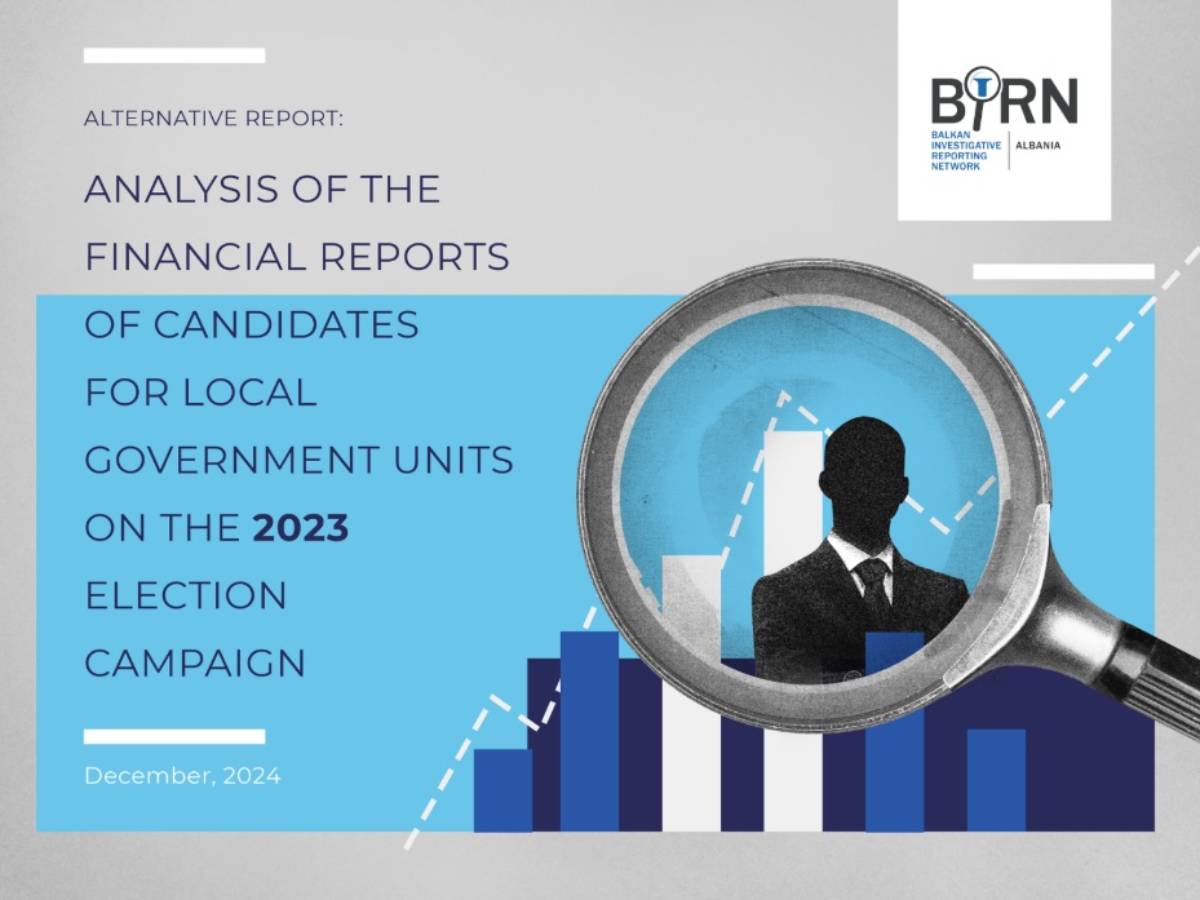
BIRN Albania has released a comprehensive analysis of the financial declarations of mayoral candidates during the 2023 local elections in Albania, highlighting critical gaps in transparency, compliance and accountability in electoral campaign financing.
The alternative report, “Analysis of the Financial Reports of Candidates for Local Government Units on the 2023 Election Campaign,” is crucial to understanding the financial integrity of political campaigns, identifying systemic weaknesses in financial disclosures and proposing key reforms to improve oversight.
This report builds on BIRN Albania’s previous publication on the financial reports of political subjects in the May 14, 2023 local elections, which provided a detailed analysis of campaign financing, sources of public and private funds and the spending patterns of political parties.
This new report serves as a complementary analysis, with a specific focus on the financial declarations submitted by mayoral candidates, who often manage and spend significant amounts of funds independently for their campaigns. In some cases, candidates’ personal funds or third-party contributions play a decisive role in shaping the campaign, affecting electoral competition, fairness among candidates, and the possibility of external influences on local governance.
Understanding how candidates manage their finances, both in relation to their respective political parties and as independent actors, is crucial to assessing transparency, discrepancies and potential irregularities in the financing process.
This report aims to:
Promote Transparency: The report provides detailed insights into campaign revenues, expenditures and donor contributions, shedding light on how electoral funds are raised and spent.
Reveal Discrepancies: Differences were found between candidate-reported finances and official audit figures, raising concerns about hidden campaign funding and regulatory inefficiencies.
Expose Cash Dependency: With 42.49 per cent of campaign expenditures conducted in cash, the report highlights the risks of untraceable transactions, financial misreporting, and potential election finance violations.
Underreporting in Political Ads: Social media campaign financing was significantly underreported, despite independent data indicating higher actual expenditures on platforms like Facebook and Google.
This report is intended to assist journalists, experts and stakeholders in accessing open and transparent data on political party finances, as well as to facilitate further analysis of electoral campaign costs in the country.
The financial data declared by electoral subjects and candidates will enable various domestic observer groups to validate their findings from on-the-ground monitoring and compare financial reports with publicly available data declared by the media and other credible sources on political parties’ revenues and expenditures.
Furthermore, the findings of this report aim to encourage the Central Election Commission (CEC) and other stakeholders to improve the electoral financial reporting system, the auditing process and the enforcement of sanctions in cases where reporting issues are identified.
The Balkan Investigative Reporting Network in Albania, BIRN Albania, and the Centre for Science and Innovation for Development, SCiDEV, have published their latest report, Annual Report 2024: Tracking Albania’s Progress on Media Freedom and Journalistic Safety in Line with EU Standards.
The report provides a comprehensive assessment of Albania’s media landscape in the context of the country’s EU accession process, highlighting key challenges and areas requiring urgent reform.
Developed within the framework of the project “Strengthening Media Freedom, Professionalism, and Journalists’ Safety in Albania”, the report is based on extensive quantitative and qualitative data, including a survey conducted with local journalists, as well as in-depth research and analysis.
This initiative will continue with annual reports for 2025 and 2026, ensuring a long-term assessment of media freedom and journalist safety trends in Albania. The research has been produced in partnership with BIRN Albania, SCiDEV, and Qendra Faktoje, with financial support from the European Union.
Albania’s EU accession process has created momentum for reform but progress is hindered by systemic challenges, inconsistent policy implementation and lack of political commitment. Albania’s Rule of Law Roadmap and Roadmap for the Functioning of Democratic Institutions include provisions to strengthen media freedom and journalist safety but their implementation has been slow and ineffective.
“The EU integration process presents an opportunity for Albania to undertake meaningful reforms in the media sector. However, a ‘tick-box’ approach will not be enough – sustained political will and legal enforcement are necessary to ensure long-term progress,” the report states.
The report underscores serious threats to independent journalism in Albania, including physical threats, legal harassment, and economic instability. Key takeaways include:
Increasing Threats and Intimidation: Journalists in Albania are frequently targeted with threats, harassment and lawsuits, contributing to self-censorship and insecurity.
Systemic Vulnerabilities in Journalistic Work Conditions: The lack of employment contracts, low wages, informal payments and job insecurity remain key challenges, leaving media professionals vulnerable to external pressures. These conditions are exacerbated by opaque media financing and concentrated ownership, which prioritize political and commercial interests over journalistic integrity.
Restricted Access to Information: While Albania has legal provisions guaranteeing access to public information, enforcement remains inconsistent. Journalists often face delays, refusals or bureaucratic hurdles when requesting critical information from public institutions, undermining investigative reporting.
Gender-Specific Challenges for Women Journalists: Female journalists face additional risks, including verbal attacks, smear campaigns and online harassment, which disproportionately affect their ability to work safely and participate in the public discourse.
Media Ownership Concentration and Lack of Transparency: The report highlights the continued dominance of a few powerful media owners, often with strong political and business ties. Despite some regulatory efforts to increase transparency, these issues remain largely unresolved.
The report calls for urgent reforms to protect media freedom and journalistic safety, including: stronger legal protections against intimidation and SLAPP lawsuits; improved economic security through fair wages and labour law enforcement; enhanced transparency in media ownership and financing; better access to public information through stricter accountability measures; and targeted interventions to address gender-based violence against women journalists.
These recommendations aim to create a safer, more independent and more transparent media environment in Albania.
BIRN Albania and SCiDEV invite journalists, researchers, policymakers and civil society organisations to engage with the findings of the report and collaborate in advocating for stronger media protections and a more independent press in Albania. The research will continue in 2025 and 2026, ensuring continuous monitoring and policy recommendations based on empirical data.
At a joint webinar organised by BIRN and ECPMF, civil society and media representatives and experts saw little hope for improvement in terms of digital rights violations and internet freedoms in the region.
Members of civil society, media, experts and researchers, at a webinar entitled “Rights in the Digital Space 2024”, said internet freedoms are deteriorating at an unprecedented pace in Southeast Europe.
The event was jointly organised by the Balkan Investigative Reporting Network, BIRN, and the European Centre for Press and Media Freedom, ECPMF.
“In 2024, BIRN was able to identify more than 1,700 significant digital rights violations [but] these are not all the violations that are happening in the digital space but violations … that are either examples of viral trends, or of something that has a lot of consequences, or something that is an emerging trend,” Ivana Jeremic, Digital Content Lead at BIRN’s Digital Rights Programme, said.
“Discrimination, genocide denial, foreign influences and disinformation are key violations in the region,” Jeremic added. She underlined that the use of artificial intelligence, AI, had caused a major spike in digital violations in 2024.
Usual suspects: Turkey, Serbia and Hungary
Cara Raeker, from ECPMF, said their monitoring recorded 1,548 press freedom violations in 35 European countries, including Southeast Europe.
In Albania, Bosnia, Croatia, Hungary, Turkey, Serbia, Romania, North Macedonia, Montenegro and Kosovo, “we found 417 cases with 756 people affected. We have found most cases in Turkey, Serbia and Hungary,” Raeker said.
Raeker underlined that online and digital attacks are the most common forms of attacks on press freedom.
Gurkan Ozturan, from ECPMF, who is also Turkey rapporteur for Freedom House’s Freedom on the Net project, said Turkey remains a major violator of digital and internet freedoms.
“Turkey remains still ‘not free’ in the digital space, with continuous restrictions on press and media fields as well as in the field of freedom of expression, access to information and digital privacy,” he said.
He shared examples of internet and digital platform restrictions, the use of draconian laws to censor internet and media as well as major violations of citizens’ online data.
Mila Bajic, from Share Foundation and Freedom House’s Freedom on the Net project, said internet freedoms continue to deteriorate in Serbia as well.
“In 2024, Serbia fell to 70 points [on the Freedom on the Net rankings] which is basically the line between ‘partly free’ and ‘free’, which is the lowest score the country ever got,” Bajic said.
She expected the situation to continue to deteriorate. “We will be falling … under the ‘free’ line and will be chartering into ‘partly free’ territory,” Bajic said.
In a panel on big tech companies, Bojana Kostic, a Human Rights and Tech Researcher, noted an “asymmetry” between big tech and citizens’ rights.
“Incredible power asymmetry will not play out well at the end, to the detriment of freedom of expression and other human rights and all citizens’ wellbeing,” Kostic said.
Journalists among most-targeted groups
Speakers agreed that journalists are among the most-targeted groups online because of their work.
The threats often result in real-life consequences, such as the case of jailed Georgian journalist Mzia Amaglobeli.
Teona Sekhniashvili, Network and Advocacy Officer at the International Press Institute, IPI, said Amaglobeli has been prisoned unjustly.
“A veteran Georgian journalist who has been fighting against injustice and for full press freedom for years … is now unjustly held in pre-detention,” Sekhniashvili said, adding that Amaglobeli was one of the first to stand up against the Georgian government’s notorious foreign agents law.
“The law would basically require NGOs and newsrooms to register as organisations pursuing the interests of foreign power,” Sekhniashvili explained.
“The law gives a lot of legal rights to the Justice Minister [of Republika Srpska] to mark anyone receiving money from abroad as an agent of foreign influence. In the end, they could be banned from existence and from actually conducting their activities,” Kurtic said.
On February 18, a webinar brought together 44 journalists and media professionals from six Western Balkan countries to gain deeper insights into the state of the digital environment, and equip them with the tools to navigate an increasingly complex and threatening digital landscape.
The online training presented findings on digital threats and attacks while equipping participants with practical tools and strategies to enhance their protection in the digital space.
This report serves as an expanded addition to BIRN’s Digital Rights Violations Annual Report 2023-2024 and provides a comprehensive regional analysis of emerging trends and recurring breaches in the cybersecurity landscape of the Western Balkans.
It highlights critical vulnerabilities in infrastructure and media exposure to cyberattacks, offering a detailed assessment of institutional responses to cybersecurity threats across all Western Balkans countries.
Findings revealed that most states in the region have adopted a reactive rather than proactive approach to cyber threats, often driven by external pressures rather than making genuine, forward-looking efforts.
Progress appears to stem more from the urgency of responding to crises than from careful planning or foresight. The report underscored the need for a multisectoral approach to create a safer digital environment.
The second session was also the final Learning Circle under the Western Balkans Media for Change project. The objective was to enhance participants’ knowledge of digital safety practices – an essential skill in today’s world. The training provided advice on identifying phishing threats, implementing preventive measures, and utilizing practical tools and applications.
Participants were guided on protecting electronic devices, safeguarding against remote intrusions (including hacking, malware, and phishing attacks), and adopting safe internet browsing practices. The session concluded with practical demonstrations, allowing participants to observe real-life examples of cyberattacks and understand their mechanisms firsthand.
This training is part of the Western Balkans Media for Change Project, funded by the UK government and implemented by the British Council in partnership with BIRN, the Thomson Foundation, and INTRAC, as well as part of the Reporting Digital Rights and Freedoms project, funded by the EU.
On February 18, BIRN Montenegro launched a new version of its website, birn.me, aiming to meet the needs of a new generation of readers.
The improved portal design allows for easier navigation and access to key information. Thanks to the new homepage structure and section layout, visitors can quickly find content that interests them.
To stay updated with the portal’s content, readers can now subscribe to our newsletter, and will be sent the best stories via email.
“BIRN Montenegro will continue to provide its readers with investigative stories from the country and the region and strengthen collaboration with citizens and various social groups,” BIRN Montenegro editor Samir Kajosevic said.
“The new portal design is another step toward enhancing communication with our audience. As always, we expect readers to actively participate in creating our portal’s content by reporting illegalities and suggesting topics they believe are insufficiently covered in the media,” he added.
Kajosevic noted that BIRN Montenegro will continue to publish monitoring reports of institutions, policies and laws, and provide suggestions for improving laws and policies in the areas it covers.
We are awarding 10 fellowships to journalists from Central and South Eastern Europe with compelling story ideas that require on-the-ground reporting, in-depth research, significant funding, and dedicated editorial support.
Applications are invited under this year’s theme, Resilience. An independent committee will select the successful applicants to participate in our annual professional development programme, which provides intensive editorial support and resources to produce a long-form investigative or analytical story for publication by BIRN, its media partners, and regional media outlets.
Our published work includes features, analysis, and investigative reports presented in depth for a global audience. We prioritize strong storytelling and rigorous, on-the-ground reporting, hallmarks of high-quality magazine journalism.
Who Can Apply?
Journalists with demonstrable professional experience from the following countries are eligible:
Albania, Bosnia-Herzegovina, Bulgaria, Croatia, Czech Republic, Greece, Hungary, Kosovo, North Macedonia, Montenegro, Poland, Romania, Serbia, and Slovakia.
Applicants must hold citizenship or permanent residence in one of the eligible countries.
What the Fellowship Offers?
Selected fellows will receive:
A bursary of €3,000 to support their reporting
Intensive training and mentoring from world-class editors
Ongoing editorial and networking support from BIRN’s leading regional journalistic network across 14 countries of the Central and SEE region
An introductory seminar in Vienna (May 13-17) focused on advanced reporting and storytelling techniques
Additional awards ranging from €1,000 to €3,000 for the three best stories
Global and regional publication in English and local languages through BIRN’s media network
Membership in the Fellowship alumni network, fostering collaboration among journalists since 2007
Here’s what our editor, Neil Arun, has to say about this year’s theme:
Resilience is a great thing, we are told. Resilient individuals easily bounce back from life’s setbacks. Resilient organisations readily adapt to changing market conditions. Resilient supply chains keep the shelves stocked through wars, trade wars and pandemics. As European societies brace for a seismic jolt from a new political reality, you may want to consider what resilience means in this context. Perhaps your proposed story has protagonists who embody resilience in the face of hard times. Or perhaps your proposal itself embodies that spirit, in seeking to deploy journalism as a tool to address a persistent problem.
There is another way of thinking about resilience as a quality embodied not by principled journalists or activists – the usual “good guys” – but rather, by their adversaries. Seen this way, the new order emerging in Europe is testament to the resilience of the forces that are now in the ascendant. How did they succeed despite so many apparent setbacks? If resilience played a part in their ascent, was it the only factor? Or was their ascent also aided by the lack of resilience, the fragility and rigidity, of the alternatives on offer?
I hope that’s enough to get you thinking and don’t stress if the story you want to pursue for the Fellowship has no obvious link to resilience. It is better to propose a strong story that loosely fits the annual theme rather than pitch a weak story that fits the theme perfectly. The annual theme is, as always, our way of testing your ability to re-mould your proposal. It is a test, in other words, of your resilience. Have fun with it.
About the Fellowship for Journalistic Excellence
Since 2007, the Fellowship has provided journalists with funding, mentorship, and editorial guidance to produce agenda-setting investigative stories. Designed to foster a strong and responsible press, the programme has played a vital role in shaping journalistic standards across the region while advancing the careers of its fellows.
Established by the Balkan Investigative Reporting Network (BIRN) and Erste Foundation, the Fellowship originally focused on South-Eastern Europe and expanded in 2020 to include Czech Republic, Hungary, Poland, and Slovakia.
To read past Fellowship stories and learn more about the programme, visit the official Fellowship page.
Join us for an insightful webinar on February 20, 2025, organised jointly by the European Centre for Press and Media Freedom and the Balkan Investigative Reporting Network.
The event will explore the intersection of digital rights, media freedom and the role of big tech companies in shaping the online environment. By bringing together digital rights experts, researchers and representatives from tech companies, the discussion will focus on the latest findings from key reports published by civil society organisations, the challenges faced by independent media and the influence of big tech on internet freedoms.