Meet the People Behind BIRN: Sasa Dragojlo

Each month, BIRN introduces you to a different member of its team. For September, meet Sasa Dragojlo, Balkan Insight’s Serbian correspondent.

Sasa Dragojlo, 33, wanted to write poetry with rhythm and hip-hop music but at the same was curious about people and the world. Eventually, he decided to become a journalist because it combines all of these.

Before journalism, he did many jobs from working in call centres to warehouses; however, in April 2015 he grasped the opportunity to work for BIRN. Since then, he has never quit this “nutjob profession”, as he calls it.

His favourite topics to work on are about corruption, crime, human trafficking, etc. Together with BIRN’s Kosovo correspondent, Xhorxhina Bami, he worked on an investigative story on the weaponry seized from Serb gunmen in northern Kosovo.

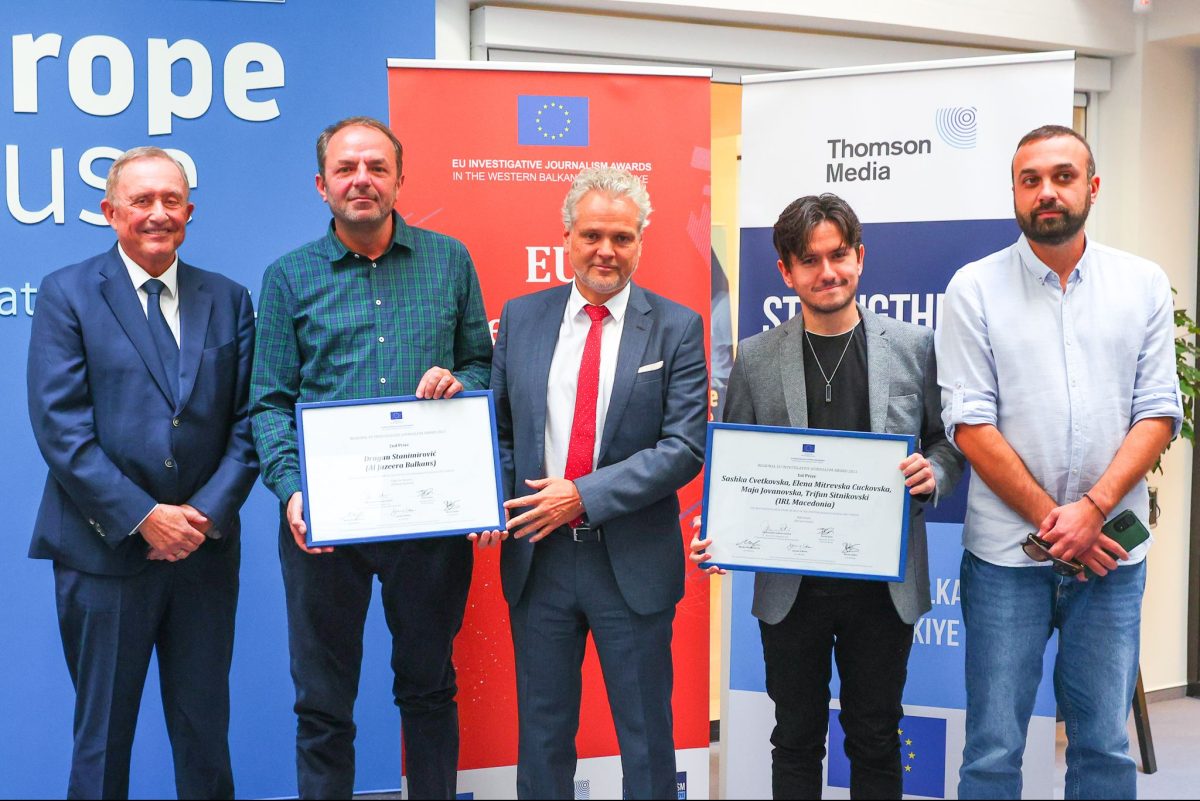
Recently, he won third prize as part of a team of BIRN and the Centre for investigative journalism of Serbia CINS for an investigation into Serbian arms exports to Myanmar following the army coup in that country. He also won third prize in the EU investigative awards for a story on a translator for the Serbian police who led a people-smuggling gang.

Let’s meet him!

  1. Why did you become a journalist and work for an investigative non-profit like BIRN? What do you like most in your job, and what is the most challenging thing?

I always wanted something linked to writing – from literature to poetry with rhythm, etc., like hip hop music. However, I have also been curious about the world in general and why we, as individuals, act like we act and that led me to the politics of our communities and the ideologies that shape them. But I also like to be active, learn about real people and ‘fight the power’. And when you combine all that, you get journalism – an eclectic field that combines all of that. However, when I got my degree at the Faculty of Political Science the future in journalism was not so clear. I wrote columns, essays and free-form prose in multiple online media, but could not live off it, so I worked multiple ‘real jobs’ – from call centres to warehouses. I thought I would never find a media that wanted me, have enough money, or where I wanted to work (I would not want to work in 90 per cent of the media; a construction job looked more attractive). But in April 2015 I got a chance to work for BIRN and since then I never quit this nutjob profession.

  1. What kind of stories do you prefer to work on?

I like to work on stories where, along with big corruption or crime, you have a story of ordinary small people. During my career I noticed that many colleagues would avoid stories about labour exploitation, human trafficking, or the housing crisis, but chase procurement frauds or dirty things concerning big names in politics, etc. But I find it wrong, and it’s one of the reasons people do not trust old-school media. Since I started working, I always emphasized those topics and they are the ones I’m proudest of. I would not name one, because there are really a lot of them.

  1. Together with Xhorxhina Bami, you worked on an investigative story on the weaponry seized from Serb gunmen in northern Kosovo last month. Would you like to tell us more about this?

This story is a classic reaction to an event that shook the whole region and even further. We wanted to see what we can do as a proper and professional newsroom. Since both sides – Belgrade and Pristina – are not trustworthy actors and are looking for their propagandist angle, we decided to take a look at the material evidence – the weapons arsenal seized by Kosovo Police. After days of close looks at the weapons, we found our angle – a pile of weapons whose marks suggested they were made in Serbian institutions or arms factories in recent years, which made them easier to trace. Our story was the first independent evidence in this case and many regional media were interested in reporting about it. I gave numerous interviews in Serbia and a few in the region and I hope the impact will not end at that.

  1. Recently, you won third prize as part of a team of BIRN and the Centre for investigative journalism of Serbia CINS for an investigation on Serbia’s arms exports to Myanmar. Also, you won third prize in the EU awards for a story on a Serbian police translator who led a people-smuggling gang. Tell us more about these investigations.

The investigation about Serbia’s arms export to Myanmar following the army coup in that country was a great example of collaboration between different media organisations. When we found out we were working on the same story, we decided to cooperate and not to go into competition. That is the main reason I really like that story, beside it shows how business and especially the arms industry are always looking to bypass legal and ethical norms. Tackling that is one of the key goals of professional journalism.

The story “With Police Connections, Serbian-Syrian Translator Turned People-Smuggler” is one of my favourite stories. I spent months working on it, meeting sources in the crime underworld, informants of security services and police, and lost a lot of nerves to prove my claims. But the results have been rewarding. This story shows how our world works – hypocrisy and fake humanitarians, criminals and police as two sides of the same coin, violence and human rights violations as a norm – the refugee crisis as a global phenomenon we cannot escape from. As much as we ignore it, it will not stop. Things seem to get much worse, considering the ongoing ecological and social crisis, along with bloody wars all over the globe.

  1. Can you advise fellow journalists from the region on how to investigate arms trafficking? 

First, I would tell any journalist to develop sources. Go out there and speak to the devil itself. Not for exhibitionism, but to understand and collect information you will use in the public interest. You need to touch the heart of darkness in order to write about it. In our world, where the few rule the many, good contacts are essential. Important information, unfortunately, is rarely obtained through FOI requests. OSINT methods are necessary and really essential to investigate arms trafficking, but without good sources, in most cases, you are just touching the surface.

 

Marija Vasilevska

Marija joined the BIRN team in September 2022 as a Project Manager for Business Development.

She is based in Skopje, North Macedonia, working on projects under the program Capacity Building and Strengthening of Independent Media. Marija also works on designing BIRN’s business development strategy including project scoping, business case development, project plan construction, resource definition and successful execution. She also plans and contributes towards the designing of projects.

Marija brings more than 15 years of working experience in the NGO sector, nationally, regionally and internationally. Her extensive working experience includes coordination and projection of actions in the fields of media, education and human rights. She is passionate about developing projects and programmes that comprise innovative approaches, different stakeholders and digitalization focused on ensuring a long-term impact in society. Marija is also highly experienced in monitoring and evaluation and quality assurance in higher education.

Her previous working experience includes working as a Project Manager in Blink 42-21, as a Monitoring and Evaluation Specialist in a USAID-funded project and working in a production house in various positions, including being a journalist. She has also worked with UN Women, the Regional Cooperation Council, the European Students Union, and other international organisations, in different capacities.

Marija holds a Master’s in finance and financial Law and a Bachelor’s degree in law obtained from Justinian Primus – Skopje. Currently, she is a PhD student at University American College–Skopje, focusing her research on the quality of education in relation to macroeconomic development.

Since May 2025, she has been Head of Programmes.

Vuk Tesija

Vuk Tesija joined BIRN Hub in February 2023 as a correspondent from Croatia.

He is based in Osijek, Zagreb and Hvar, trying to cover all relevant news and processes in Croatia. Previously he worked as a correspondent for the Deutsche Welle, an editor in the daily Glas Slavonije, a journalist at CIN Sarajevo, a correspondent for the daily Jutarnji List, and occasionally worked with a dozen other media. He wrote his first articles on a typewriter more than 25 years ago.

Along with his native Croatian, he speaks English, Macedonian and some Russian.

Azem Kurtic

Azem joined BIRN in 2022 as a correspondent from Bosnia and Herzegovina. Based in Sarajevo, he reports on daily developments for Balkan Insight and the Balkan Transitional Justice programme. He covers politics, rule of law and human rights, transitional justice, corruption and organised crime, producing in-depth analysis and features combining elements of data journalism and multimedia storytelling.

He started his career in the youth newsroom at Bosnia’s public broadcaster, BHRT, where he covered a range of topics for different radio shows over the course of three years. At the same time, he was a reporter with the Press Council in Bosnia and Herzegovina, working on a production of a radio show on media ethics, self-regulation and media freedoms.

For five years he was part of Deutsche Welle’s Balkan Booster project, where he gained experience in mobile journalism and video storytelling, while reporting from Western Balkan countries.

For more than three years, he worked in different production companies as producer of festivals and events, documentary films and series, as well as live TV and radio programmes.

He holds a degree in physiotherapy, but has been working in media since high school. He attended various informal education programmes, such as Press Council’s School of Media Ethics, BH Journalists’ Press Academy, Media Center’s Data Journalism Camp and reporting on minorities with Sarajevo Open Centre.

He is co-author of the book From Empire to Republic; Stories from Central Europe, 100 Years After the End of the Habsburg Monarchy and several other publications.

He speaks Bosnian, English, and some German, Spanish and Albanian.


Elma Bajric

Elma joined BIRN Hub in September 2022 as HR Officer. She is based in BIRN Hub’s Sarajevo office. Her main responsibilities is to ensure that the organisation can meet its objectives by having the workforce in place. She is involved in sourcing and planning the overall HR strategy and assist in creating and implementing HR policies and procedures.

With more than eight years of experience in the field, Elma worked in various industries. She has a proven track record in field of administration and human resources.

She is a Law graduate and in addition to her formal education, she has attended trainings and seminars related to administration and human resources to stay updated on industry’s best practices.

Along with the native BCS, she speaks English.


Gentiana Murati

Gentiana joined BIRN Hub in September 2022 as a Programme Manager for Capacity Building and Strengthening of Independent Media. She is based in BIRN Hub’s Sarajevo office. Her main responsibilities include planning and designing the programmes, proactively monitoring their progress, resolving issues, and initiating appropriate corrective actions. She ensures effective quality assurance and overall integrity of the programmes.

As a human rights activist with over ten years of experience in project cycle management for Civil Society Organizations, CSOs, Gentiana’s background lies in building the capacities of CSOs in the Balkan region through mentoring, particularly in project cycle management, strategic planning, fundraising, carrying out effective advocacy initiatives, organizational and financial management, monitoring, evaluation, and reporting, among others.

Before joining BIRN, Gentiana worked as a Grants Manager & Capacity Development Expert at the Kosovo Women’s Network. She managed grants throughout the region supported through the Kosovo Women’s Fund. Furthermore, she has extensive experience providing capacity development expertise to various CSOs in the Balkans.

Since April 2025, she has been Deputy Director.

Gentiana studied Economics at the University of Pristina. In addition to her formal education, she has attended various project cycle management and gender equality-related trainings and seminars.

Besides Bosnian and Albanian, she is fluent in English.

Amina Mahovic

Amina has worked for BIRN HUB as a Project Manager since October 2022. She is based in BIRN HUB’s Sarajevo office, responsible for the smooth, uninterrupted implementation of Digital Rights projects.

Previously she worked for USAID BiH’s Monitoring and Evaluation Activity in BiH (MEASURE-BiH) as a Research Analyst. Among others, she was part of the MEASURE-BiH assessment team that conducted Digital Ecosystem Country Assessment, Diaspora Assessment, and Basic Education Assessment in 2018. As a student, she worked on several projects focused on youth employment and activism, project management and international student mobility. For many years, she was an active member of the European Youth Parliament in BiH.

She hold a Bachelor Degree in Project Management and is currently working towards a Master Degree in Marketing. Along with the native BCS, she speaks English.

Hamdi Firat Buyuk

Hamdi Firat Buyuk is a political analyst who joined BIRN in 2016 as a correspondent and he has been covering Turkey and occasionally Bosnia and Sandzak region for Balkan Insight.

Before joining BIRN, Firat worked in think tanks and media as a political analyst, journalist and editor and joined several projects on his areas of expertise. Firat’s pieces and comments on Turkey, Turkish foreign policy and the Balkans have appeared in Turkish, Balkan and international media houses including Radikal, Gazete Duvar, PolitikYol, Euronews, Aljazeera Balkans, The Economist and Foreign Policy.

His academic work includes a book chapter entitled “Partners or Security Challengers? The Implications of the Presence of Turkey, the Gulf States, and Iran in the Western Balkans” at the Peace and Security in the Balkans published by Routledge and an academic article entitled “Measuring Turkey’s contemporary influence in Bosnia and Herzegovina: myth and reality” in the Journal of Southeast European and Black Sea Studies.

Firat holds an MSc degree in international relations from the University of Essex, England.

Firat speaks Turkish, English and Bosnian.

Call for EU Investigative Journalism Award 2023 is now closed

Journalists from the Western Balkans and Türkiye submitted more than 260 applications to the Call for EU Investigative Journalism Award 2023.

A total of 267 applications have been submitted for the EU Investigative Journalism Award 2023, encompassing both national and regional categories. These applications came from seven different countries. This prestigious award honours exceptional investigative stories published in the preceding calendar year.

From the pool of received applications, the evaluation jury will choose the top three stories from each of the seven countries, resulting in 21 selected stories. This selection process ensures that the most outstanding works from each country are recognized and acknowledged.

This year, the EU Award has introduced an exciting addition in the form of a regional award. This category seeks to recognise the finest stories that transcend national boundaries and address issues of significance to the entire region. By creating this new category, the award aims to inspire journalists to broaden their perspective and tackle matters that have a broader impact.

A separate evaluation jury will be established to evaluate the regional award submissions. This dedicated panel will review all entries and select the three stories that have the most substantial regional impact. This initiative will foster a sense of collaboration among journalists and encourage them to delve into regional matters that affect a wider audience.

The annual award fund for each of the countries is 10,000 euros and the prize fund for regional awards is also 10,000 euros. The three best stories of the year are awarded, and the amount for national and regional prizes is 5,000 euros (first place), 3,000 (second), and 2,000 (third).

In the past four years, 84 investigative stories from the Western Balkans and Türkiye produced by 124 journalists were awarded. These stories contributed to resolving cases of power misuse, corruption, organised crime, pollution of the ecosystem, and other wrongdoings.

The organiser of the award is Thomson Media, an organisation with decades of experience in media development and the promotion of media freedom on a global level.

The EU Award for Investigative Journalism 2023 is part of the project “Strengthening Quality Journalism in Western Balkans and Türkiye II”. This aims to recognise and promote outstanding achievements in investigative journalism as well as improve the visibility of quality journalism in the Western Balkans and Türkiye.

The project is funded by the European Union, and it is implemented by a consortium composed of Balkan Investigative Reporting Network – BIRN Hub, Central European University (CEU) – Hungary, the Association of Journalists (AJ) – Türkiye, Thomson Media (TM) – Germany, University Goce Delcev Stip (UGD) – North Macedonia, The Independent Union of Journalists and Media Workers (SSNM) – North Macedonia, Media Association of South-East Europe (MASE) – Montenegro, and Balkan Investigative Reporting Network Kosovo (BIRN Kosovo).

For more details check here.

BIRN Hosts Internet Freedom Meet in Belgrade, Serbia

BIRN hosted Internet Freedom Meet, a four-day conference, in Belgrade, Serbia, from June 26 to 29. The gathering brought together 18 speakers and more than 30 participants – journalists, researchers, media freedom and human rights activists, fact-checkers, and tech enthusiasts working in digital rights.

The four-day event started with a keynote address by Caroline Sinders, a machine-learning-design researcher and artist. Sinders, founder of Convocation Design + Research, has developed expertise at the nexus of machine learning, user research, and public good design through collaborations with such esteemed entities as Amnesty International, IBM Watson and the Wikimedia Foundation.

The first day also featured an engaging roundtable discussion, “Enhancing Internet Freedom Through Digital Rights Activism,” moderated by Sinders. Joining the panel was Rima Sghaier, a respected name in digital rights advocacy, Amar Karađuz from the citizens association “Why Not,” and Bojan Perkov, a digital policy coordinator at the SHARE Foundation. They exchanged thoughts and strategies on bolstering internet freedom through digital rights advocacy. To close the day, Sghaier led a hands-on workshop on “Engaging in Digital Rights Activism.”

The second day shed light on the pressing concern of online-to-offline violence. Carlos Guerra, Technical Advisor on Digital Security at Greater Internet Freedom Project, led the day by giving an introductory address and later moderating a discussion featuring Katarina Golubović, from the Lawyers’ Committee for Human Rights (YUCOM), and Hristina Piskulidis, a Communications Officer at ASTRA.

Both women, experienced in human rights advocacy and eradicating human trafficking, respectively, shared perspectives in the roundtable discussion titled “Preventing Violence: Online Extremism and Offline Consequences.”

Guerra’s afternoon workshop on digital safety in the time of remote work was particularly inspiring to participants who learned how to protect themselves in the work-from-home era.

Later in the day, Anđela Milivojević, an investigative reporter, led a thought-provoking workshop addressing cyberbullying and online harassment in investigative journalism based on her investigative article published by BIRN’s Balkan Insight, which prompted a reaction by Telegram, a 700-million user instant messaging app.

Day three showcased BIRN’s regional research report “Hidden in Plain Sight,” which focuses on the accountability of Balkan telecommunication companies, using the Ranking Digital Rights’ methodology. Dragana Žarković Obradović, BIRN Serbia country director, presented the main findings and led the discussion about the report’s results.

L-R: Dragana Zarkovic Obradovic, Tanja Maksic, Bojan Stojkovski, Ana Toskic-Cvetinovic, Leandro Ucciferri (on screen)

The panel included Leandro Ucciferri, global partnerships manager at Ranking Digital Rights, Tanja Maksić, a researcher and project coordinator from BIRN Serbia, Ana Toskić-Cvetinović, executive director of Partners Serbia, and Bojan Stojkovski, who was one of the researchers for the report.

To close the day, Ivana Jeremić, an editor at Balkan Insight, hosted a workshop that looked closer at BIRN’s recent investigation on so-called “free roaming” in the Balkans.

The final day of the Internet Freedom Meet in Belgrade was dominated by discussions on artificial intelligence, AI. Ljubiša Bojić, a senior research fellow at the University of Belgrade’s Institute for Philosophy and Social Theory and a coordinator of Digital Society Lab, gave a thought-provoking keynote address.

A round table discussion on AI accountability, the EU AI Act, and responsible use of AI followed, moderated by Bojić. The discussion was enriched by insights from Deniz Wagner, an adviser to the world’s only intergovernmental media freedom watchdog – OSCE Representative on Freedom of the Media, Predrag Tadić, an assistant professor at the University of Belgrade’s School of Electrical Engineering, and Branka Anđelković, programme director of the Public Policy Research Center.

The last session of BIRN’s Internet Freedom Meet in Belgrade was Wagner’s workshop, which equipped attendees with tools for advocating responsible AI policies.

Speakers and participants agreed that BIRN’s Internet Freedom Meet in Belgrade propelled the dialogue on a variety of critical issues by facilitating the platform for timely and much-needed discussions revolving around internet freedom and digital rights, setting the stage for future discussions and collaborations aimed at safeguarding these integral aspects of our lives in the digital era.