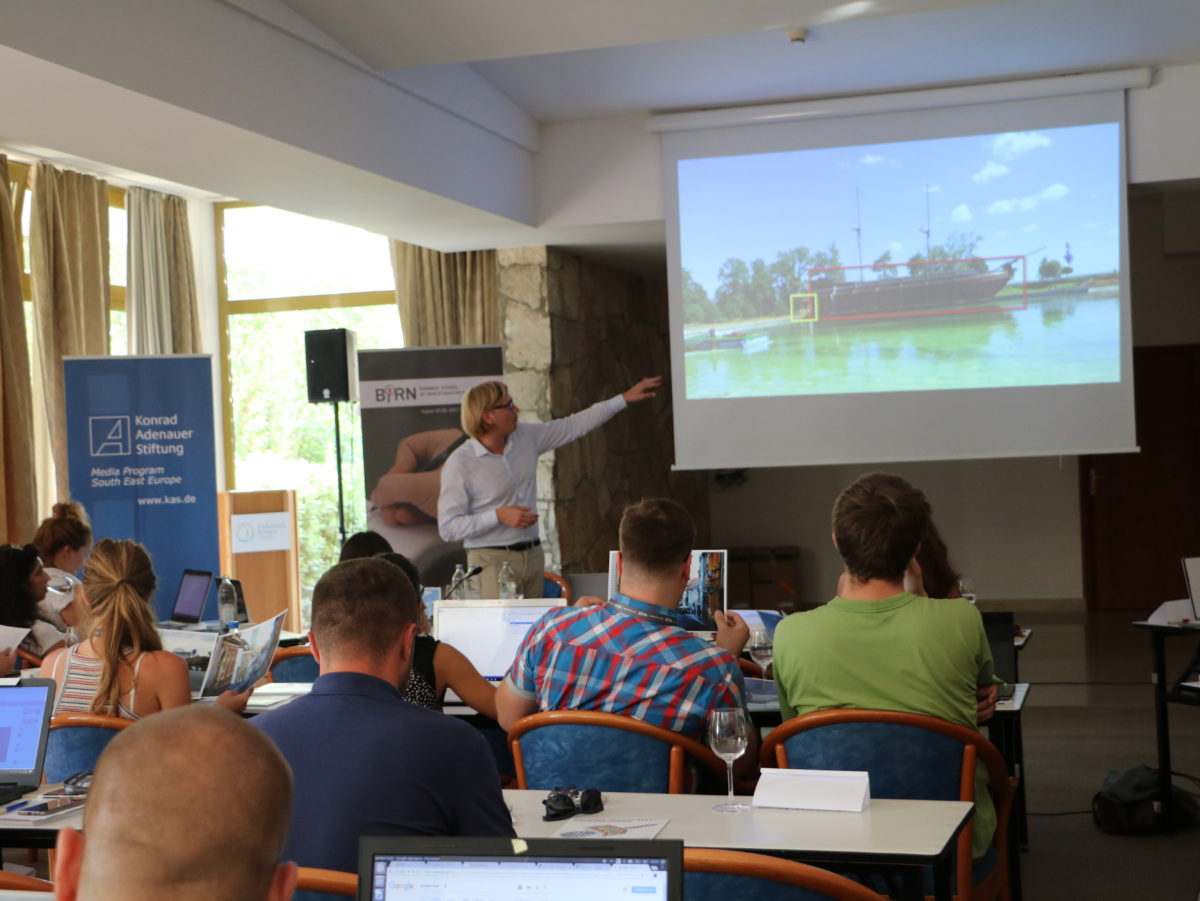
BIRN Summer School Day 3: Interviews, Tech, Data and Digital Wellbeing

BIRN’s Summer School of Investigative Journalism continued with interview tips and tactics, insight into the benefits of new technologies and advice on staying well while on the job.

Day Three of BIRN’s Summer School of Investigative Reporting began on Wednesday with a session dedicated to the secrets of a good interview before considering the benefits of new technologies and the challenge of protecting mental health.

Authenticity, preparation and “knowing your subject” are key to conducting a good interview, lead trainer and Reuters investigative projects editor Blake Morrison told the more than 30 participants in Mlini, Croatia.

“These people don’t know us, and we have to maintain a certain level of distance from them, we can’t be their friends,” he said. “Sometimes we have to convince them that they want to be interviewed by us.”

BIRN’s 14th Summer School brings together journalists from across Central and Eastern Europe for a week of insight and advice from 15 trainers.

Drawing on years of personal experience, Morrison urged the participants to think about “what makes your friends tell you their secrets” and to approach every interview as if they are interviewing themselves. He stressed the need for “confidence, honesty, curiosity and genuine interest in the people and topic”.

Digital infrastructure experts Boris Budini and Redon Skikuli of CryptoParty Tirana continued the day with a workshop looking at the benefits of technology in journalism.

“The intersection of technology and journalism helps us to protect ourselves and our sources, but also to use available tech to do our research and expose abuse of power,” Budini said.

The tech duo treated the participants to a list of tips and tricks in navigating open source intelligence, advanced use of search engines and the filtering of data.

The day continued with parallel group sessions on advanced data journalism, digital security and how to search the dark web. The day ended with workshops on mental health.

BIRN Summer School Day 2: Mission Investigate, AI and Forming Storylines

During the second day of BIRN’s Summer School of Investigative Reporting, participants had a chance to gain insights into forming and running an investigation and the challenges posed by artificial intelligence.

The second day of BIRN’s Summer School of Investigative Reporting in Mlini, Croatia on Tuesday started with a session on investigations at the Scandinavian Broadcast Service.

Journalists with the Swedish public broadcaster, Maria Georgieva and Ali Fegan, shared details about a TV programme focusing on investigative journalism called Mission Investigate and how they create the story from start to finish.

Georgieva said that when forming the idea “it is all about asking the right questions in the beginning”.

The Scandinavian team broadcasts around 35 investigations each year. They said they receive “30,000-40,000 emails with tips and ideas” each year, of which almost all are processed by the team.

“We are still one of the few PBS services that have a landline which you can call,” Fegan said.

Fegan and Georgieva shared details on the story selection process, how to “bulletproof” the idea, and how to make sure that the story is completed.

“Most of the stories we do are reporter-driven, which means that they first of all have to have a ‘spark’ for the story. Then we have the demand of the audience, and the rest is what we as a group decide deserves to be investigated,” Fegan added.

Lead trainer Blake Morrison, investigative projects editor with Reuters in New York, continued the day with a session on generating story ideas and how to investigate specific topics and areas.

As Morrsion said that “generating ideas is the hardest”, before explaining his process of finding a good story, sharing tips and tricks from his fruitful career.

“Consider how to integrate these tips into your work schedule,” he said, adding that one of the most important steps is to gain an editor’s support in writing the story, but also their encouragement to help you succeed with the story.

“You need to be your best advocate by developing greater expertise in your beat and by changing your line of sight to look for bigger, more impactful stories. This will make you indispensable,” Morrison added.

Professor in data journalism at Columbia University Journalism School, Jonathan Soma, gave a workshop on how to navigate the challenges of using artificial intelligence (AI) tools in journalism. Soma warned many AI tools had what he called “a three percent hallucination rate” whereby they make up or construct a certain amount of content, even when working with predetermined text or documents.

Soma’s session also looked at large language models, or LLMs. He said they “are flawed at everything they do, and it’s only by a strange, strange accident that we find them to be useful.”

Soma emphasised that AI tools can and should be used, “but only for error-resilient tasks.”

Georgieva and Fegan ended the day by sharing their personal experiences in running months-long cross-border investigations, sharing tips and tricks on how to approach such a task.

BIRN’s Annual Summer School Kicks Off in Croatia

The latest edition of BIRN’s summer school brings together almost 35 journalists from across Central and Eastern Europe for a week of investigative reporting training with a focus on collaborative, cross-border stories.

BIRN kicked off the 14th edition of its Summer School of Investigative Reporting on Monday on the Croatian coast with insight and advice shared by experienced and award-winning journalists.

The week-long summer school in Mlini, near Dubrovnik, brings together almost 35 participants from Albania, Bosnia and Herzegovina, Kosovo, North Macedonia, Serbia, Uzbekistan, Ukraine, Georgia, Hungary, Romania, Bulgaria and Poland in polishing their skills in investigative journalism and mastering new ones.

Opening the event, BIRN regional director Milka Domanovic said the selection process was “becoming harder each year”.

“We would like to wish you a successful week and invite you to take this opportunity to master and learn new skills and to network with each other,” Domanovic said.

The participants began hearing from some of the 15 trainers who will present their insights into investigative journalism techniques, digital security, artificial intelligence, visual storytelling, investigating war crimes and how to take care of mental wellbeing on the job.

Lead trainer Blake Morrison, investigative projects editor with Reuters in New York, said he hoped the participants will leave the school “inspired”.

“Inspired, first of all, to do cross-border investigative journalism and master their skills,” he said. “Also, our goal is to inspire them to connect with each other, as they can learn from themselves without any trainer’s input.”

After a session with Morrison on creativity in investigative journalism, BIRN editors Ivana Jeremic and Kreshnik Gashi talked about covering online gender-based violence and how to have an impact.

Jeremic said preparation and planning is key, “as we have to provide accurate information and avoid sensationalism and victim blaming”.

The narrative, she said, should centre on “survivors’ experience, needs and perspectives”.

Gashi shared the experiences of BIRN Kosovo in reporting on gender-based violence, including the harassment endured by one of its journalists after her phone number was leaked in a Telegram group.

“She had hundreds of calls and more than 1,000 messages in less than an hour,” Gashi said.

Seven people were arrested as a consequence of a BIRN  investigation into a group in which users shared derogatory videos, ‘deep fake’ images and the personal information of women.


Elena Kostyuchenko, an independent Russian journalist and civil rights activist, talked about investigating human rights abuses and the challenges of covering the events since Russia invaded Ukraine.

The first day ended with tips and tricks on digital security for journalists shared by Monika Kutri, a journalist safety specialist with the Croatian Journalists’ Association.

BIRN Film on Wartime Home Swaps Gets TV Premiere

BIRN’s new film ‘Your House was My Home’, about how war forced villagers in Serbia and Croatia to exchange homes with each other to save their lives, premieres on Al Jazeera Balkans on Tuesday.

‘Your House was My Home’, which tells how Serbs and Croats from Kula in Croatia and Hrtkovci in Serbia swapped houses and moved to each other’s villages after the outbreak of war in 1991, has its television premiere on Al Jazeera Balkans on Tuesday at 5.05pm local time.

The half-hour documentary follows the stories of two of the villages’ residents – Goran Trlaic, who left Kula for Hrtkovci, and Stjepan Roland, who left Hrtkovci for Kula.

Before the 1990s conflict, Kula was predominantly populated by Serbs, while the majority of the people in Hrtkovci in Serbia.

Since the end of World War II, they had lived peacefully together – until the first multi-party elections in 1990, when nationalists came to power and minorities were not welcome in either republic anymore.

A series of threats and violent incidents started a chain reaction as increasing numbers of inhabitants of Kula and Hrtkovci exchanged properties so they could escape to safety.

This was described by officials as ‘humane relocation’, but it was actually a forced population exchange in the midst of a war.

“There has never been ‘humane relocation’ except in the heads of nationalist leaders and their devastating policies in the 1990s in the former Yugoslavia,” said the film’s director, Janko Baljak.

“Relocations of this kind were carried out forcibly and left unimaginable consequences on the lives of people and on relations between nations who lived in peace and harmony before the war,” he added.

The personal recollections in ‘Your House Was My Home’ show how this forced population exchange had a devastating long-term effect on the lives and relationships of ordinary people from both villages, said Baljak.

“The duty and obligation of engaged documentary film maker is a continuous fight against short-term memory,” he said.

See more information about the film here.

BIRN Summer School Day 4: How to Scale Up Investigation

On the fourth third day of BIRN’s Summer School in Dubrovnik, journalists heard how to pitch stories, structure investigative projects and use open data.

The fourth day of BIRN’s Summer School Master Class of Investigative Journalism in the historic city of Dubrovnik on Thursday started with a session on pitching story ideas, run by Lawrence Marzouk, editor with Balkan Investigative Reporting Network.

Marzouk explained how stories can be pitched to editors without overpromising while bearing in mind the possible angle, sources and the outcomes.

“You need a clear idea; do not spread a lot of different things,“ he said.

Marzouk said journalists should try not promise too much from a story and must be realistic, but their stories have to be fresh and new, workable and possible, to explain why something is important.

“At the beginning, you should at least have a theory in your head, something you would try to prove,“ he said.

Miranda Patrucic, an investigative reporter and regional editor with the Organized Crime and Corruption Reporting Project, continued her lecture on how to “follow the money“.

She explained how to gather publicly available information about companies and how to research their financial statements and assets.

“A financial statement summarizes the revenues, costs and expenses incurred during a specific period of time,“ Patrucic explained.

In the afternoon session, Blake Morrison, lead trainer and investigative projects editor at Reuters, advised journalists on how to pitch stories and structure investigative projects.

“You should always think of how to better communicate the story, to use the audio-video material, the data,” he said.

During the last Thursday’s session, BIRN’s Marzouk shed light on a case study about the arms trade from the Balkans and Central Europe to the Middle East.

Journalists heard how to use open data to trace and track the arms trade.

Marzouk explained that, while researching a “controversial industry” like the arms trade, journalists “have to harvest all the possible open source databases” because the industry is highly regulated, meaning that there is a lot of documentation.

During the fourth day, participants at the Summer School also continued to work on their investigation proposals that they will present on Friday.

The eighth BIRN Summer School has brought together young journalists from Albania, Austria, Bosnia and Herzegovina, Bulgaria, Canada, Croatia,  the Czech Republic, Greece, Kosovo, Luxemburg, Macedonia, Montenegro, Romania, Serbia, Slovenia, Ukraine and the United States.

The Summer School is organized in cooperation with the Media Program South East Europe of the Konrad Adenauer- Stiftung, Open Society Foundations and the Austrian Development Agency (ADA), the operational unit of Austrian Development Cooperation with the support of EU..

BIRN Summer School: The Art of Interviews and Tracing Money

On the third day of BIRN’s Summer School, journalists heard how to conduct interviews and investigate offshore industries.

On day three of the BIRN summer school in Dubrovnik, Blake Morrison, the lead trainer and investigative projects editor at Reuters, held a session on the “art of interviewing” and on how to convince difficult sources to talk, describing interviews as a crucial component of the journalistic job.

The task was “how to get the information from the people. And to do it ethically,” he said.

“My philosophy on interviewing is pretty simple… Think of it as a blind date,” he noted,  explaining that the interviewee needs to “be understood.

“It’s very important to be curious. If you don’t understand something, don’t presume, ask,” he continued.

Morrison explained that there are three types of interview: information interviews, which involve collecting information on something; accountability interviews, asking a person to explain his or her acts; and emotional interviews, in which person sheds light on his or her emotional perspective.

Morrison emphasised the need for preparation and gave insight into why some people agree to give an interview: vanity, the need to be understood, self-interest, desperation, guilt and curiosity.

“I really believe as a journalist is that our commitment to honesty is crucial,” Morrison said.

The workshop on data journalism and using advanced internet research continued on Wednesday.

Henk van Ess, who works with a number of European media outlets, as well as Bellingcat, continued his training on data journalism, answering questions from the participants through stories he has covered over the years.

He showed the participants how to use open sources and social media for their investigative stories, showing the example of the work he did in tracing the ISIS executer, Jihadi John.

Miranda Patrucic, an investigative reporter and regional editor with the Organized Crime and Corruption Reporting Project, also held an interactive lecture on how to “follow the money” and how to investigate offshore industry.

She conducted an exercise on tracking money and on shell and shelf companies through various databases, both open-source and paid-for.

“Many of offshore companies have a legitimate purpose in the business word, however, they could be manipulated by criminals to hide their crimes, money laundering,“ Patrucic observed.

The eighth BIRN Summer School has brought together young journalists from Albania, Austria, Bosnia and Herzegovina, Bulgaria, Canada, Croatia,  the Czech Republic, Greece, Kosovo, Luxemburg, Macedonia, Montenegro, Romania, Serbia, Slovenia, Ukraine and the United States.

The Summer School is organized in cooperation with the Media Program South East Europe of the Konrad Adenauer- Stiftung, Open Society Foundations and the Austrian Development Agency (ADA), the operational unit of Austrian Development Cooperation with the support of EU.

BIRN Summer School Day 2: Social Media, Fact-Checking for Investigative Journalists

BIRN’s Summer School continued on Tuesday with sessions exploring data journalism and fact-checking methods. s.

Head trainer and investigative projects editor at Reuters, Blake Morrison, showed BIRN Summer School Master Class of Investigative Journalism how to use a creative approach to fact-checking in Dubrovnik.

An interactive exercise explored the difference between supposition and proof and how to separate fact from suspicion, while determining standards for fact-checking.

Monday’s workshop on data journalism continued into its second day. Christiaan Triebert, a conflict researcher with Bellingcat, led the group. Bellingcat has achieved notoriety for its utilisation of open source information to investigate armed conflicts and corruption, and has won multiple awards.

During the workshop, participants learned about analytical tools required for data journalism, while Triebert explained the process of digital open source investigation, and how it can improve investigative reporting skills.

The middle of the session examined the capacity of geolocation tools to pinpoint exact places and how to use satellite imagery as a fact-checking tool. Triebert explained how advanced internet applications such as Google Maps can bolster research underpinning complex investigative stories.

“But you will still need traditional reporting and journalists on the ground,“ Triebert said.

Henk van Ess, who works with various European media outlets, as well as Bellingcat, also provided data journalism training, answering questions from BIRN Summer School participants about using social media as an investigative tool.

Journalists learned Facebook data mining methods, how to find elusive people through checking secret IDs, and how to discover closed groups or find people working for security agencies. In short, “how to search over two trillion Facebook postings in a clever way,“ he said.

The eighth BIRN Summer School has brought together young journalists from Albania, Austria, Bosnia and Herzegovina, Bulgaria, Canada, Croatia,  the Czech Republic, Greece, Kosovo, Luxemburg, Macedonia, Montenegro, Romania, Serbia, Slovenia, Ukraine and the United States.

The Summer School is organized in cooperation with the Media Program South East Europe of the Konrad Adenauer- Stiftung, Open Society Foundations and the Austrian Development Agency (ADA), the operational unit of Austrian Development Cooperation with the support of USAID Macedonia.

Eighth BIRN Summer School Opens in Croatia

BIRN’s latest Summer School opened on Monday in Dubrovnik with interactive sessions on advanced digital research and use of open data sources.

Some 35 reporters from the Balkans and across the world gathered on Monday in the historic resort city of Dubrovnik in Croatia for the eighth BIRN Summer School Master Class on Investigative Journalism.

After greeting this year’s participants, Blake Morrison, the school’s lead trainer and investigative projects editor at Reuters, held an interactive exercise and discussion about the challenges of investigative reporting. Morrison shared sources and interview techniques and tips on researching complex investigations.

The first day continued with an introductory workshop on data journalism led by Christiaan Triebert, a conflict researcher with Bellingcat, a multi-award winning collective that uses online open source information to investigate armed conflicts and corruption.

During the workshop, participants learnt about the analytical tools needed for data journalism while Triebert explained the process of a digital open source investigation, research and verification, and how to use digital tools to uncover corruption and crime. “There is so much information available online,“ he said.

Henk van Ess, who works with various European media and Bellingcat, meanwhile showed how to go “fast and furious with stuff that seems impossible to validate”.

Van Ess shared plenty of practical tips to validate information from social media and other open sources.

Blake Morrison, the school’s lead trainer and investigative projects editor at Reuters

In the afternoon, the participants were divided up into smaller groups for in-depth sessions with Reuter’s editor Morrison.

The eighth BIRN Summer School has brought together young journalists from Albania, Austria, Bosnia and Herzegovina, Bulgaria, Canada, Croatia,  the Czech Republic, Greece, Kosovo, Luxemburg, Macedonia, Montenegro, Romania, Serbia, Slovenia, Ukraine and the United States.

The Summer School is organized in cooperation with the Media Program South East Europe of the Konrad Adenauer- Stiftung, Open Society Foundations and the Austrian Development Agency (ADA), the operational unit of Austrian Development Cooperation with support of USAID Macedonia.

BIRN Summer School of Investigative Reporting

BIRN Hub

The BIRN Summer School of Investigative Reporting works to enhance the reporting skills and journalistic standards of journalists from the Balkans and beyond, training 20 journalists from the Balkan region and 10 international journalists each year.

Summary

Every year BIRN gathers renowned international investigative journalists and experts to train the Summer School participants, including Sheila Coronel, professor at Columbia University; Nick Davies, the journalist for The Guardian who revealed the Rupert Murdoch affair; Mark Schoofs, a ProPublica Senior editor and two-time Pulitzer Prize winner; and Paul Bradshaw, one of the UK’s most well-known bloggers.

BIRN also provides financial support for the top story ideas generated during the School. Summer School participants are divided into groups, where they develop their story ideas, and they then conduct investigations and produce a story that BIRN publishes on its flagship news portal- Balkan Insight. The Summer School also provides networking opportunities for the journalists who attend.

The training, which is held over five days each year, uses a curriculum based on the Investigative Journalism Handbook ‘Digging Deeper: A Guide for Investigative Journalists in the Balkans’, which was published by BIRN and has been translated into Albanian, Macedonian, and Serbian.

BIRN’s Summer School is organised in cooperation with the Konrad-Adenauer-Stiftung’s Media Program- South East Europe, and funded by the Open Society Foundation, the OSCE Missions to Serbia and Skopje, the OSCE Mission in Kosovo, the US Embassy in Skopje, BIRN Kosovo and the Embassy of the Netherlands in Zagreb.

Information Sheet

Main Objective:
Bringing high quality and high standards to investigative reporting in the Balkans, with the opportunity for wide dissemination of summer school journalists’ work in the Balkan region, and internationally.
Specific Objectives:
  • Enhancing investigative reporting skills and journalistic standards of 20 journalists from the Balkan region and 10 international journalists each year;
  • Providing networking opportunities for the journalists attending the school;
  •  Promoting investigative journalism in the Balkans by publishing investigations produced by journalists trained at the Summer School.

Main Activities:

  • Training – BIRN provides five days of training based on the curriculum ‘Digging Deeper’.
  • Financing investigative stories – BIRN provides financial support for the best story ideas put forward during the School. An average of three stories are produced each year.
  • Publishing – BIRN publishes investigative pieces from Summer School participants on BalkanInsight.com

Target Groups:

Journalists, media experts, investigative reporters from the Balkans; International journalists and media experts; Local, regional, and international media outlets.
Highlights:
Digging Deeper handbook for investigative journalism, translated into Albanian, Macedonian, and Serbian languages.

BIRN Summer School 2017 in Dubrovnik

This year’s BIRN Summer School will be held in the stunning Croatian coastal city of Dubrovnik from August 20-26.

The summer school will bring together some of the world’s best journalists and trainers for a six-day programme.

Reporters will have the opportunities to learn cutting-edge investigative skills and enjoy the delights of the Adriatic Sea.

Reuters editor Blake Morrison, three times a finalist for the Pulitzer investigative award, has been appointed lead trainer.

He will be joined by multiple-award-winning reporter/editor Miranda Patrucic from the Organized Crime and Corruption Reporting Project and Henk van Ess, an expert in Open Source Investigative Journalism, plus others.

During the sessions, journalists will learn how to dig for data, convince difficult sources to talk, transform their research into sparking prose and harness the power of video.

All participants will have the opportunity to apply for the Investigative Story Fund andthe three best story ideas will be awarded with funding ranging from 1,000 to 3,000 euros.

The location isMlini, a pretty fishing village located 10 kilometres south of Dubrovnik, the so-called ‘Pearl of the Adriatic’.

It offers a quiet setting with stunning beaches and excellent seafood, while Dubrovnik itself is internationally renowned for its fascinating history and breathtaking architecture.

Participants will have the chance to enjoy the idyllic surroundings while honing their investigative journalism skills.