BIRN Summer School Kicks off in Montenegro

The fifth BIRN summer school of investigative journalism has opened in the Montenegrin coastal town of Becici, bringing together top trainers and journalists.


Some 35 reporters from the Balkans and across the world have gathered on Monday for the five-day summer school, aiming to boost their skills.

The school was kicked off by lead teacher and Guardian journalist Paul Lewis, who will teach students how to think about data in the digital age and use social media to investigate.

The introductory lecture was followed by investigative case studies from BIRN editor Lawrence Marzouk, while in the afternoon participants were given a detailed session in data journalism by Markus Lindemann.

Miranda Petrucic from the Organized Crime and Corruption Reporting Project explained to students how she exposed high profile corruption cases in Montenegro.

The day finished with a panel debate focused on the challenges of tackling corruption within the defence and security sector in the Western Balkans.

Alberto Bin, director of Integration, Partnership and Cooperation at NATO, spoke about reforms in South East Europe, while Dina Bajramspahic, from Montenegrin NGO Alternative, and Katarina Djokic, from Belgrade Centre for Security Policy, reflected on the current methods of fighting corruption in their countries.

The Summer School is organised in cooperation with the Media Program South East Europe of the Konrad-Adenauer-Stiftung and with support of the Austrian Development Agency (ADA), the operational unit of Austrian Development Cooperation, the North Atlantic Treaty Organization, OSCE Mission in Kosovo, OSCE Mission to Serbia, OSCE Presence in Albania, OSCE Mission to Montenegro and USAID Macedonia.

BIRN Summer School Chooses Investigative Story Winners

After five days of intensive training at the fourth annual BIRN Summer School, four groups of reporters whose investigations will be funded were announced at the closing ceremony.

The Summer School jury, composed of lead trainer David Leigh, BIRN regional director Gordana Igric, director of the Konrad-Adenauer-Stiftung Media Programme South East Europe Christian Spahr and former BIRN editor Lawrence Marzouk, chose the teams from a total of ten.

The teams’ investigations will be financed from a total fund of 6,000 euro and the resulting stories will be published on the Balkan Insight website.

The participants making up the chosen teams were: Kristina Ozimec, Gabriela Delova, Vlado Apostolov and Sashka Cvetkovska from Macedonia; Alisa Mysliu from Albania; Milena Perovic Korac and Milica Marinovic from Montenegro; Magda Munteanu from Romania; Semir Mujkic from Bosnia and Herzegovina; Flutura Kusari, Arta Avdiu and Una Hajdari from Kosovo, and Charly Loufrani  from France.

For five days last week, participants at the Summer School from Albania, Kosovo, Macedonia, Montenegro, Bosnia, Bulgaria, Romania, Croatia, Serbia, Slovenia, France, Austria and Estonia learned how to use freedom of information laws, conduct investigative interviews, make the most of computer-assisted reporting, start investigations and put stories together, and more.

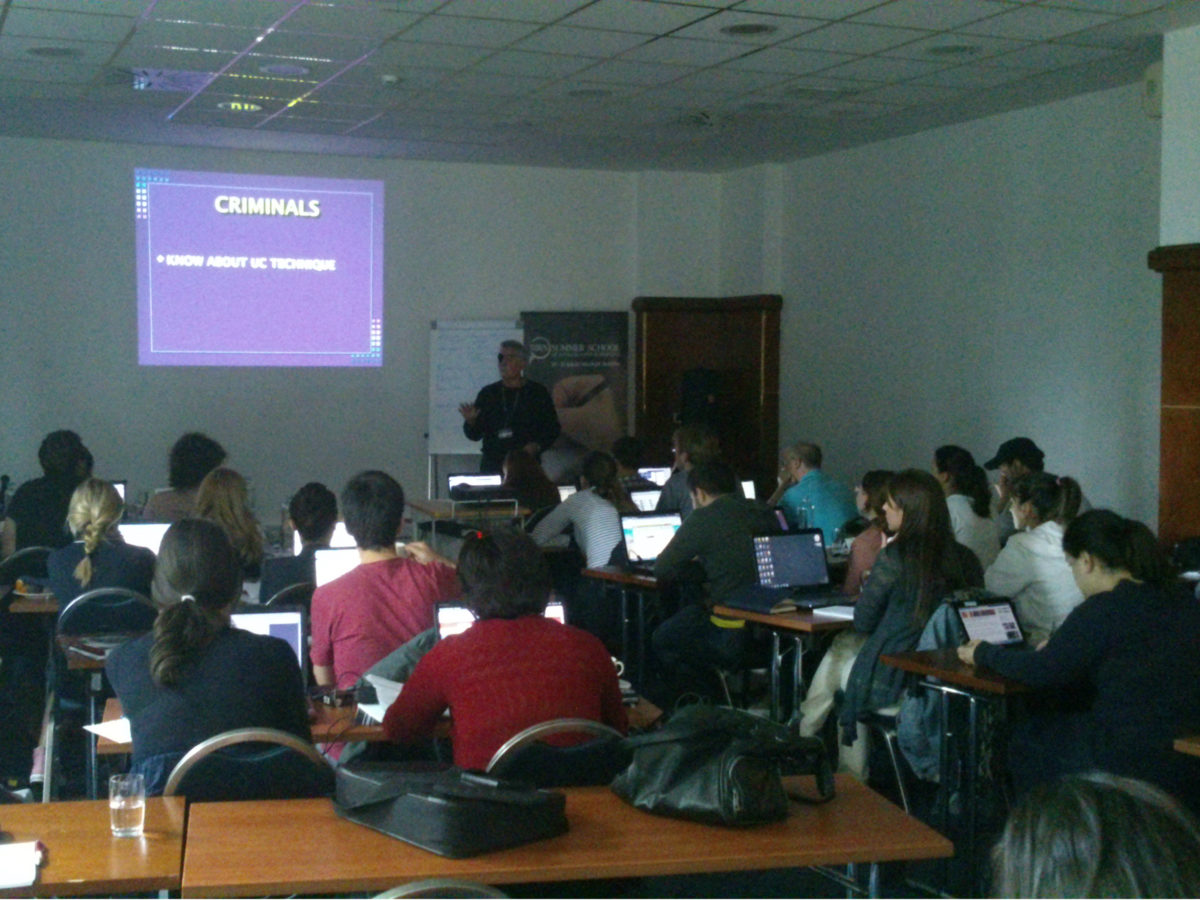
This year’s Summer School also had two special guest lecturers, the chief officer of Bari police, Luigi Rinella, and former FBI undercover agent Stephen Salmieri. While Rinella explained how the Italian part of the international investigation into suspected Balkan drugs criminal Darko Saric operated, Salmieri presented necessary skills for undercover work.

This year’s BIRN Summer School was held at Bled Lake in Slovenia.

The BIRN Summer School of Investigative Reporting 2013 was organised in cooperation with the Media Program South East Europe of the Konrad-Adenauer-Stiftung and with the support of the King Baudouin Foundation, the Belgian National Lottery, the OSCE Mission in Kosovo, the OSCE Mission to Serbia and USAID in Macedonia.

Developing Undercover Work at BIRN Summer School

The fourth day of the Balkan Investigative Reporting Network Summer School programme continued with lectures on undercover operations and research, as well as tips for following paper trails in stories.

Former FBI undercover operative Stephen Salmieri told the journalists participating in the Summer School that undercover investigative work is extremely dangerous, which is why it should be used as sparingly and requires a lot of preparation.

In order to minimise security risks, Salmieri said that journalists working undercover should not change their personality. He also said that journalists should know their targets and research their sources, as well as keep in constant contact with their parent organisation.

“When doing investigations, know everything you can know your enemy. Let go of your ego and reduce tensions. If you come across as aggressive, the situation will quickly escalate,” said Salmieri.

A perfect undercover agent, according to Salmieri, is a smart and aware person who listens carefully.

Two times Pulitzer Prize winner Eric Nalder gave the participants of the Summer School tips on how to gather material evidence and documents from companies and organisations. He emphasised the importance of physically going to organisations, carefully interviewing workers and using psychological tricks to control the communication with them.

Nalder also said that after gathering documents, journalists should organise them carefully.

“Always be organised. Use Excel or other spreadsheets to organise your documents, otherwise you might get lost in them,” said Nalder.

British journalist David Leigh also discussed the need to collect documents, but also highlighted that while writing the story, journalists should make sure to provide readers with several points of access.

“Provide photos, interviews, galleries and short clips. Presentation is key. Your story is useless if it does not reach the public,” said Leigh.

The BIRN Summer School is taking place this week in Slovenia with 30 journalists from Serbia, Slovenia, Kosovo, Croatia, Bosnia and Herzegovina, Montenegro, Albania, Bulgaria, Austria, Estonia, France and Romania participating. It will finish on Friday.

The BIRN Summer School of Investigative Reporting 2013 is organised in cooperation with the Media Program South East Europe of the Konrad-Adenauer-Stiftung and with the support of the King Baudouin Foundation, the Belgian National Lottery, the OSCE Mission in Kosovo, the OSCE Mission to Serbia and USAID in Macedonia.

BIRN’s Summer School Hears Tips For Developing Investigations

The second day of the Balkan Investigative Reporting Network’s annual summer school for investigative journalism continued with lectures and workshops on how to develop story ideas and gather information.

Renowned British journalist David Leigh started the day by speaking about possibilities for developing stories which have emerged from major data leaks, such as the material released by WikiLeaks.

“Your aim should be to use WikiLeaks to build your investigations by using the information as actual leads to uncover new things,” said Leigh.

Another way to collect valuable information when building investigations is filing official requests for information to governments, said Helen Derbishire, from the NGO Access Info Europe.

“The requests themselves can help your stories in many ways. For one, you can actually get the information you wanted. Never assume you would not get something. Even if you are rejected, you can appeal, but also you can publish the rejection, which is a story in itself,” she said.

German journalist Marcus Lindemann also revealed ways through which researchers can use Google and social networks to find personal data on individuals of interest.

The executive director of the Organised Crime and Corruption Reporting Project, Paul Radu, said that investigations are about creativity and connecting the dots.

“Today we have a lot of access to a variety of information. The more data we have, allows us to discover bigger schemes… This is fun! It’s just great to ruin the plans of criminals and to get to the bottom of a story,” said Radu.

He used examples of several investigations he worked on to explain the ways in which journalists can gather information about money laundering, offshore companies and proxy companies.

Researcher Laura Ranca highlighted the importance of data visualisation in investigations, explaining that the collected information is only as good as it is presented to the readers.

The BIRN Summer School opened on Monday in Bled, Slovenia with 30 journalists from Serbia, Slovenia, Kosovo, Croatia, Bosnia and Herzegovina, Montenegro, Albania, Bulgaria, Austria, Estonia, France and Romania participating. The lectures will continue on Wednesday.

BIRN Summer School of Investigative Reporting 2013 is organized in cooperation with the Media Program South East Europe of the Konrad-Adenauer-Stiftung and with support of King Baudouin Foundation and Belgium National Lottery and OSCE Mission in Kosovo, OSCE Mission to Serbia and USAID in Macedonia.